
How the best Fashion brands use Catalog Ads
August 31, 2026
Fashion brands have been among the first to run Catalog Ads. Throughout the years, you would think there is a clear playbook on what works and what the best setup for fashion Catalog Ads is. But there isn't. So we tried to dig deeper and find out more about how fashion brands are running Catalog Ads.
Four familiar messages show up on almost every fashion Catalog Ad running on Meta these days:
- Free returns
- Quality guaranteed
- Fast delivery
- Ratings & reviews
And these are strong messages, textbook examples, tested and loved, the go-to for any marketer. They're used across every industry known to advertisers. And sure, we'd assume they work everywhere. They do, just not for fashion.
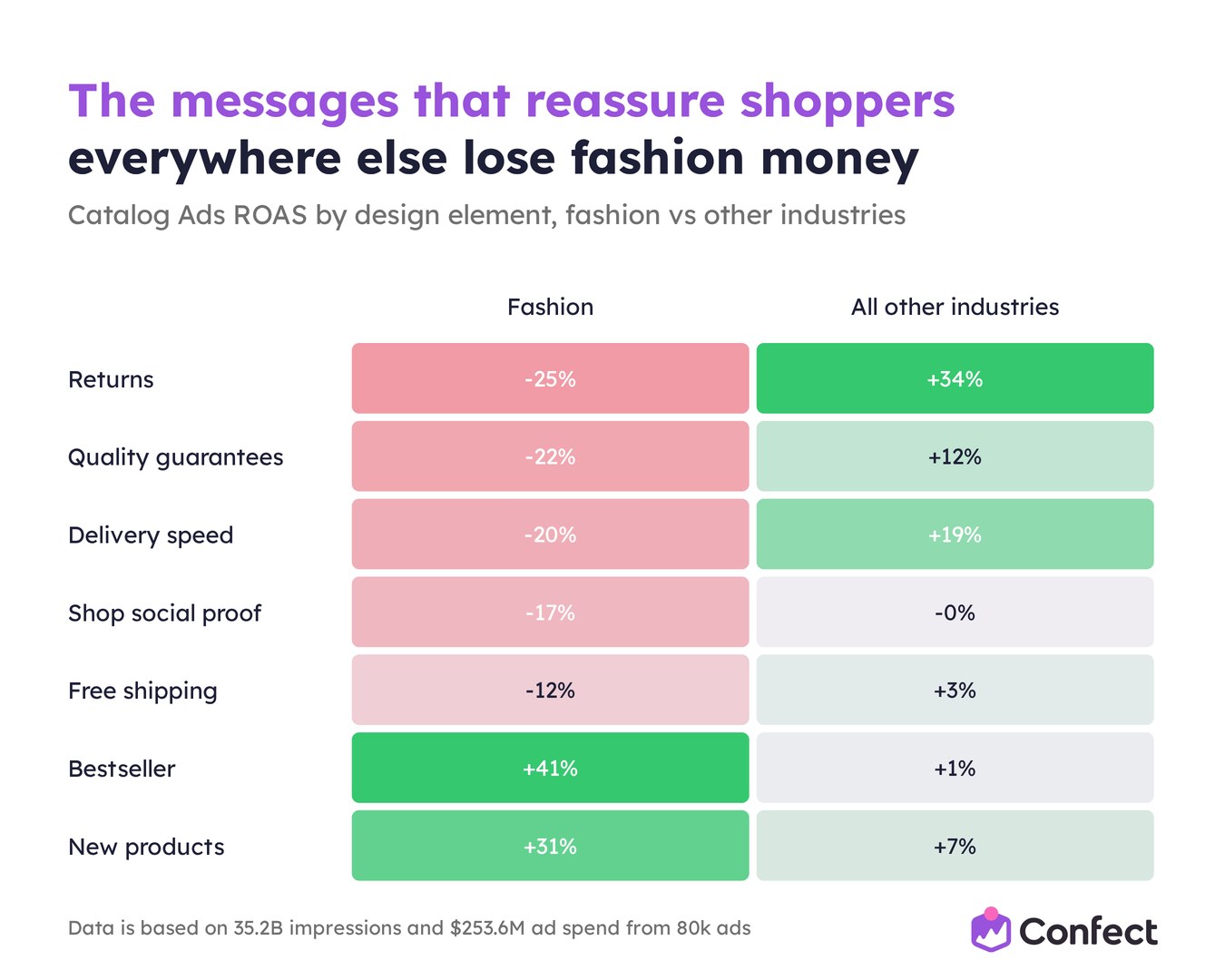
It was a finding we stumbled upon accidentally, and then it went down the rabbit hole. In typical Confect style, we pulled a massive dataset to see what actually goes on with fashion Catalog Ads.
That led us to look across 35.2 billion fashion Catalog Ad impressions and $254 million in fashion ad spend, from 1,488 advertisers, and yes, fashion is the only industry we measure where the standard reassurance messages in Catalog Ads return lower performance than without them.
Crazy, or is it?
So here's the mechanism underneath it. Operational messages don't fail in fashion because fashion shoppers are difficult. They fail because the message barely persuades anyone. Everywhere else, it persuades a great deal.
Remember the word persuade as we move deeper into the study.
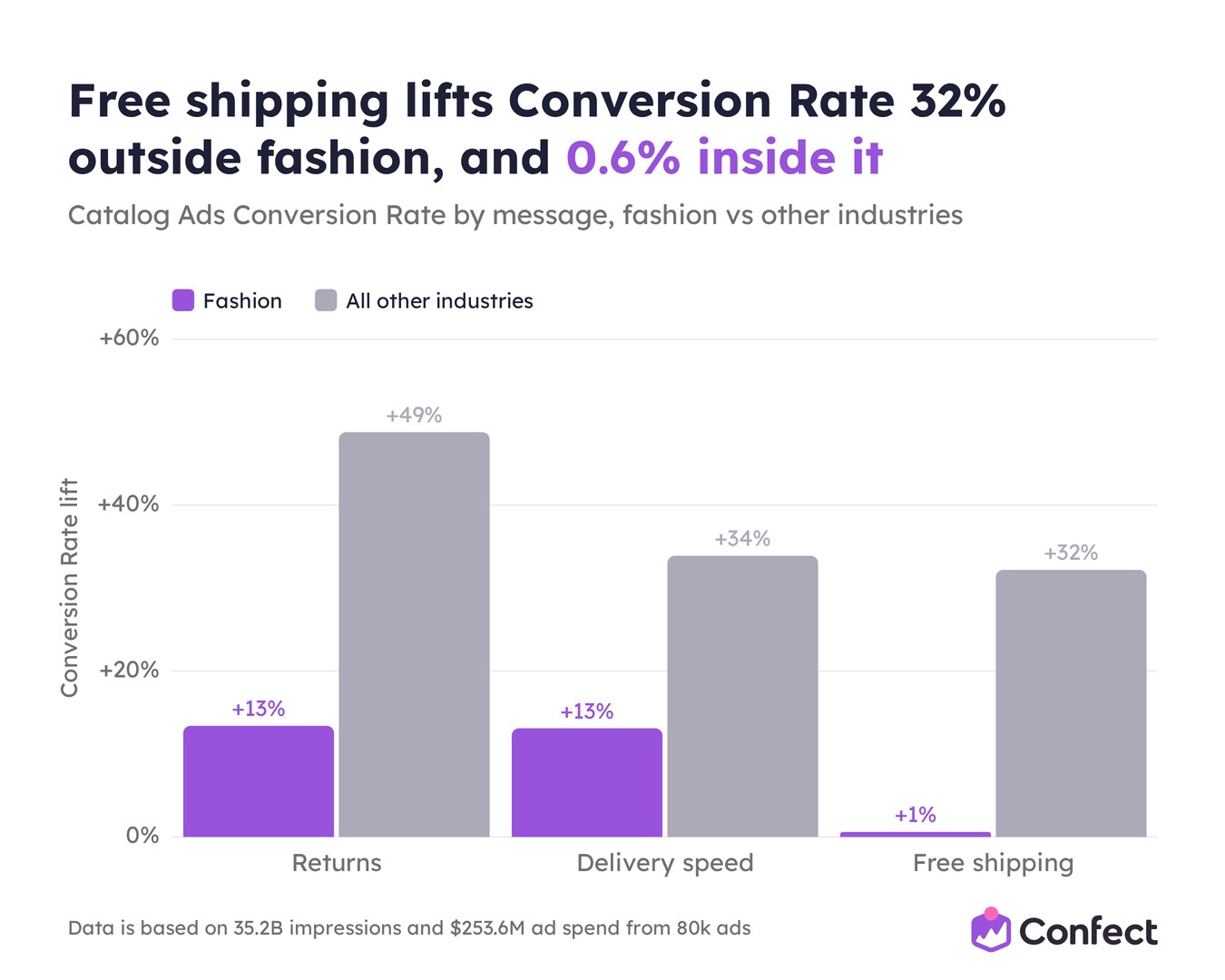
Tell a furniture buyer that returns are free and nearly half again as many go on to buy: +48.8%. Tell a fashion buyer the same thing and you get roughly a quarter of that bump, +13.4%.
Free shipping, the offer that is supposed to be the most motivating instrument in retail, moves fashion conversion rate by a whopping 0.6%.
Promise a quality guarantee on a Catalog Ad and fashion shoppers become less likely to buy, not more, at -17.2%.
That's the whole story in one chart.
The reassurance in fashion Catalog Ads isn't hitting, so the clicks it costs never get paid back. In every other industry, Catalog Ads with reassurance messages hit hard.
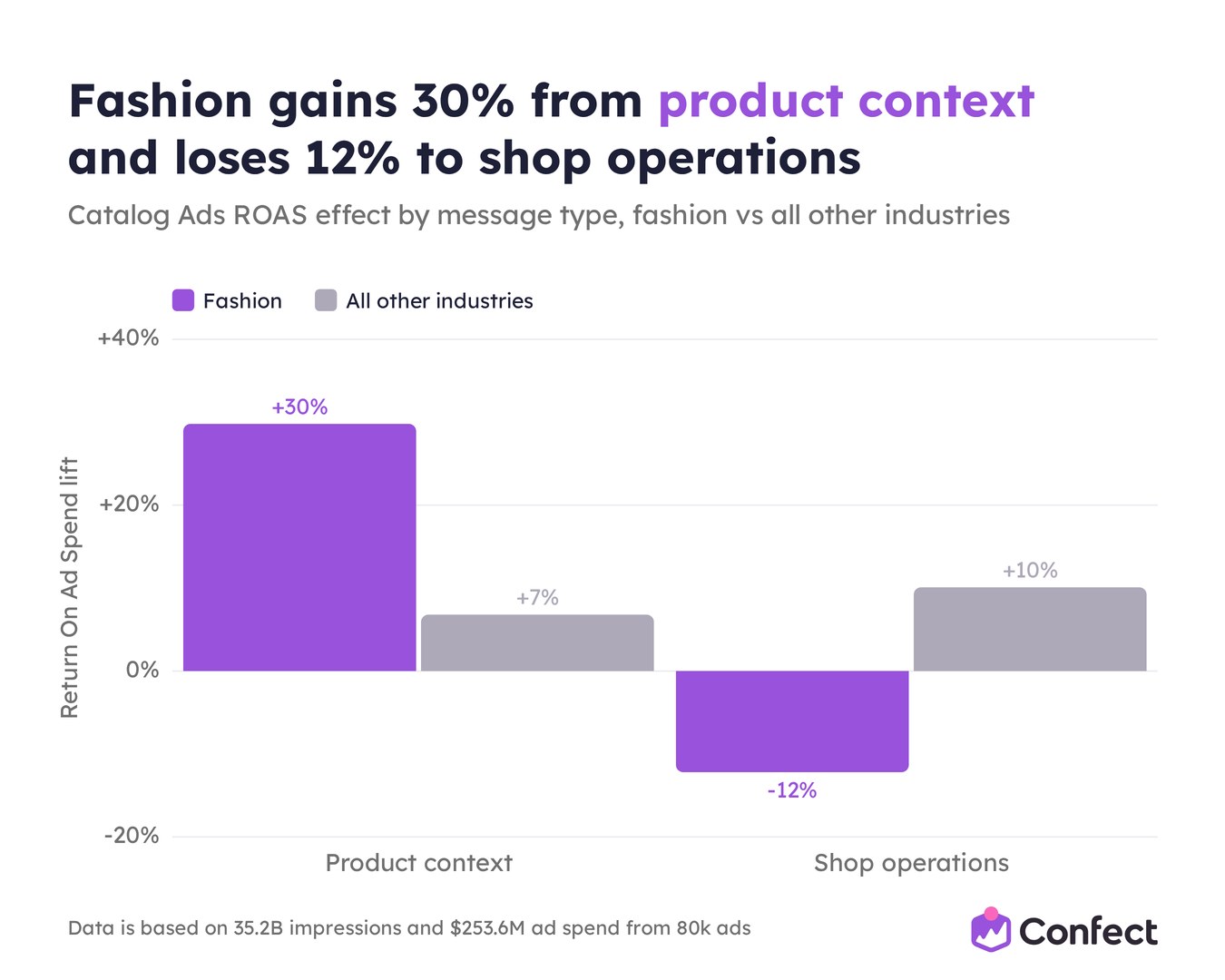
Now sort every design element in the dataset into two buckets, and the pattern stops looking like a cherry pick.
- Shop operations: shipping, returns, ratings & reviews.
- Product related context: bestseller, new, trending. T
We get two bars pointing in opposite directions.
Fashion is bought fifferently
Fashion shoppers do not need to be reassured about the transaction -They need to be reassured about the choice.
Nobody sees your microwave.
Everybody sees your coat.
In every other category the risk a shopper is managing is transactional: will it arrive, will it work, can I send it back. In fashion the risk is social: will this look right on me, will it look right to other people.
Almost every Catalog Ad run by a fashion brand on Meta is answering the wrong question, in the most expensive space the brand owns
Everything that follows holds across fashion as a whole. It also stops holding in specific places, and we went looking for those. A high-end label and a discount retailer get opposite answers on half of what is below.
So do a prospecting ad and a retargeting ad.
So do a brand selling its own name and a retailer selling forty others.
We cut the data by price tier, shop type and funnel position precisely so you can find the version of this that is about you rather than about the average.
Eleven sections. What the inversion is and why it happens, what belongs in the design, where each message belongs in the funnel, what changes at your price tier, how fashion discounts, how narrowly to slice your product sets, which format does which job, why the product image carries more weight in fashion than anywhere else, the third strongest design element most fashion advertisers have never heard of, and the two budget decisions that separate the best fashion advertisers from everyone else.
| Fashion | Whole study | |
|---|---|---|
| Impressions | 35.2 billion | 70.1 billion |
| Catalog Ads | 79,528 | 147,122 |
| Advertisers | 1,488 | 3,585 |
| Ad spend | $253.6 million | $463 million |
| Tracked revenue | $2.43 billion | $4.87 billion |
| Clicks | 1.09 billion | 2.06 billion |
| Purchases | 19.2 million | 37.5 million |
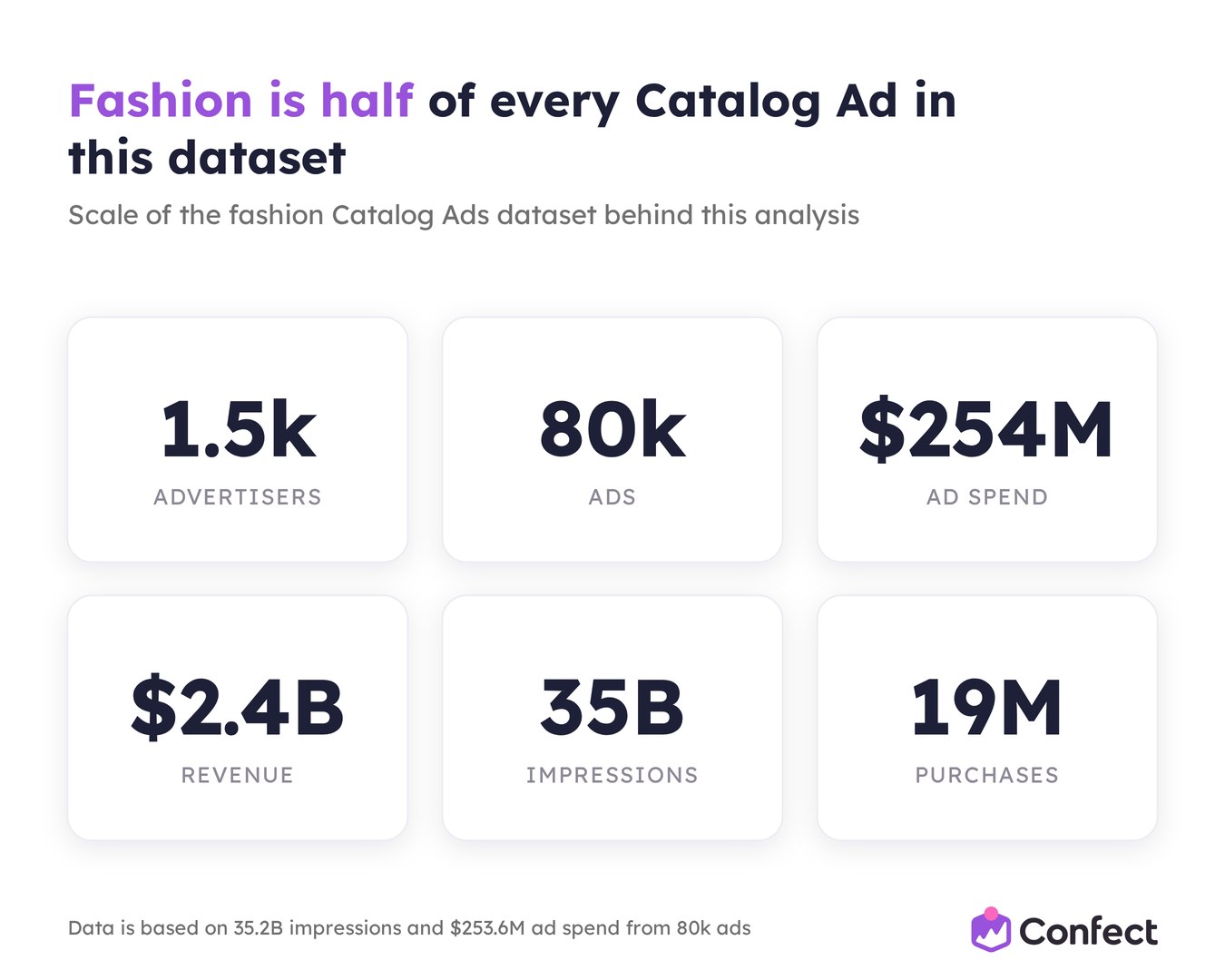
Fashion is half of everything we measure. Every fashion figure in this piece comes from the left column. Every comparison against other industries uses the difference between the two.
| Click-through rate | 2.95% | Cost per click | $0.22 |
|---|---|---|---|
| Conversion rate | 1.82% | Cost per purchase | $12.35 |
| CPM | $6.62 | Average order value | $129.79 |
| Catalog Ads per advertiser | 41 |
Study-wide baselines, so every relative figure below has a real number behind it: CTR 2.95%, conversion rate 1.82%, CPM $6.62, cost per click $0.22, cost per purchase $12.35, average order value $129.79, and 41 Catalog Ads per advertiser.
How to read the numbers in this piece. Every percentage compares Catalog Ads that use an element or tactic against Catalog Ads that do not, inside the same group of advertisers. So "bestseller designs lift ROAS 41%" means fashion Catalog Ads carrying a bestseller design returned 41% more than fashion Catalog Ads without one. These are correlations across a very large dataset, not controlled tests. Every figure is an advertiser-balanced median: we take each advertiser's typical Catalog Ad first, then the median across advertisers, so one brand running eight hundred ads counts once rather than eight hundred times.
1. Why fashion inverts the rules
In every other category the risk the shopper is managing is transactional. In fashion it is social. That single swap explains almost everything in this piece, and the data makes the case in two moves.
The first is that fashion does respond to social proof, just not yours. A bestseller label is product-level social proof, and it is one of the two strongest elements in fashion at +41% ROAS with an 18% better cost per purchase.
Shop reviews are advertiser-level social proof, and they cost 17% of ROAS.
Fashion shoppers are not asking whether you are a safe shop to buy from. They are asking whether other people wear the garment.
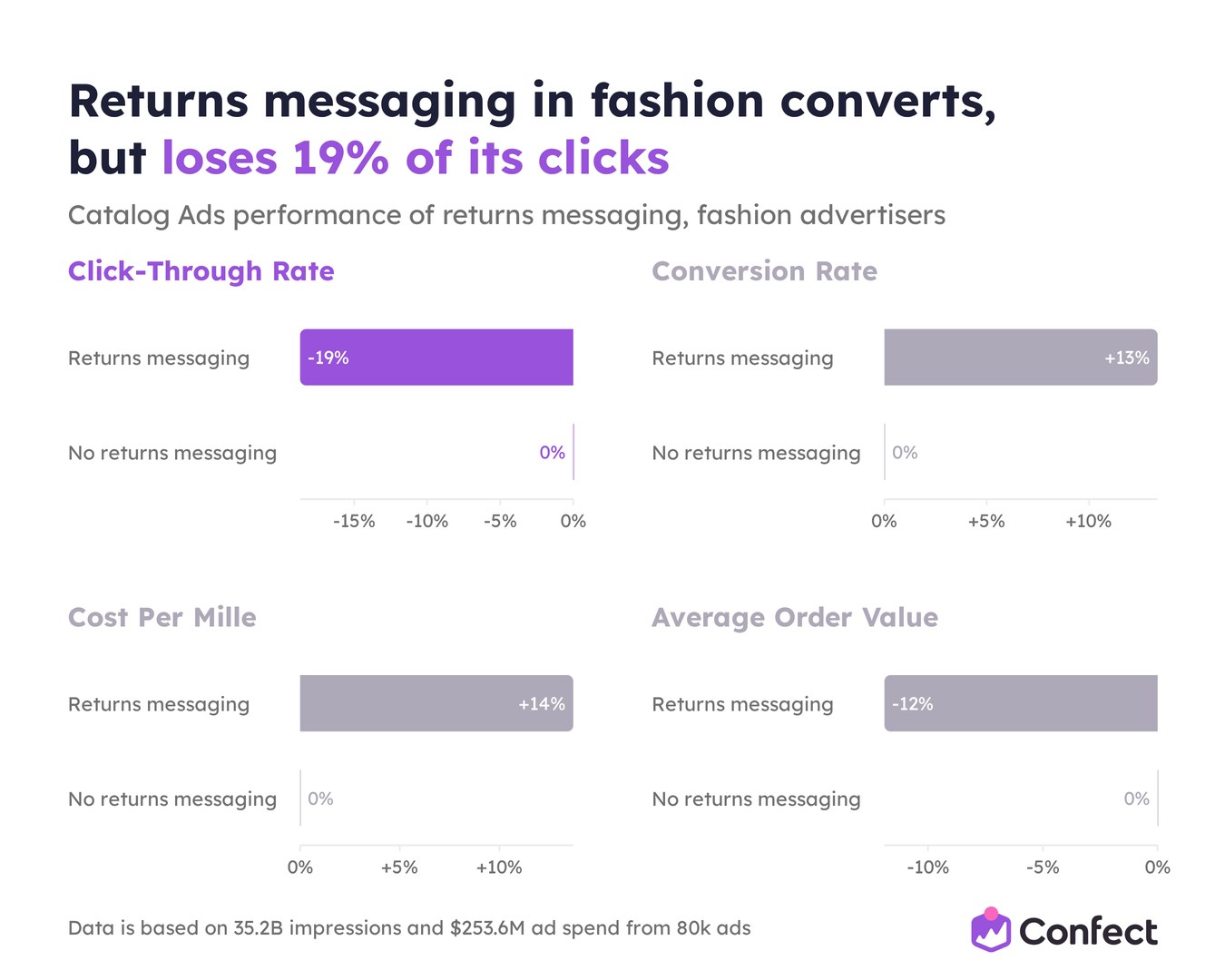
The second is that operational details changes who clicks, not how well you persuade. Returns messaging in fashion lifts conversion rate 13.4%, which is a real lift.
It also loses 18.7% of its clicks, pays 13.7% more on CPM, and drops average order value 11.9%. It does not fail at persuading.
It fails at attracting, and what it does attract is worth less per order. Talking about returns turns a desire ad into a logistics ad.
Six ideas sit behind this, and they are worth naming because they predict what happens next rather than describing what already happened.
- Perceived Risk Theory says consumers weigh financial, performance, social and psychological risk, and that an ad has to address the dominant risk for its category. Fashion's dominant risk is social. Almost every fashion Catalog Ad addresses the financial one.
- Hedonic vs Utilitarian Shopping Motivation says some purchases are made for pleasure and some for function. Fashion is heavily hedonic, and the pleasure sits in the choosing.
- Conspicuous Consumption and Signaling Theory, and the Conspicuous Consumption Code underneath them, say that products displayed in public follow different rules than products used in private.
- The Social Proof Hierarchy says not all social proof is equal. In fashion the only social proof that counts sits on the garment, not on the shop.
- Overcoding says that when every element in the ad design signals the same thing, the ad takes on that meaning as a whole. Stack shipping, returns, guarantee and rating on one card and the ad stops reading as fashion and starts reading as a discount catalog.
- The Zero Price Effect earns its place here by failing. Free is supposed to be the most motivating word in retail. In fashion, free shipping costs 11.8% of ROAS. When free stops working, the ad is not being read as a transaction at all.
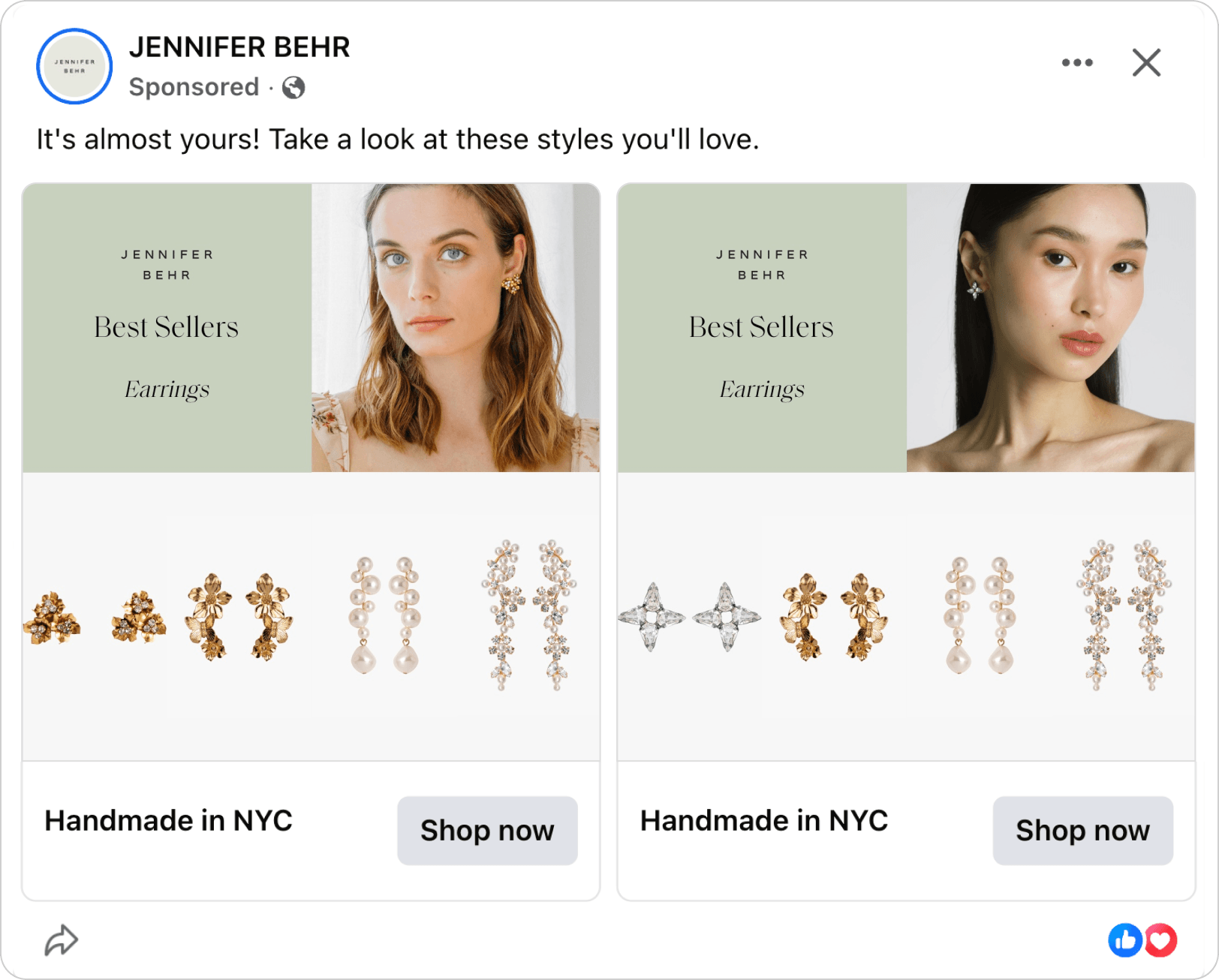
Jennifer Behr and Maison MRKT put the popularity of the piece on the card and left the price off it entirely, and saw ROAS climb 76%.
2. What to put in the design
The fashion Catalog Ad has three high-value elements: brand, popularity, newness. Almost everything else is either nice-to-have or liability.
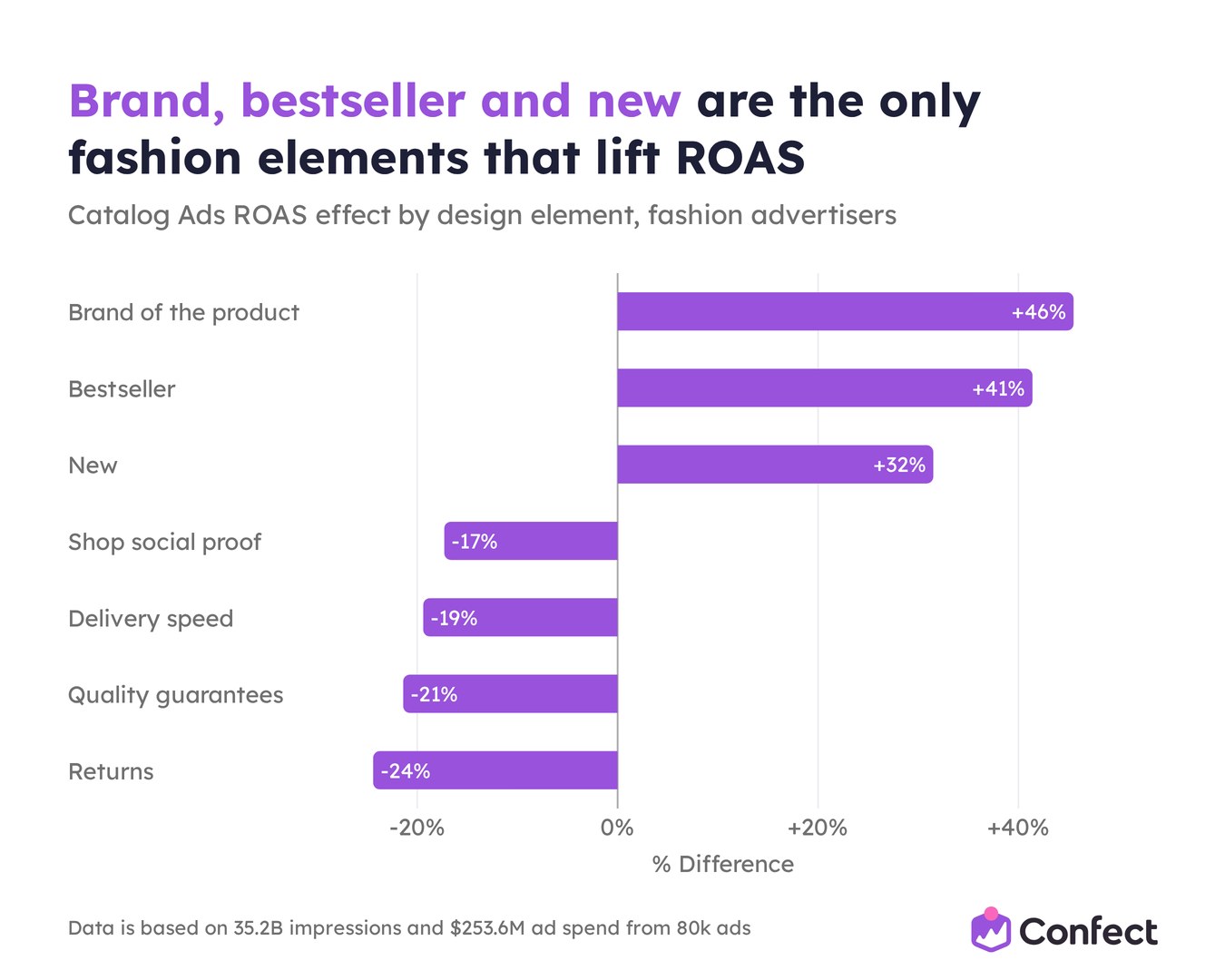
There is a mechanic under that ranking that reframes everything after it. In fashion, most design elements lower click-through rate while raising conversion rate, average order value and CPM. So the question is never whether an element helps. It is whether it helps enough to pay for the clicks it costs. Bestseller and new are the only two elements that lift attention and profit at the same time.
Why bestseller and new work together rather than against each other
Bestseller and new look like two findings. They are one.
Fashion buyers want to be distinctive and to belong at the same time. "Other people wear this" resolves the fear of getting it wrong. "Nobody has this yet" resolves the fear of looking like everyone else. Every fashion purchase runs both anxieties at once, which is why the two elements that answer them sit at the top of the table, and why they do not cancel each other out when a brand runs both.
This is the Individuality vs Belonging Tension, and it explains the two biggest numbers in this section in one sentence: consumers want to express uniqueness and fit into a group simultaneously, and the brands that resolve both win. Normative Social Influence and Mimetic Desire cover the bestseller half. Variety-Seeking Behavior covers the new half.
The same label, two completely different economies
Outside fashion, a bestseller label works on people. Click-through rate rises 15.8% and conversion rate rises 15%. And the advertiser ends up no better off: ROAS moves 0.9% and cost per purchase gets 20.6% worse.
In fashion the same label lifts ROAS 41% and cuts cost per purchase 18%. Popularity is not simply useful information in fashion. It is part of the product.
Newness behaves the same way. New lifts fashion ROAS 31.5% against 7.3% everywhere else, and the sub-metrics show that is not a rounding difference. Fashion gains clicks on newness at CTR +5% while other industries lose them at -10.3%. Fashion gains conversions at +7.8% while other industries lose them at -8.4%.
The reason is risk again. Nobody wants the first version of a television. You wait for other people to test it, so newness in electronics reads as unproven and the buyer would rather have the model that has been out a year. In fashion, newness is the product. What you are buying is being early.
.png)
Bronze Snake framed the release as a drop instead of a promotion, and the design returned 54% more ROAS with a 22% better cost per purchase.
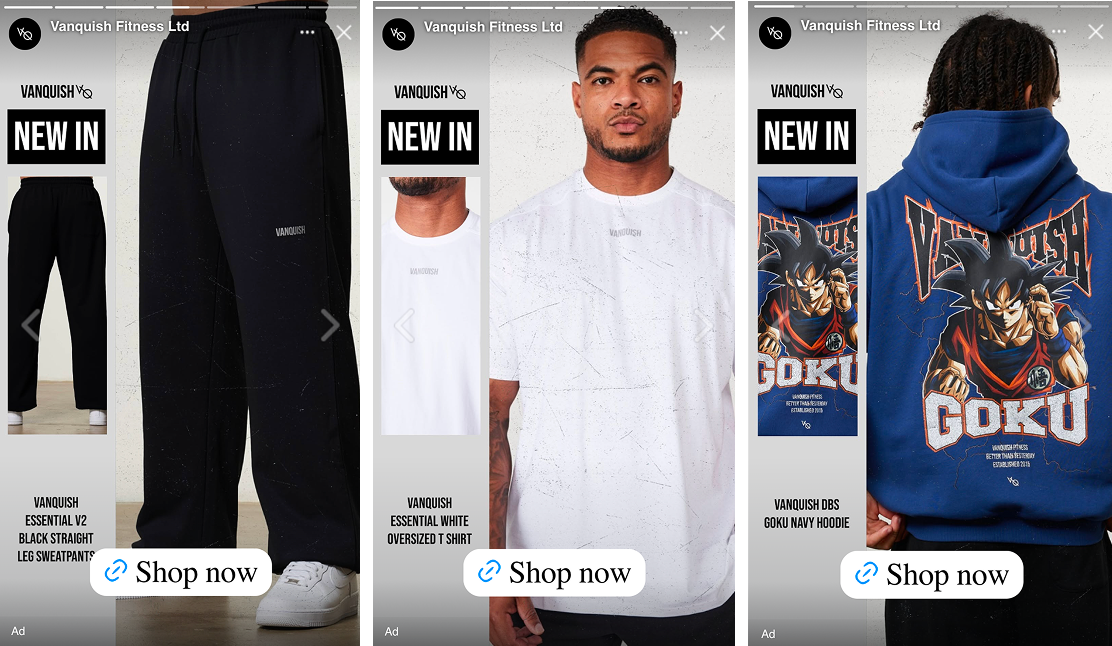
Vanquish Fitness ran NEW IN messages on their Catalog Ads and saw a 39% increase in ROAS
Every element in a Catalog Ad is either an attractor or a qualifier
Everything in a fashion Catalog Ad does one of two jobs. It brings people in, or it screens people out.
A signature repeats across the whole dataset: an element lifts conversion rate hard and wrecks click-through rate and cost per click. Those are qualifiers. They do not persuade, they filter.
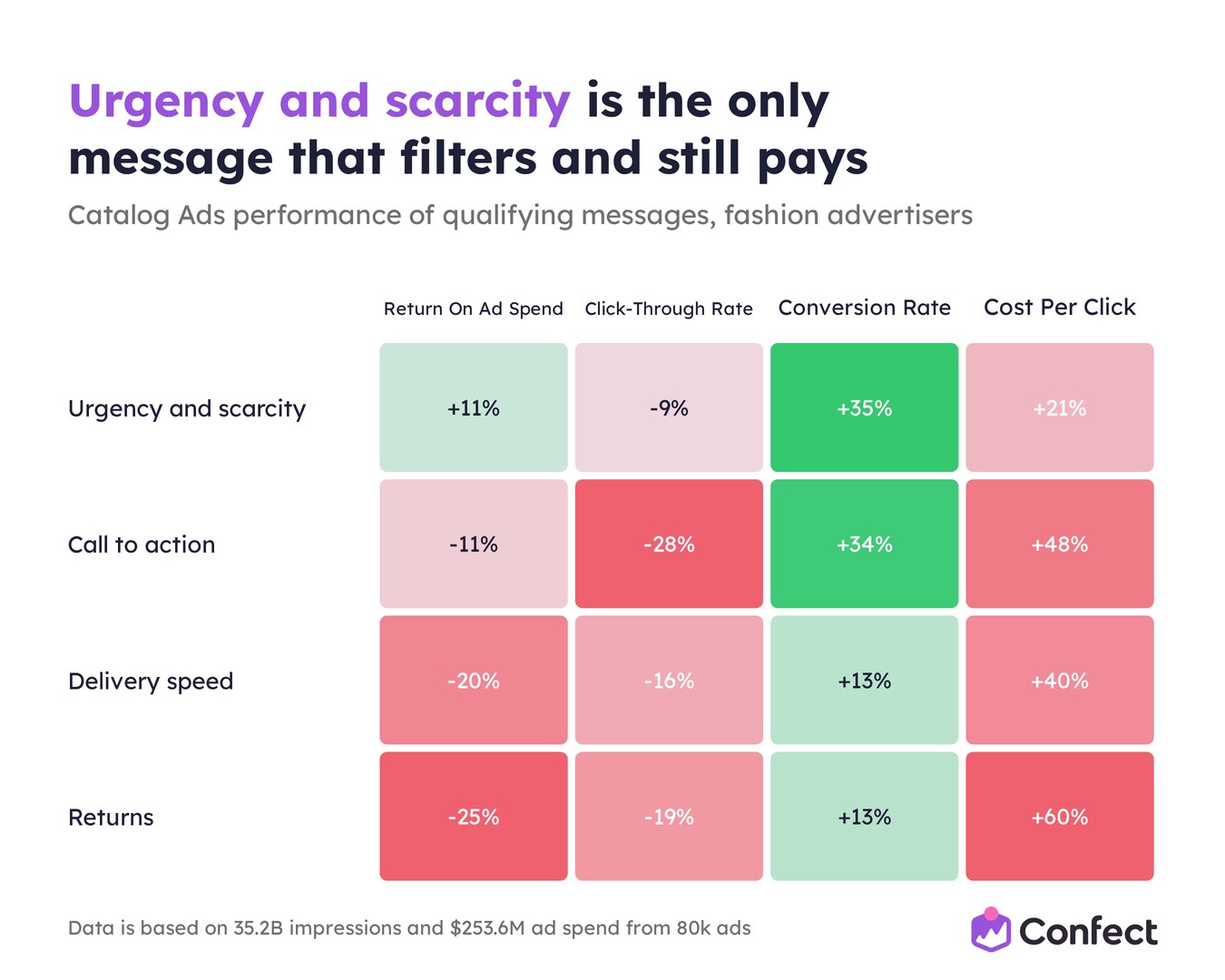
Only one of those four filters profitably. Urgency and scarcity is the conversion rate champion of the entire fashion dataset at +35.33%, rising to +47.70% in the lower funnel and +76.03% for high-end brands, and it is the only qualifier whose ROAS survives the clicks it costs.
The mirror image is the attractor: it buys clicks and gives back conversion. Voucher codes are the cleanest case in fashion, a traffic tool hidden as an offer. Cost per click 15.5% cheaper, conversion rate 15.7% worse, and ROAS still netting +8.99%.
Bestseller and new are the only elements in fashion that buy attention and profit at the same time, which is why they top the table.
This is worth more than the four rows in it, because it gives you a rule for elements nobody has measured yet, including whatever you are about to invent. Ask what the element is buying: attention, or qualification. Then check whether the price was worth it. Scarcity Effect, Loss Aversion and the Deadline Effect explain why urgency qualifies so hard. The Deal-Prone Consumer explains why voucher codes attract the wrong half of the audience.
.jpg)
Ksubi and Elephant Room found the version of urgency that a premium brand can wear, and the campaign returned 79% more ROAS.
3. Where each message belongs in the funnel
Shop reassurance is not wrong. It is misplaced. The further down the funnel a shopper is, the more they care about who they are buying from. The further up, the more they care about the product.
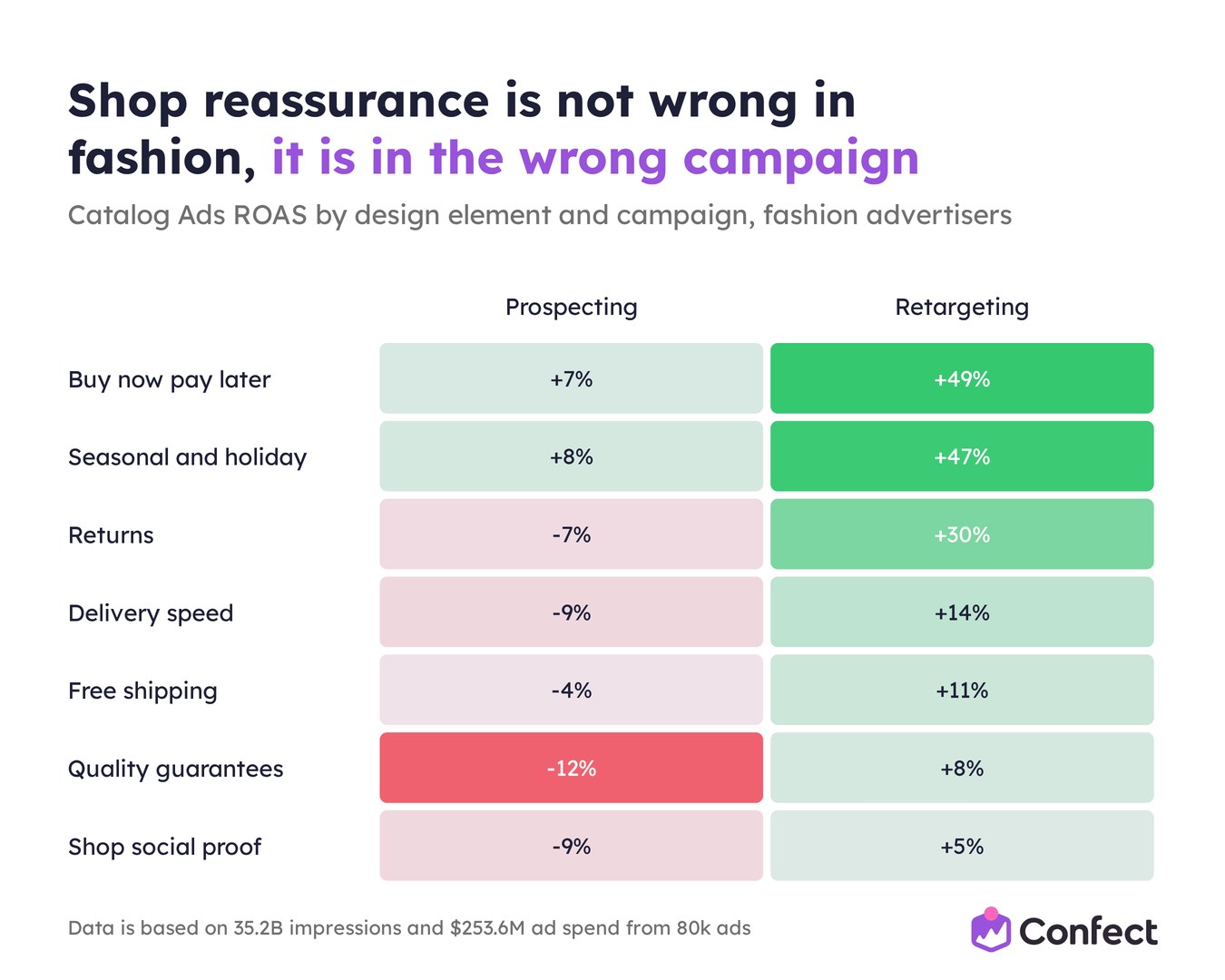
The prospecting winners are the product elements from the last section: brand +60%, bestseller +39%, voucher codes +21.9%, new +18.3%, urgency and scarcity +18%.
A bestseller badge does two different jobs depending on where you run it. In prospecting it returns +39.0% ROAS with a cost per click 32.7% cheaper, so popularity is buying cheap attention from people who do not know you. In retargeting it returns +42.7% ROAS driven by conversion rate +55.5%, so popularity has become the last reassurance before checkout. One element, two mechanisms, and both of them work.
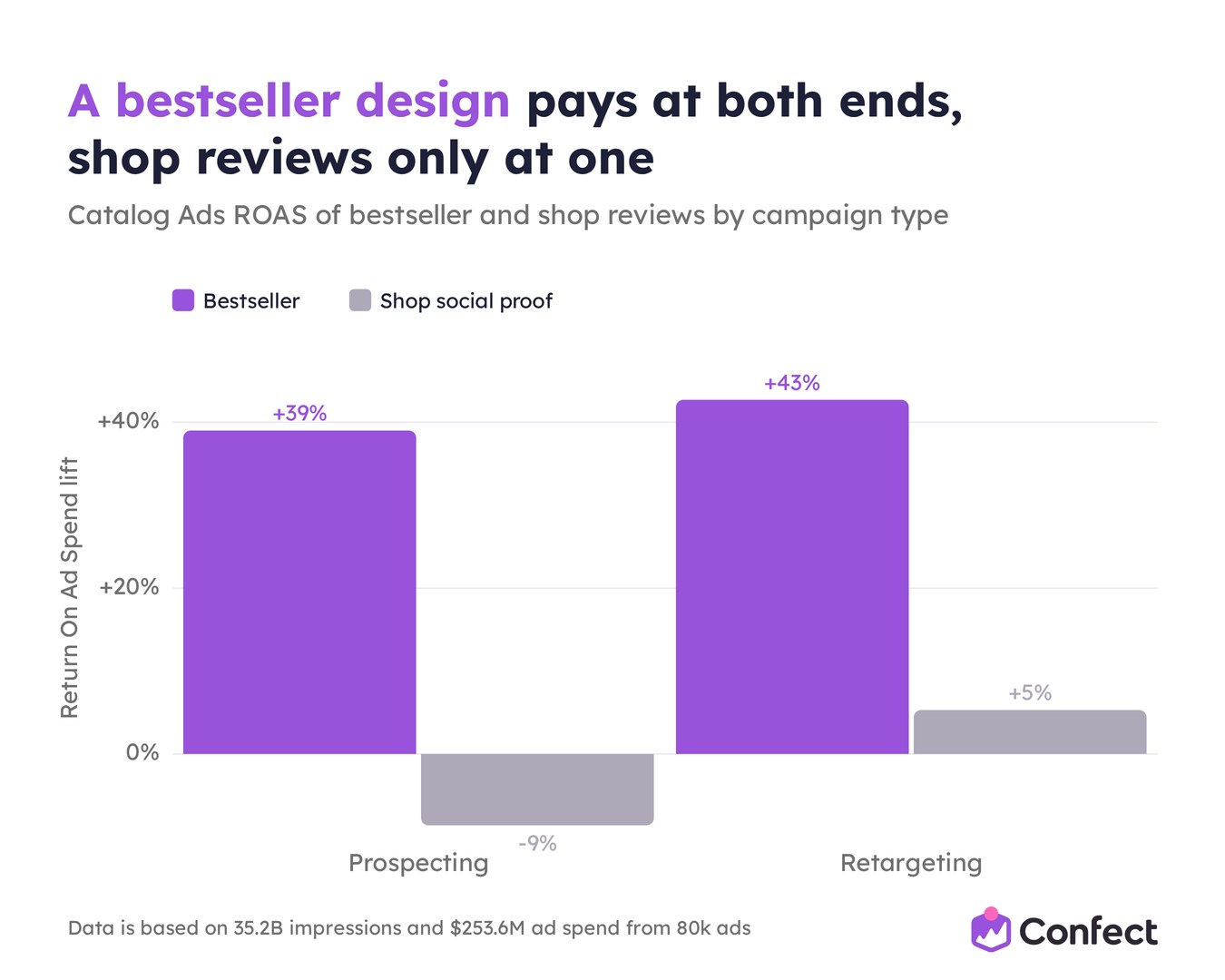
There is a second-order finding in the prospecting column that is easy to miss. The differences up there are flat. No single element dominates. That flatness is the finding: prospecting rewards breadth, not one winning message. Run many designs and let Meta match message to person. Retargeting rewards being specific about yourself as a shop.
Browse Mode vs Search Mode and The Messy Middle explain why the same shopper wants different information at different moments. Creative Is the New Targeting and Creative Diversification explain the prospecting breadth argument: when targeting is automated, the creative set is the targeting.
Retargeting Decay explains why reassurance lands so hard at the bottom, where the shopper has already decided they want the garment and is now deciding whether to trust you with the money.
.png)
Nobody's Child and Incubeta run separate design logic for sale and non-sale products rather than one design for everything, and saw CTR rise 21% on sale Catalog Ads and 6% on the rest.
.png)
More on which campaigns to build around this split in the best campaigns for Catalog Ads.
4. Shops price tier changes the playbook
Fashion is the one industry where being high-end does not cost you Return On Ad Spend, and being cheap does not buy you any.
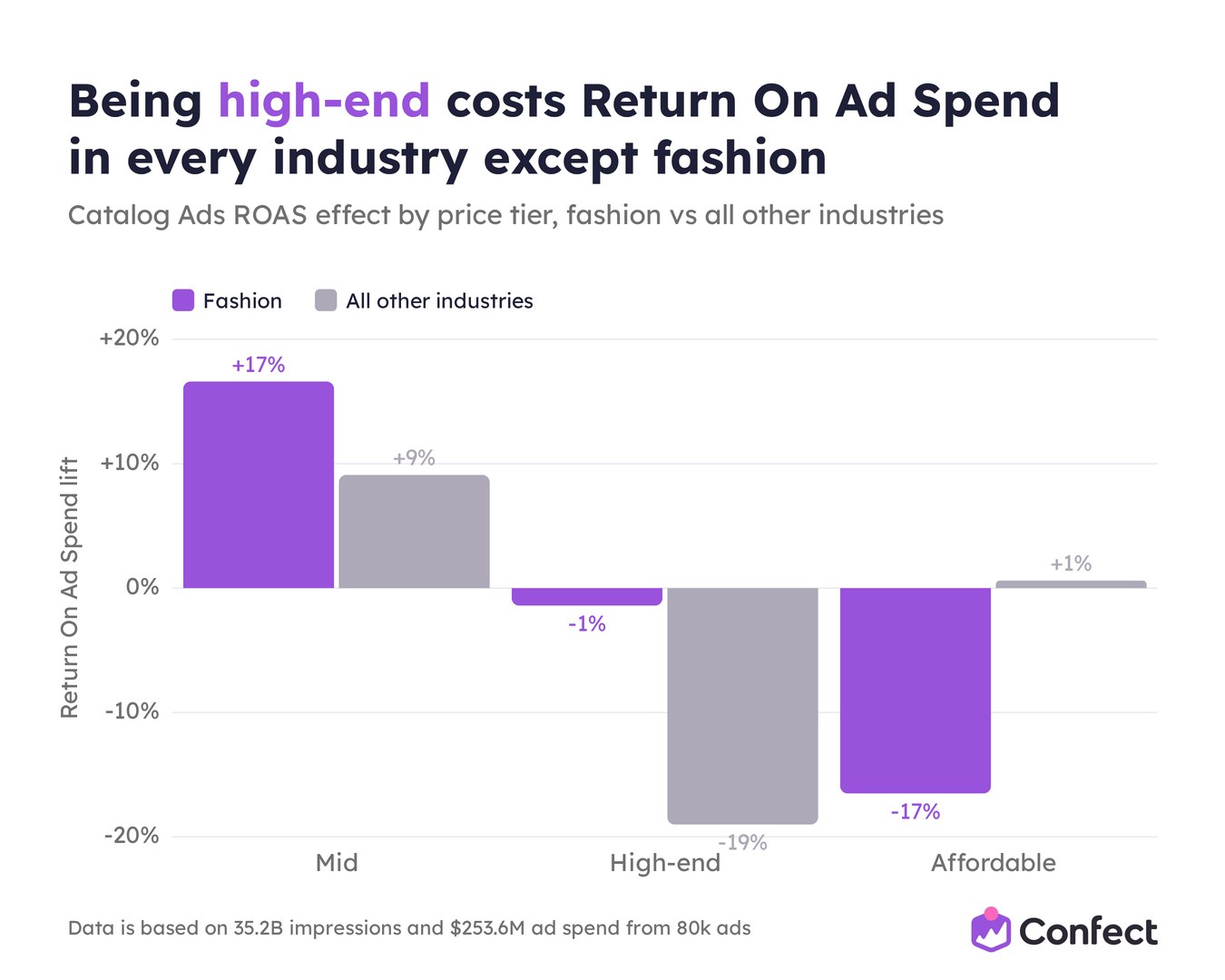
High-end fashion holds an almost average ROAS on an average order value 106% above the fashion mean. High-end outside fashion only manages +19.3% on order value, which is why it drop to -19.0%. A luxury handbag and a luxury blender are not the same business.
Then the tier changes what your designs should be about.
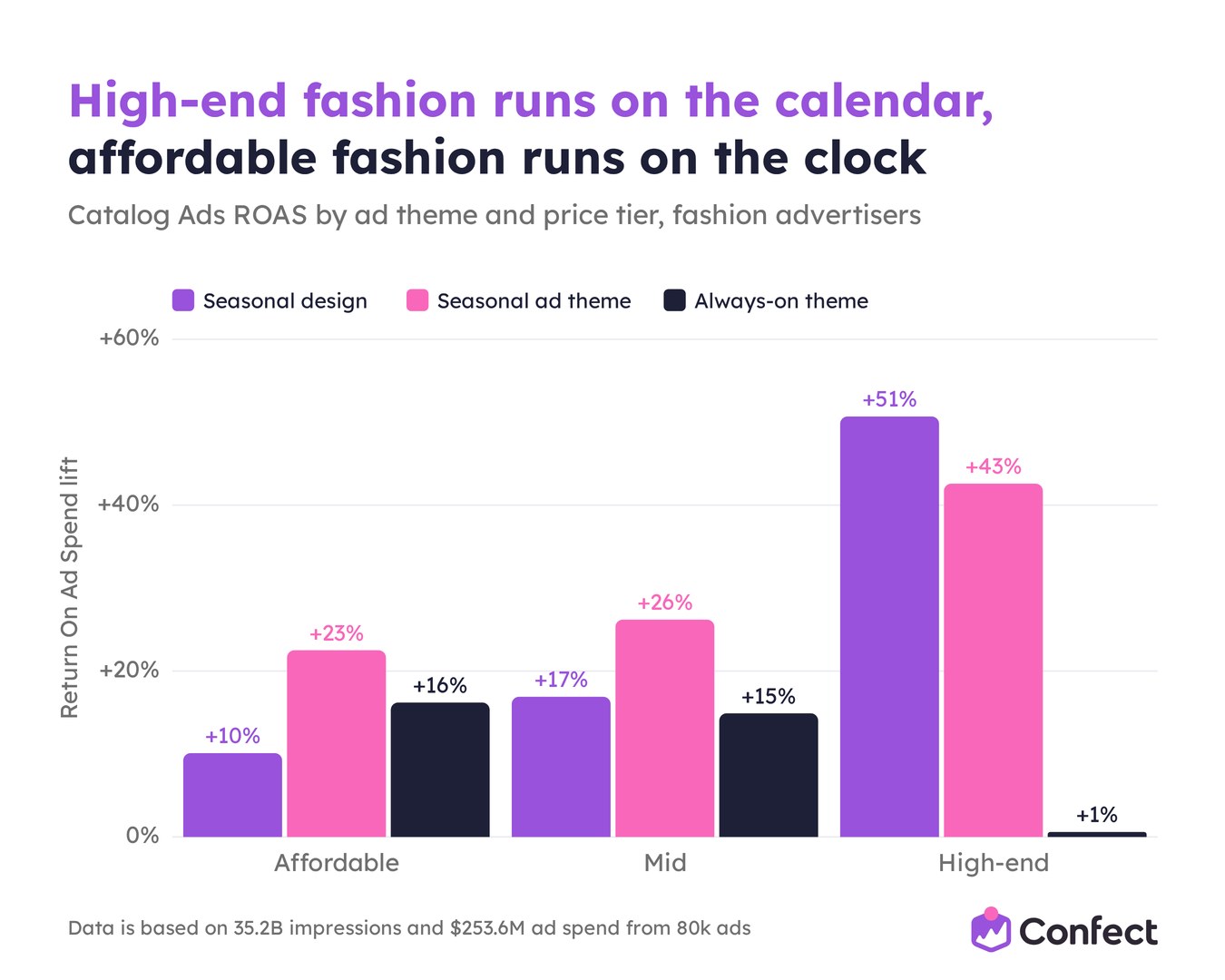
Cost per purchase tracks the same way. A seasonal design is 5.1% worse for affordable brands, 20.4% better for mid, and 26.8% better for high-end. A seasonal ad theme gives high-end brands a 34.7% better cost per purchase.
Three tier-specific numbers sit inside that line rather than beside it.
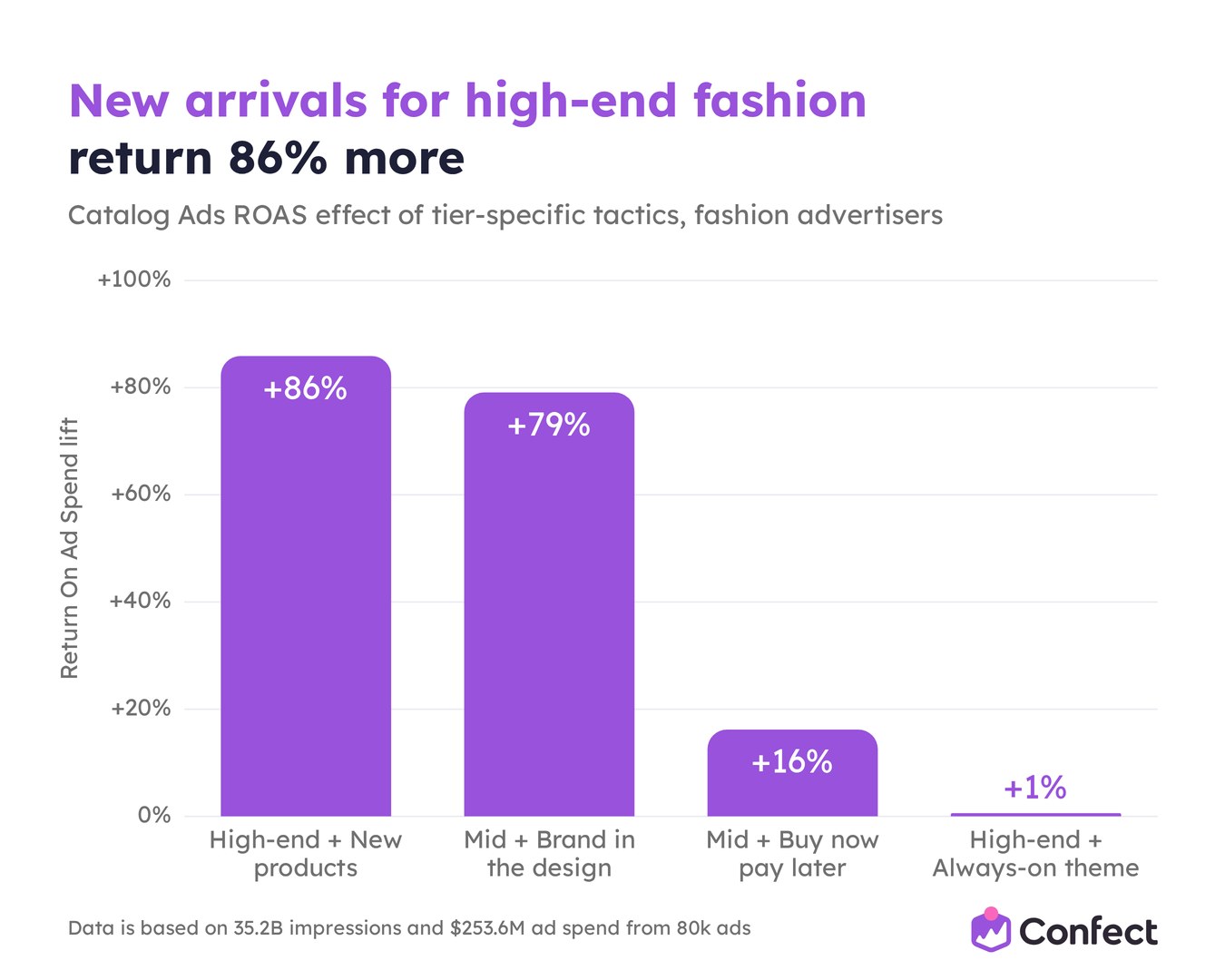
- High-end plus new products returns +85.9% ROAS with a 14.8% better cost per purchase. It is the largest figure in the price-level data, and it is the calendar argument measured twice: new arrivals at +85.9% and seasonal design at +50.7% are the same instinct. If you sell at the top of the market, your Catalog Ads should be built around collections, not offers.
- Mid-price plus the brand in the design returns +79.1% ROAS with a cost per click 40.8% cheaper. It is the largest brand figure anywhere in the data, which makes sense: at mid-market the brand name is the thing that separates one navy coat from another navy coat at the same price.
- Mid-price plus buy now pay later returns +16.2% ROAS with a cost per purchase 41.9% better. It barely registers for high-end. It is a mid-market instrument and it should be treated as one.
Brands and multi-brand retailers get opposite answers
Seasonal messaging lifts brands 24.6% ROAS with a 13.7% better cost per purchase, and costs multi-brand retailers 15.7% ROAS with a 6.6% worse cost per purchase.
A retailer's "SS27" means nothing to a shopper. The brand name on the garment does, which loops straight back to the +45.5% on brand in the design.
The theory here is unusually load-bearing. The Veblen Effect and the Paradox of Luxury explain the high-end order value: for some goods, price is part of the appeal.
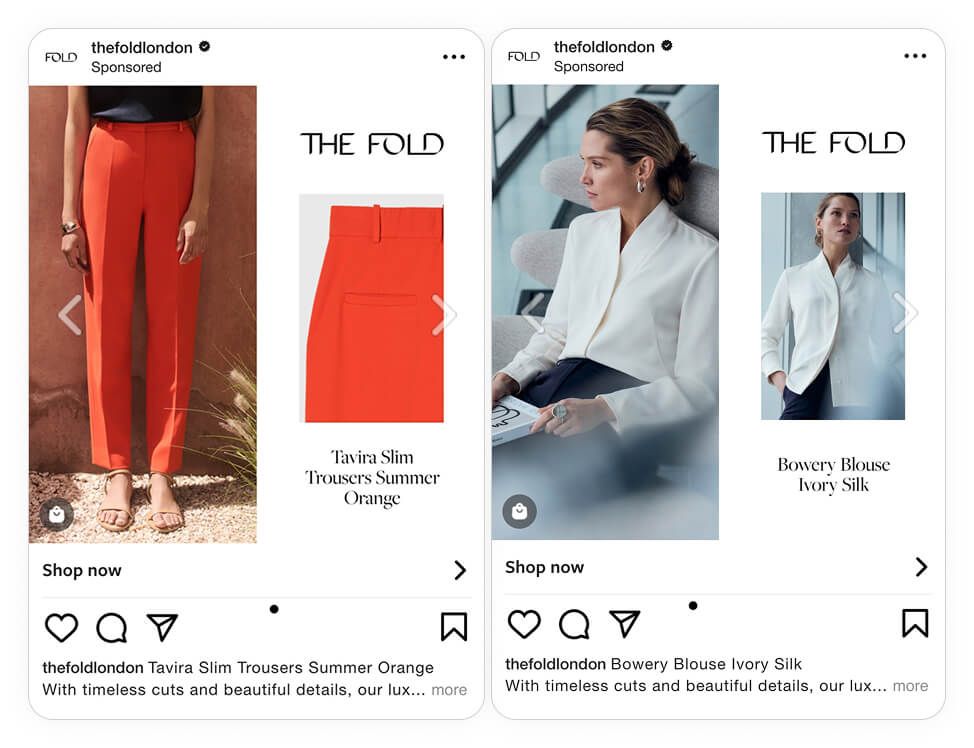
The Absent Signifier explains why high-end brands strip pricing out entirely, which is what sits behind The Fold's +124% ROAS after removing pricing fields from the design.
Semiotic Disruption and Category Codes explain why an affordable brand can wear a discount code and a high-end brand cannot: the code is not just information, it is a signal about what kind of shop this is. And the Exclusivity vs Accessibility Tension is the strategic version of the same trade.
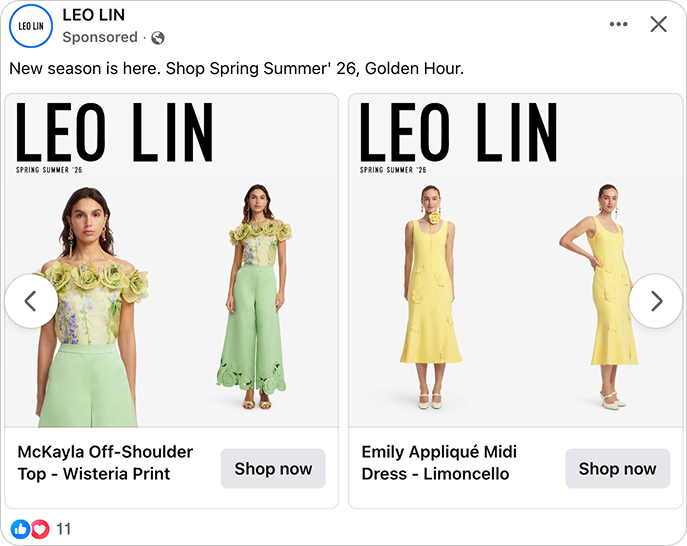
LEO LIN and Elephant Room built the Catalog Ads around brand awareness instead of discounts and returned 82% more ROAS.
The full version of the top-of-market playbook is in Catalog Ads for high-end and luxury brands.
5. How fashion brands discounts on Catalog ads
Fashion's discount ladder is the exact reverse of everyone else's.
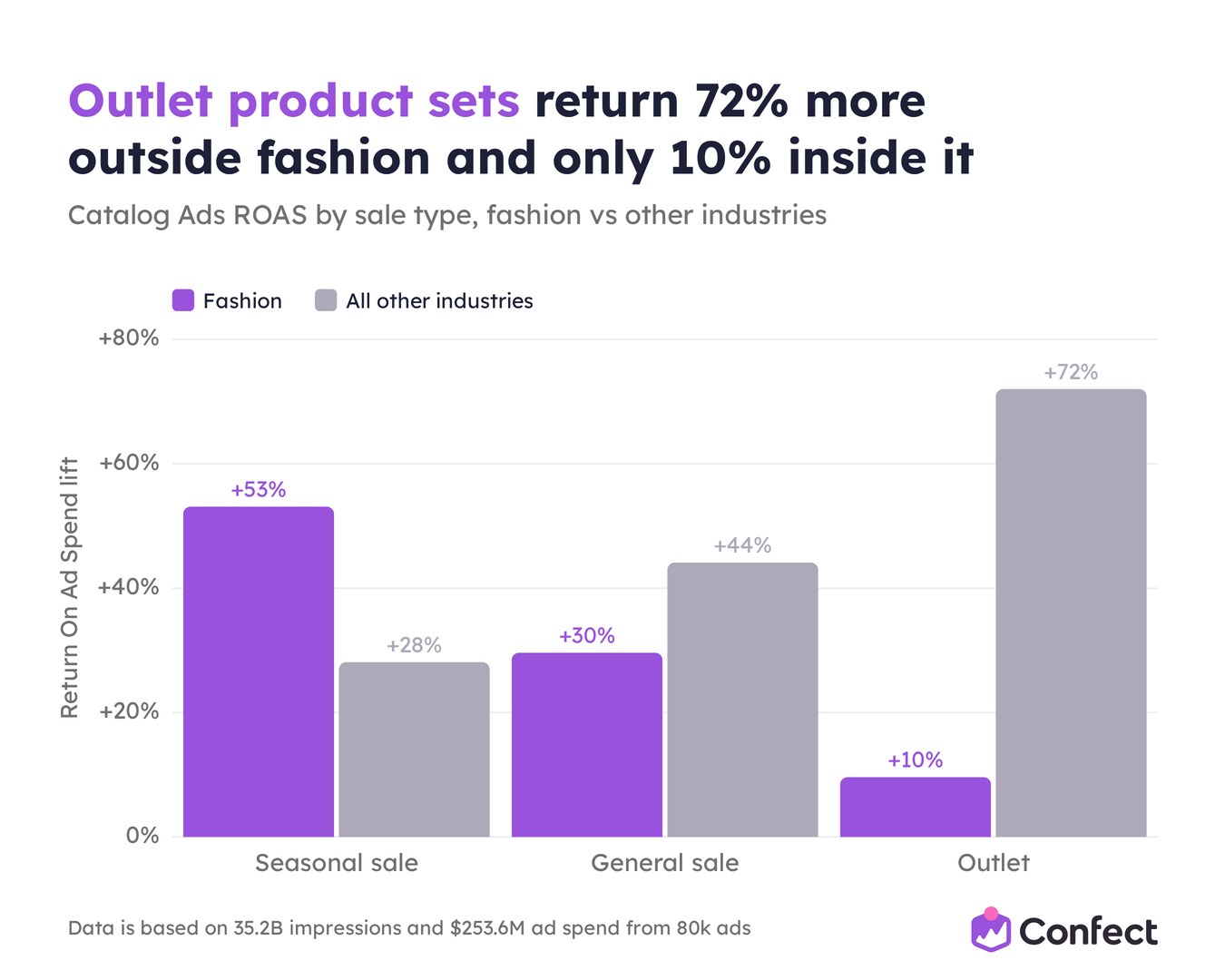
The seasonal sale sub-metrics in fashion are the rare case where everything moves the right way at once: cost per purchase 28.4% better, CTR +7.5%, conversion rate +9.1%, CPM 13% cheaper.
-1.png)
Tretorn let the season carry the sale campaign.
The reason is what each sale type says about the garment. A seasonal sale is an event with a legitimate reason the product got cheaper. End of season does not damage the coat. An outlet says the coat failed. Outside fashion, an outlet says you got a bargain on a perfectly good object, which is why it is the strongest sale type everywhere else and close to the weakest here. Transaction Utility Theory, the Framing Effect and Category Heuristics all point at the same thing: the discount is never just a number, it is a claim about why the number changed.
Give the sale its own design, not a badge on the old one
The strongest argument for design variants in this entire piece is hiding in the sale data.
A sale-specific design variant returns +52% in fashion against +16.5% outside it. A new-specific variant returns +37.5% in fashion against -15.2% outside it. A seasonal ad theme returns +29.9% ROAS in fashion with a 19.2% better cost per purchase.
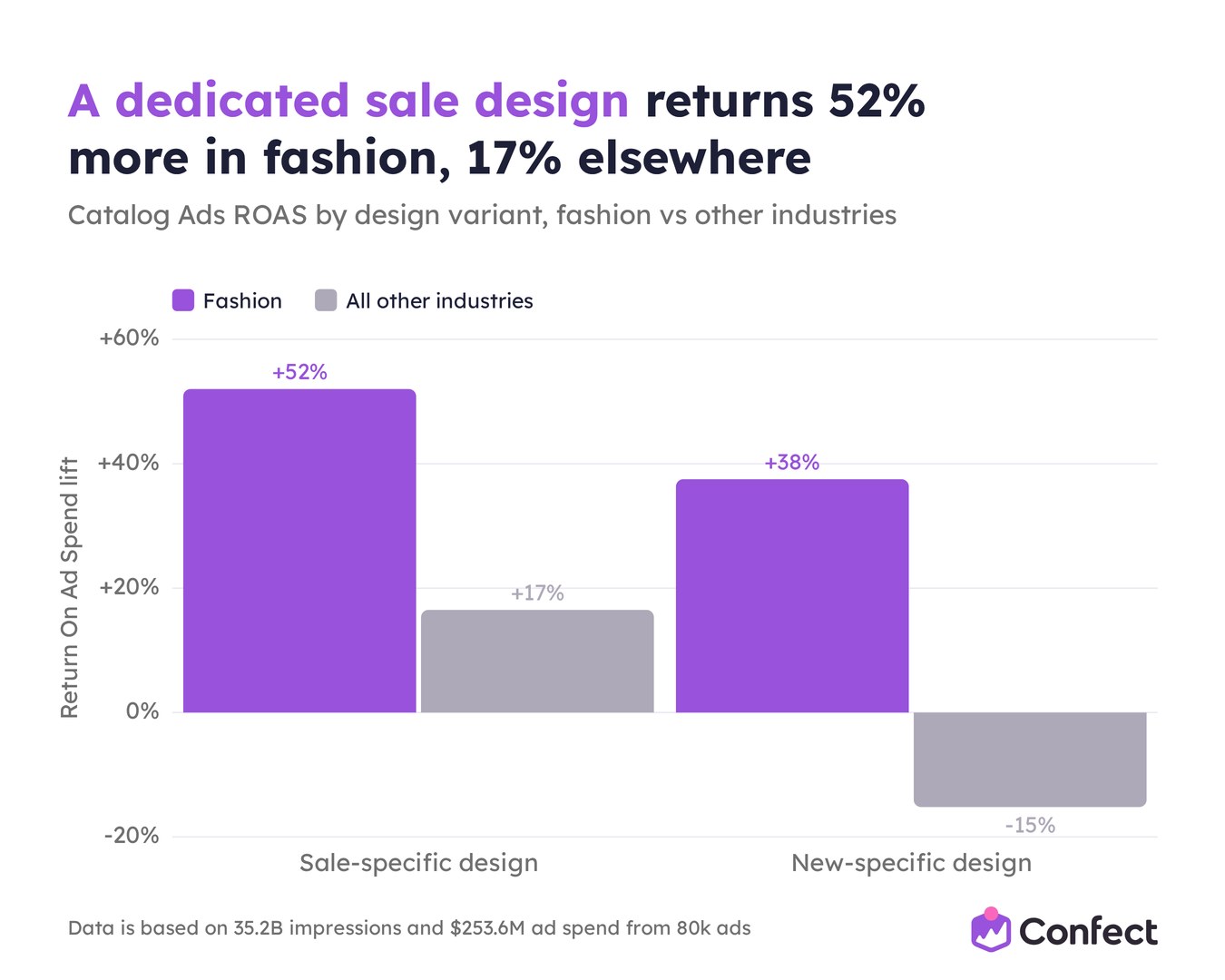
That +52% comes from a dedicated sale design, not a sale badge bolted onto the always-on design. Design rules make that cheap to run: the sale products get the sale design and everything else keeps the evergreen one, from the same data source, without a second campaign.
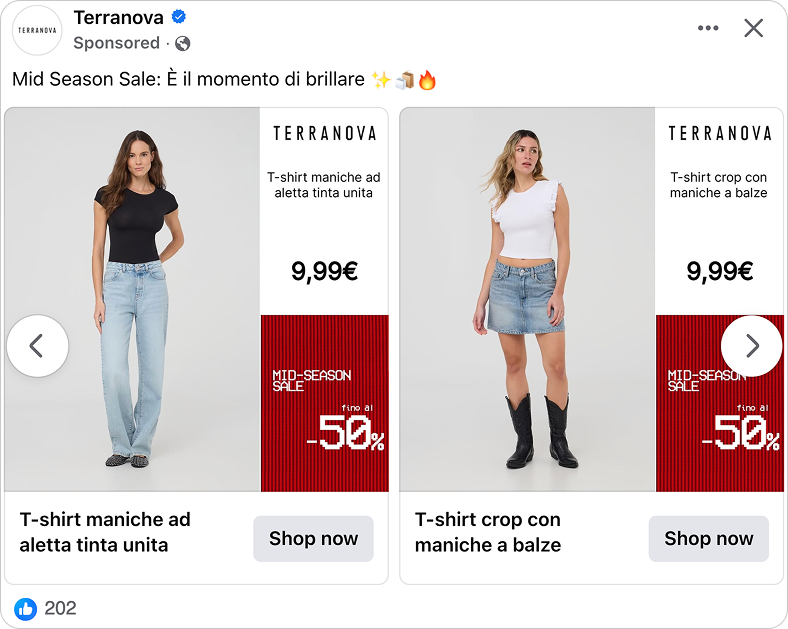
Terranova and Visioni Agency built the Mid-Season Sale its own design rather than badging the existing one, and returned 116% more ROAS with a 94% higher conversion rate.
6. How narrow to slice your product sets
Specificity pays until it starves the algorithm. The rule that comes out of the fashion data is a clean one: slice by who the product is for, not by which product it is.
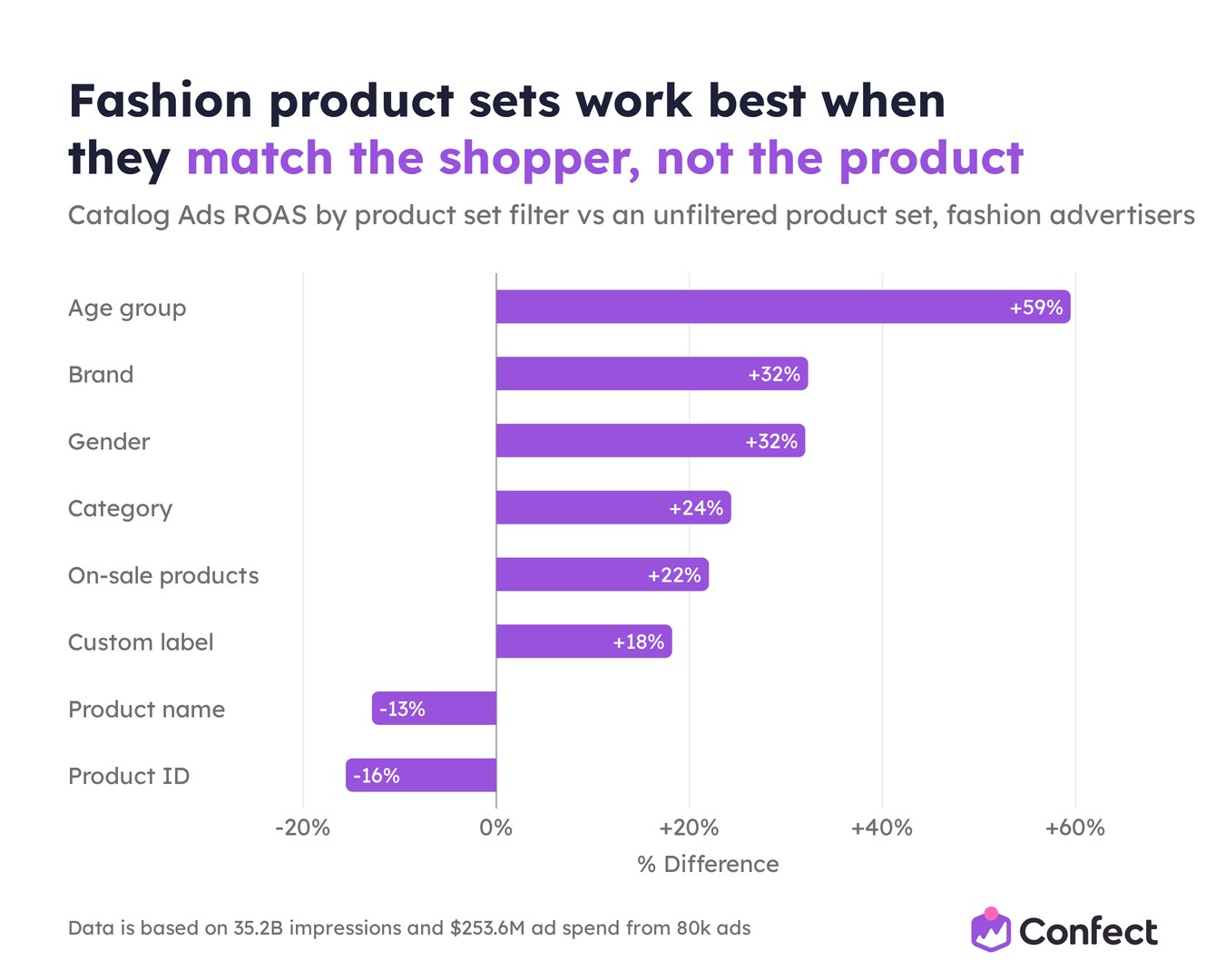
The pattern is not obvious until all eight rows sit together. Every winner is an attribute a shopper would use to describe themselves or what they came for. Kids or adults. Men's or women's. This brand. This category. Every loser is an attribute only the retailer cares about. A product ID is a perfect description of a garment and it means nothing at all to the person buying it.
Gender is the persuasion filter. Conversion rate +15.8%, average order value +9.2%, cost per purchase 22.0% better. Showing a shopper only the half of the catalog that is for them does exactly what it looks like it does.
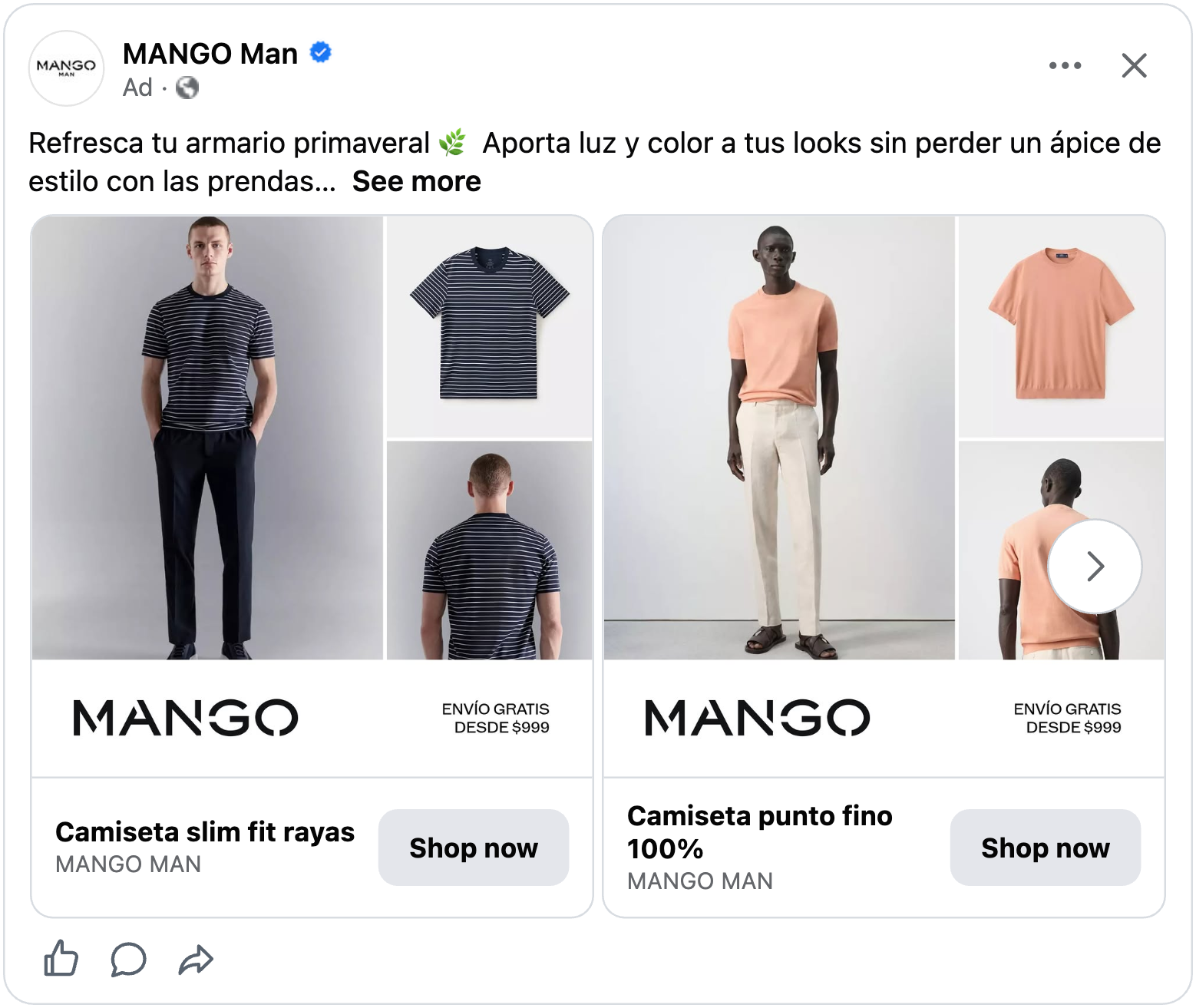
Category is the efficiency filter. The best cost per purchase of any filter that clears the reliability bar at 25.4% better, with conversion rate +11.0% and average order value +17.2%.
Brand is the filter where everything moves at once, which is rare in this dataset: CTR +1.7%, conversion rate +6.2%, CPM 21.9% cheaper, average order value +6.6%, cost per purchase 15.0% better. It is also the filter that loops back to the highest-value design element in fashion. Filtering by brand and rendering the brand on the card are the same idea, executed in two places.
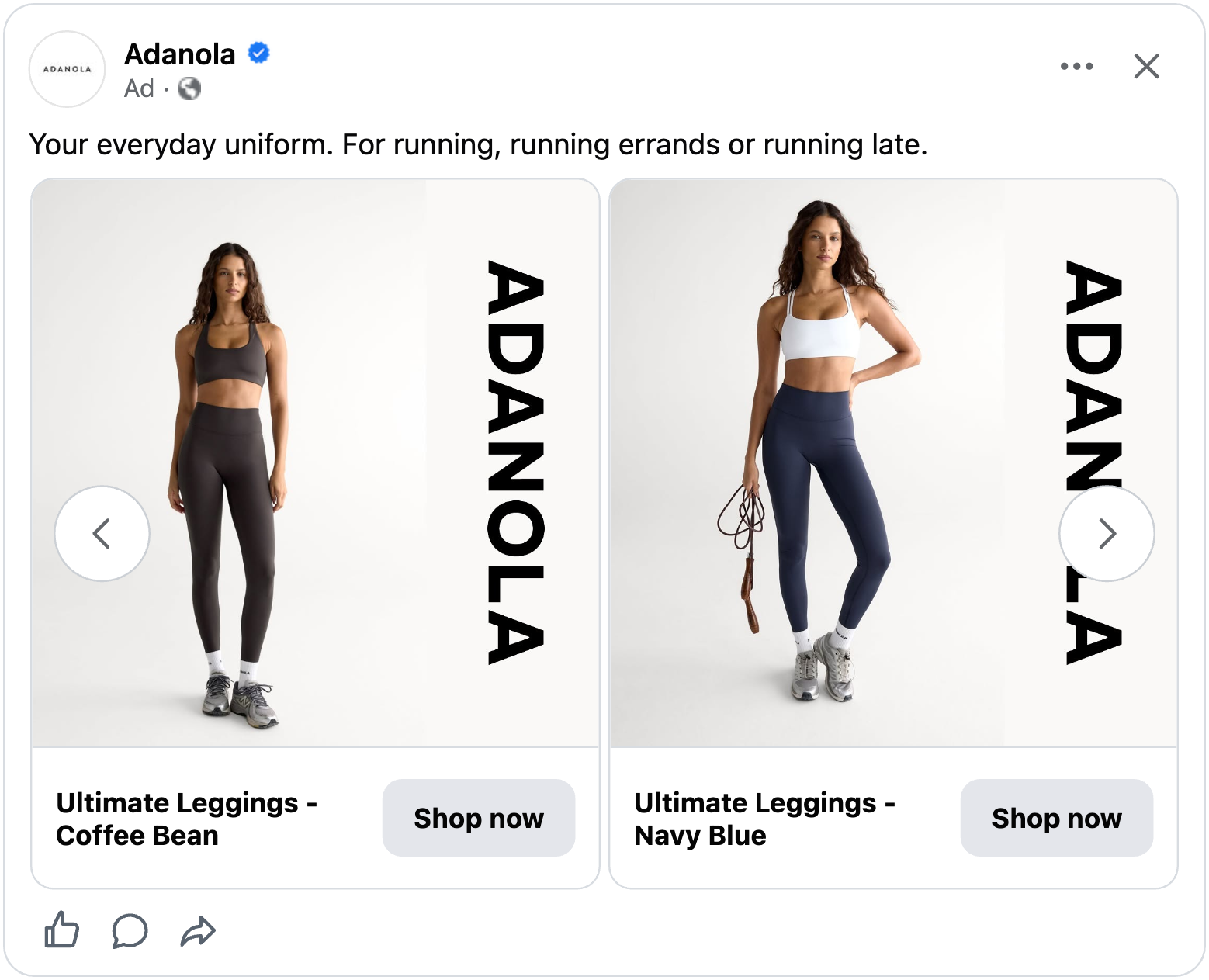
The Targeting Paradox sets the ceiling on all of this: precision raises the rate and lowers the volume, and past a certain point you have raised the rate on almost nobody. The narrower you target, the better the rate, but the less you have in your targeting pool.
How to expand? Broaden targeting, or keep adding markets - or both.
Category Entry Points explains why the winners win, because 'something for the kids' and 'something for the party' are how people actually enter a category. Social Identity Theory explains why a set built around who the shopper is outperforms a set built around what the retailer stocks.
.jpg)
Hummel and Oui Oui ran one design system across seven markets and multiple sub-brands, and returned 93% more ROAS with a 54% better cost per purchase.
7. Which is the best-performing Catalog Ad format
The three Catalog Ad formats are not three ways to do one job. They are three different jobs, and most fashion advertisers judge all three on the same metric.
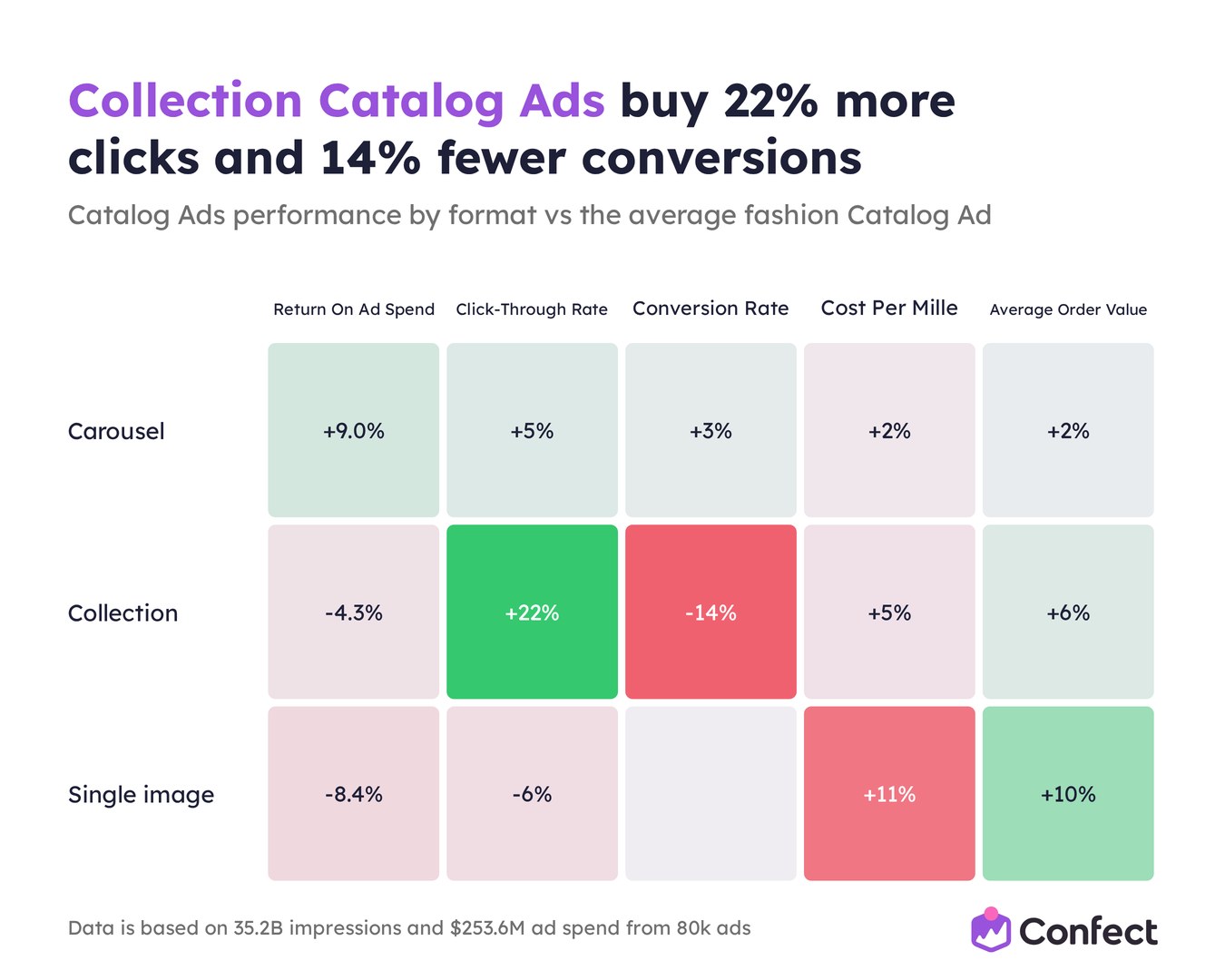
Carousel is the all-rounder and the safe default: if you run one format, run this one. Collection is a browsing format, so buy it for traffic and discovery and stop judging it on ROAS. Single image buys attention badly, costs the most to deliver, and sells more per order at AOV +10.3%.
Single image loses the auction for a reason worth understanding, because it also explains why the other two win it. One product means one thing to look at and less to engage with.
Carousel and collection give people something to do, and Meta charges less to deliver ads that people interact with. That is Auction Dynamics and Relevance Score doing its work, and it is the one place in this piece where the platform, not the shopper, is setting the price.
The ranking reverses by price tier
Never give a format answer without asking what the brand charges.
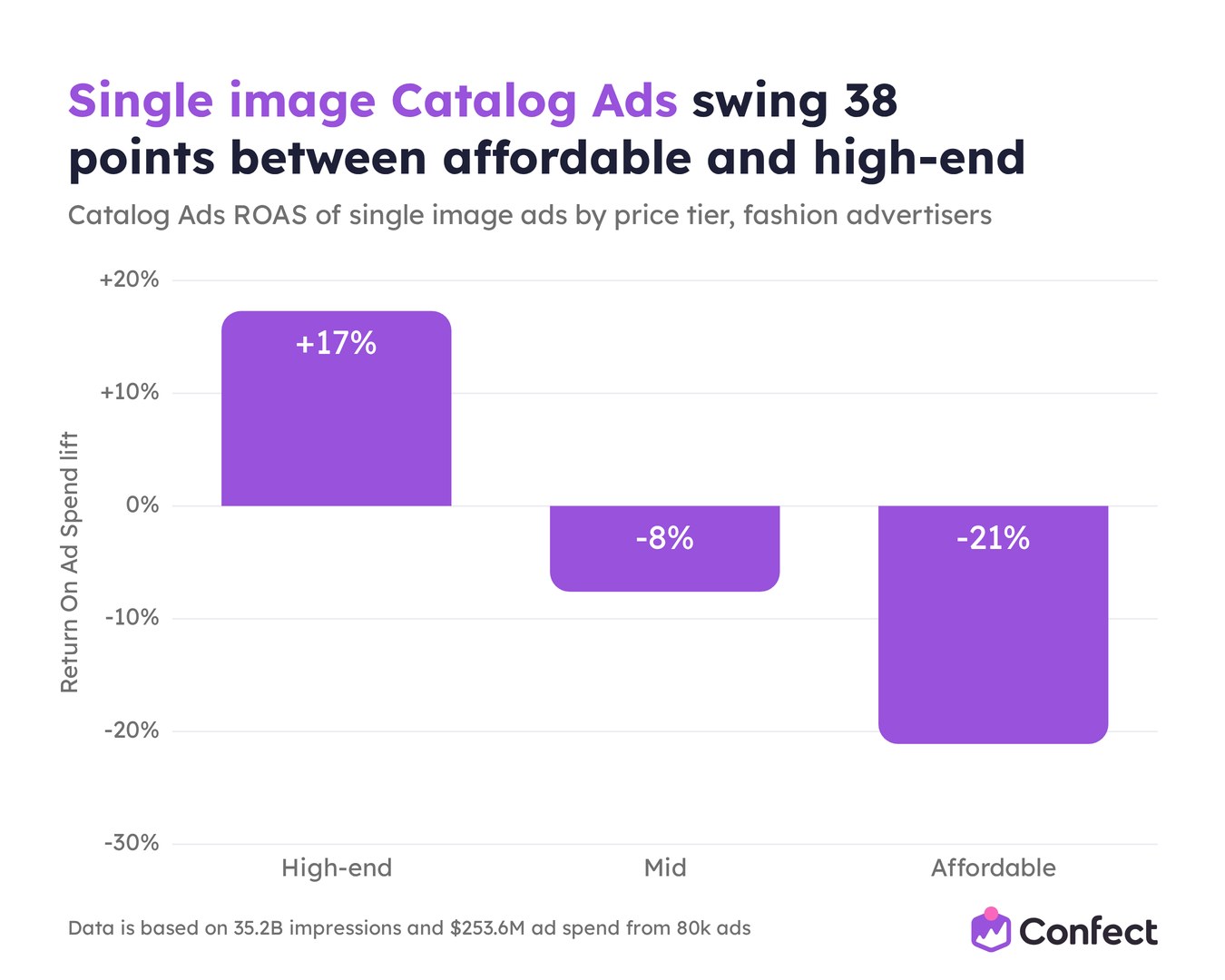
Every tier gets a different answer, and the single image spread is the widest figure in this piece: +17.3% for high-end against -21.1% for affordable. Affordable brands also get an 18.5% better cost per purchase from carousel.
The reading is the price tier argument from section four, applied to layout. A high-end brand can afford to give one garment the whole frame, because the garment is the argument.
An affordable brand cannot, because its argument is range and price, and one product at a time makes both invisible. Message-Medium Fit is the formal version of that. The Serial Position Effect is the practical one: in a carousel, the hero product goes first and the best offer goes last, because those are the two cards anyone remembers. The Gruen Transfer explains what a collection ad is actually for, and the Diderot Effect explains why complete-the-look works inside it.
-1.png)
Urban Outfitters and Nest Commerce designed one Catalog Ad for three ratios rather than cropping one into three, and returned 50% more ROAS.
8. Let the product be the ad
In fashion the product image is the message. In every other industry it is one input among several.
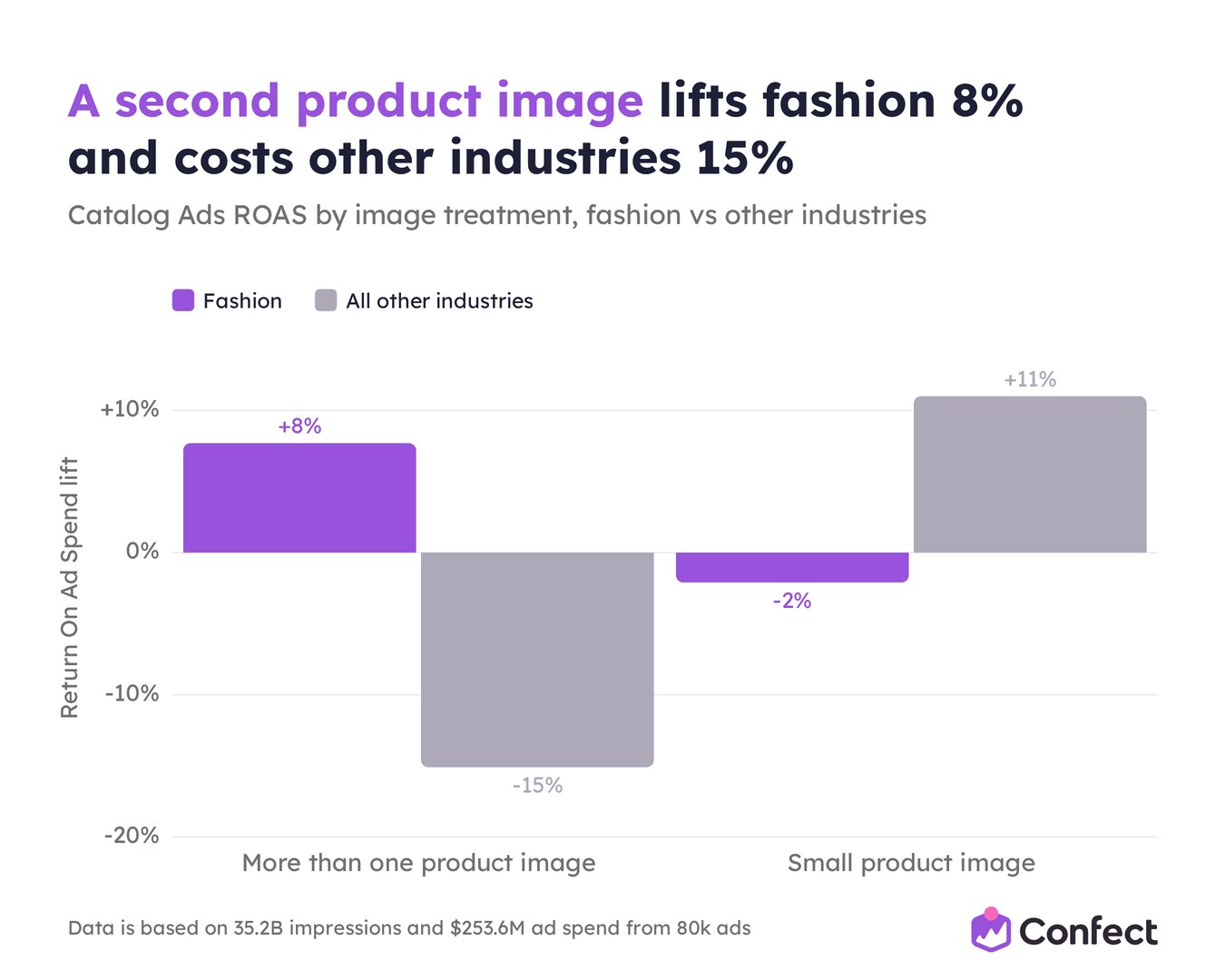
A garment is not described by its attributes. A shopper cannot judge a coat from its name, brand and price the way they can judge a monitor from its resolution, size and refresh rate. Non-fashion brands shrink the product to make room for specifications and it works, at +11.0% for a small product image. Fashion brands that shrink the product remove the only thing being evaluated.
A second angle answers the question a specification sheet answers everywhere else. What does the back look like. What is the texture. How does it sit on a body.
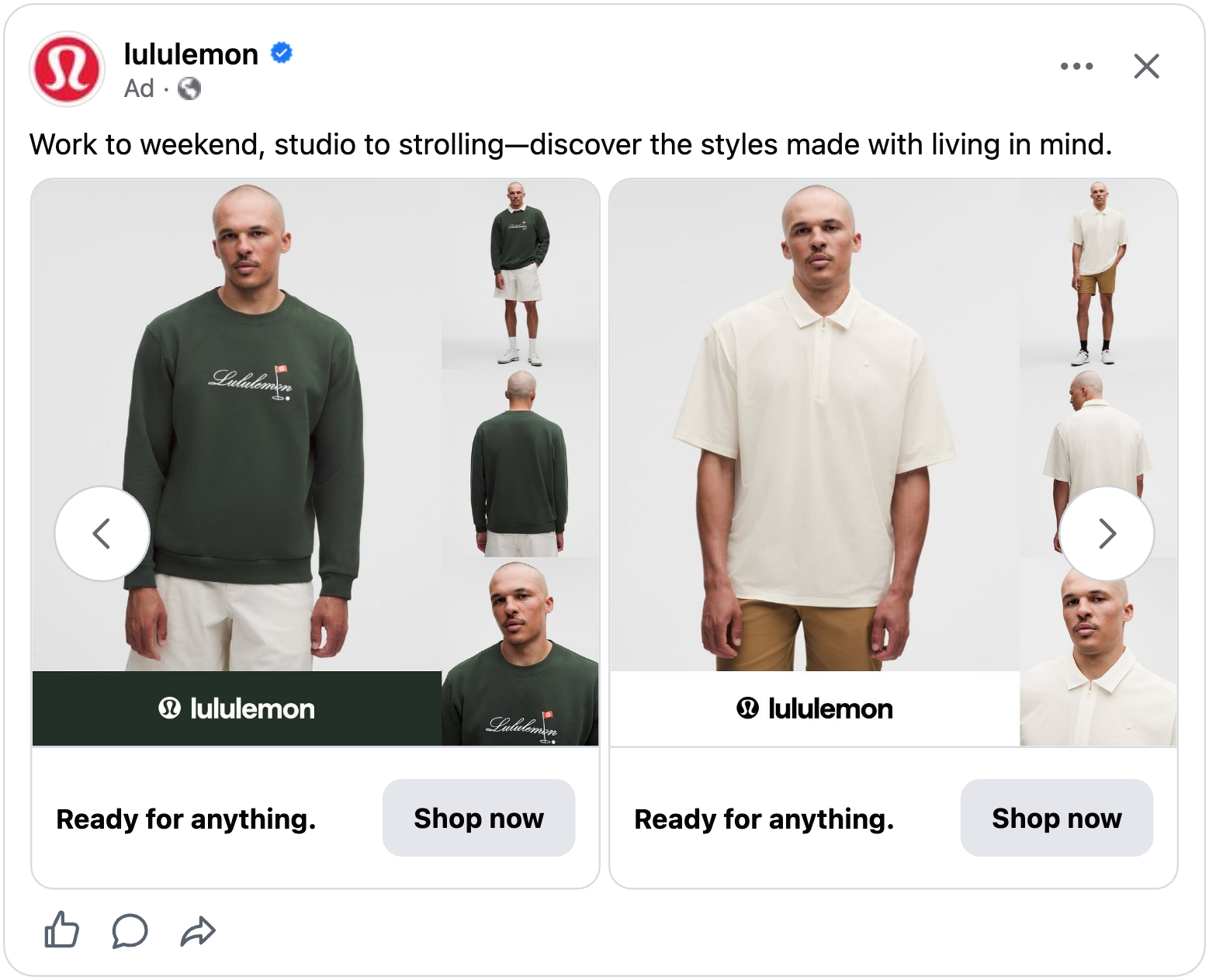
Note the shape of the numbers, because it puts this element firmly in one of the two camps from section two. Multiple images lose 3.2% of clicks while raising conversion rate 8.5% and order value 6.2%. That is a qualifier, not an attractor. Use it deeper in the funnel.
The funnel data confirms that rather than leaving it as an assertion. Additional images return +12.97% ROAS in retargeting with conversion rate +13.96%, against +7.78% in prospecting. The second angle earns its keep once someone is already considering the garment.
Figure-Ground is the whole argument in one idea: something has to be the subject and everything else is the field it sits on. Information Density explains why adding a true fact can still make an ad worse. The Absent Signifier explains why a clean product shot with no context reads as versatile rather than empty. And Perceived Risk Theory comes back one last time, this time the performance half, answered visually instead of verbally.
.png)
Bravissimo and Bonded Agency answered the fit question inside the ad, with a close-up and a model shot in the same frame, and returned 45% more ROAS.
9. Product Assets, the element most fashion advertisers have never heard of
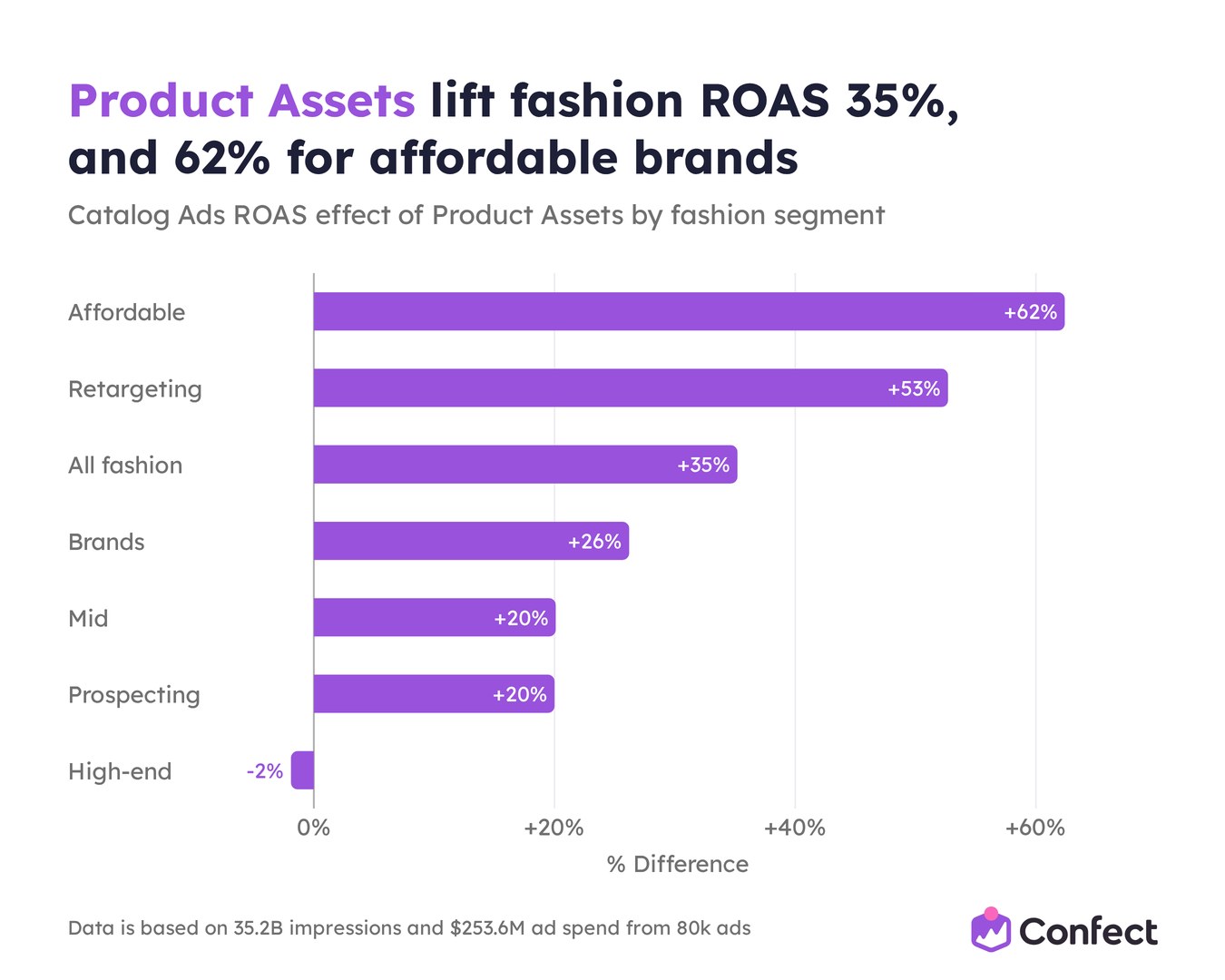
It is the third strongest design element in fashion, and it is the only one on the list that most fashion advertisers cannot name.
What a Product Asset actually is
A Product Asset is an image layer in the design that swaps itself based on one field in your data source. You upload one image per possible value of that field, and at render time each product pulls the image that matches it.
A garment tagged with a brand gets that brand's logo. A product in the organic cotton line gets the organic mark. If a product has no value for that field, the layer does not appear at all, so you can badge only the products that qualify.
The four fashion use cases worth building
- Brand logos for multi-brand retailers. The strongest one, and it closes a loop this piece opened in section two. The brand of the product is the highest-value element in fashion at +45.5%, and for a retailer carrying thousands of products across dozens of labels, a Product Asset keyed to the brand field is the only practical way to render it. The finding and the mechanism are the same sentence.
- Colour and material variants. Fashion is the colour-variant category, which makes this the obvious use case and also the one that gets out of hand fastest. Across thousands of products, keying on colour means building thousands of images. Key on a coarser field instead, such as category, and get most of the effect for a fraction of the work.
- Certification and material marks. Organic cotton, recycled content, responsible wool. A visual mark carries a claim that would otherwise cost a line of text.
- Collection or line identity. A background or mark that changes by collection, so one design carries a whole season without anyone touching it product by product.
Why it works
It is the section one argument, one more time. An image communicates a product fact without spending a line of copy. Fashion punishes copy and rewards the garment, so a Product Asset is the only way to add information to a fashion Catalog Ad without paying the click-through rate penalty that text costs. That is exactly why conversion rate lifts 21.9% while click-through rate barely moves. It qualifies without repelling.
Dual Coding Theory and Picture Superiority explain the mechanism: images and words are processed through different channels, and images are remembered better. Trust Transfer and Third-Party Validation explain why a certification mark works harder than a sentence making the same claim. Aspirational Reference Groups explain the brand logo.
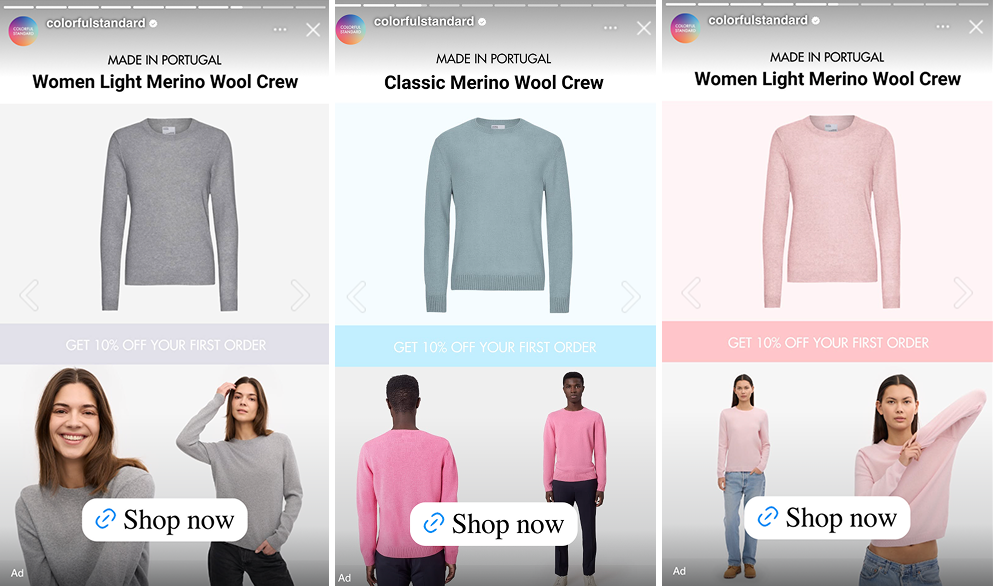
Colourful Standart let each product set the colour of the card , and returned 216% more ROAS.
10. What actually separates the best fashion advertisers
Both of the biggest findings in this dataset are about how fashion brands spend, not how they design. Neither one needs a designer.
The best fashion brands do not only buy conversions
Fashion brands that also invest in non-conversion objectives see, on their conversion Catalog Ads, ROAS +26.4% and a cost per purchase 7.9% better. Underneath that: CTR +5.3%, conversion rate +2.6%, cost per click 8.5% better, CPM 4.7% cheaper, and average order value +10%.
Non-fashion brands doing exactly the same thing see +12.5%. Fashion gets more than double the return on brand investment.
And it does not appear to matter much which objective you buy.
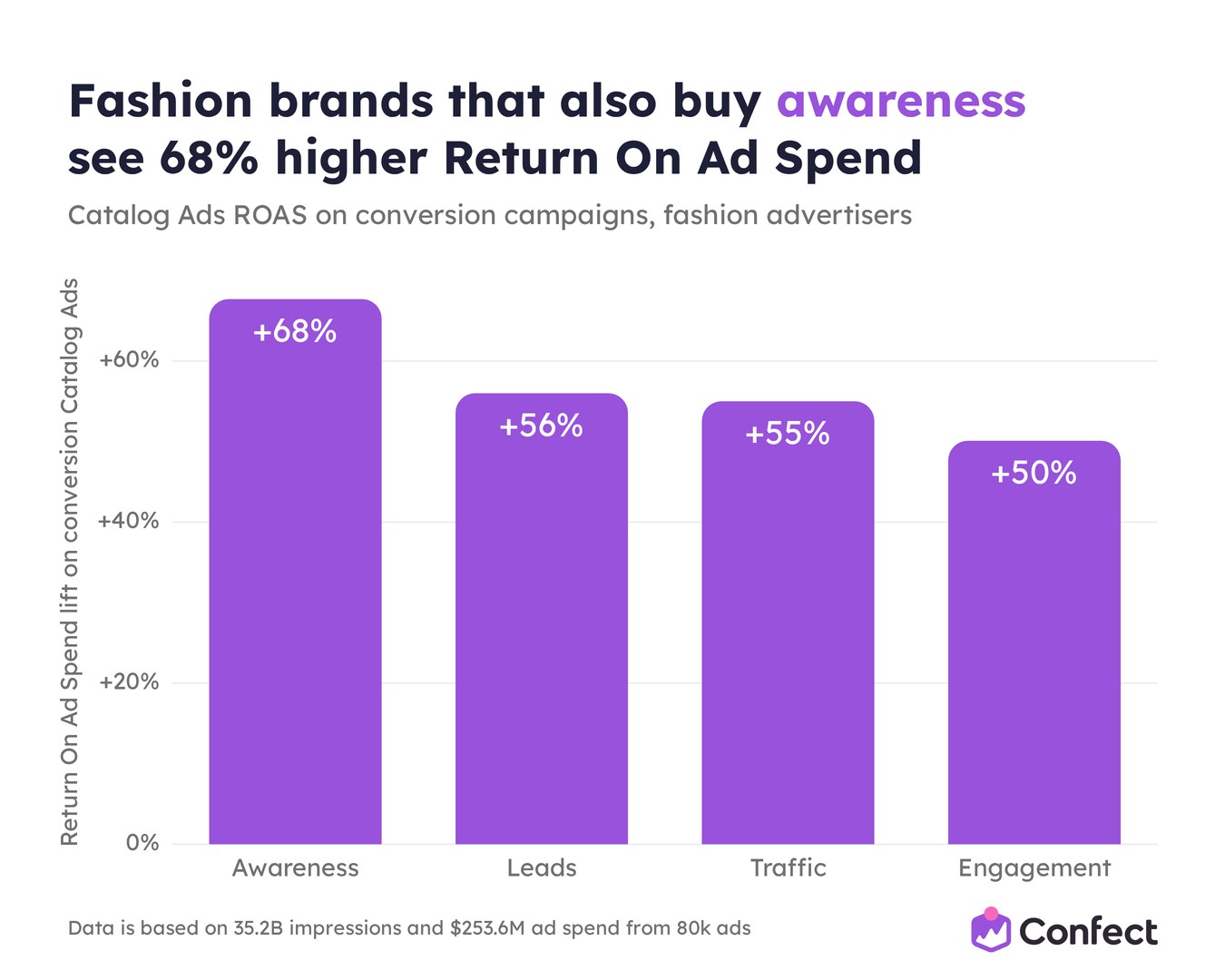
Every option on that chart pays back between 50% and 68%, and every one improves cost per purchase by 15% to 19%. The decision is not which objective. The decision is whether to buy anything other than conversions at all.
About one third of fashion advertisers do, against roughly half of non-fashion advertisers.
Which is the provocation in this whole piece, stated plainly: fashion is the most brand-driven category in retail, and fashion advertisers are the least likely to buy brand. Two thirds of them are leaving the largest single lift in this dataset on the table.
The Long and Short of It is the reference point here, and its 60/40 split is the number most fashion brands have inverted. Mental Availability and Category Entry Points explain what the other 60 is actually buying. Share of Voice vs Share of Market explains why it compounds. The Halo Effect Across Channels explains why it shows up on the conversion campaigns rather than in its own reporting line.
It also explains why fashion under-invests, and the diagnosis matters more than the scolding. Last-click attribution systematically undervalues everything at the top, and fashion's short consideration window makes pure performance marketing look self-sufficient. The awareness campaign never gets credit for the conversion Catalog Ad that closed 68% better because it ran.
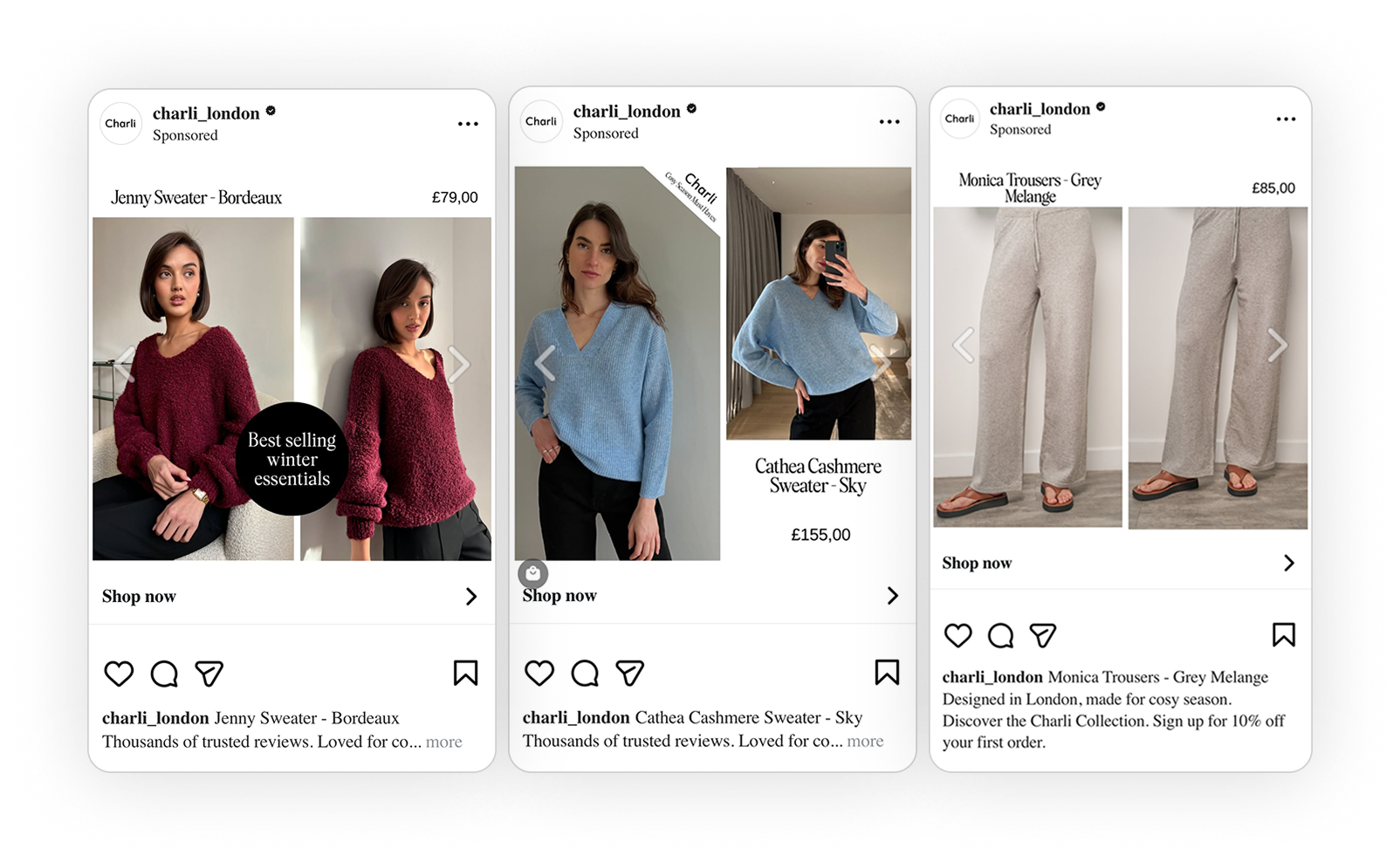
Charli and Prospa ran four full-funnel tactics at once and lifted new customer purchases 313%.
The best fashion brands put most of their Meta budget into Catalog Ads
The math is mathing, the more you spend on Catalog Ads, the better your ROAS
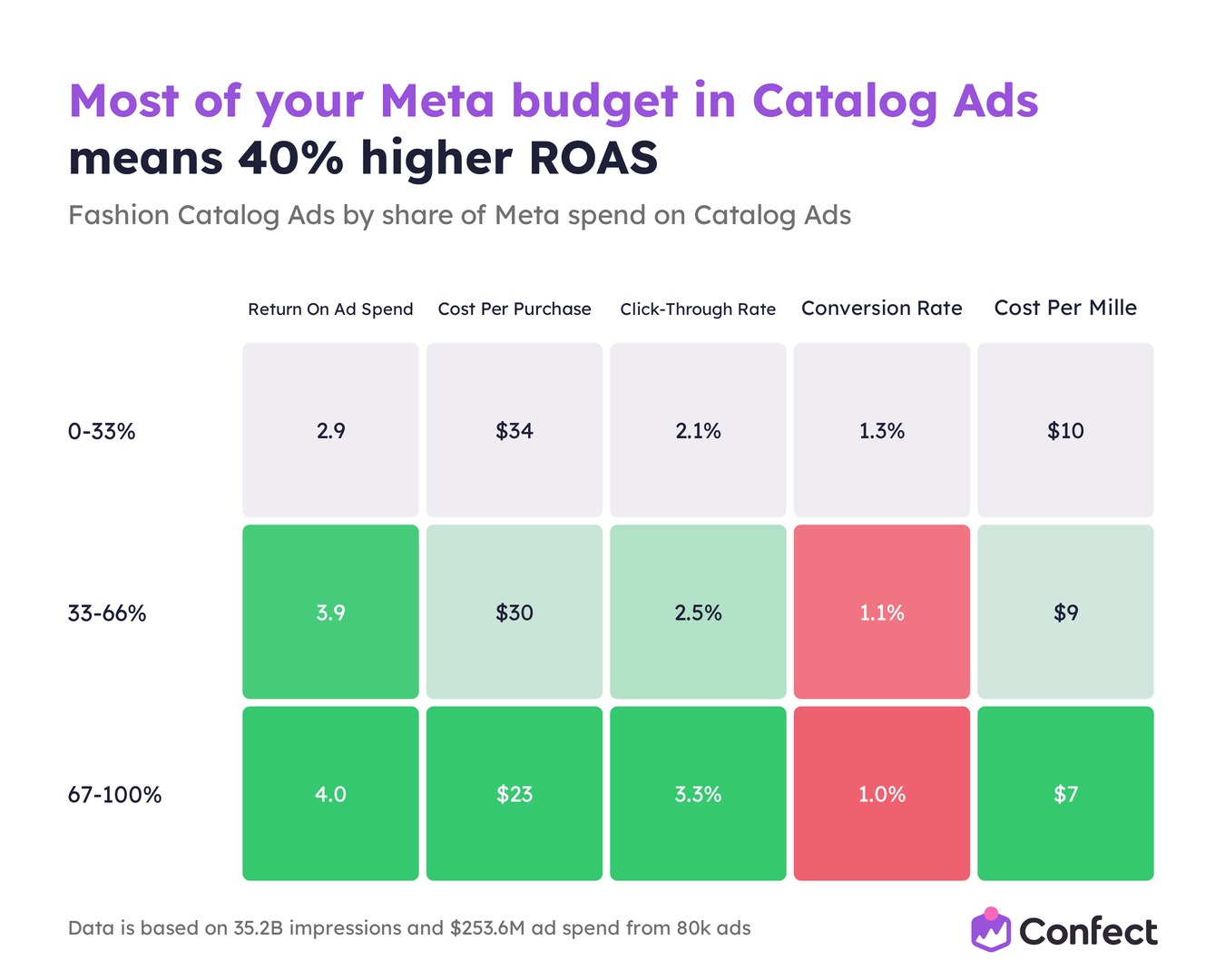
A 40% higher ROAS and a 33% lower cost per purchase between the least committed fashion advertisers and the most. The gain shows up in CTR and CPM, which makes this a delivery story rather than a landing page story.
The conversion rate column is the tell. It is the only metric that moves the wrong way, and it moves the wrong way consistently: 1.33%, then 1.06%, then 1.03%. A 22.6% decline from the least committed to the most.
That is exactly what you would predict from how Meta's ranking systems now work. One Catalog Ad design produces hundreds of product-specific variations, the ranking systems get far more to choose from, and they push further into colder audiences. Colder traffic converts at a lower rate. You win anyway, and by a wide margin, because you are buying so much more of that traffic so much more cheaply.
Signal Density, Creative Diversification, the Explore-Exploit Trade-Off and Creative Is the New Targeting all describe the same machine from different angles. The full version of that argument is in Meta Andromeda
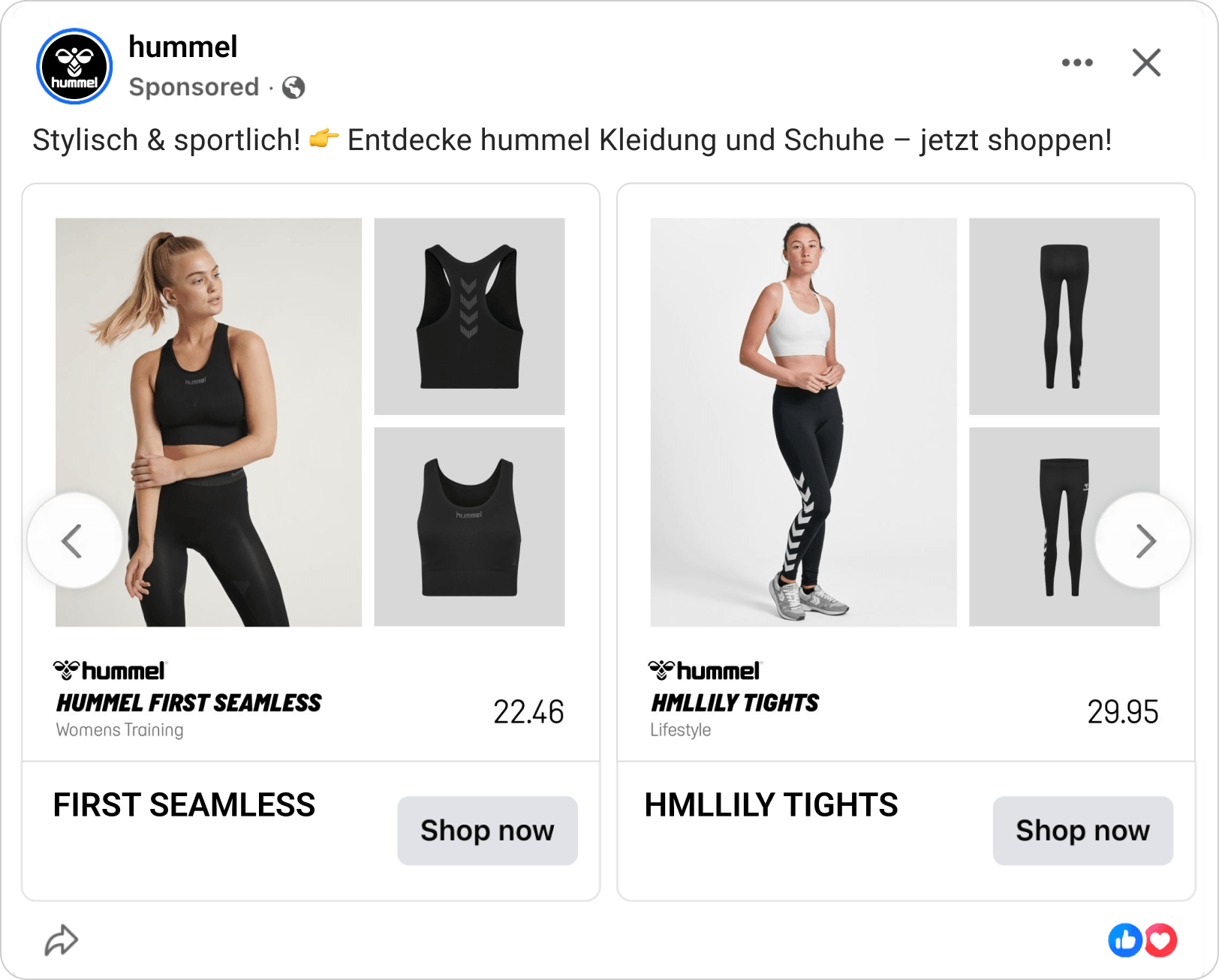
Hummel and Oui Oui scaled ad spend 97% and still improved ROAS 93% with a 54% better cost per purchase, which is what buying more of a cheaper impression looks like.
Fashion Catalog Ads, One question, asked of every design
There is no checklist at the end of this. Fashion does not reduce to twelve lines, and a piece that ends by pretending it does argues against everything above it.
What it does reduce to is one question, and it works on elements nobody has measured yet, including whatever you are about to invent.
Does this help someone decide whether the garment is right for them?
A second angle does. A bestseller label does. A new arrivals frame does. The brand on the garment does. A seasonal reason the price changed does. A shipping badge does not, a returns policy does not, and a shop rating does not, however true they are and however hard they work everywhere else in retail.
Every other industry sells reassurance about the transaction. Fashion sells reassurance about the choice.