
How Maison MRKT increased ROAS by 76% for Jennifer Behr with Confect
April 21, 2026

Jennifer Behr is one of those brands you recognize instantly. Founded in 2005 by sculptor-turned-designer Jennifer Behr, the brand has become New York's foremost luxury hair accessories and jewelry atelier. Every piece - from crystal combs and pearl headbands to statement earrings - is handcrafted in their Brooklyn studio, with Swarovski crystals individually prong-set by hand.
The brand's celebrity roster speaks for itself: Sydney Sweeney wore a custom veil to the Met Gala, Taylor Swift and Beyonce have both been spotted in their pieces, and the brand gained mainstream fame when Blair Waldorf wore Jennifer Behr headpieces on Gossip Girl. The pieces retail at Bergdorf Goodman, Net-a-Porter, Saks Fifth Avenue, and Neiman Marcus.
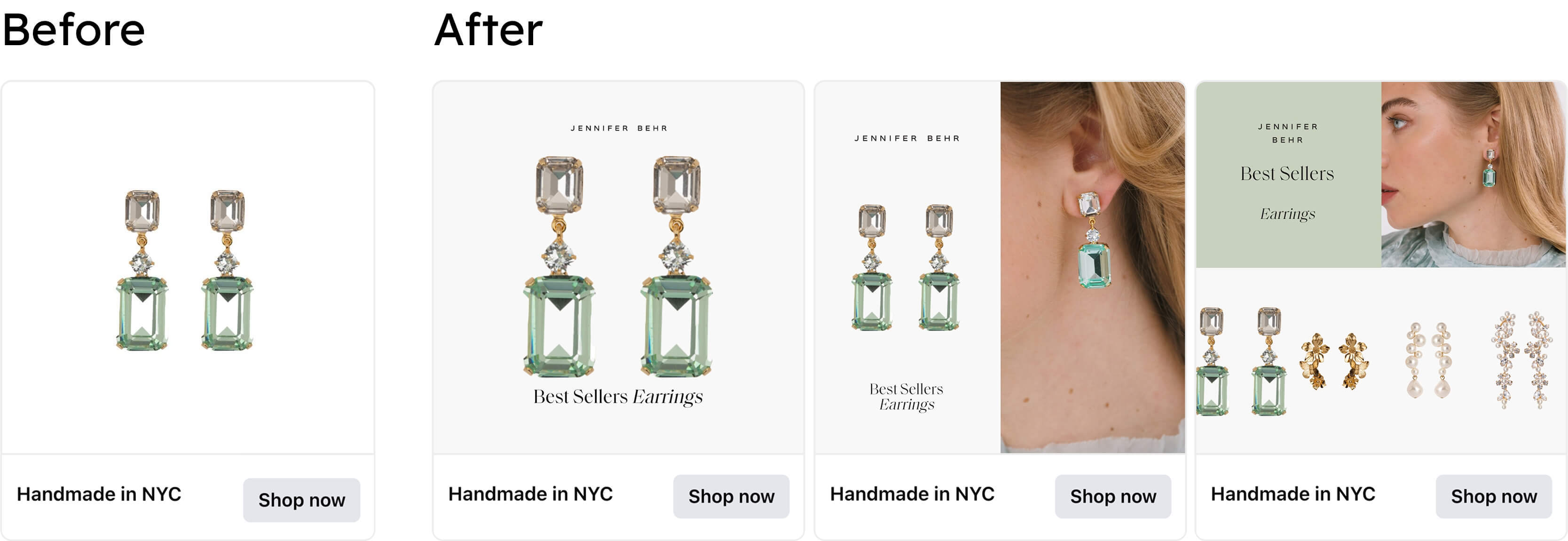
Before Confect, Jennifer Behr's Catalog Ads looked like every other brand's: bare product images on white backgrounds. For luxury hair accessories and jewelry, that's a problem. A crystal comb sitting alone on white looks like a craft supply. It doesn't communicate the $300 price point, the handcrafted quality, or the editorial elegance that defines the brand.
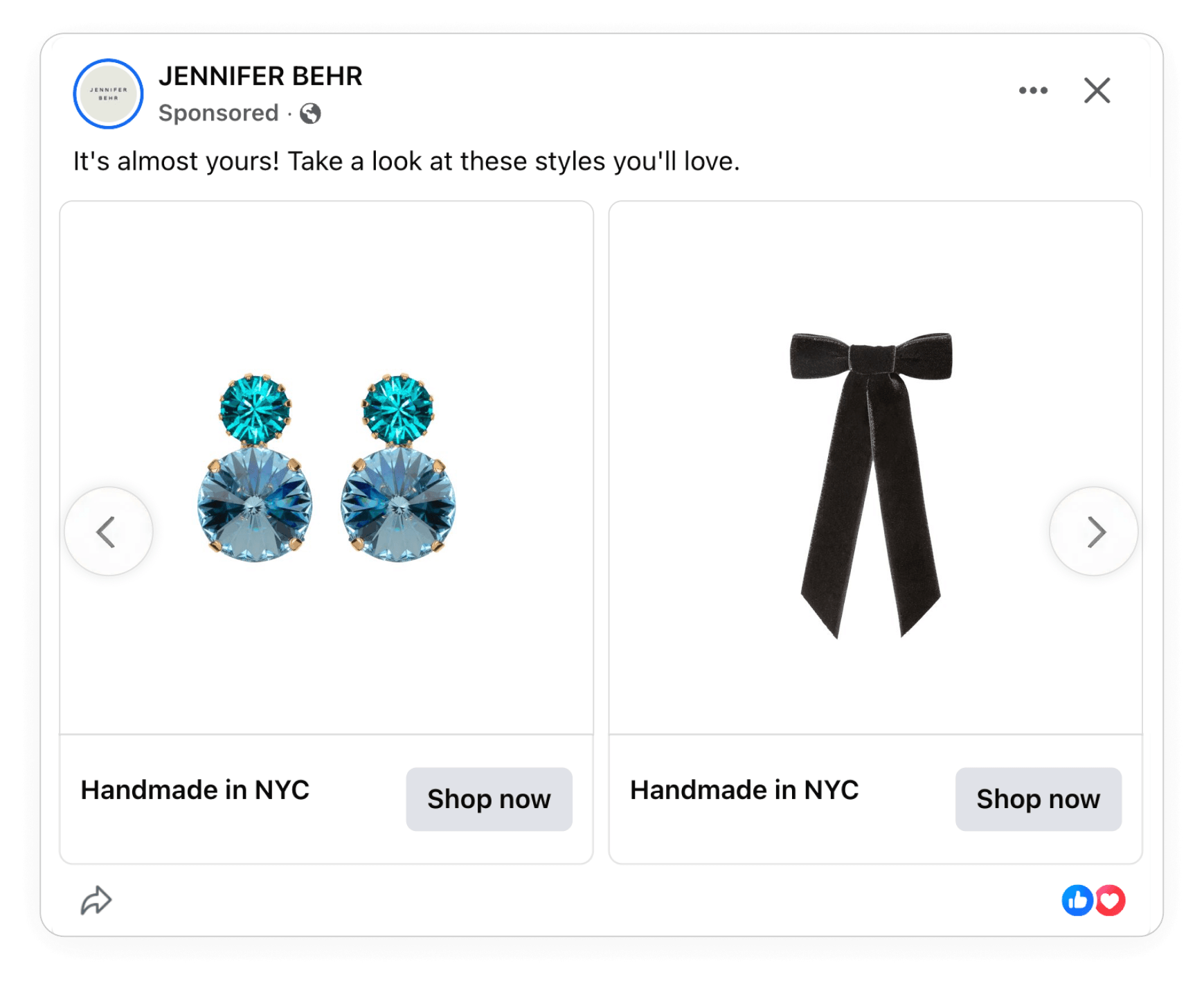
Maison MRKT, the agency managing Jennifer Behr's advertising, saw an opportunity to completely transform how the brand shows up in Catalog Ads. They designed a system of branded, editorial-grade Catalog Ads that look like they belong in a magazine rather than a Facebook feed.
We spoke with Amanda Johnson, Vice President of Digital Marketing at Maison MRKT, about the tactics they used to transform Jennifer Behr's Catalog Ads.
Their results using Confect for their Catalog Ads
Maison MRKT and Jennifer Behr saw better performance coming from both their new audiences, their engaged audiences, and their existing customers.
Amanda shared 4 important tactics they implemented via Confect that helped them achieve these results.
Turning Catalog Ads into luxury editorial, not just product listings
Here's the challenge with advertising luxury accessories through Catalog Ads. A pair of crystal drop earrings, photographed on a white background, looks exactly the same whether it costs $30 or $3,000. The product image alone doesn't communicate the craftsmanship, the brand heritage, or the "handmade in Brooklyn" story that justifies the price.
And that's what Jennifer Behr's Catalog Ads were doing before Confect. Plain packshots. White backgrounds. No brand, no context, no luxury signal whatsoever. For a brand sold at Bergdorf Goodman and worn by Sydney Sweeney at the Met Gala, that's a huge disconnect.
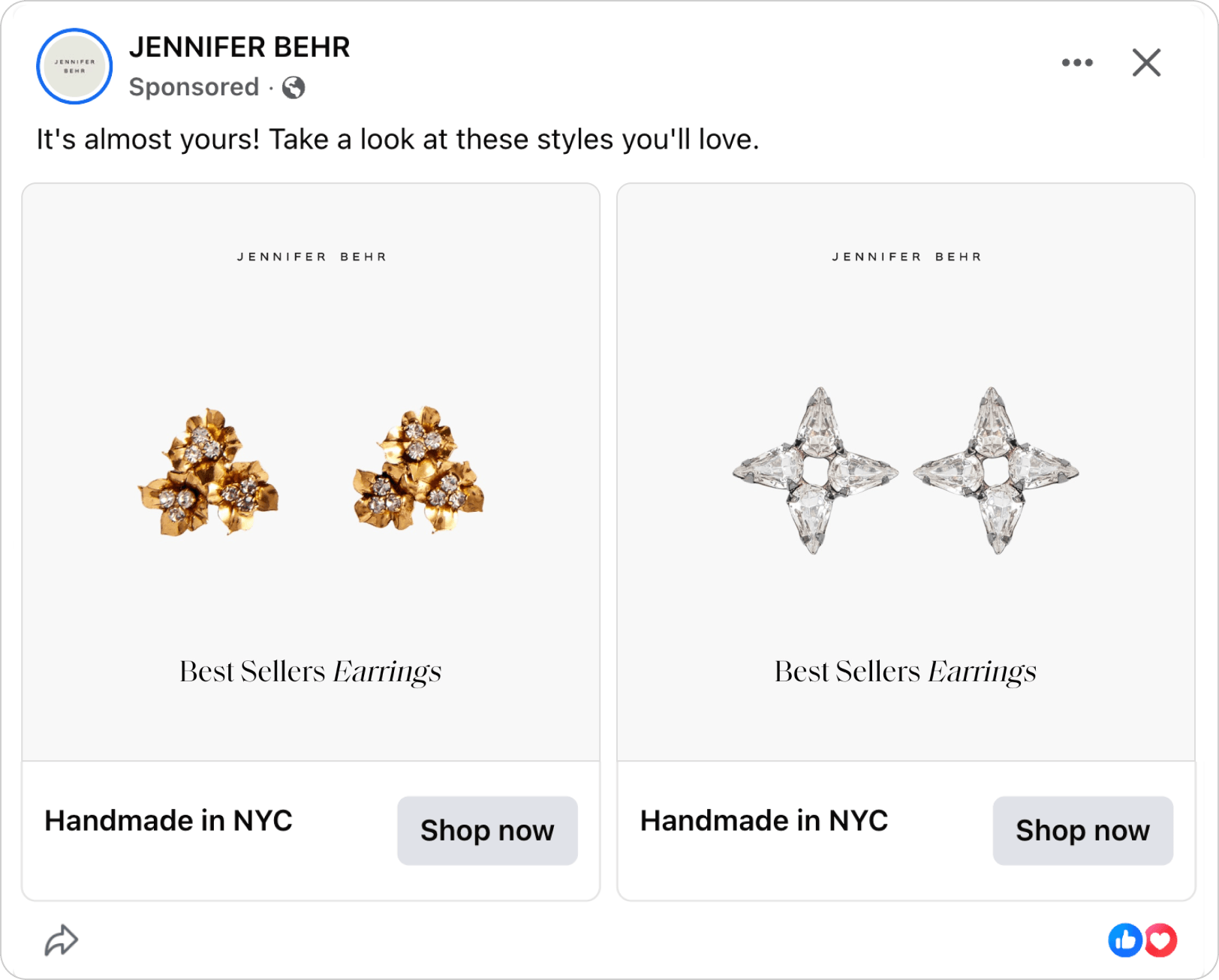
Maison MRKT's first move was to bring the Jennifer Behr brand world into every Catalog Ad. They built a design system using the brand's own color palette, clean serif typography, and generous white space. The Jennifer Behr logo anchors the top of every card. The "Handmade in NYC" tagline appears in the link description of every carousel card.
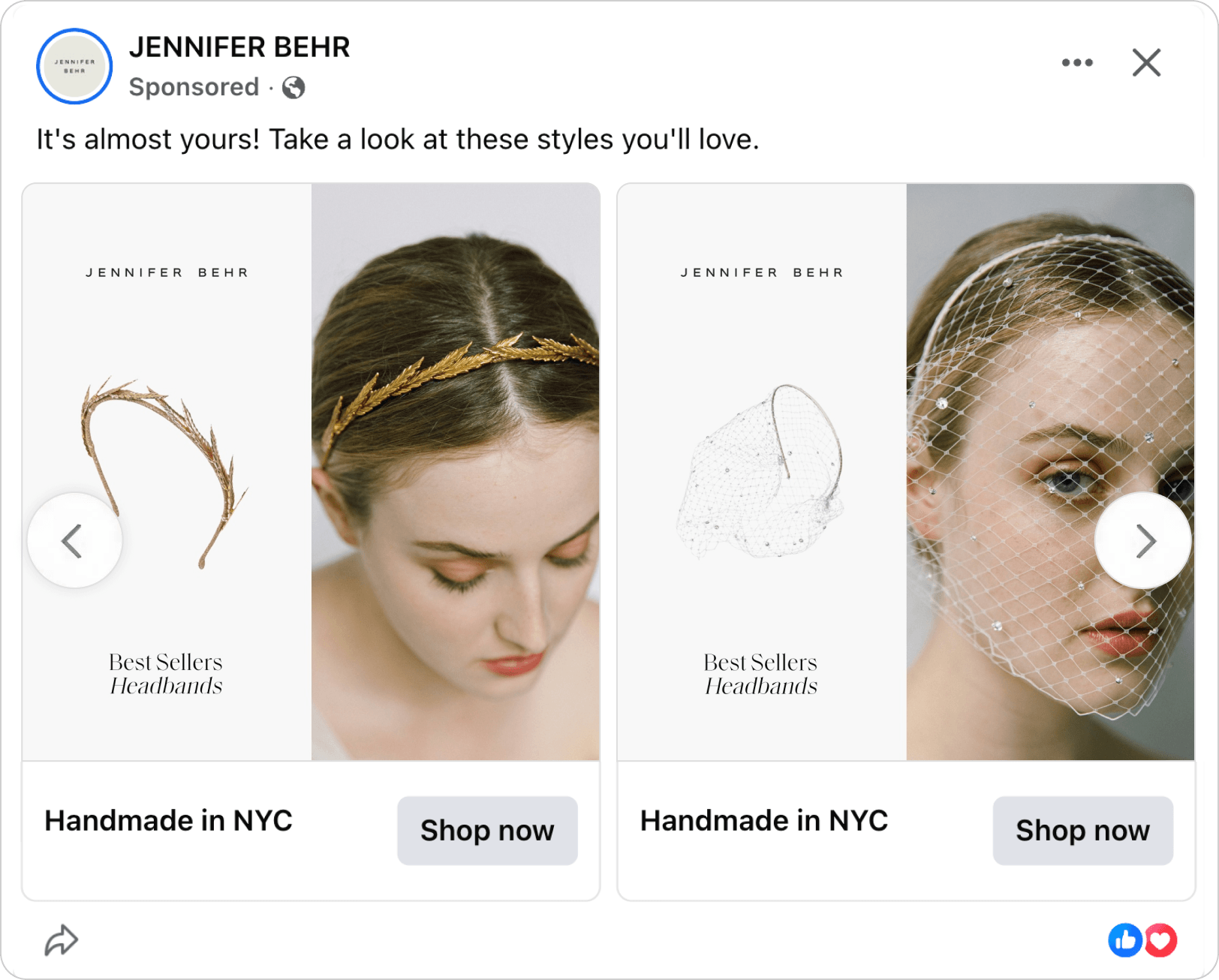
But the real transformation was adding lifestyle imagery. In one of their design variants, every product card splits into two halves: the packshot on the left, and a close-up photo of the product being worn on the right. A crystal comb tucked into a low bun. A gold leaf headband across a model's forehead. A voilette framing a face.
This matters more for accessories than almost any other product category. When someone sees a crystal comb on a white background, they have no idea how big it is, how it sits in their hair, or how it catches light on a real person. The lifestyle image answers all of those questions in a fraction of a second.
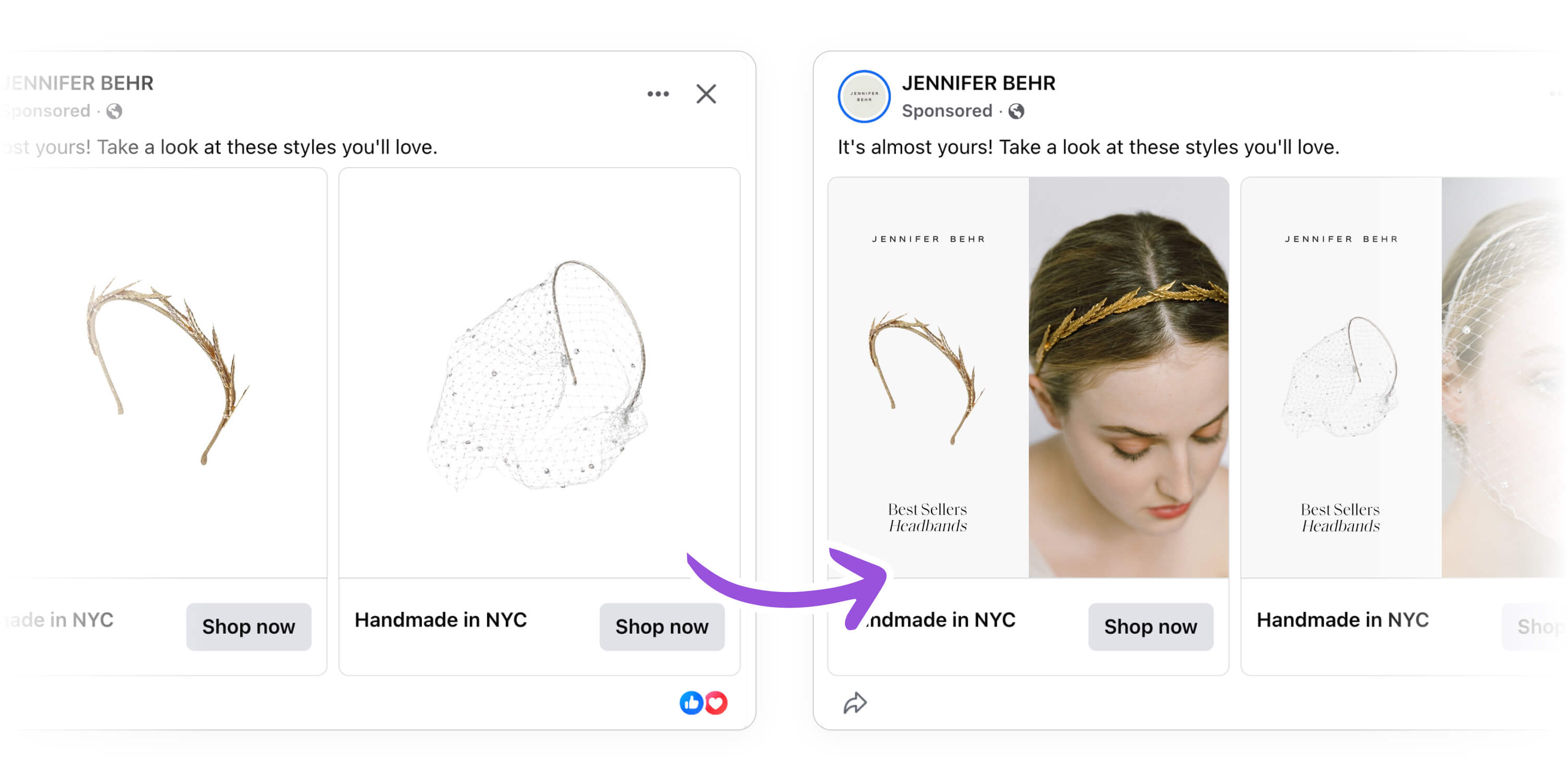
When it comes to accessories and jewelry, showing the product on a person isn't a nice-to-have - it's the difference between a shopper understanding the product and scrolling past it.
The design choices also respect a critical principle for luxury brands: no prices, no discounts, no sale badges. Maison MRKT made a strategic choice to keep the focus on brand and product. No red starburst, no "20% OFF" - just beautiful product, beautiful model, and the brand name. The ads feel premium because they deliberately omit the elements that signal "discount."
 Amanda Johnson
VP of Digital Marketing at Maison MRKT
Amanda Johnson
VP of Digital Marketing at Maison MRKT
"Best Sellers" labeling as automated social proof
Every Catalog Ad card in Jennifer Behr's campaigns carries a specific label: "Best Sellers" followed by the product category. Best Sellers *Combs*. Best Sellers *Headbands*. Best Sellers *Bobby Pins*. Best Sellers *Earrings*.
This is a small detail that does enormous work, and it's powered by Confect's design rules. Amanda and her team set up rules that automatically apply the "Best Sellers" label and the correct category name to qualifying products. No manual tagging for every product. The rules handle it.
But why does labeling something as a "Best Seller" matter so much?
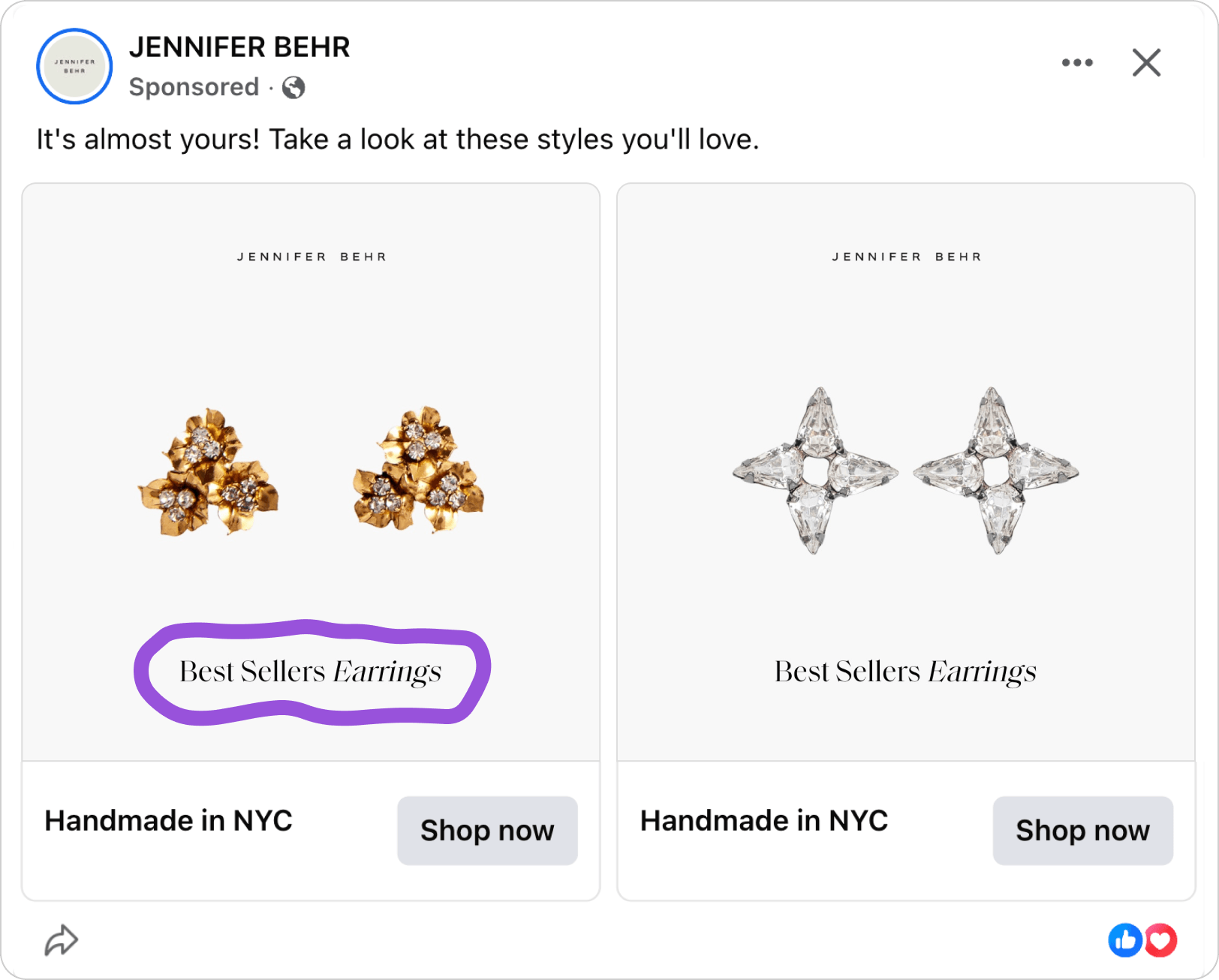
Think about it from the customer's perspective. You're scrolling through your feed and you see a pair of crystal drop earrings for $348. You like how they look. But $348 is a lot to spend on earrings. You hesitate.
Now imagine those same earrings labeled "Best Sellers Earrings." Suddenly, you're not the only one who thinks they're beautiful. Other people - a lot of other people - already bought them. The purchase feels less risky.
This is the bandwagon effect in action. It was the great Robert Cialdini who identified social proof as one of the six fundamental principles of persuasion. When we're uncertain about a decision, we look to what others have done. And with a $348 pair of earrings, there's plenty of uncertainty.
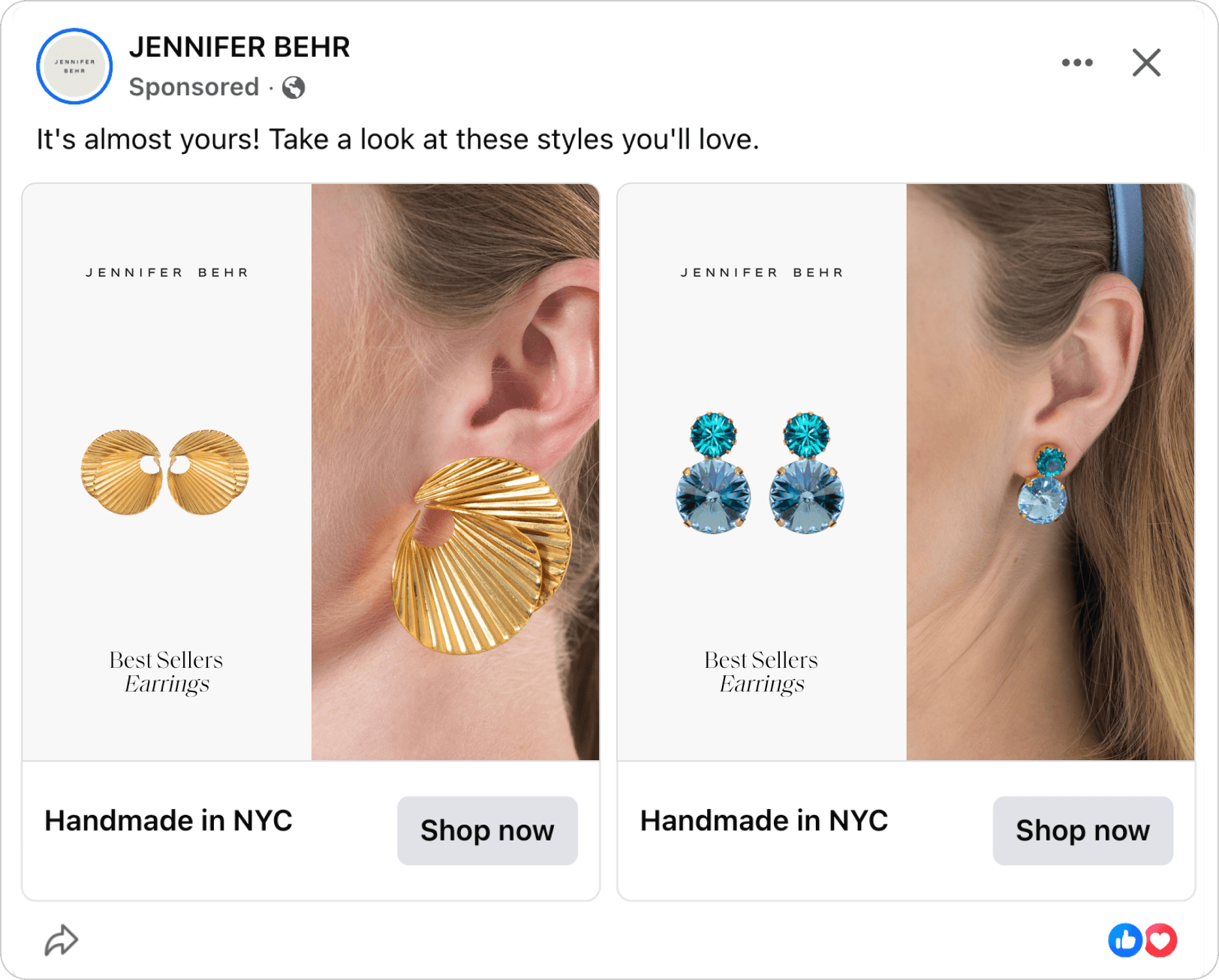
The impact shows in the numbers. The Engaged Audience - people who already knew Jennifer Behr but hadn't purchased yet - saw the largest performance lift of any segment. ROAS jumped 76%, CPA dropped 53%. These are people who were already interested. The "Best Sellers" label gave them the final push: "Other people already bought these. You're making the right choice."
It's worth noting that showing social proof in Catalog Ads is one of the most consistently effective tactics across Confect's data. But Maison MRKT's approach is particularly smart because it combines social proof with category organization - which brings us to Use Case #3.
Amanda Johnson
VP of Digital Marketing at Maison MRKT
Category grouping to let Meta's algorithm hyper-optimize delivery
Maison MRKT didn't just label products as "Best Sellers." They organized them by product category - and that matters for a reason that's less about the consumer and more about the algorithm.
Jennifer Behr sells 500+ products across 16 categories. Combs, headbands, bobby pins, earrings, voilettes, bracelets, necklaces, tiaras - the catalog is deep. Without any organization, Meta's algorithm has to figure out which of those 500 products to show each person. That's a lot of guesswork.
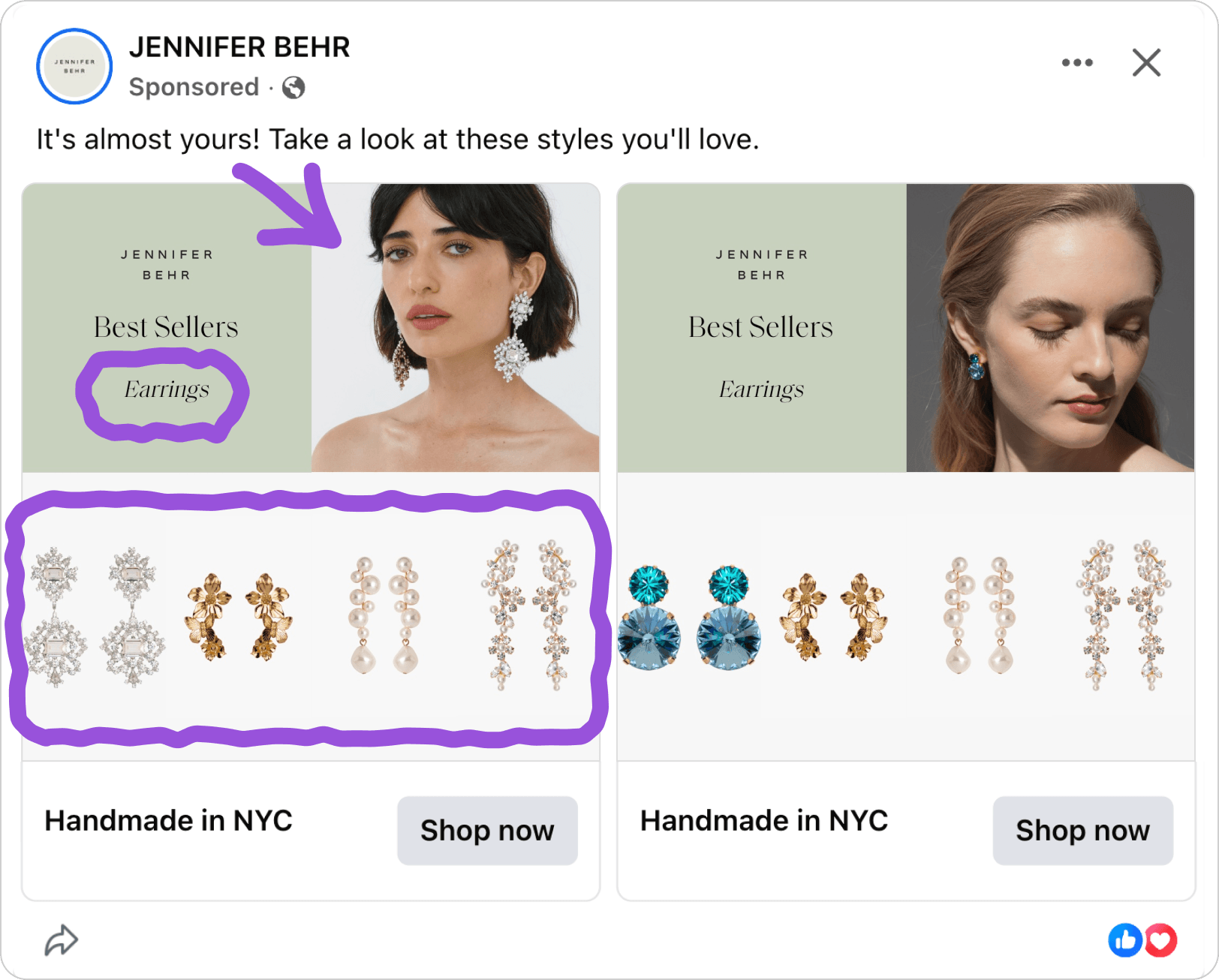
By grouping products into specific categories within the Catalog Ad designs, Amanda and her team gave the algorithm a much cleaner signal to work with. When someone engages with a "Earrings" card, Meta now knows this person is interested in earrings specifically - not just "Jennifer Behr stuff." The algorithm can then hyper-optimize delivery, showing earring-focused ads to earring-interested people, headband-focused ads to headband-interested people, and so on.
.jpeg) Sloan Baker
Creative Strategy at Maison MRKT
Sloan Baker
Creative Strategy at Maison MRKT
This is especially powerful for Jennifer Behr's broad catalog. A woman shopping for bridal headpieces has very different intent than someone looking for everyday earrings. Category grouping lets the algorithm separate those audiences and serve each one the most relevant products.
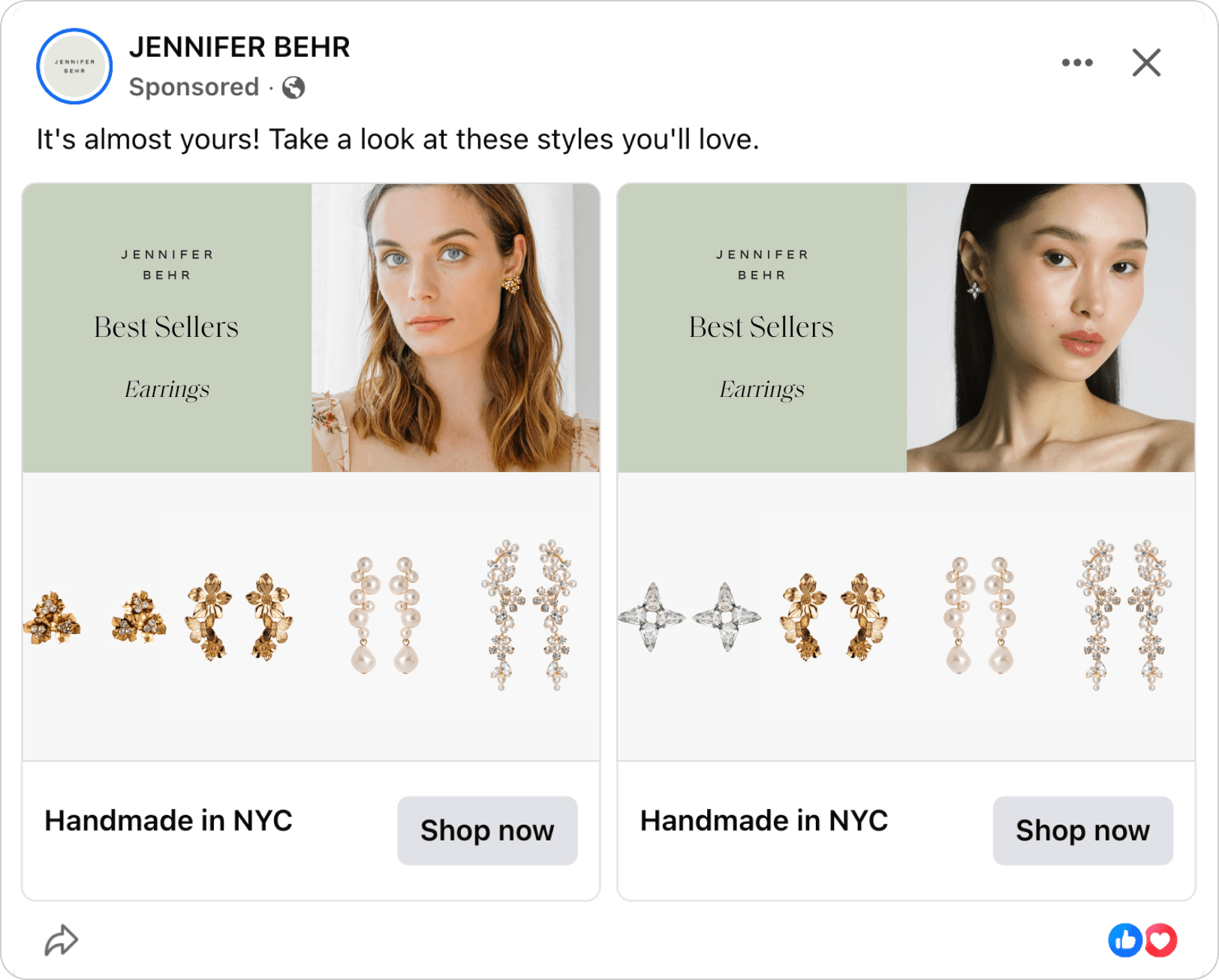
In the most advanced design variant, Maison MRKT took this a step further. Each card features one lifestyle hero image at the top, plus a row of four additional best-selling products from that category at the bottom. This turns a single Catalog Ad card into a mini category page. If the first product doesn't catch your eye, three more are right there.
The customer sees curated best sellers in their preferred category. The algorithm gets clean signals about what each person is interested in. Both sides win.
People who already knew the brand were adding products to cart at a dramatically higher rate. That's what happens when you show someone the exact category they care about, filled with products other people already bought, presented in a design that looks like it belongs at Bergdorf Goodman.
Amanda Johnson
VP of Digital Marketing at Maison MRKT
A/B testing three creative approaches with design variants
Maison MRKT didn't just pick one design and hope for the best. They built three distinct design tiers, each adding a layer of information on top of the last, and tested them simultaneously using Confect's design variants.
Tier 1 - Packshot only. Clean white background, single product image, brand logo, "Best Sellers" category label. The product does the talking. Minimal information, maximum elegance.
Tier 2 - Packshot + lifestyle. Same branded framework, but now each card splits into two halves: packshot on the left, close-up lifestyle photo on the right. Shows how the product looks when worn. More information, same elegance.
Tier 3 - Lifestyle + category bestsellers. The most information-dense version. Hero lifestyle image at top, four additional best-selling products from the same category at the bottom. Turns each card into a mini product discovery experience.
This testing approach is smart for two reasons.
First, it lets Meta's algorithm find the right match between creative and audience. Some people respond best to a clean, minimal packshot. Others need to see the product on a model before they care. Others want options and social proof before they click. By running all three simultaneously as variants, Meta can serve each person the version most likely to resonate with them.
Second, it generates insight about what matters most for luxury accessory advertising. Does the lifestyle image make the biggest difference? Or is it the row of additional products? Or is the clean packshot enough? Running all three in parallel answers these questions with real data rather than assumptions.
This ties into a broader principle that Confect sees consistently across its data: more creative variations give Meta's algorithm more room to optimize. Instead of forcing every impression through one design, you give the algorithm options. And algorithms with options consistently outperform algorithms without them.
Amanda Johnson
VP of Digital Marketing at Maison MRKT
Conclusion
What Amanda and her team at Maison MRKT built for Jennifer Behr is a masterclass in running Catalog Ads for a luxury brand without compromising a single inch on brand positioning.
Every design choice - the sage green palette, the serif typography, the lifestyle imagery, the absence of prices and discounts - protects Jennifer Behr's luxury positioning. And every performance decision - the "Best Sellers" social proof, the category organization for algorithmic optimization, the three-tier A/B testing - pushes the numbers in the right direction.
The results speak for themselves. A 76% increase in ROAS and a 53% decrease in CPA for engaged audiences. A 26% lower CPA and 65% lower CPM for new audiences. A 36% lower cost per Add to Cart across new prospects.
But what makes this case study especially relevant is what it proves for other high-end brands. Luxury brands often hesitate with Catalog Ads because the default format - plain products on white backgrounds - feels beneath their brand. It looks cheap. It looks generic. It looks nothing like their carefully art-directed website or their editorial campaigns.
Sloan Baker
Creative Strategy at Maison MRKT
Jennifer Behr's Catalog Ads prove that doesn't have to be the case. With the right design system, Catalog Ads can look indistinguishable from a hand-designed editorial layout - while running automatically across hundreds of products.
Maison MRKT showed that you can protect your brand and drive your performance at the same time. The two are not in conflict. In fact, for a luxury brand, they're the same thing.