
Vanquish Fitness & Prospa
June 18, 2026
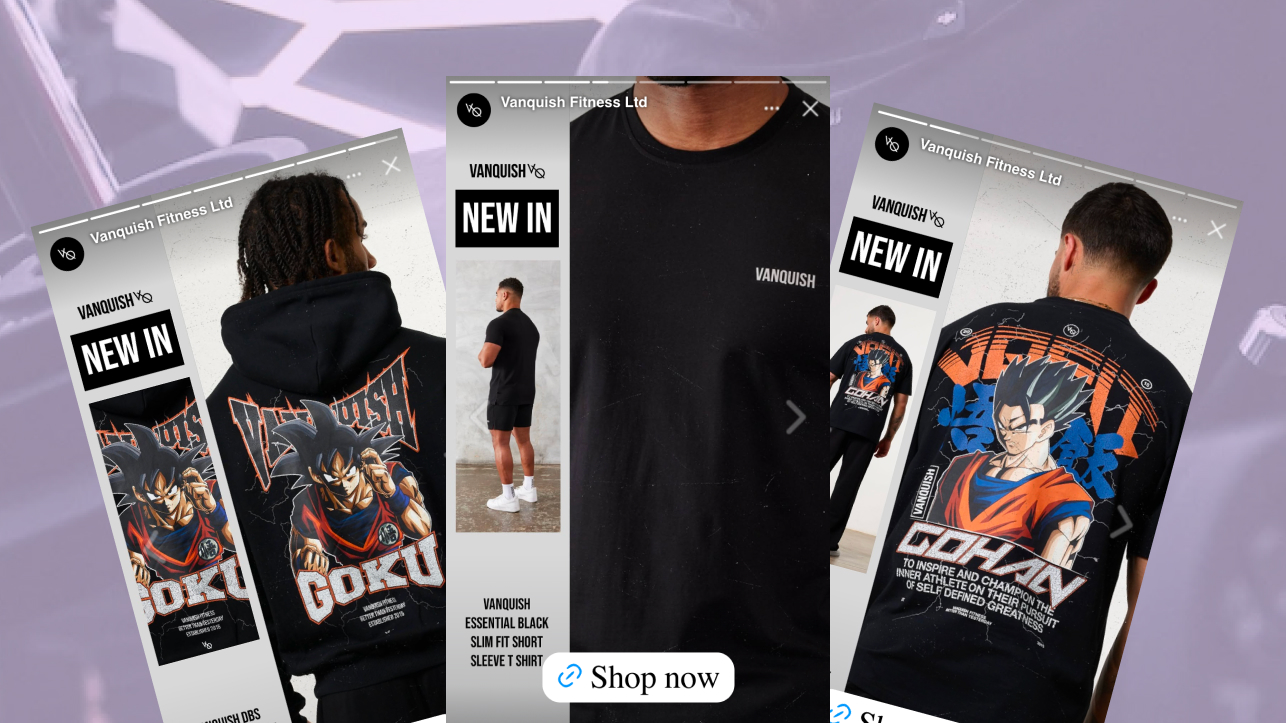
The ad: A Catalog Ad built for the drop, not the deal
There is no price. No discount. No "limited time only."
Vanquish Fitness and Prospa built their Catalog Ads entirely around one message: something new just arrived. The copy is "New styles just landed - explore the latest drops." Every card. Every product. Every format.
For a gymwear brand with a following that treats new drops the way sneaker fans treat releases, that is the right message. The Vanquish customer is not waiting for a sale. They are waiting for something worth buying at full price, right now, before everyone else has it.
The design reflects that exactly. Bold graphic prints paired with clean model shots. A "NEW IN" badge locked top-left across every card. Multiple formats that each hold their composition without anything cropped or compromised.
Why it won Catalog Ad of the Week
Vanquish Fitness is not a brand where people buy because something is on sale. Their audience shops for drops. New arrivals, things worth having at full price, styles they want to own before the rest of the feed catches up. The decision to buy is not driven by a financial calculation. It is driven by novelty.
Prospa built the entire Catalog Ad around that. No price, no discount, no campaign mechanic. Just product, just "new in," just the visual pull of something fresh. Every design decision in this campaign serves that one idea - and the result is a Catalog Ad that speaks directly to the motivation that actually drives purchase for this audience.
The result is +39% ROAS. A number that reflects what happens when the creative matches the motivation.
.png)
A Catalog Ad that speaks directly to the motivation driving purchase for this audience does not need to persuade anyone of anything. The desire is already there. The ad just needs to show up at the right moment, in the right frame, and make it easy to act.
What makes this Catalog Ad great
Selling the drop, not the deal
There is a version of this campaign that shows prices. Strikethrough originals, discount badges, "up to X% off." It would perform well. Most Catalog Ads built that way do.
But Vanquish's audience is not shopping on price. They are in what behavioral economists would call variety-seeking mode - buying because something is new, not because it is cheap. This segment does not need a financial reason to buy. They need a reason to feel like they are ahead.
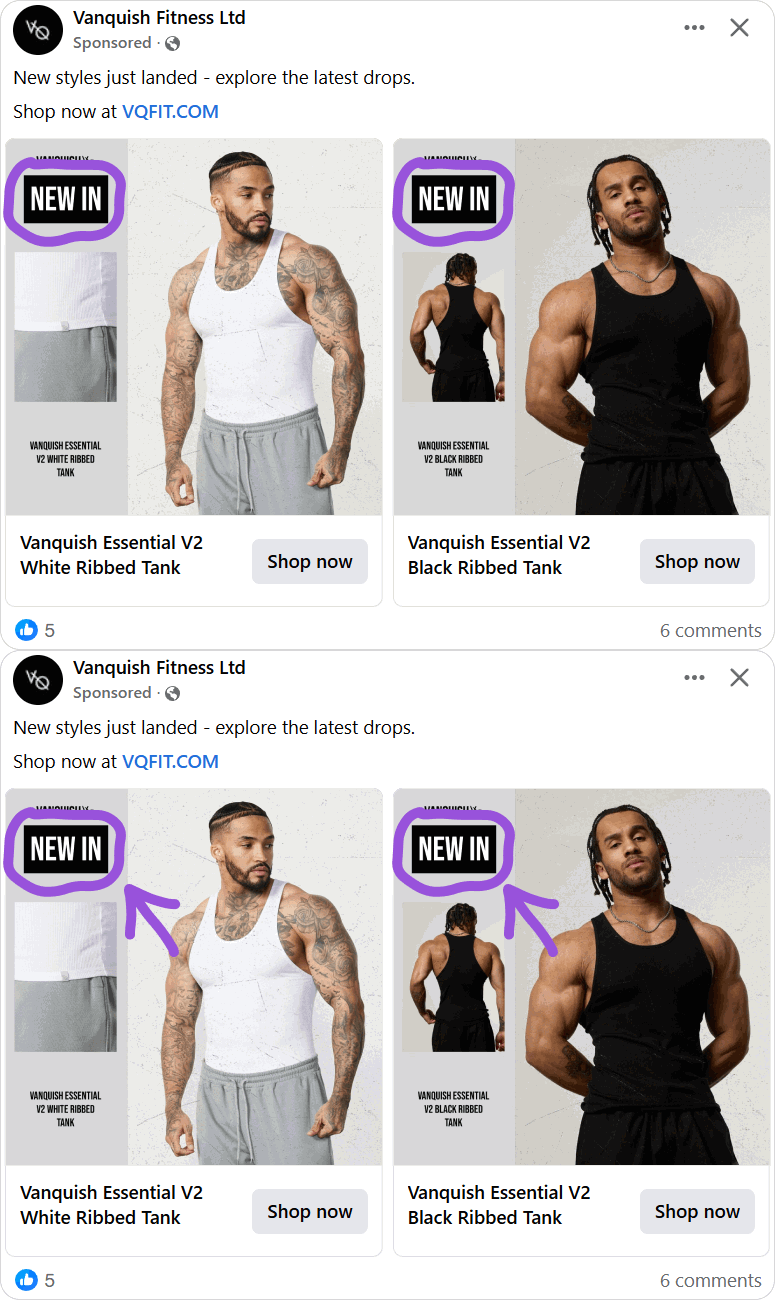
"New styles just landed" does exactly that. It is not a sales message. It is an access message.
The "NEW IN" badge sits top-left on every card, processed before the product name, before any other information. It is the first thing the eye lands on. And in a feed full of prices and percentages, it reads immediately as something different.
Two angles, one frame
Here is the thing that sets this campaign apart from almost every other fashion Catalog Ad.
Each product is shown twice, at the same time - but from entirely different angles. A graphic tee shows the front print in a tight close-up alongside a full-body model shot. Trousers appear in a clean product view next to a model wearing them from front and back. Hoodies show the artwork detail next to the full-length fit.
The detail shot answers one question: what does this actually look like? The print, the quality, the finish. For a brand built on bold graphic artwork, this matters enormously. If you cannot see the design clearly, the product loses its whole reason to exist.
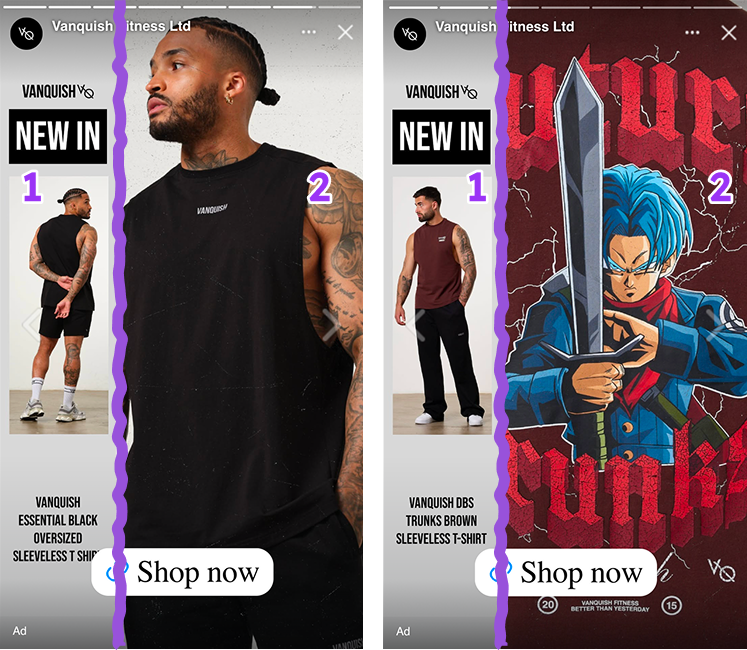
The model shot answers a different question entirely: how does this wear? How does it sit on a real person, in real proportions, in motion?
Most Catalog Ads answer one of those questions. Vanquish and Prospa answer both, in the same frame, in the same glance. A buyer who sees the print detail and the fit context simultaneously has far fewer open questions by the time they reach the product page. That is not a coincidence. It is the same logic Vanquish already applies across their emails and website, where products are shown in multiple views as a matter of course.
The Catalog Ad does not feel like a departure from the brand experience. It feels like a continuation of it.
A design system built to scale
Vanquish's catalog covers tees, hoodies, trousers, vests - dozens of products, all running through the same design frame. What is impressive is that this does not produce a feed of identical-looking cards.
The black and white base palette holds everything together. But each product brings its own visual world. The graphic artwork on a DBS Trunks tee reads completely differently to a clean black jogger or a bold hoodie print. The frame creates recognition across the catalog. The product creates difference within it.
That consistency does quiet work. When every card shares the same structure, the brain starts recognising Vanquish before it has even read the product name. But because the product content varies (bold graphic artwork, clean black basics, statement hoodies) nothing in the feed looks like a copy of the card before it.
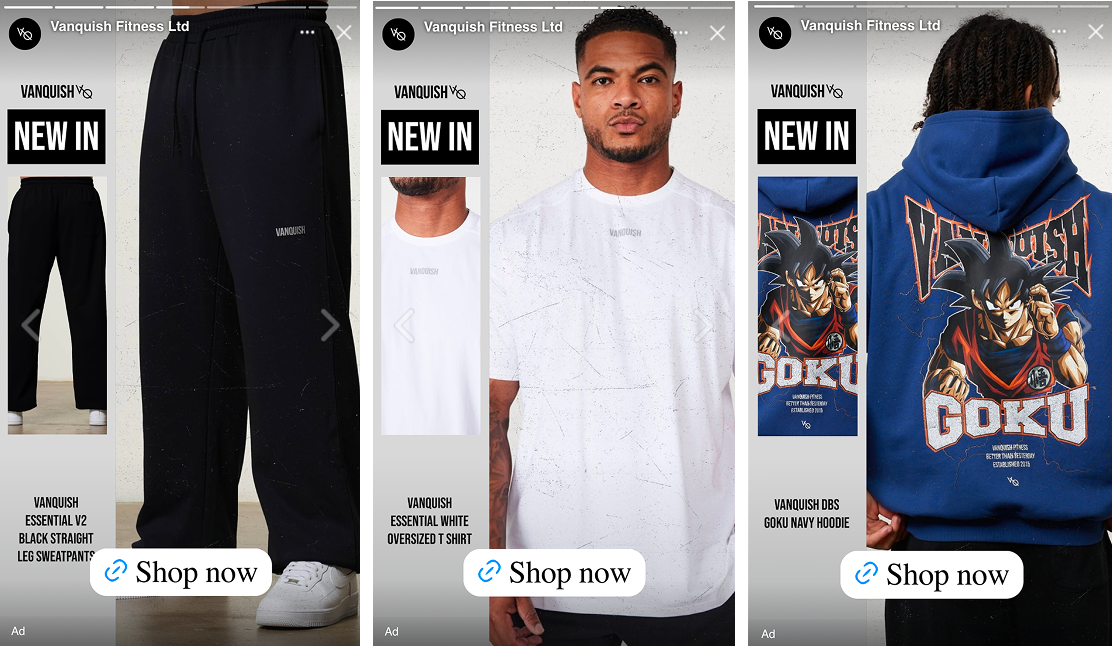
The variety does quiet work for the algorithm too. Someone who lingers on a graphic print hoodie is a different signal to someone who pauses on clean black trousers. Because the creative varies meaningfully at the product level, Meta can find both buyers without any manual audience setup - and serve each the product most likely to convert.
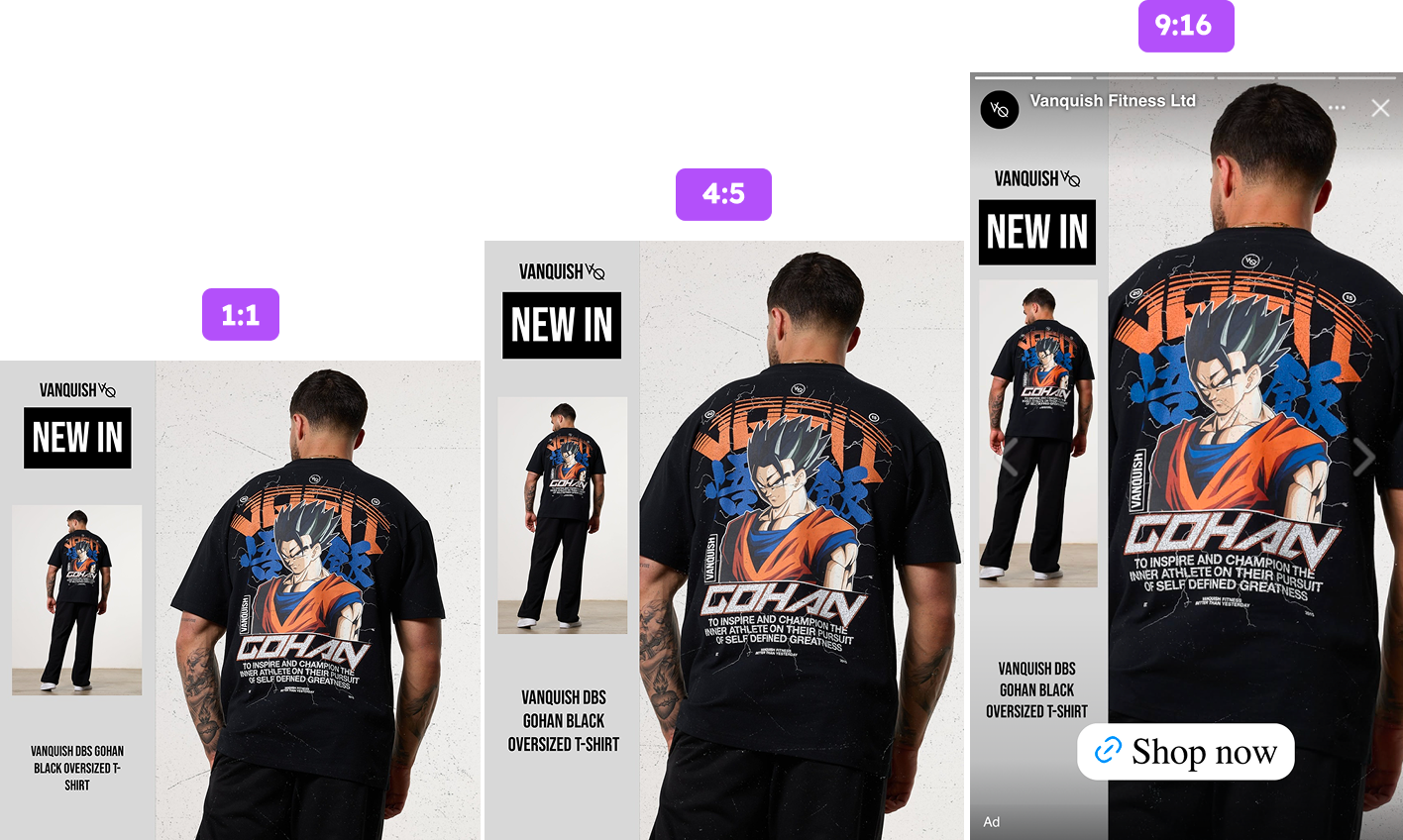
The same logic applies across formats. This campaign runs across 1:1, 4:5, and 9:16, and none of them is a crop of the others. The "NEW IN" badge stays clear of the platform interface in every placement. The dual-angle display adapts to the taller frame without compression. The product name stays legible at the bottom. Placements that run properly built creative give the algorithm more to work with - and more room to find the right buyer at the right moment.
Key Takeaways
Vanquish Fitness and Prospa built something that is hard to copy without first doing the work they did: understanding exactly who the buyer is and what actually makes them act. That is what makes this Catalog Ad worth studying.
👉 Lead with novelty when your buyer is not shopping on price.
For fashion brands with loyal audiences, "new in" converts because it speaks to the motivation that actually brought the customer to the feed.
👉 Show two angles instead of one.
A detail shot and a model shot together answer more questions in a single glance than either image does on its own. When buyers have fewer open questions before clicking, more of them click.
👉 Build a design system that scales across products and placements.
A consistent frame with genuinely different product content keeps the catalog feeling curated rather than mass-produced - and gives the algorithm more creative variation to find the right buyer across every format.