
How Hummel & Oui Oui increased ROAS by 93% with Confect
May 12, 2026
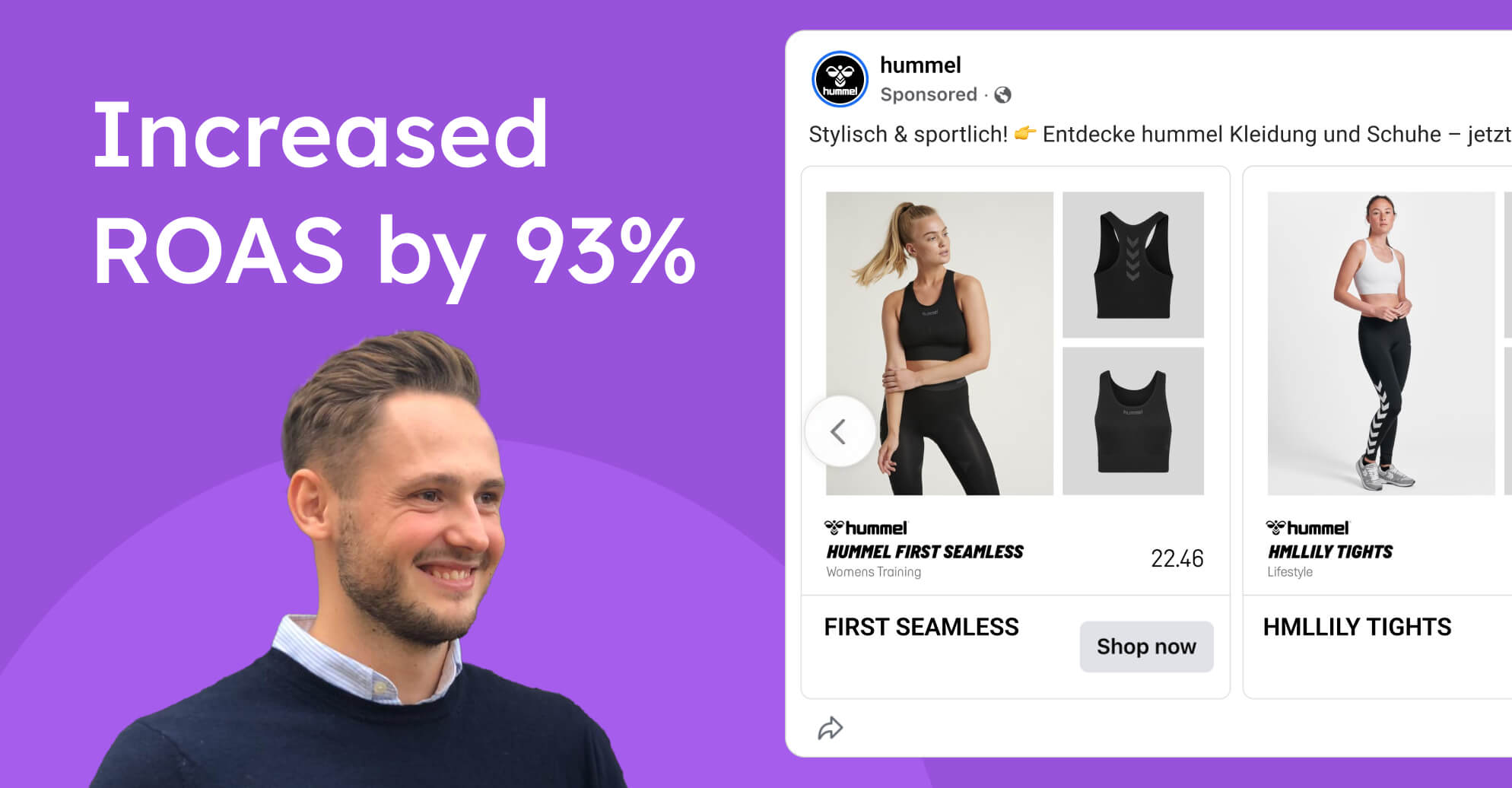
Hummel is one of the world’s oldest and biggest sportswear brands. Their iconic chevrons appear on many outfits, and they are the sportswear brand for many of the football teams in the Premier League, La Liga, and the Bundesliga.
Off the pitch, Hummel operates webshops across many markets, sells everything from performance sportswear to lifestyle sneakers, and runs sub-brands including Halo and Newline. With over a thousand employees and a presence spanning six continents, this is not a small brand testing the waters. This is a global sportswear institution.
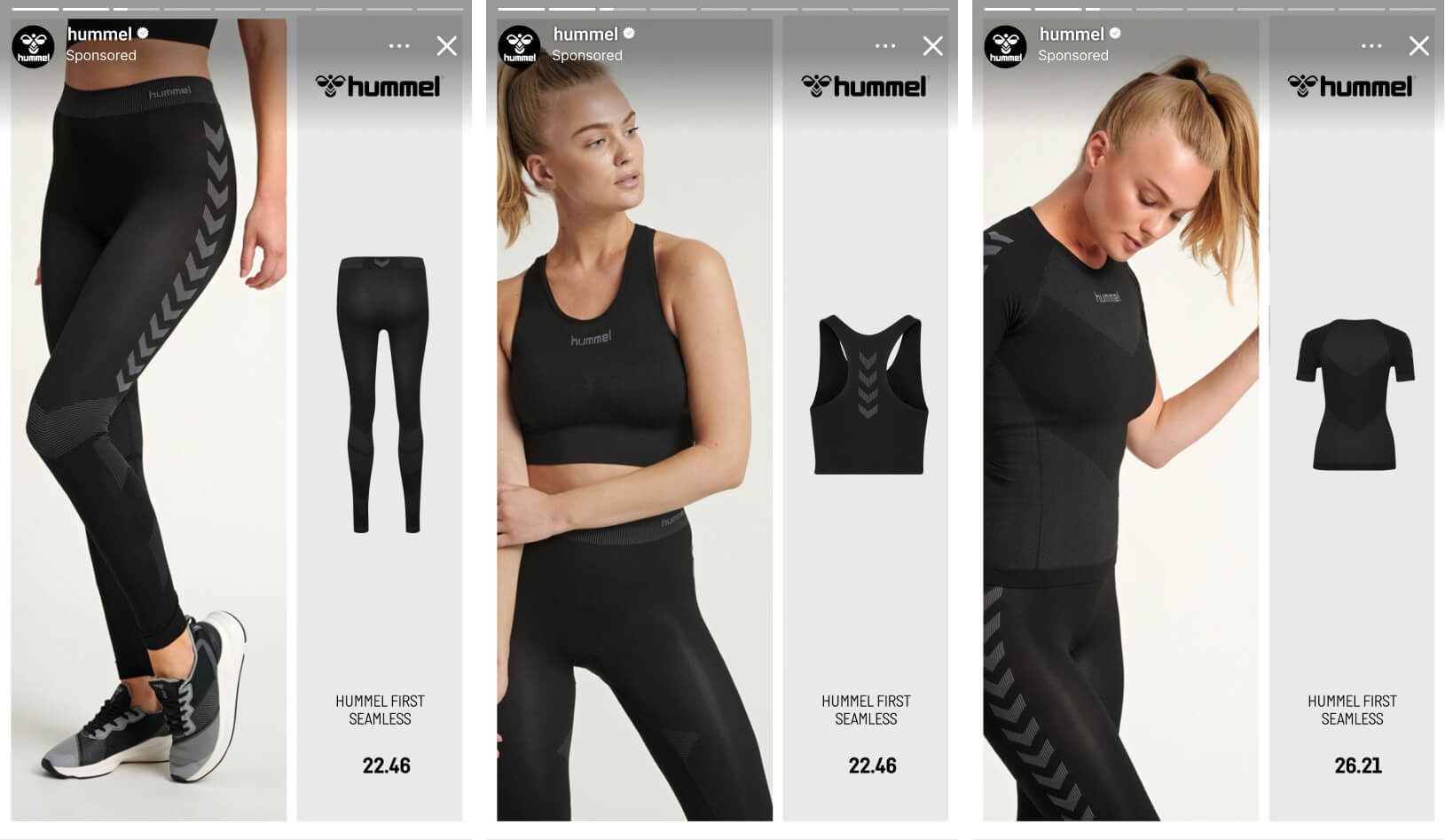
Before using Confect, Hummel’s Catalog Ads looked like most eCommerce brands’ Catalog Ads: bare product images on white backgrounds, occasionally testing Meta’s built-in overlays. Functional, but completely disconnected from the brand that spent a century building one of the most recognizable logos in sport.
Hummel and their agency Oui Oui transformed this by building what is effectively an intelligent design system inside Confect - dozens of designs that automatically adapt to the product, the market, the campaign, and the customer. The result isn’t just better-looking ads. It’s a Catalog Ad operation that scales.
We spoke with Michael Kaanbjerg, Senior Paid Social Specialist at Oui Oui, about how they built Hummel’s Catalog Ad strategy with Confect.
Results
Hummel’s revenue from Catalog Ads grew by 280% YoY - and they managed to scale up their ad spend by +97%. That means Hummel didn’t just improve efficiency. They improved efficiency so much that they could profitably double their investment in Catalog Ads, turning them into one of their strongest performance channels.
Michael shared four important tactics they implemented with Confect that helped them achieve these results.
Catalog Ads that change with every campaign moment
Here’s what most brands do with their Catalog Ads: they set up one design and leave it running. Maybe it has a logo. Maybe it shows the price. But whether it’s July or the day before Christmas, the consumer sees the same ad. The Catalog Ads exist in a bubble, completely disconnected from whatever the brand is actually doing.
Hummel’s approach is the opposite. Their Catalog Ads are always relevant to what’s happening right now.
This matters more than most advertisers realize. A consumer scrolling through their feed in early December is in a different mental state than one scrolling in March. In December, they’re thinking about gifts. If your Catalog Ad shows a plain product image with a price, it doesn’t connect to that mindset. But if it shows a design and messaging relevant to the season? Now it’s relevant. Now it answers the question the consumer is actually asking: “What should I buy for someone?”
By aligning their Catalog Ads with the marketing calendar, Hummel’s ads don’t just show the right product to the right person. They show it in the right context. And context is what makes someone stop scrolling.
No matter whether the context right now is Singles Day or they are having a more evergreen outlet going on.
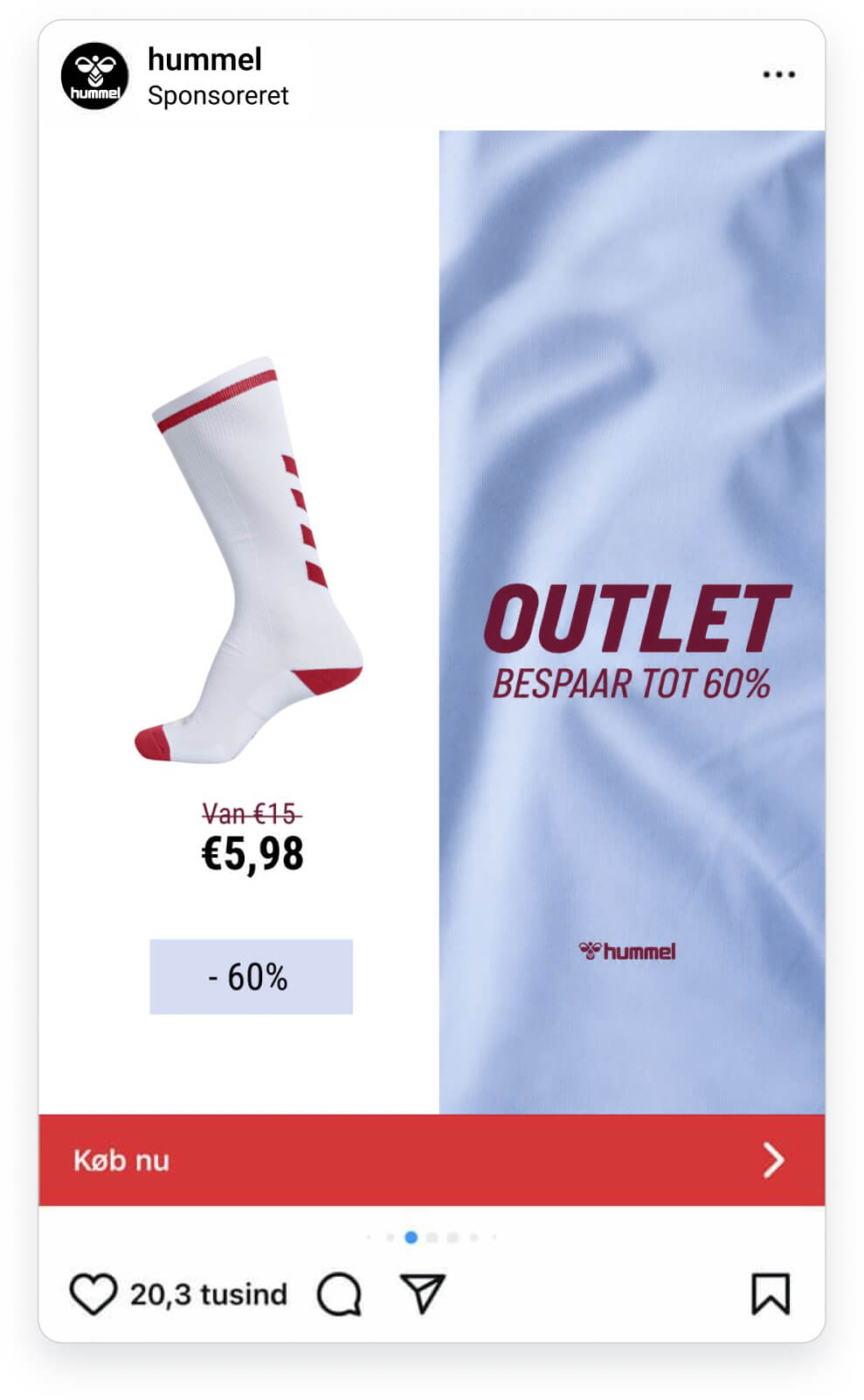
But here’s where it gets really smart. Hummel and Oui Oui don’t just update their designs between campaigns. They hyper-optimize within campaigns, creating a progression of urgency that keeps consumers engaged throughout the entire promotional period.
Every transition is automated. Oui Oui set up scheduled design rules in Confect ahead of time, so the designs activated and deactivated on specific dates without anyone touching the campaign. No pausing. No restarting. No resetting the learning phase.
They followed the same playbook for their Mid Season Sale. The sale started with a standard discount design. Then stage two kicked in with an additional 10% extra. Then a final push with 15% extra on top. Each stage had its own Catalog Ad design with updated messaging, automatically swapped via scheduled rules in Confect.
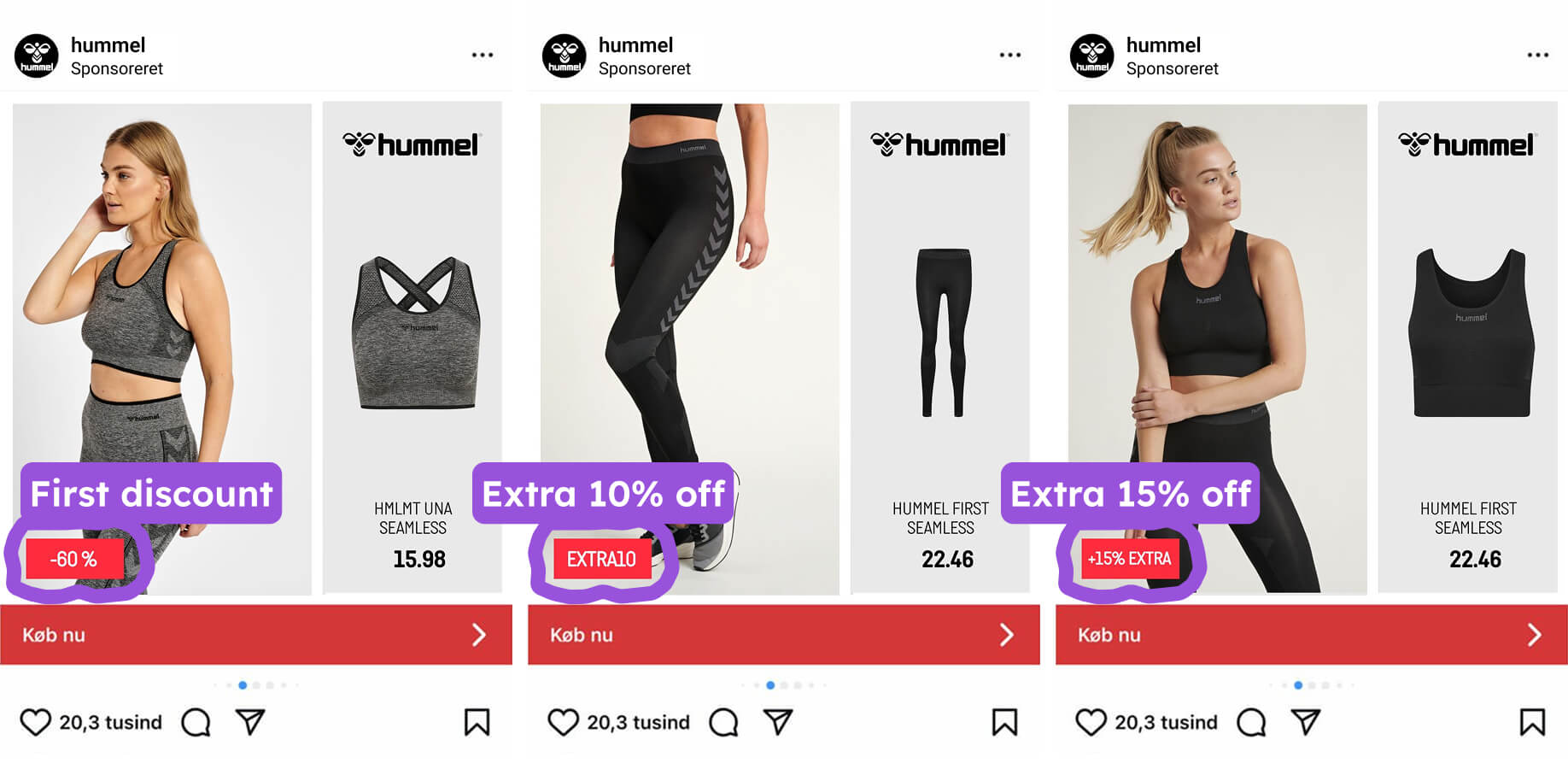
This is clever for a reason most advertisers overlook. When you run the same sale design for three weeks straight, it stops working. Your audience has seen it. They’ve processed it. They’ve decided not to act. But when the message changes - when it goes from “sale” to “today only” to “last chance” to “extra 15% off” - every shift re-triggers attention. You’re creating multiple decision moments instead of one, and each moment carries more urgency than the last.
That’s a big part of why Hummel’s Click Through Rate improved by 43%. Their ads weren’t static billboards. At any given moment, the Catalog Ads reflected what was actually happening - the right campaign, the right message, the right urgency level. Every few days, consumers had a new reason to pay attention.
 Michael Kaanbjerg
Senior Paid Social Specialist at Oui Oui
Michael Kaanbjerg
Senior Paid Social Specialist at Oui Oui
Treating every product differently with design rules
Here’s a question most Catalog Ad advertisers never ask: should a pair of running shoes and a cotton hoodie look the same in your ad?
Hummel’s answer is no. And they’ve built their entire design system around that principle.
Footwear gets its own design templates with fitting product images. A running shoe needs the packshot for the silhouette. A hoodie needs a lifestyle image to show drape and texture. Putting both in the same rigid template means one of them looks worse than it should.
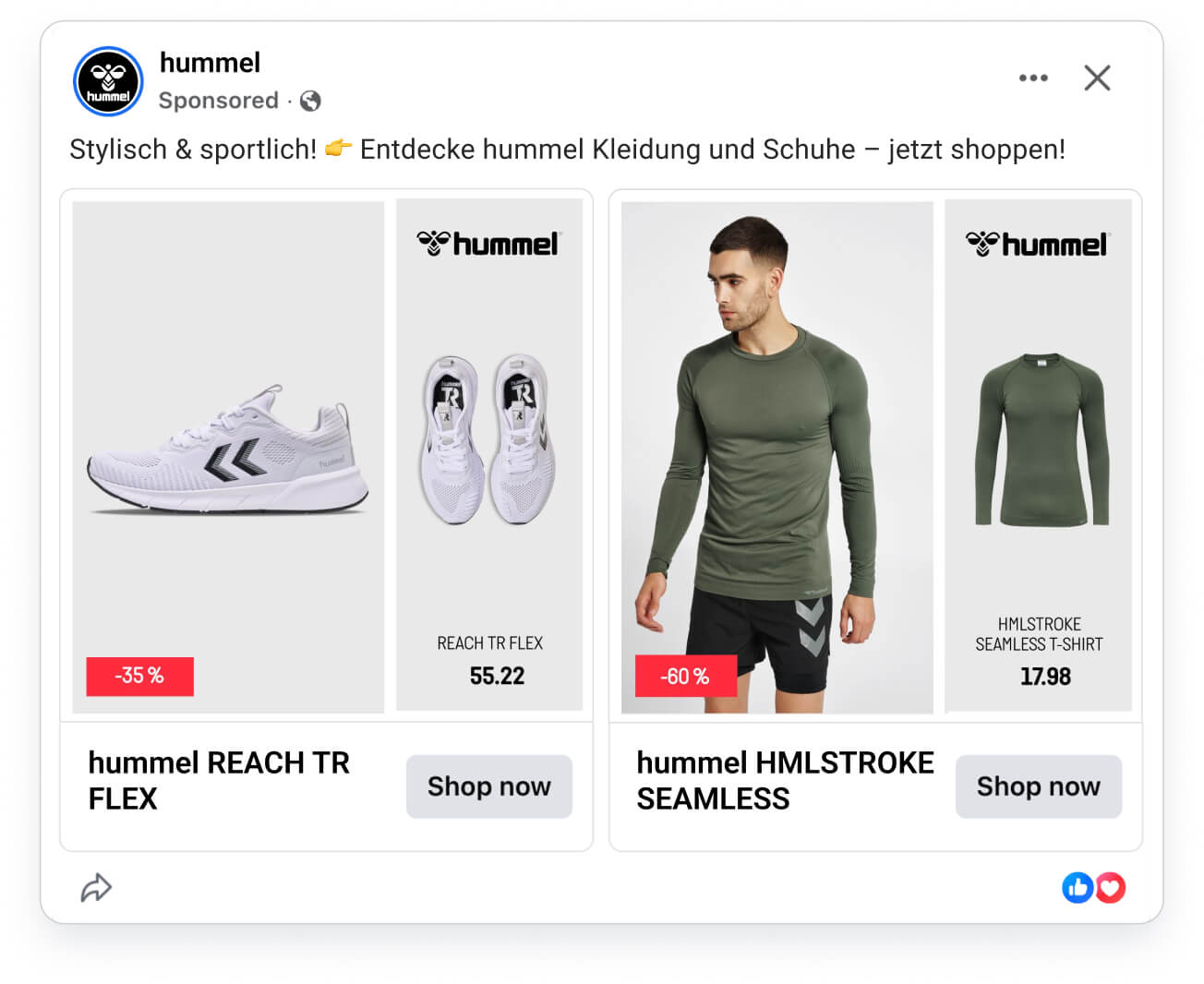
But Hummel goes further than product category. Their design rules account for multiple layers of product information:
Whether the product has a lifestyle model image or a packshot determines which design template it gets. A model wearing a crewneck sweater tells a completely different story than a flat product shot of the same item - and the surrounding design should support that story, not fight it.
Whether the product is for men, women, or kids changes the design. Not just the product shown, but the creative treatment around it. A kids’ design might have different energy than an adult performance design.
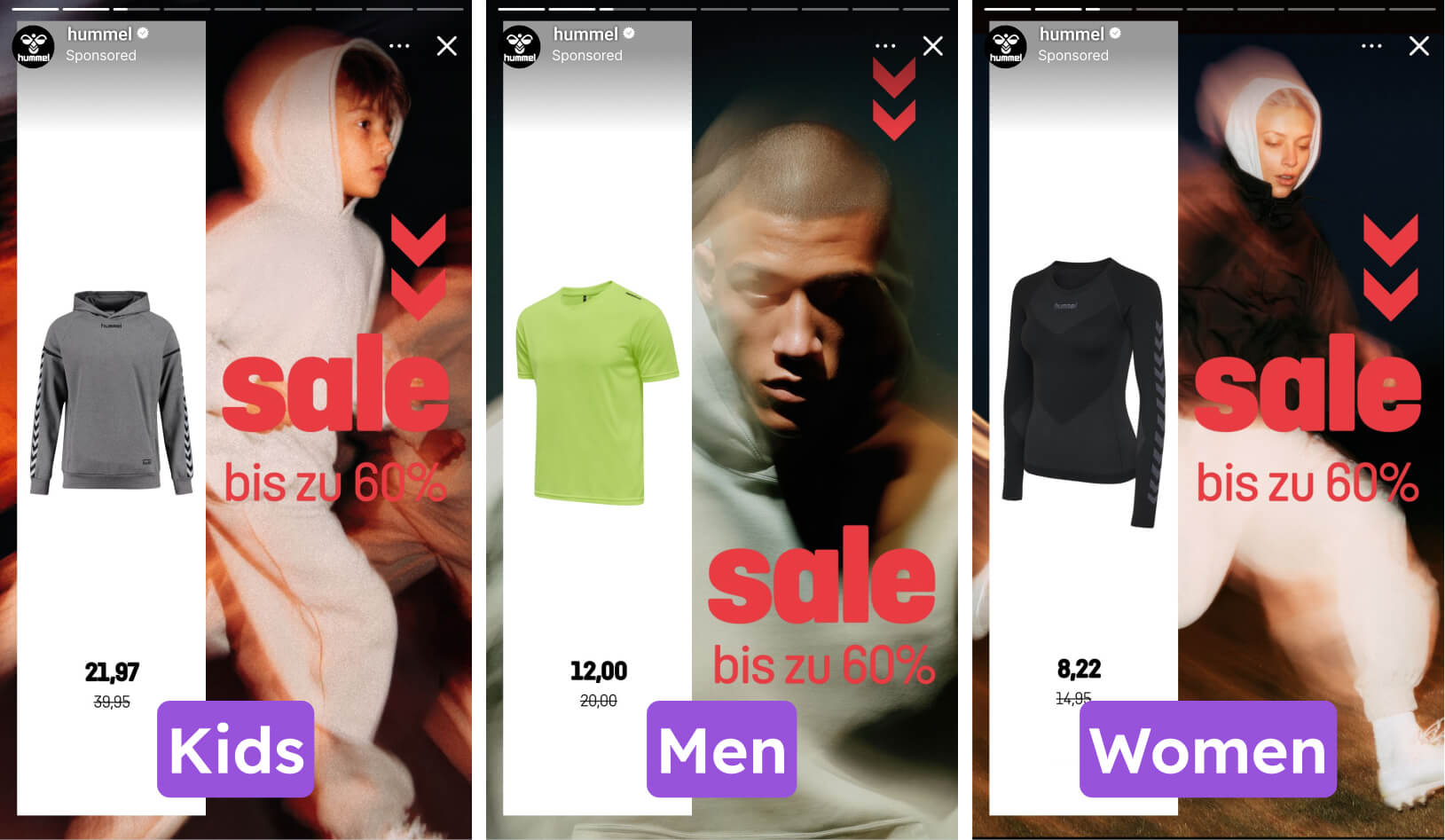
Whether the product is on sale or full price triggers a different template entirely. Sale products get urgency-driven layouts with discount messaging. Full-price products get cleaner, more brand-forward designs that focus on the product itself.
And whether the product falls under Hummel Sport, Hummel Fashion, or Hummel Lifestyle shifts the design tone to match the sub-brand’s positioning.
All of this runs automatically through design rules in Confect. When a product enters the catalog, its attributes - category, gender, image type, sale status, product line - determine which design it gets. No manual sorting. No spreadsheet of “which products get which template.” The system handles it.
On top of the automated design rules, Hummel and Oui Oui also run multiple design variants against each other. This gives Meta’s algorithm different creative options to test and learn from - finding which designs resonate best with which audiences. Creative becomes the new targeting. Instead of telling the algorithm who to show ads to, you give it different creatives and let the algorithm figure out which message connects with which person.
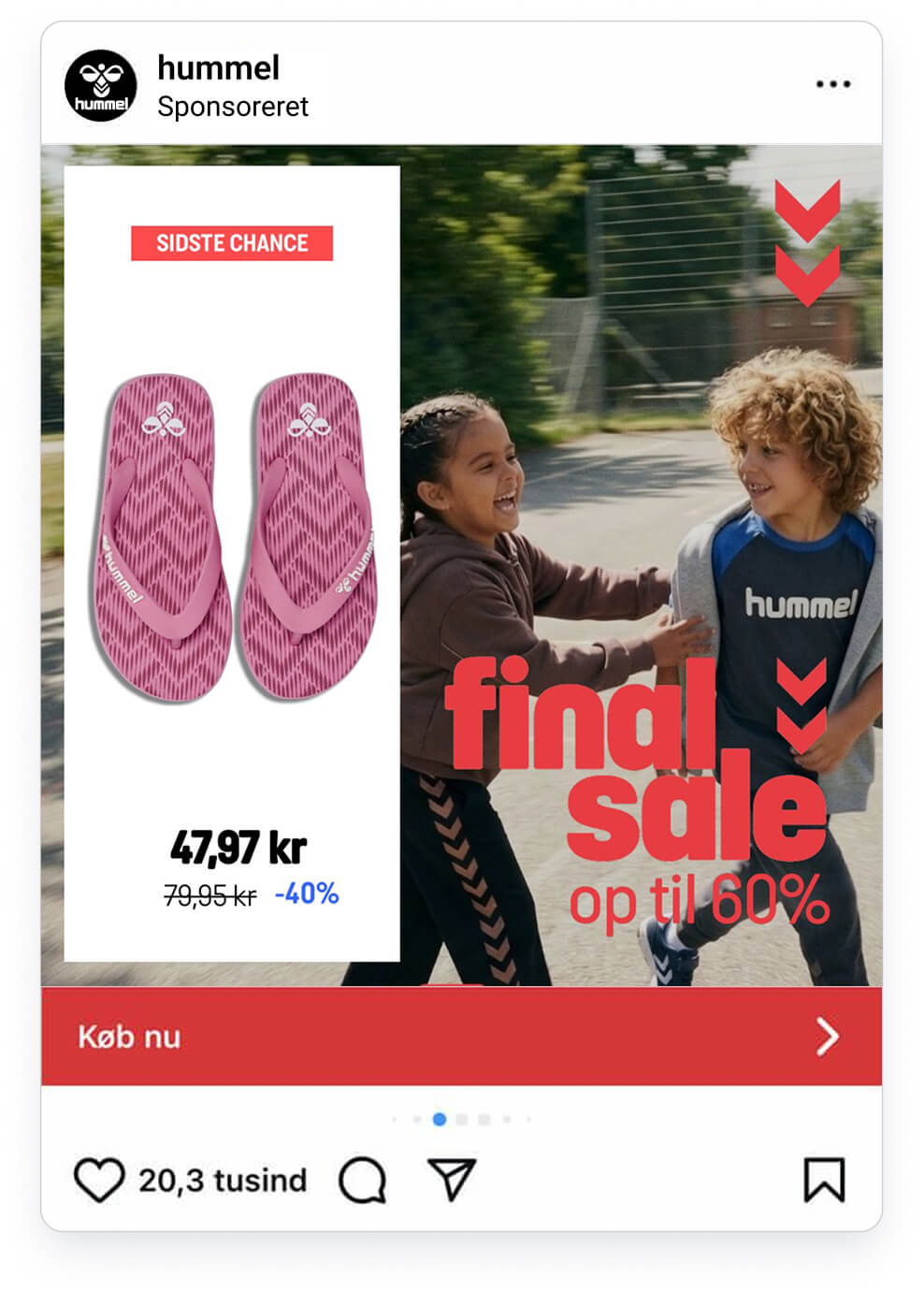
This is why Hummel’s Conversion Rate jumped by 85%. When someone clicks on a Catalog Ad that shows a running shoe in a layout designed for running shoes, with the right messaging for that product’s price point and sale status, they arrive at the product page with clear expectations. The ad matched the product. The product matches the ad. There’s no disconnect, no surprise, no friction. And that translates directly to higher conversion.
Michael Kaanbjerg
Senior Paid Social Specialist at Oui Oui
Turning Catalog Ads into a membership tool
This one is genuinely unusual - but very effective.
Hummel runs Club Hummel - a membership program with exclusive pricing. Members get lower prices on selected products. Standard loyalty program stuff. But what Oui Oui did with this in Catalog Ads is not standard at all.
Hummel feeds their member prices directly through the product catalog. Inside Confect, a design rule checks whether a product has a member price. If it does, the product gets a completely different Catalog Ad design - one that prominently displays the Club Hummel badge, the membership price, and the original price for comparison.
They even in their newer membership ads added the USP's from the membership. As a member, you'll get:
- 15% off on first order
- Free shipping on certain orders
- Exclusive prices
- Membership points when shopping
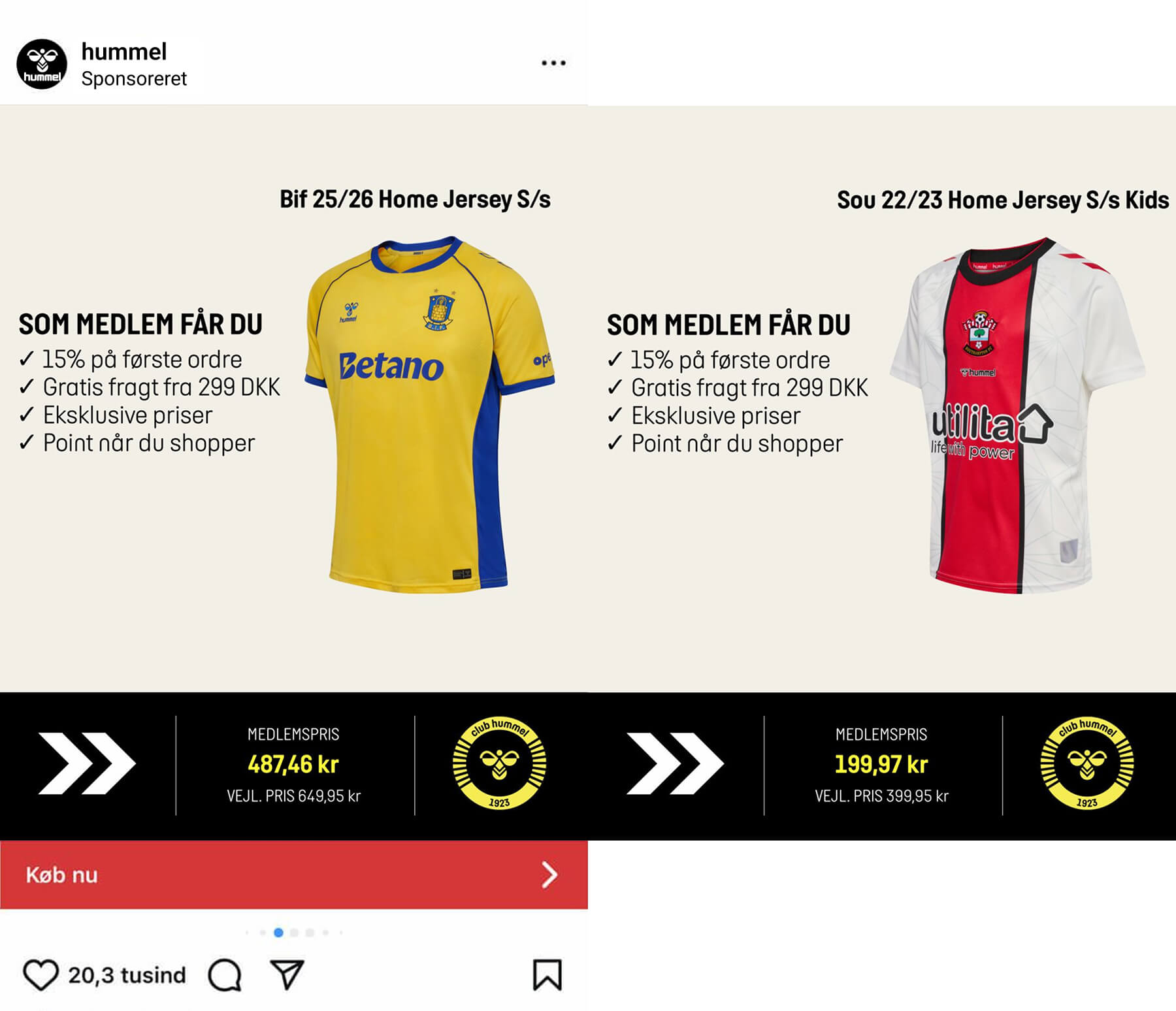
Think about what this means from the consumer’s perspective. You’re scrolling through your feed. You see a Hummel hoodie. But instead of a standard product ad, you see the Club Hummel logo, a member price that’s a fraction of the original, and the regular price crossed out next to it. The message is instant: this product is cheaper for members. And if you’re not a member yet, you now have a very specific reason to become one.
This is using Catalog Ads as a loyalty acquisition and retention tool - not just a performance channel. The same ad that sells the product also sells the membership. And because the member pricing is pulled directly from the feed, it’s always accurate. No manual updates, no risk of showing the wrong price. If Hummel changes a member price, the Catalog Ad updates automatically.
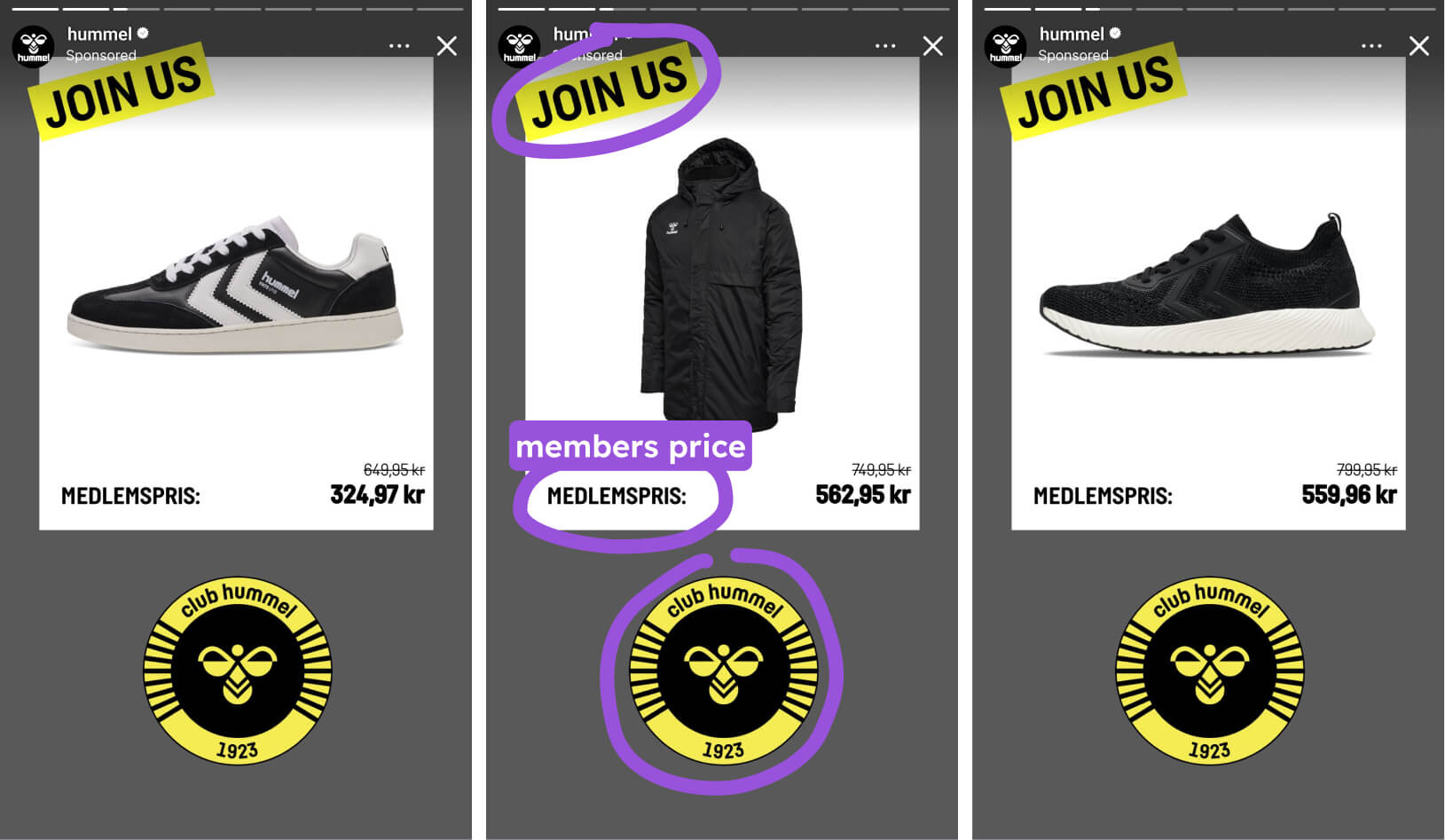
It also creates a powerful anchoring effect. The consumer sees the original price and then the member price right next to it. The original price anchors the perception, and the member price feels like a steal. But the key insight is that without the designed Catalog Ad, this comparison never happens. A plain product image doesn’t show the member price. It doesn’t show the Club Hummel badge. It doesn’t create the anchor. The designed ad creates the entire psychological mechanism.
Michael Kaanbjerg
Senior Paid Social Specialist at Oui Oui
Running a design system across 10+ countries and sub-brands
Hummel operates webshops across seven markets. Danish, German, English - each with their own language, their own promotional calendar, and their own pricing. On top of that, they run sub-brands: Halo their fashion brand and Landsholdsshoppen, the dedicated shop for the Danish national football team.
Here's a few examples from their subbrand HALO, where they also implement HALO's specific campaigns for, with HALO's own brand and campaign assets:
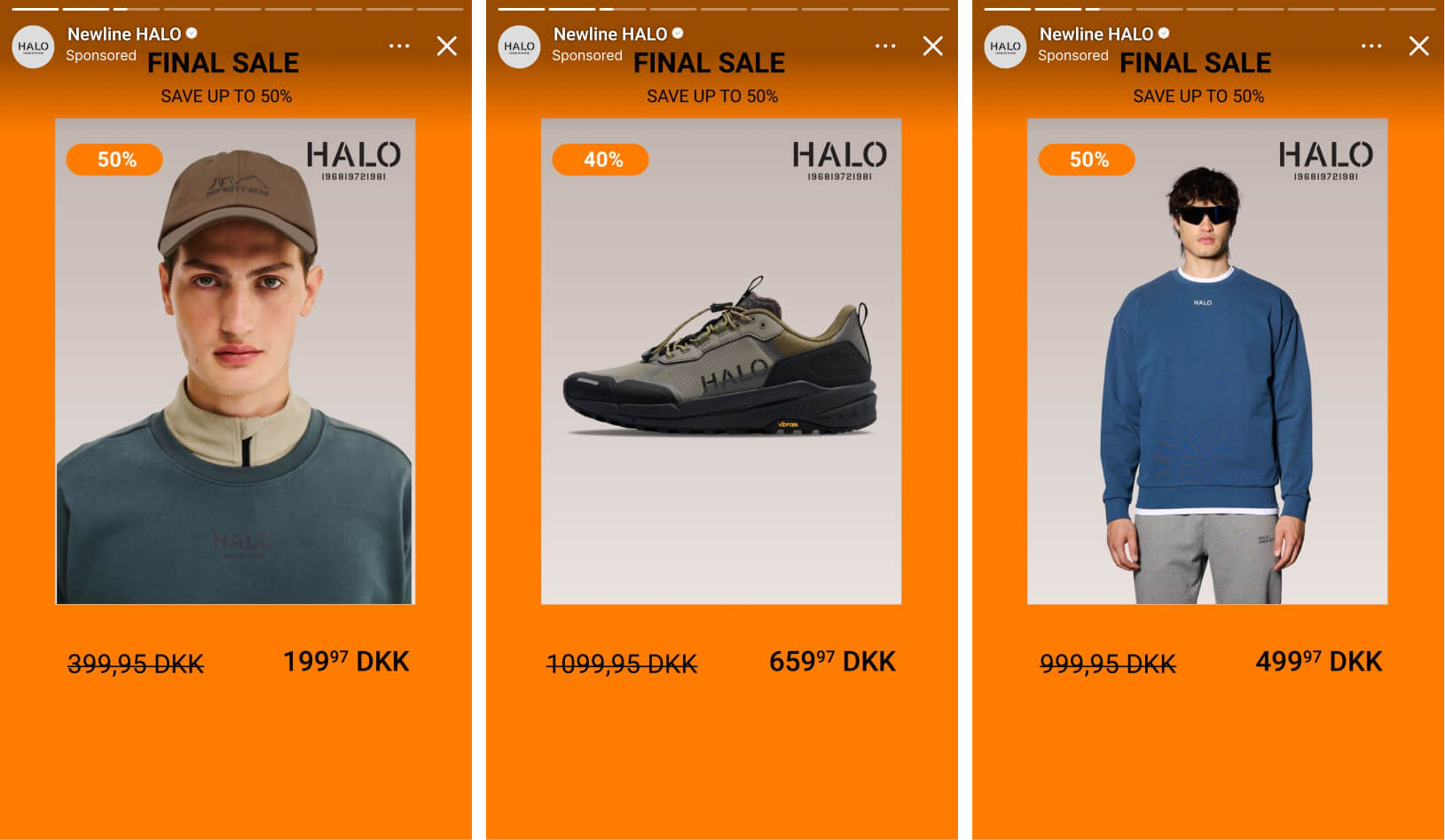
Having that many brands and markets is a lot of Catalog Ads to manage. Without a system, it’s either chaos or compromise - you either drown in manual work or you settle for one generic design that doesn’t speak to any market properly.
Oui Oui solved this by building Hummel’s Catalog Ad designs as a modular system inside Confect. The design logic - sale designs, product-specific templates, membership pricing, seasonal campaigns - works across all markets. But the messaging adapts. German shoppers see “Spare bis zu 60%” during a sale. Danish shoppers see “Spar op til 60%.” English-speaking markets get “Save up to 60%.”
And because the designs are built with Confect’s design rules, adding a new market or a new campaign doesn’t mean starting from scratch. The rules are already in place. A new market gets plugged into the existing system, and the designs generate automatically based on the same logic.
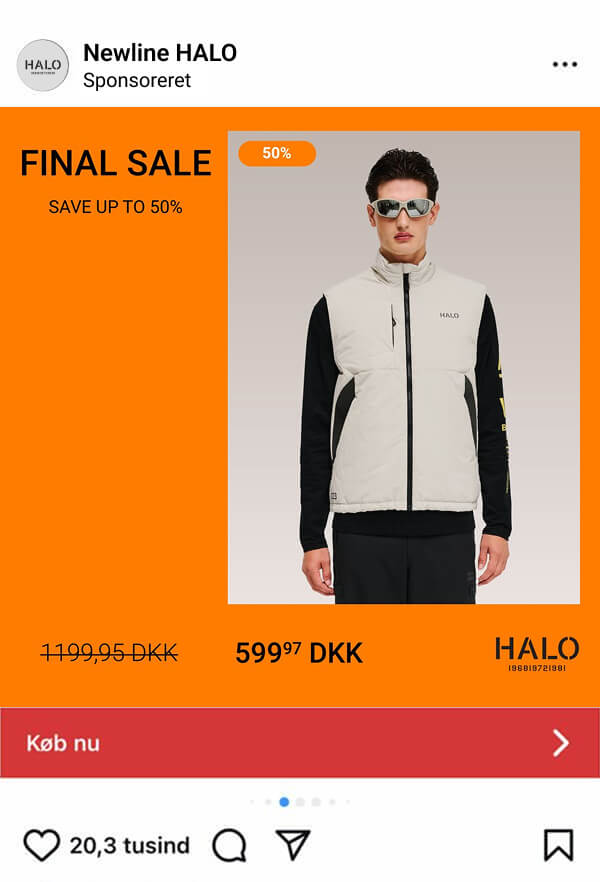
Hummel also uses multiple aspect ratios through Confect’s format feature, so the same design system produces ads optimized for different placements - feed, Stories, and beyond. And they run their Catalog Ads on Pinterest alongside Meta, extending the same design system across platforms. Wherever a consumer encounters a Hummel product ad, it looks like Hummel - not like a white-background product feed.
This is where the scaling story comes together. Hummel didn’t just double their ad spend and get better results. They doubled their spend across multiple markets, multiple sub-brands, and multiple campaign types - all running simultaneously, all managed through a single design system. That kind of operational efficiency is what makes the 93% ROAS improvement sustainable. It’s not a one-time spike from a single clever design. It’s a system that keeps performing because the logic is built in.
Michael Kaanbjerg
Senior Paid Social Specialist at Oui Oui
Conclusion
What Hummel and Oui Oui built is not just a collection of good-looking Catalog Ads. It’s an intelligent design system that makes decisions automatically - the right design for the right product, in the right market, at the right moment, with the right level of urgency.
That system produced a 93% increase in ROAS, an 85% increase in Conversion Rate, and a 43% increase in Click Through Rate. It cut Cost per Acquisition by 54%. And it gave Hummel the confidence to profitably double their Catalog Ad investment - growing revenue by 280%.
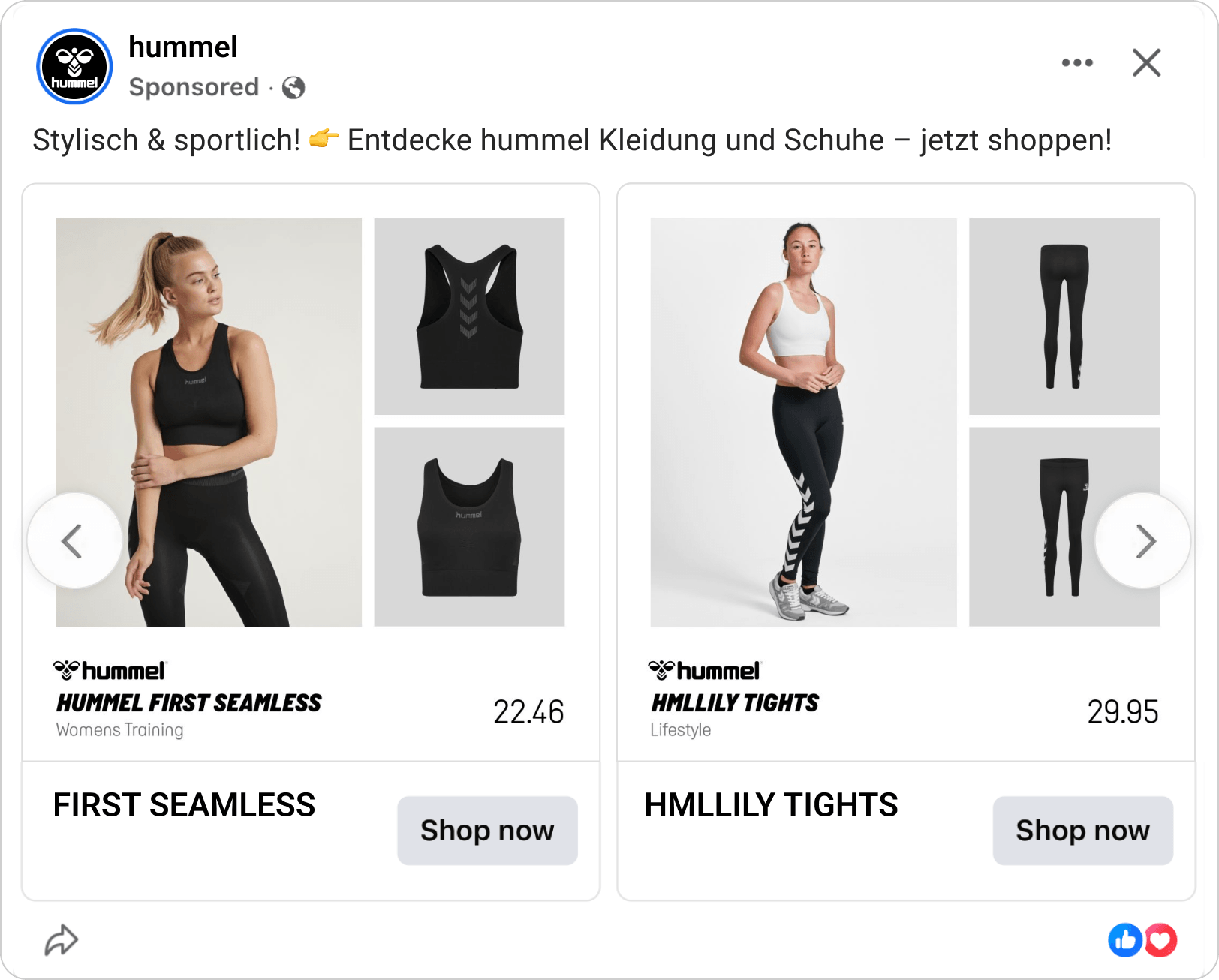
The CTR improvement came from ads that were always relevant. Campaign-specific designs meant consumers never saw stale creative. Scheduled urgency progressions re-triggered attention at every stage. Product-specific creative meant the right message for the right product. Every scroll through the feed brought something fresh.
The Conversion Rate improvement came from ads that set the right expectations. When the product in the ad matches the layout designed for that product, when the campaign messaging aligns with what the consumer sees on the landing page, the transition from ad to purchase is seamless. And when a consumer arrives with clear expectations, they buy.
One of the world’s oldest sportswear brands - the company that put chevrons on Real Madrid’s jersey and created the kit Denmark wore when they shocked the world in 1992 - now runs one of the smartest Catalog Ad setups in eCommerce. And they did it across seven markets, multiple sub-brands, multiple platforms, and every major campaign moment of the year.
If a brand with 100 years of heritage can transform their Catalog Ads, the question for everyone else isn’t whether to start. It’s why they haven’t already.