
Black Month 2026: the 2.6B impression Meta study
September 25, 2026
Black Month charges you about 45% more for every thousand impressions. Whether or not you built anything for it.
That is the first thing 2.6 billion Catalog Ad impressions from Black Month 2025 told us. It is not the most useful thing. The most useful thing is that the advertisers who paid that premium and got the most back did a handful of specific things before and during the month, and most of them are not about the size of the discount.
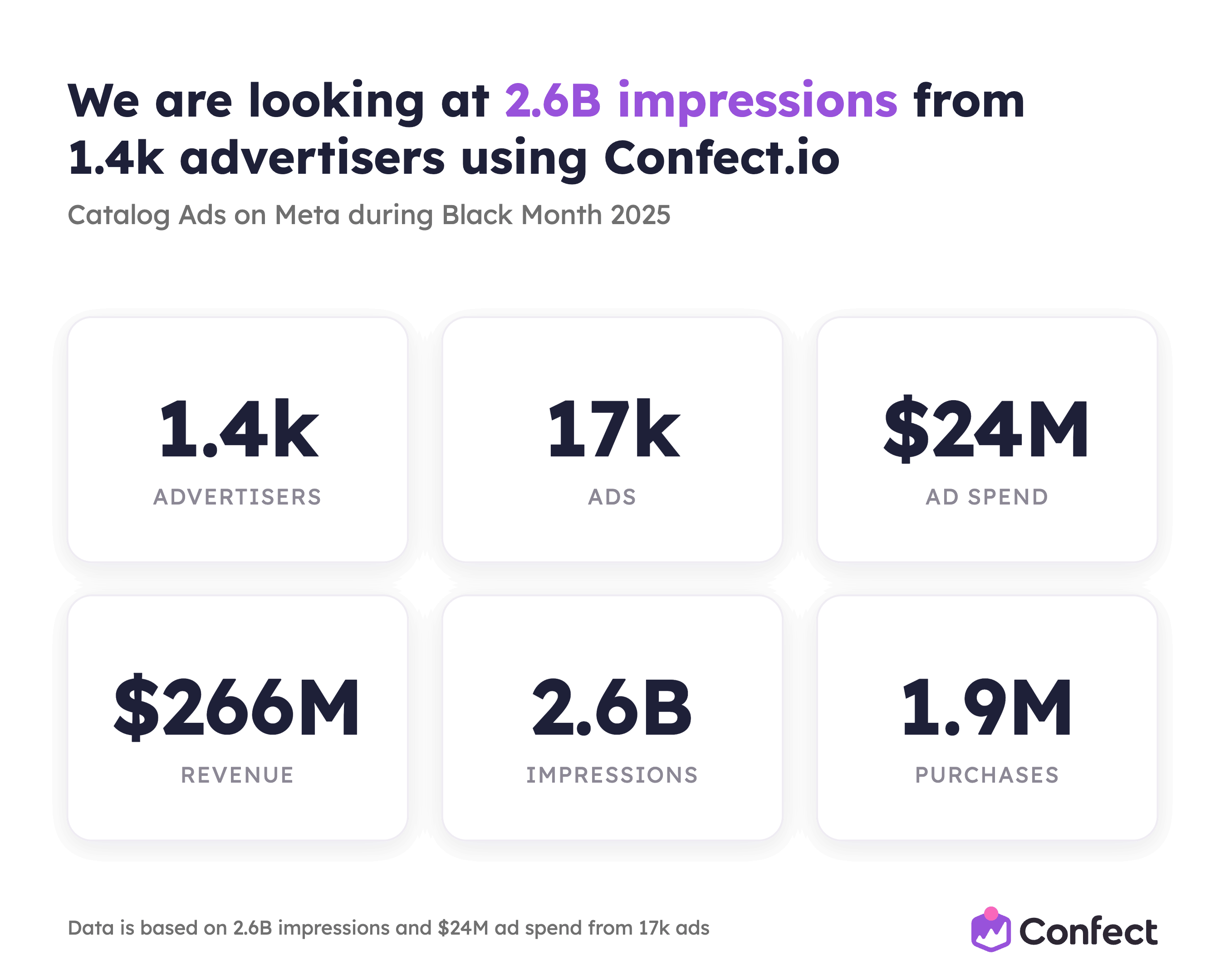
This is the largest Black Friday study we have run. It covers $24 million in ad spend, 17,390 Catalog Ads and 1,362 brands and retailers who design their Catalog Ads with Confect, from IKEA, JYSK and Intersport to ECCO, Skechers and Jack & Jones. Those advertisers get this data first. You get it now. If you want to know exactly how the numbers were made, that is at the bottom, for the nerds.
The short version: during Black Month nobody is deciding whether to buy. They are deciding who to buy from, and your discount is no longer part of that decision. Everyone has one. So three other things start separating the winners from the rest: what you built before the month, what your creative says once the shopper has eight tabs open, and whether your design can follow the product and the calendar without anyone touching it.
That is the order this piece runs in.
The findings in one place
- Black Month runs 45% higher on CPM than the rest of the year, and every other metric improves anyway. ROAS is up 34%
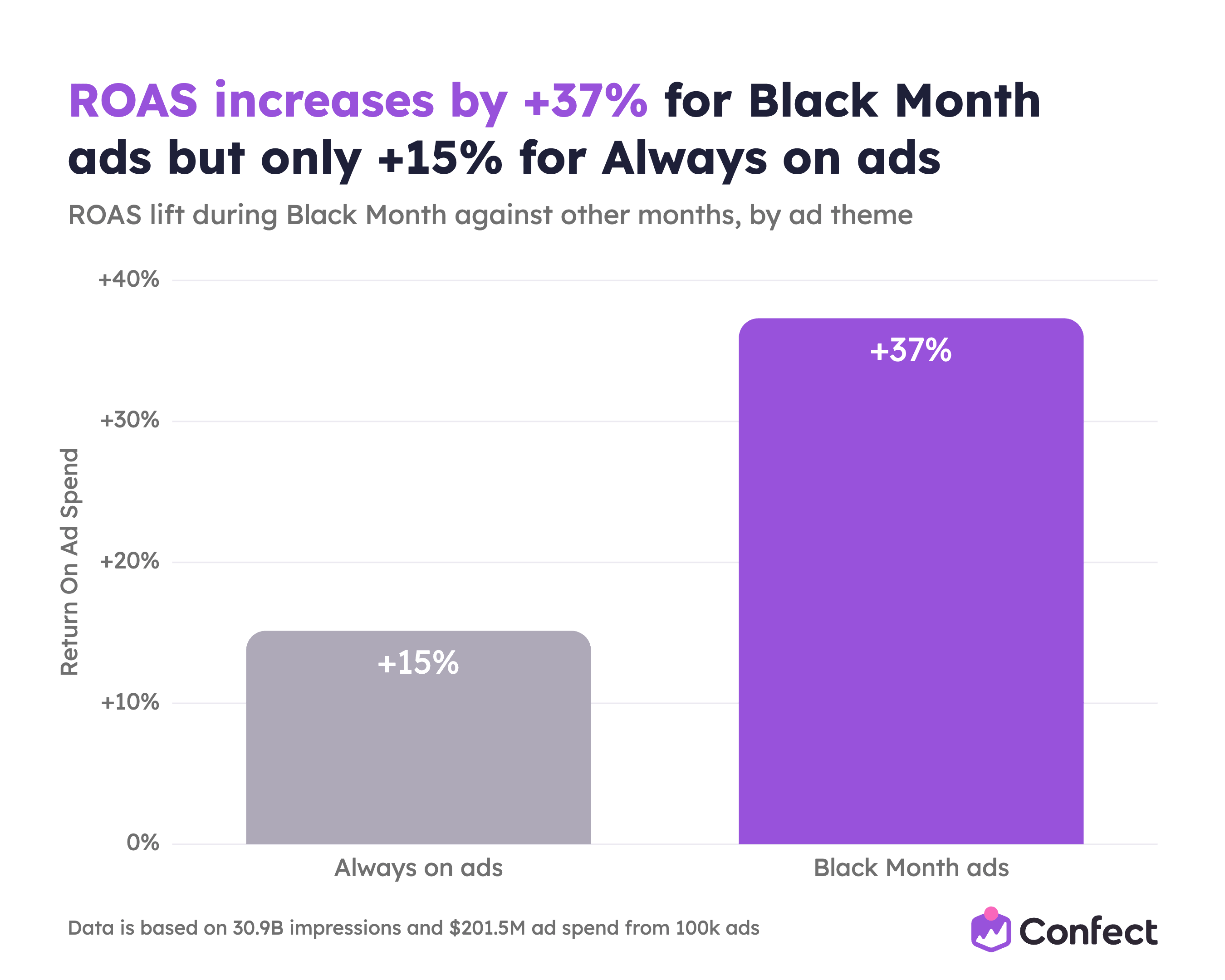
- Always-on Catalog Ads pay a higher CPM than ads built for Black Month ($12.0 against $10.6) and collect less than half the ROAS lift (+15% against +37%).
- Black Month is worth 82% more ROAS to an electronics shop and 3% more to a food and drinks shop. Small, mid-priced and single-brand shops gain most.
- Catalogs with more than 2,000 products return 20% more than the average Black Month Catalog Ad. Catalogs under 500 products return 21% less, and 31% less in prospecting.
- Advertisers who bought traffic, engagement or awareness before Black Month got 39% more ROAS from their Catalog Ads during it.
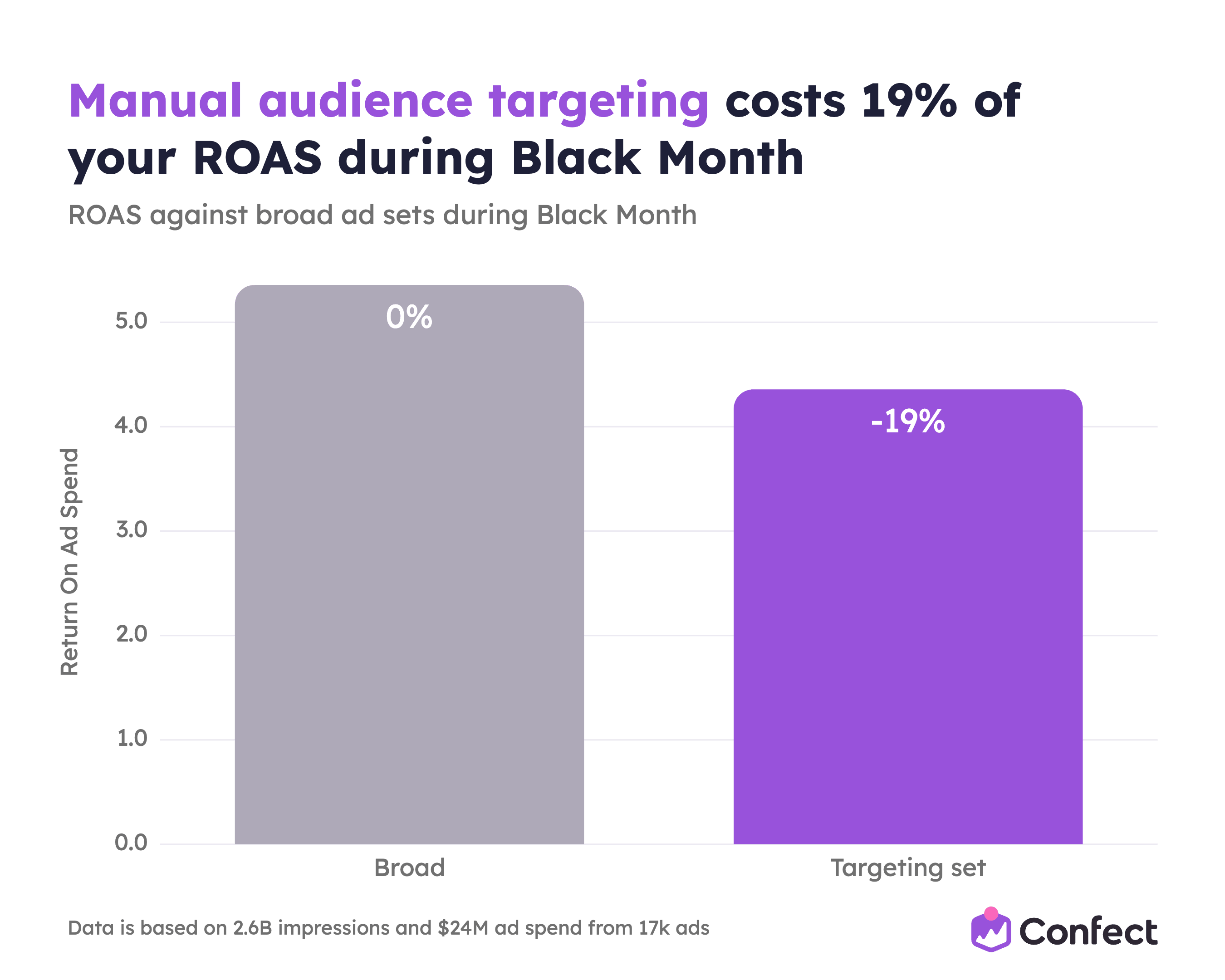
- Manual audience targeting costs 19% of ROAS during Black Month.
- Only one sale message holds its value during Black Month: the original price, struck through.
- Transaction elements (returns, shipping, delivery, a call to action) go from worthless to valuable during Black Month. Bestseller, new and brand badges lose roughly half their effect.
- Price plus a voucher code is the best-performing combination in the dataset: +64% ROAS and -38% Cost Per Purchase.
- Design rules on both product data and the calendar return 55% more than Catalog Ads with no rules.
Black Month charges everyone more. Always-on ads pay the most.
Every shop in your category is bidding for the same sales in the same four weeks. Meta, like every modern marketing channel, is an auction. More bidders, same inventory, higher price.
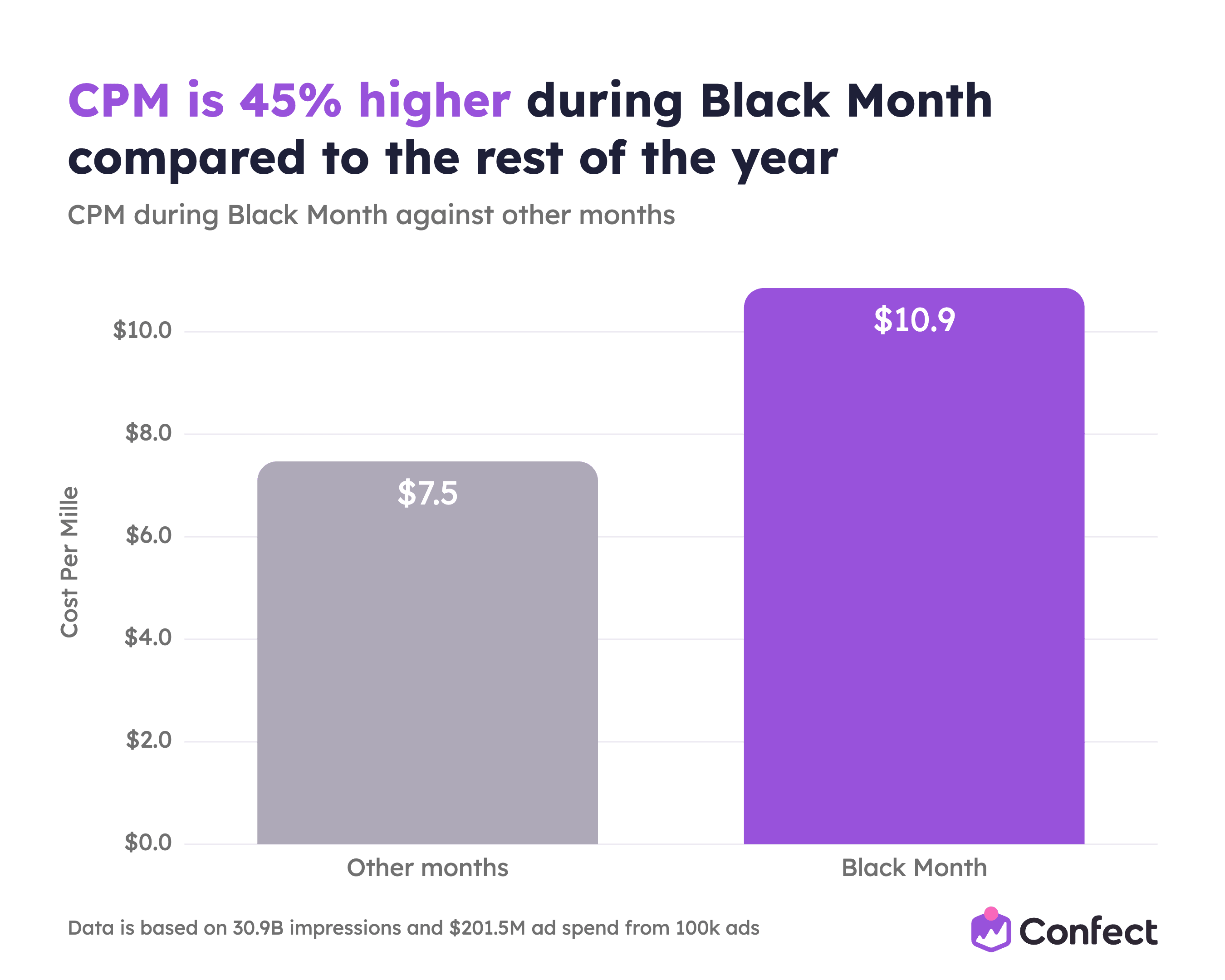
So CPM during Black Month runs 45% higher than the rest of the year: $10.9 against $7.5 for the typical Catalog Ad.
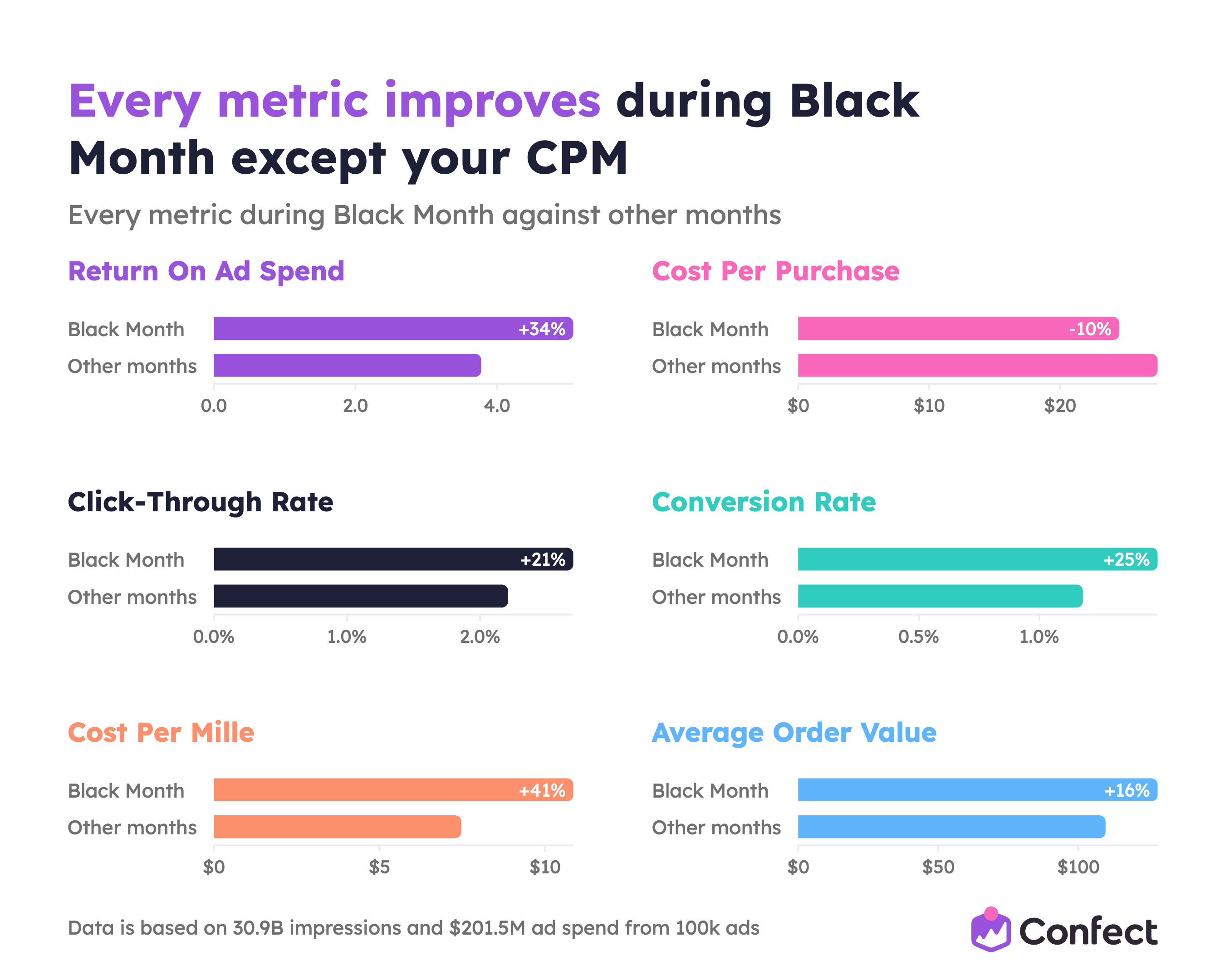
Before that reads as a warning: every other metric improves. ROAS +34%, Cost Per Purchase -10%, click-through rate +21%, conversion rate +25%, average order value +16%. Black Month is a very good month you are being overcharged for, and the overcharge is the price of the competition.
The always-on trap
Now split the Black Month Catalog Ads into two groups: the ones built for the period, and the ones that were already running and were simply left on.
Always-on Catalog Ads paid a CPM of $12.0 during Black Month 2025. Ads built for Black Month paid $10.6. And the always-on ads collected a 15% ROAS lift against the rest of the year, where the Black Month ads collected 37%.
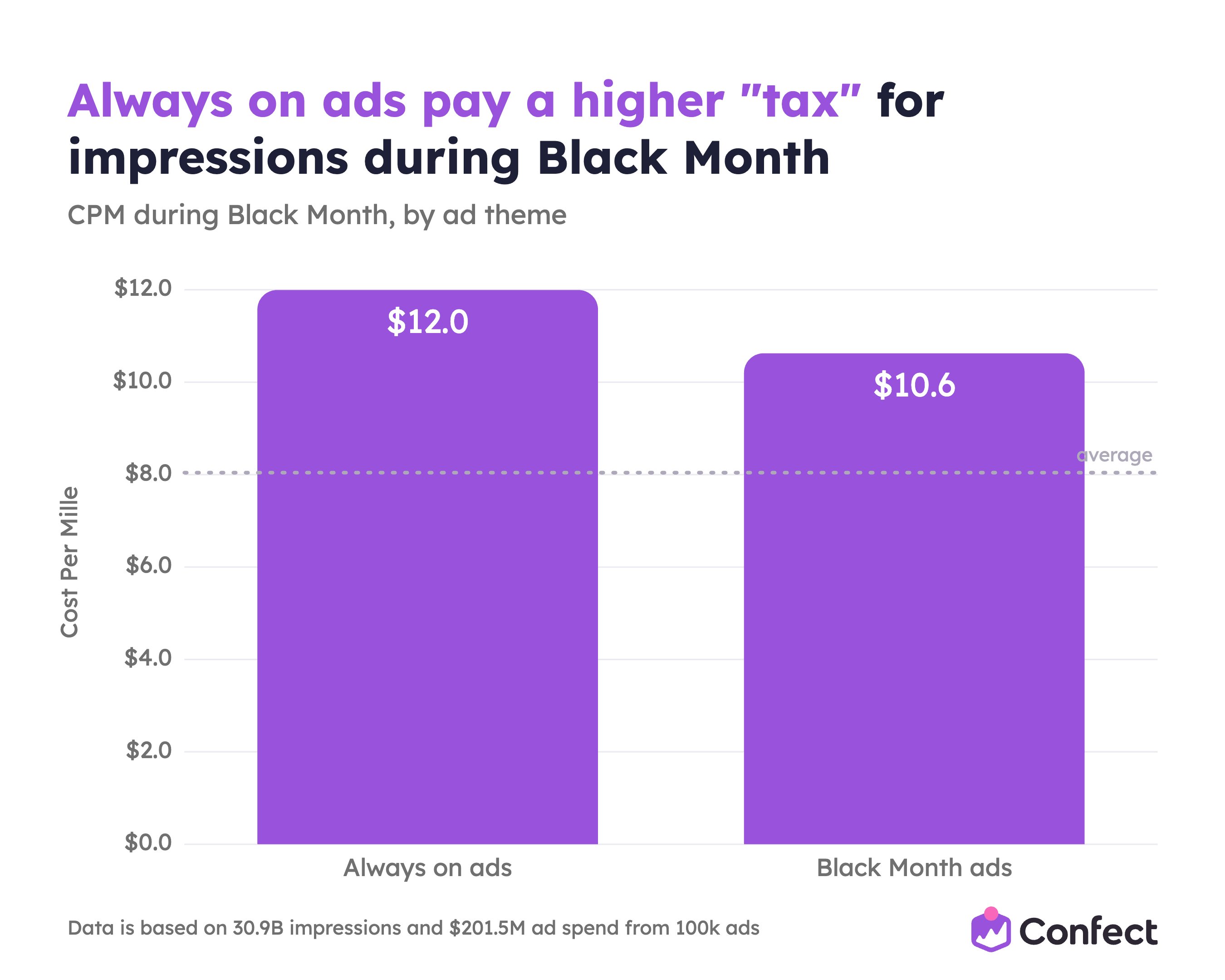
The always-on ad is worse on both lines. It pays 13% more for every thousand impressions than the ad built for the month, and it collects less than half the ROAS lift. It is not only that it performs worse. It is more expensive to run.
Why does an evergreen ad cost more to deliver? Because Meta prices delivery on how people respond. An ad that looks like every other week does not get the clicks and purchases the month is handing out, so Meta charges more to show it. Marketers who have run search ads know this as Quality Score: a great ad costs less to show than a mediocre one, because the platform wants to serve what people respond to.
The shopper's side is simpler. A shopper during Black Month is running a comparison, and an ad that does not acknowledge the month is not entered in it. The Black Month ad answers the question they are asking this week. The evergreen ad answers a question they asked in September.
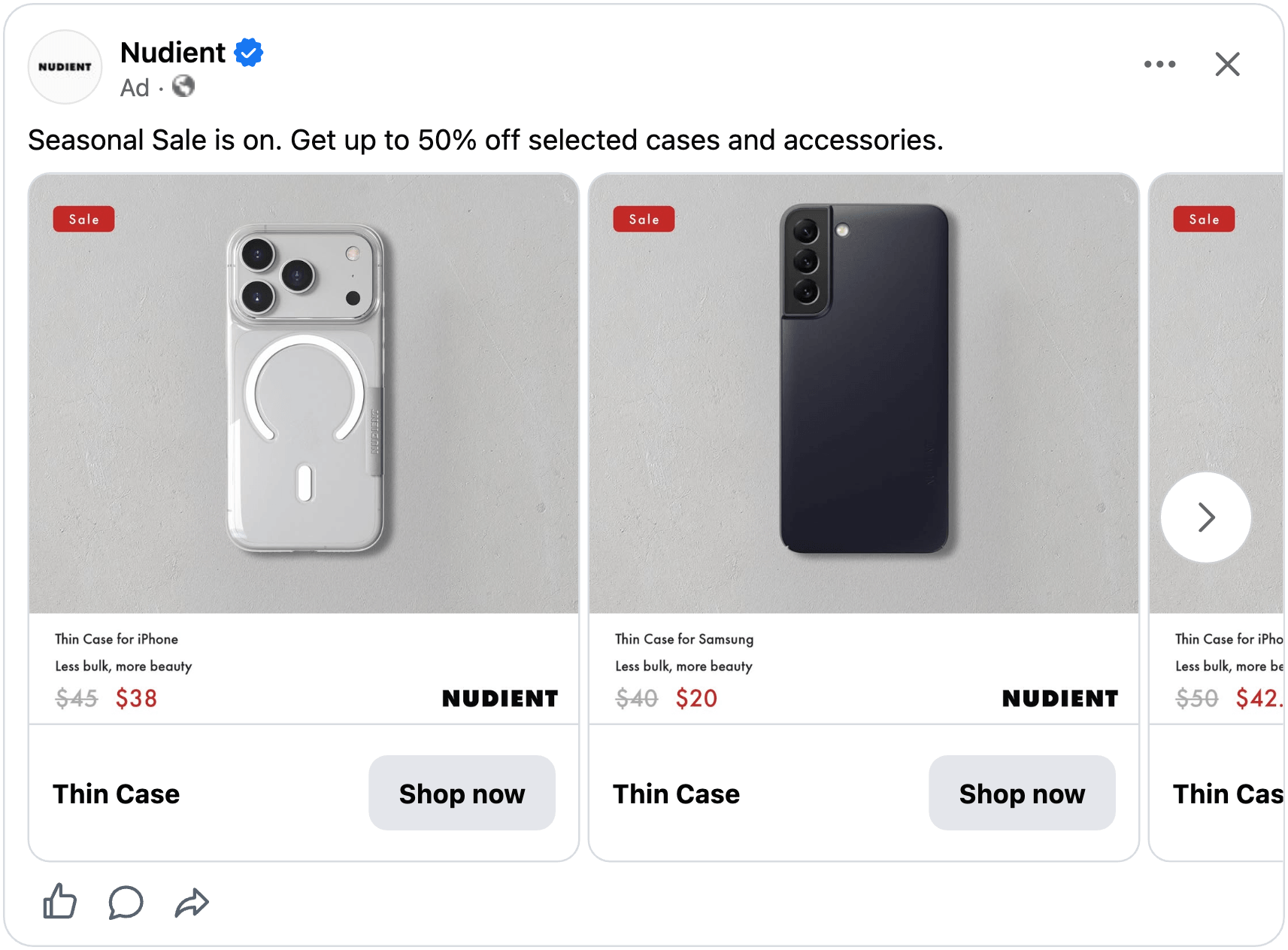
Here is the whole thesis in two ads from the same brand.
.png)
Same products. Same brand. One of them knows what month it is. (Every ad in this piece can be recreated for your own products in Confect's design assistant, if you want to skip the Photoshop.)
One more thing before we start cutting the data. Black Month is not one event. It is worth 82% more ROAS to an electronics shop and 3% to a food and drinks shop. It is worth far more to a brand selling its own products than to a multi-brand retailer, and more to a small shop than a large one. So we cut it by industry, price level, shop size, shop type and funnel position, so you can find the version of this that is about you.
Open Ads Manager and look at which of your Catalog Ads will still be running on 1 November unchanged. Every one of them is about to pay more per impression than the ads built for the month, and collect less than half the lift.
The fix is not a new campaign. It is a design that knows what month it is. Everything after this is about what that design should say.
Who wins Black Month: industry, size, price level and shop type
Black Month redistributes. It is worth more to the small, the mid-priced and the brand than to the big, the expensive and the retailer. And the reason is the same in every cut: the lift lives in conversion rate, not in attention.
By industry: electronics wins on basket size
ROAS lift during Black Month against the rest of the year, by industry: electronics +82%, home and furniture +39%, sports +33%, beauty and health +32%, fashion +29%, food and drinks +3%.
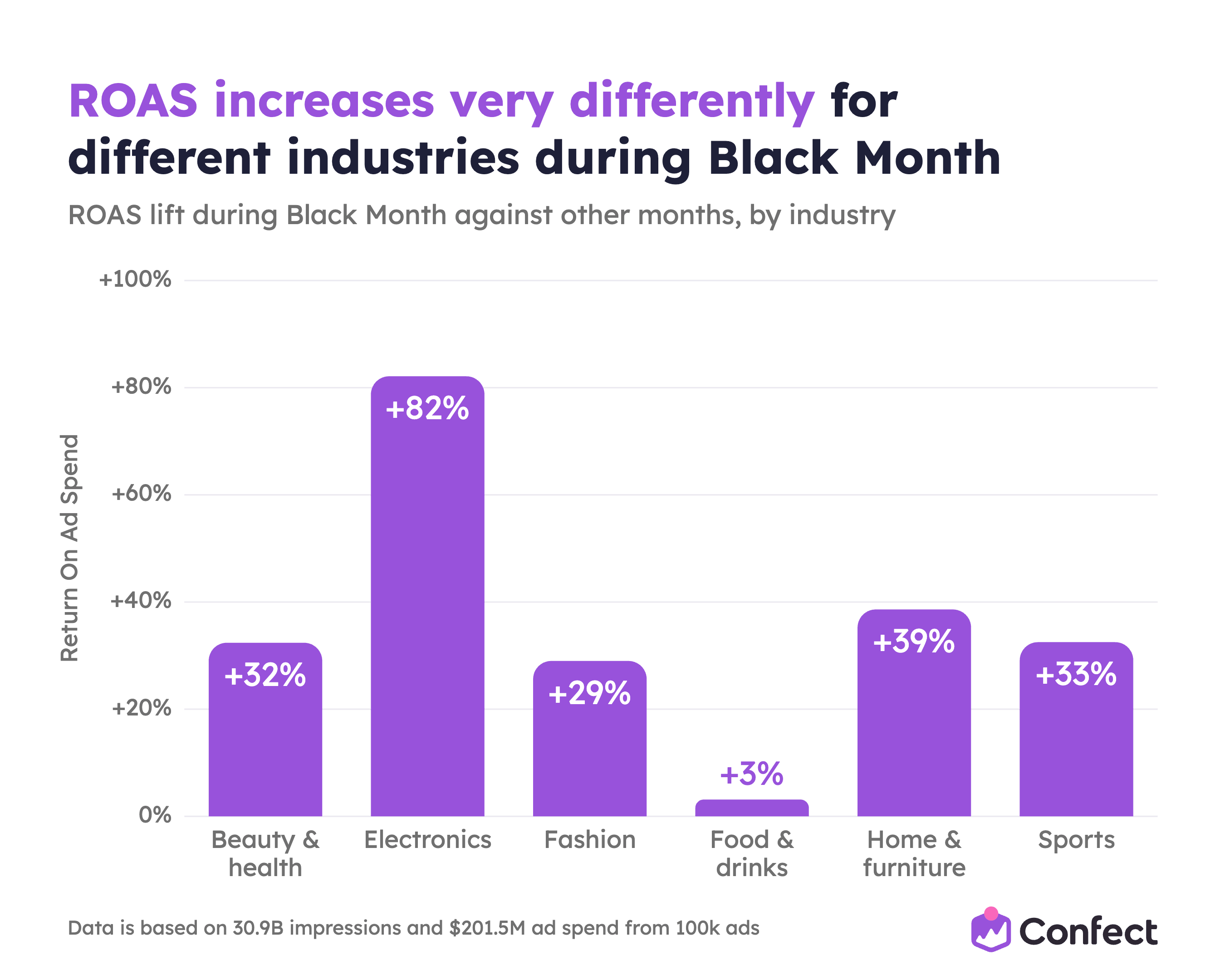
Read it as two levers. Click-through rate rises for every industry, so Black Month hands everyone more attention. Conversion rate rises everywhere too, but least for food and drinks.
What separates +82% from +32% is basket size. Electronics baskets grow 79%. Beauty baskets grow 2%. Beauty out-converts electronics and finishes 50 points behind on ROAS, and the whole gap is basket size.
Here is why. Black Month is a deferral market. People postpone the purchases worth postponing, the television and the sofa, and buy them in this window. And when they finally allow themselves to buy, they buy the big one. Behavioural economists call the waiting hyperbolic discounting turned on its head: people normally take the smaller reward now, and a dated discount window is strong enough to beat that instinct. Which tells you how much the deal is worth in the shopper's head.
Nobody postpones coffee for eleven months to get a quarter off it. That is why food and drinks gets the extra attention and almost none of the extra return.
By advertiser size: big shops win the click, small shops win the purchase
ROAS lift by advertiser size: small +32%, mid +30%, big +21%. Then the pair that explains it. Big advertisers win the clicks (click-through rate +26% against +17% for small advertisers). Small advertisers win the purchases (conversion rate +41% against +7% for big advertisers).
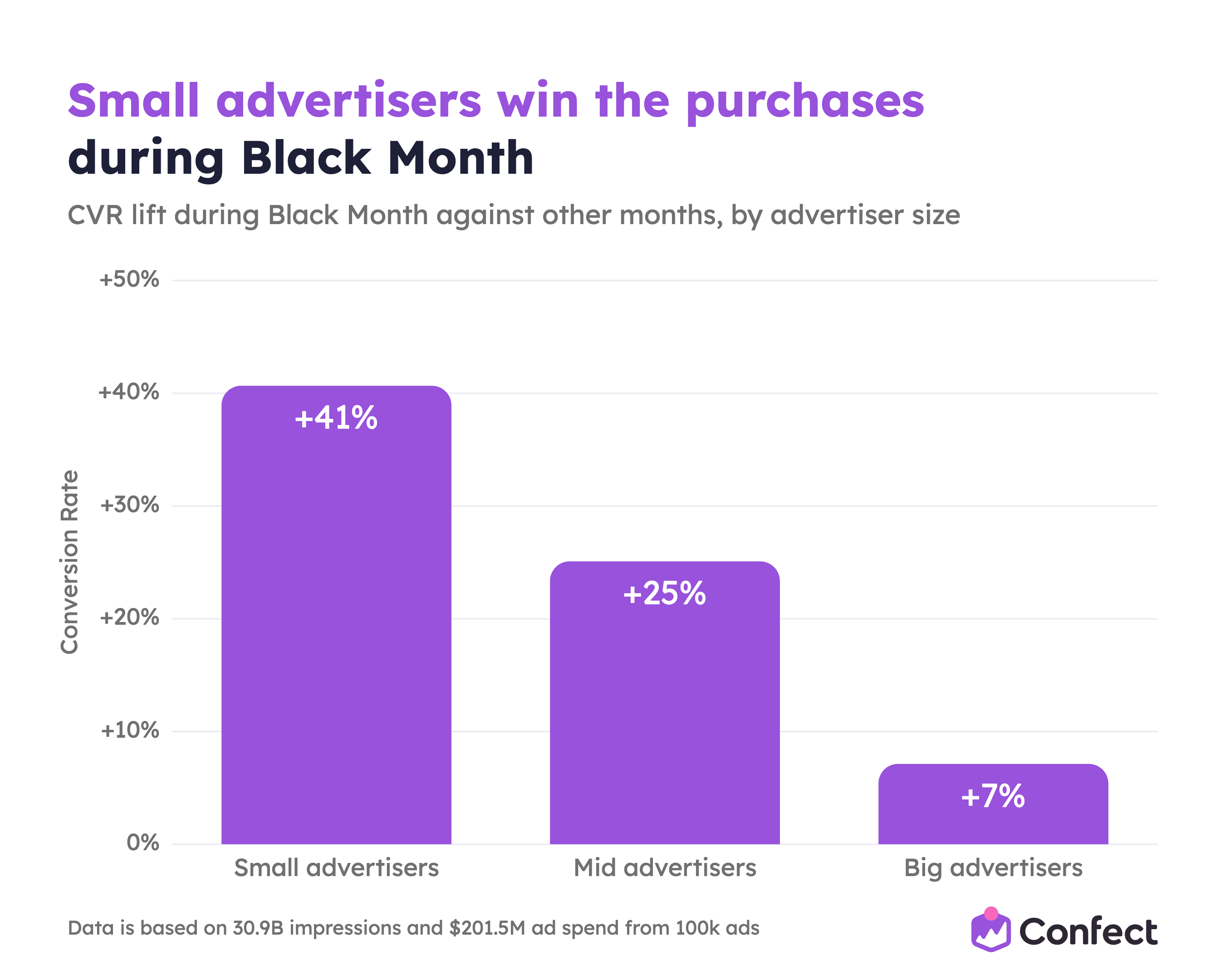
A big advertiser's advantage is being thought of first. Marketing scientists call it mental availability, and for eleven months of the year it is the moat. During Black Month the event does that job for everybody. For four weeks a second reason to enter the category appears next to "I need a new laptop", which is "what is on offer", and every advertiser is linked to that one equally.
People still click the names they know, to see the deal. Then they compare. And habit does not survive a side-by-side at 30% off. Click-through rate measures habit. Conversion rate measures preference. Black Month is the month that separates them, and big advertisers carry more of the first kind, because being the default is what being big means.
Big advertisers do keep one advantage: they pay the smallest CPM premium (+33% against +42% for small advertisers). A large budget spills into placements nobody is fighting over. A small one is spent entirely in the most contested inventory.
To be fair to the big shops: small advertisers gain most in relative terms, and big advertisers are still further ahead in absolute terms. This is about the size of the gain, not its direction.
By price level: mid-priced shops win on conversion
ROAS lift: affordable +22%, mid-priced +37%, high-end +20%.
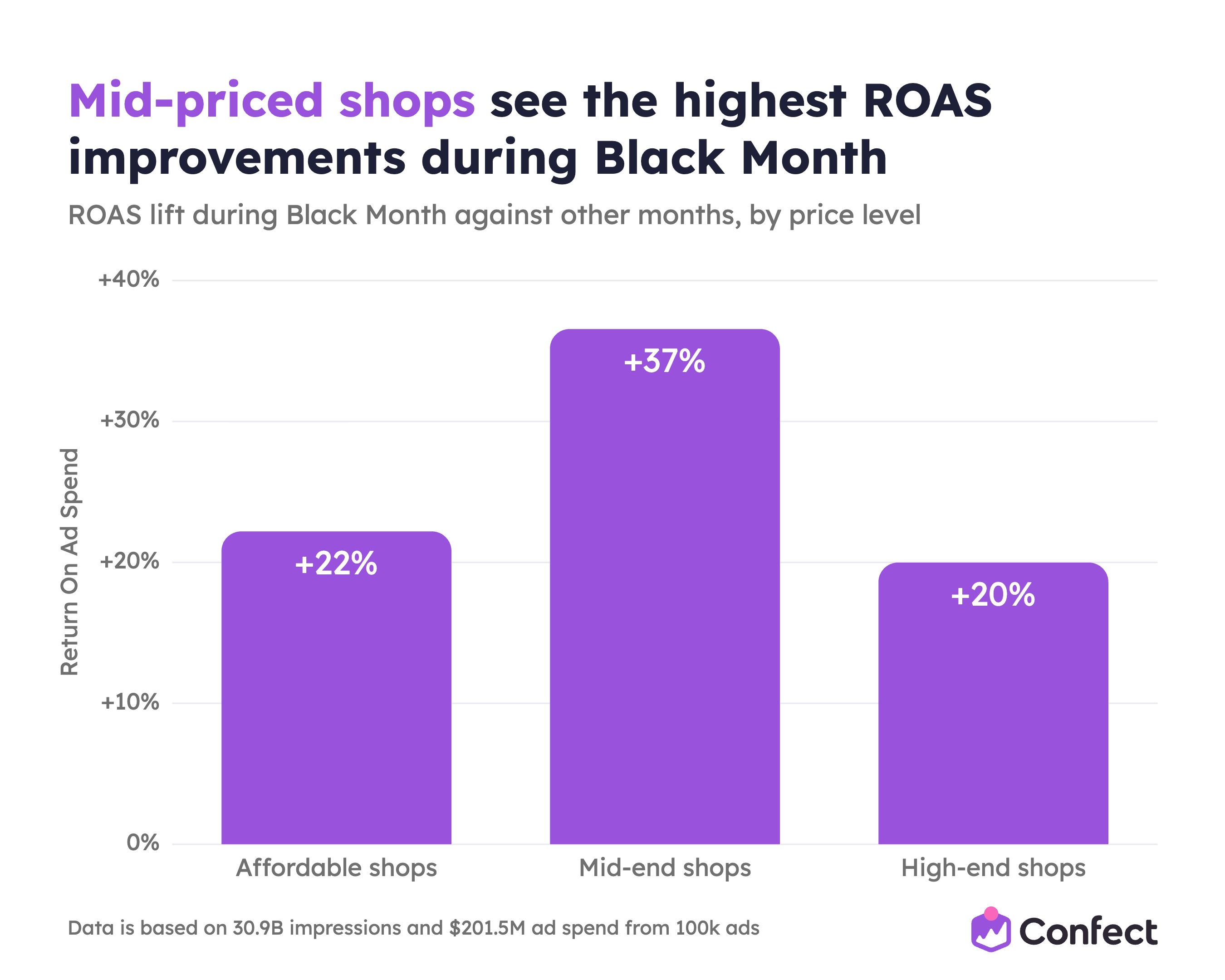
Mid-priced shops are last on click-through rate and last on basket growth, and they still win by 15 points. The entire advantage is conversion rate: +41% against +14% for affordable and +23% for high-end.
A discount closes the distance between wanting and buying, and Black Month hands every tier roughly the same discount. What differs is the size of the gap.
At a mid price, the discount and the objection are the same size. Take €120 to €85 and the hesitation disappears. At an affordable price there was barely a gap to close, so the discount funds a look at something one tier up. At a high-end price the gap is too wide for a discount alone. €900 to €675 is still €675, and it still needs sleeping on.
We saw the same shape year-round in our Andromeda study: mid-priced shops were the only price tier whose ROAS improved through the rollout. Black Month amplifies it.
One caveat on the high-end figure, and Michael Kors shows it.
.png)
No "sale". No percentage. No struck-through price. A starburst and a percentage belong to the discount code, visually, and they contradict everything a luxury brand has spent years building. So high-end brands invent a third vocabulary: membership, thresholds, gifts with purchase.
Some of them run their Black Month promotion in words the data does not read as a sale, which means the high-end figure is probably understated. If you sell at that level, we have a Tactic on exactly this.
By shop type: brands win, retailers get compared
Single-brand shops see a 40% ROAS lift during Black Month. Multi-brand retailers see 23%.
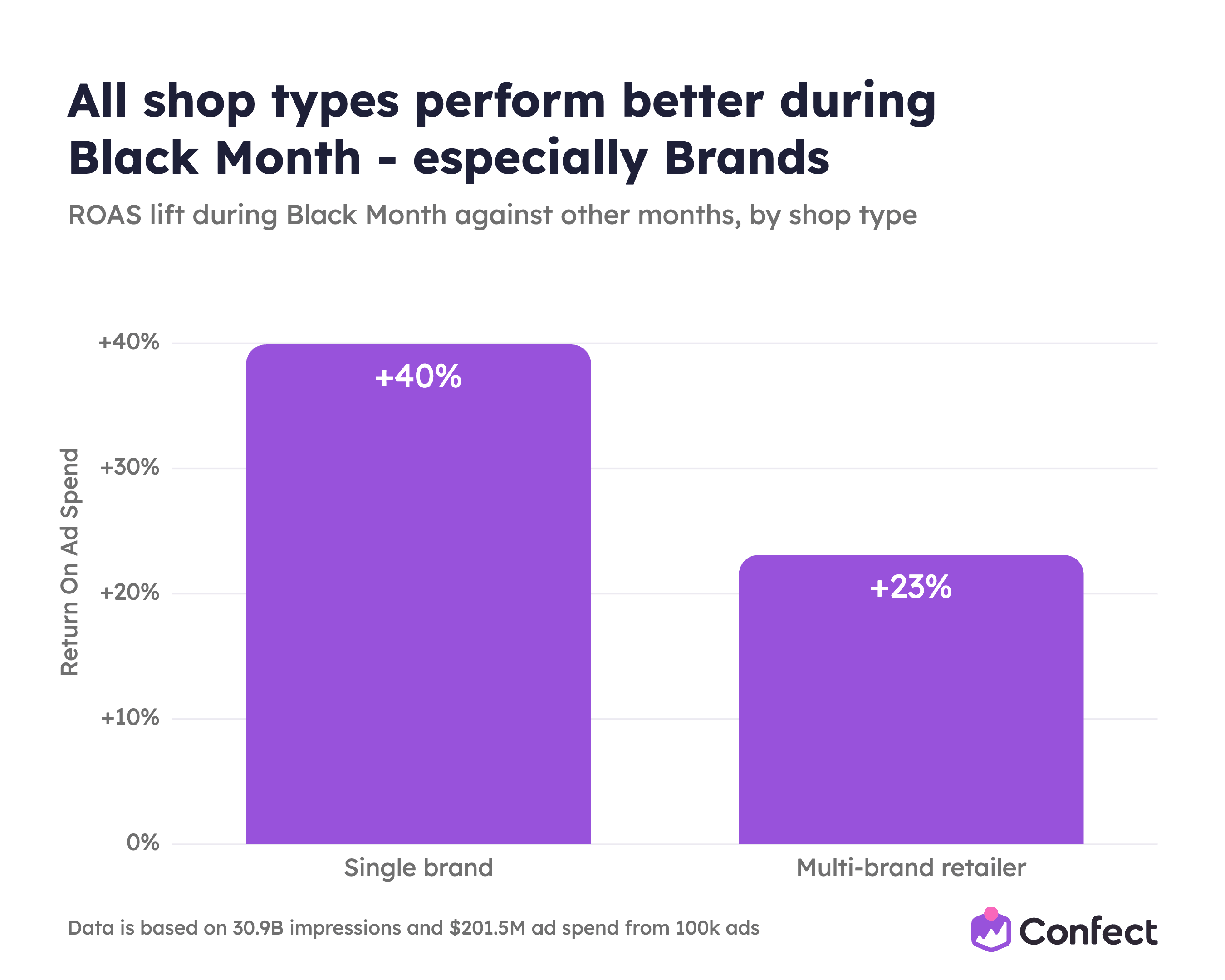
Again the advantage is conversion (+32% against +20%), not attention (click-through rate +21% against +18%). The deferred purchase is usually a named one. You do not wait eleven months for "a pair of trainers". You wait for the ones you already chose, and you buy them from whoever owns them.
A shopper who already knows what they want runs the search in their own head, and the brand wins that search by definition. A retailer faces the direct comparison a brand never has to. We have separate Tactics for brands selling their own products and for multi-brand retailers, and Black Month is where the difference between them shows most.
By average order value: the cheapest baskets grow most
ROAS lift: baskets below $100 +33%, $100 to $200 +23%, above $200 +11%.
Basket growth is what Black Month hands out (+10%, +6% and +5% respectively down the tiers). A shop already at the top of the range has the least headroom left to collect. Its structural advantage is the exact thing the month gives everyone else.
Work out which of these you are before you write a single ad, and be honest about it.
A large, high-end, multi-brand retailer should plan Black Month as a defence. You are the shop being compared against, and your habitual buyers are the ones being tempted. A small, mid-priced brand selling its own products should plan it as the best four weeks of the year to be seen by strangers, and spend like it.
Your catalog decides a lot of your Black Friday results
Two decisions you make in October decide a lot of your Black Month: how many products you let Meta advertise, and how much of your Meta budget goes to Catalog Ads. Both pay most in prospecting, and both work the same way.
Catalog size
Against the average Black Month Catalog Ad, catalogs with fewer than 500 products return 21% less ROAS, and 31% less in prospecting.
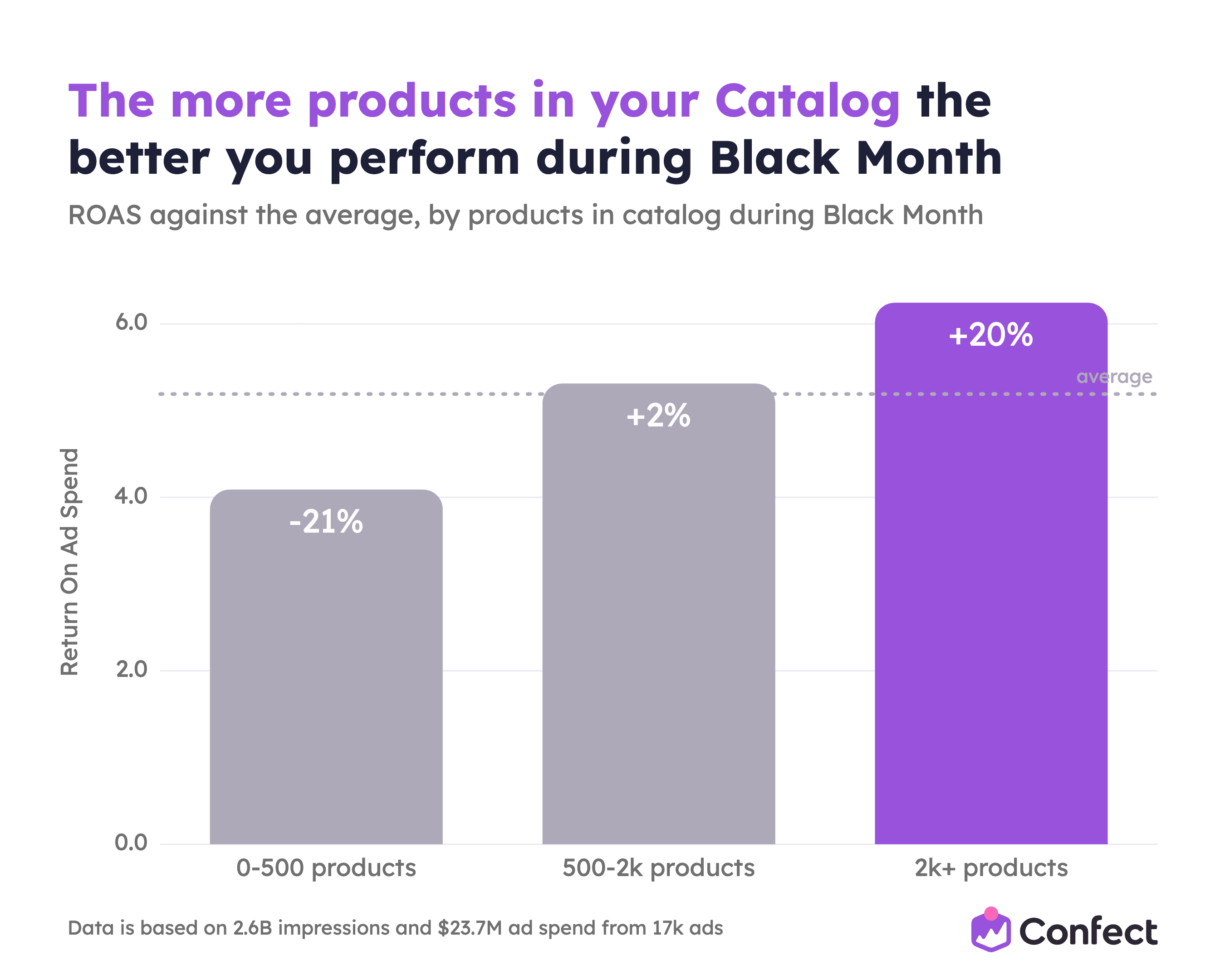
Catalogs with more than 2,000 products return 20% more, and 32% more in prospecting. The 500 to 2,000 tier sits at the average.
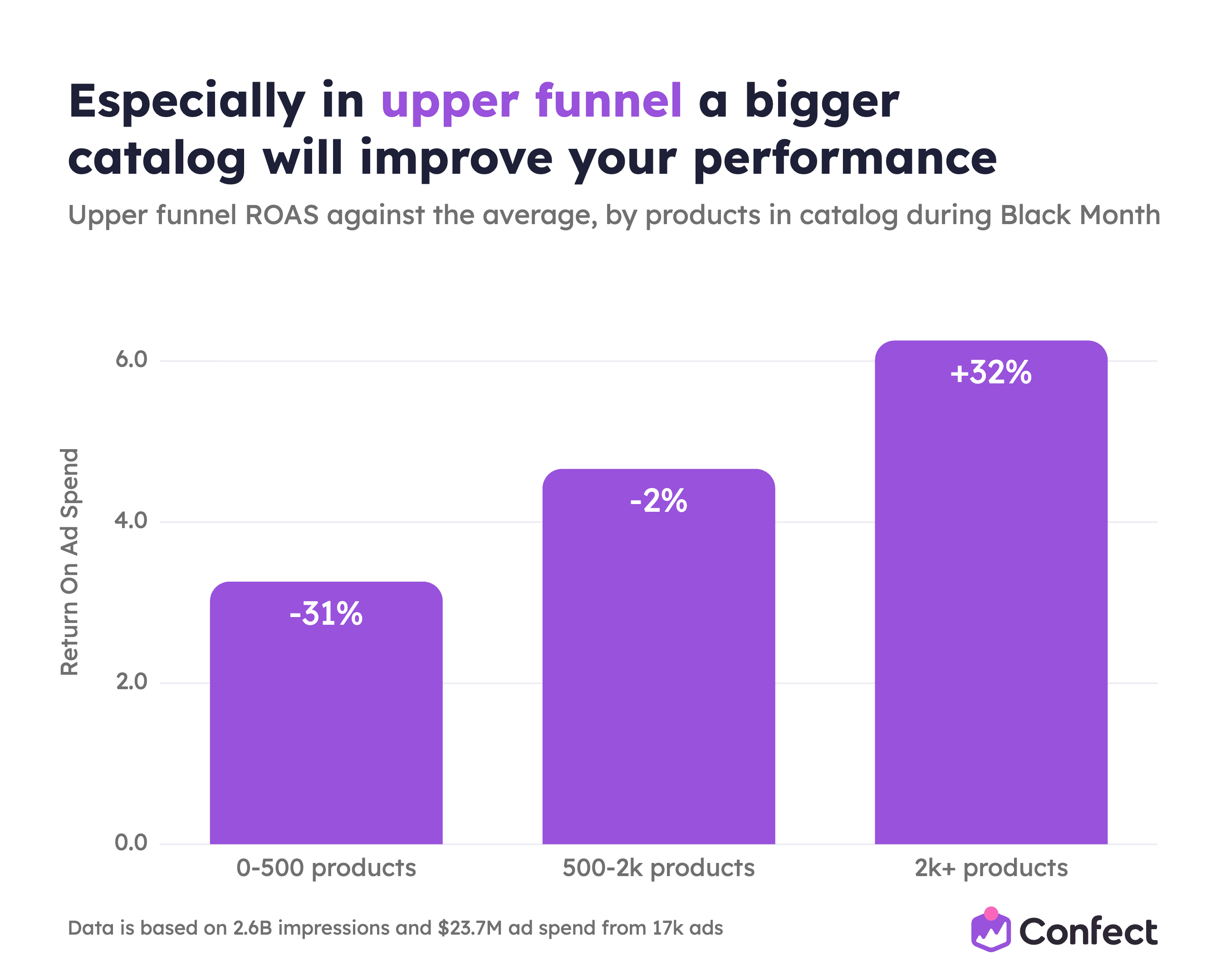
A 63-point spread in prospecting on nothing but catalog breadth.
Catalog Ads share of Meta spend
Advertisers spending under a third of their Meta budget on Catalog Ads return 9% less than the average Black Month Catalog Ad, and 24% less in prospecting. The middle tier sits around the average. Above two-thirds it is +4% across the month and +5% in prospecting.
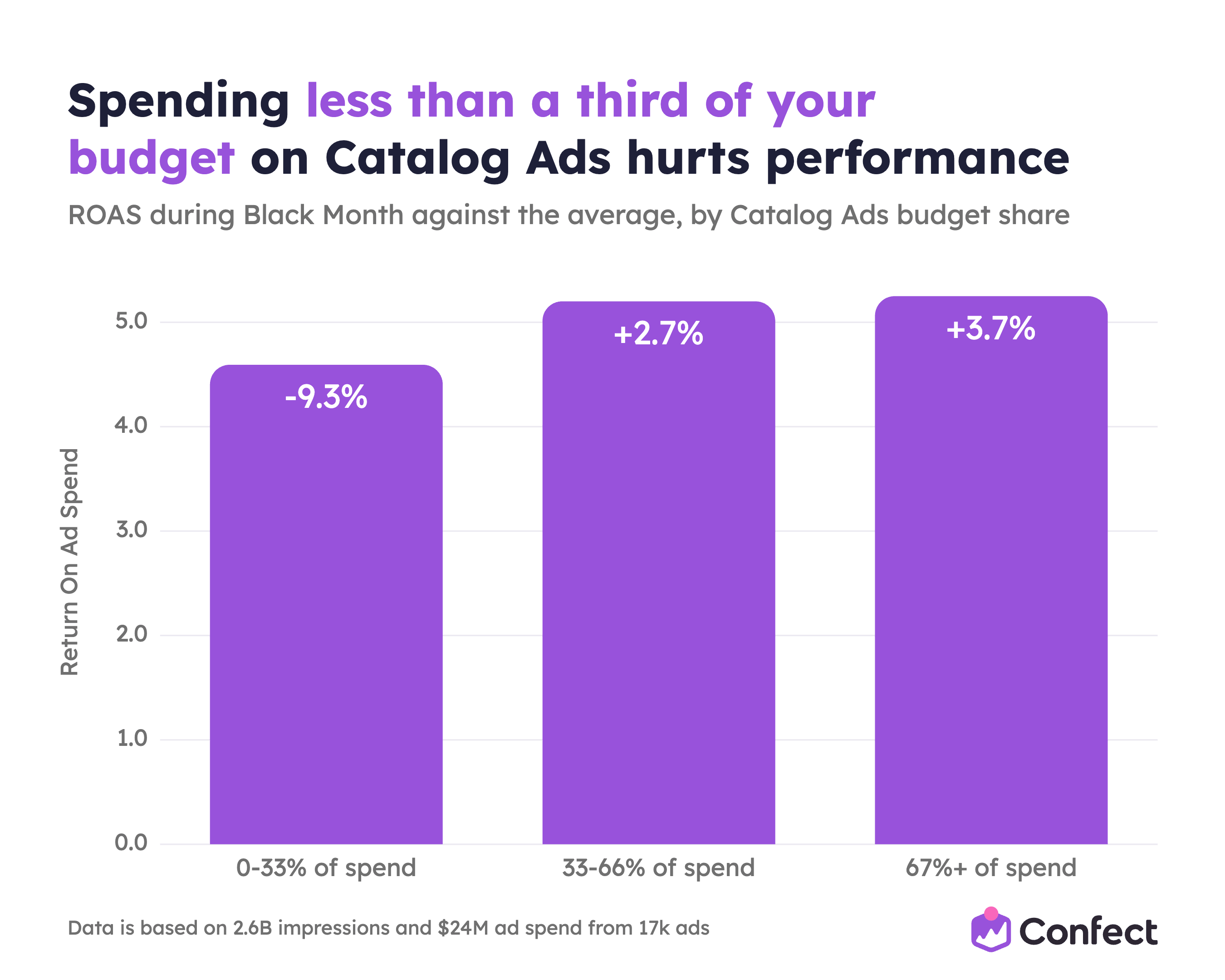
This one is deliberately the less dramatic of the two. The honest reading is that the penalty sits at the bottom, not a reward at the top.
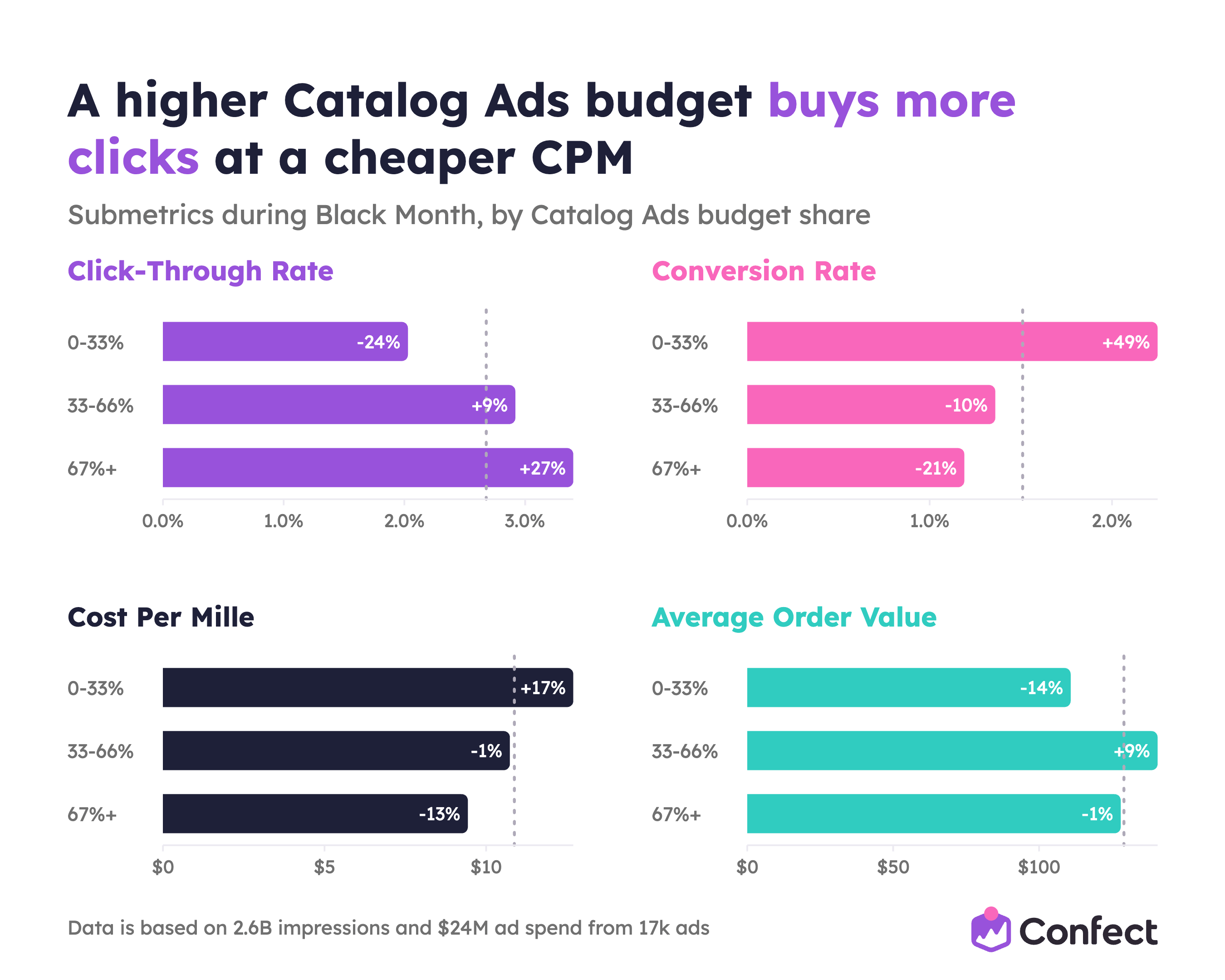
Read the conversion rate out loud
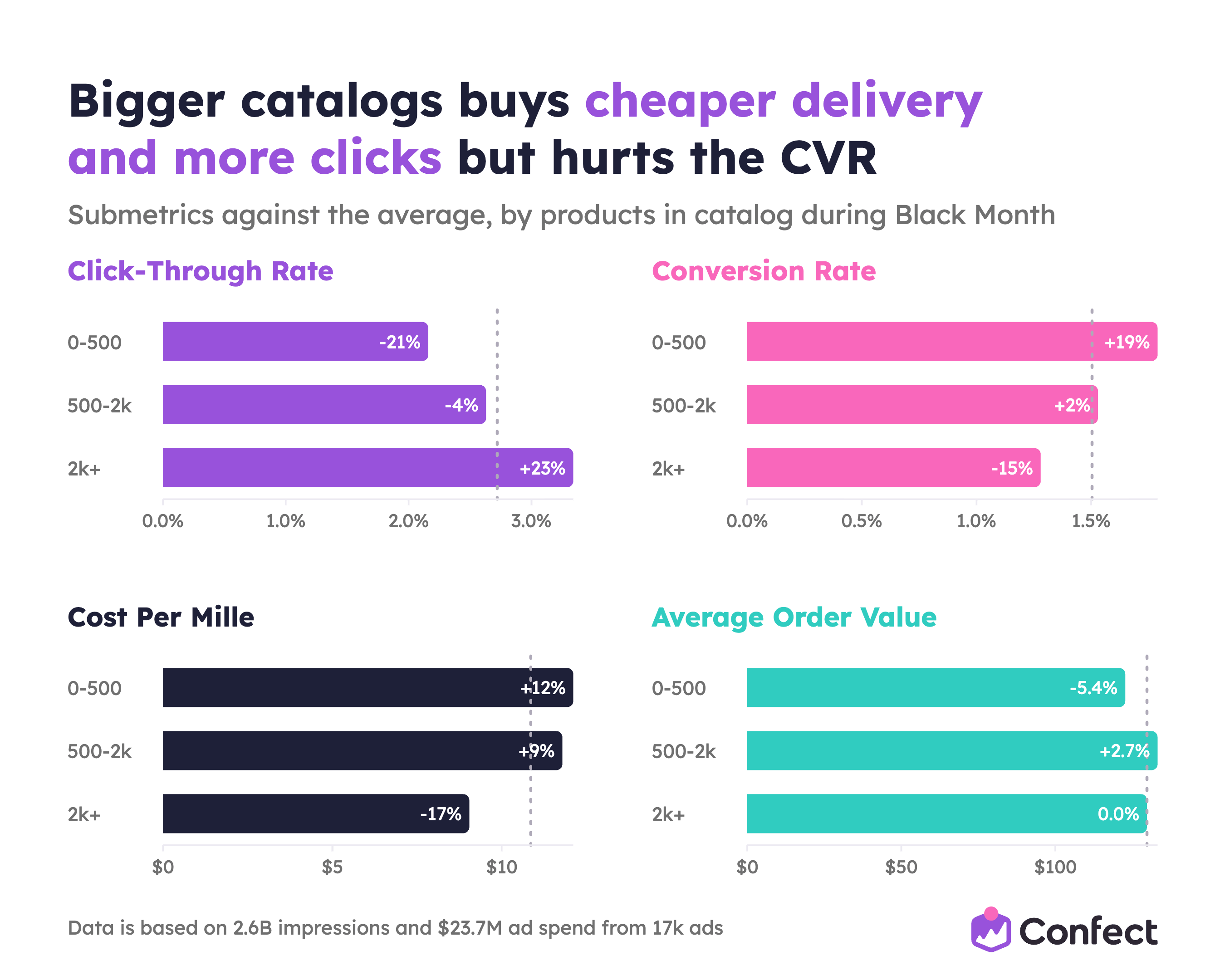
In both charts conversion rate moves the wrong way while ROAS moves the right way. Catalogs under 500 products convert 19% better than the average and catalogs above 2,000 convert 15% worse. Advertisers spending under a third on Catalog Ads convert 49% better and those above two-thirds 21% worse. That is the objection and the mechanism at once.
A shop with 300 products is the specialist in something, and its traffic arrives qualified. A shop with 8,000 products is nobody's specialist, so the traffic Meta brings is broader and a smaller share of it is ready to buy. But the broad shop delivers cheaper, wins far more clicks, and ROAS lands on the side of breadth.
You take that trade every time during Black Month. It is the month with the most people in market at once, and breadth is what lets Meta find the right product for each of them.
Why the format wins the auction
A static ad is one creative that has to work for a million people, and it cannot. A catalog with 5,000 products is 5,000 creatives. And it is more than that, because every one of them carries structured data.
Meta knows what each person in the auction is interested in. With a Catalog Ad it can filter straight down to the product that matches: brand is Nike, product type is running shoes, colour is red, on sale is true, price is below $100, age group is adult, gender is men. No static ad can do that. No static ad account has 5,000 of anything.
More relevant ads earn more clicks, and Meta charges less to deliver ads people engage with. That is the click-through rate and CPM in both charts (the biggest catalogs win 23% more clicks at 17% lower CPM, the heaviest Catalog Ads spenders 27% more clicks at 13% lower CPM), and it is the same mechanism arriving from two directions: more products and more Catalog Ads budget both give Meta more to match with.
Since Andromeda, this is how Meta's retrieval works all year. Every product is a distinct creative it can match, so a catalog is thousands of retrieval tickets and a static account is a handful. In the Andromeda study, advertisers with 5,000 or more products held the highest ROAS through the rollout, and advertisers putting 60 to 100% of their spend into Catalog Ads ran 44% higher ROAS than those under 30%. Black Month is that finding with the volume turned up.
One correction to the likeliest misreading of the last section. Small advertisers gain more than big ones. Clever advertisers do not gain more than plain ones. Every form of cleverness this dataset measures makes things worse during Black Month: trimming the catalog costs 21%, starving Catalog Ads of budget costs 9%, and narrowing the audience (next section but one) costs 19%. What wins is having products people want, being matchable, and selling well in the frame.
Check what is excluded from your catalog for tidiness. Black Month is the month that decision costs you most: the spread between the widest and narrowest catalogs in prospecting is 63 points of ROAS.
Then check your Catalog Ads share of Meta spend. Under a third is the only tier that loses, and it loses hardest exactly where the Black Month opportunity is.
Branding before Black Month pays off during it
Advertisers who bought more than purchases before Black Month got a materially better Black Month on their Catalog Ads. And the objective that pays best flips between the two periods.
Compare Black Month Catalog Ads from advertisers who buy purchases only with those from advertisers who also invested in traffic, engagement or awareness campaigns. The second group returned 39% more ROAS.
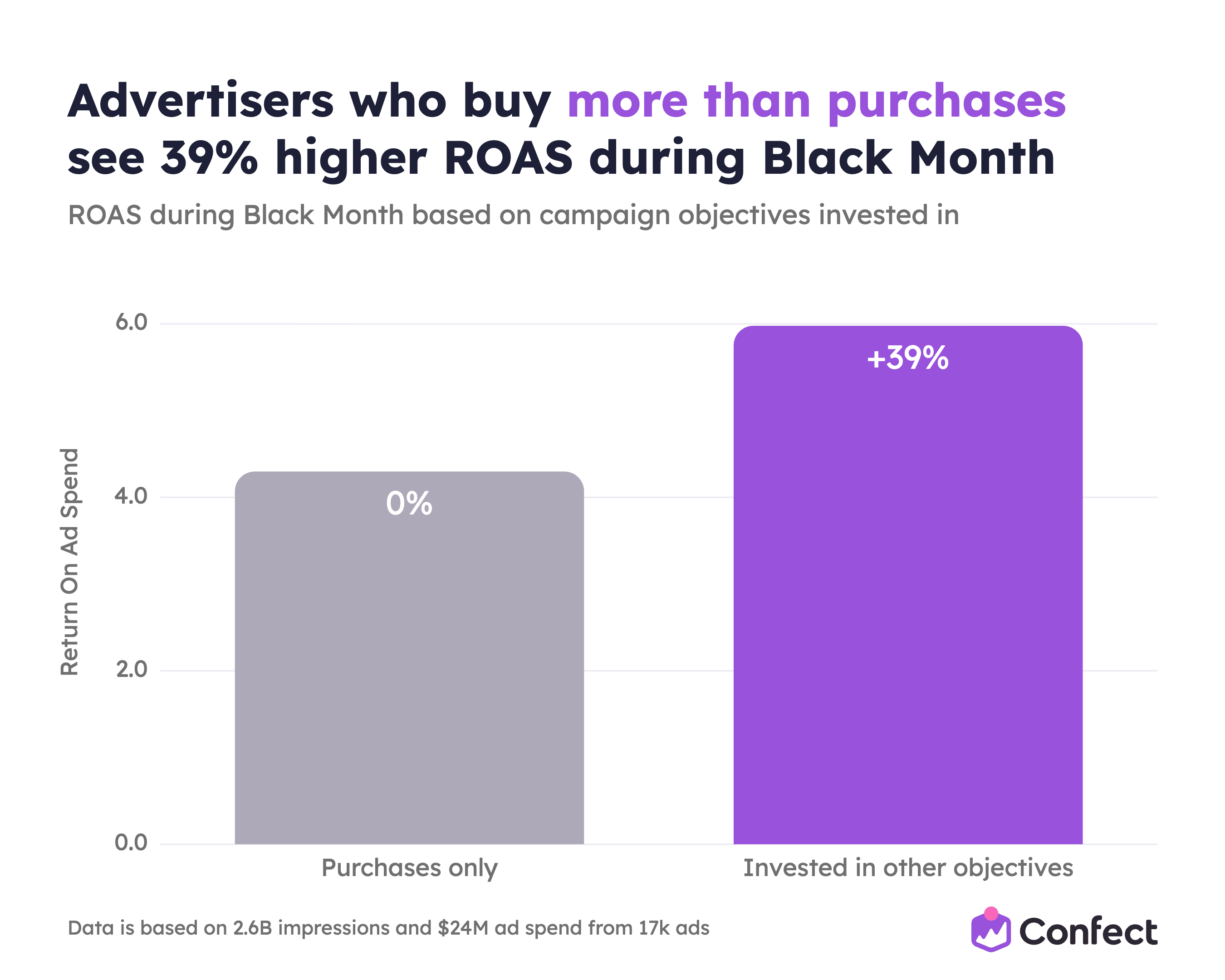
What the 39% is made of: a 22% bigger basket and a 6% cheaper CPM, paid for with a 17% lower conversion rate. A bigger basket and a cheaper auction, funded by a colder pool.
The flip: awareness outside Black Month, traffic inside it
Split the same comparison by which objective the advertiser also bought, against advertisers buying purchases only. Traffic goes from +55% outside Black Month to +69% inside it. Engagement goes from +58% to +62%. Awareness goes from +60% to +25%.
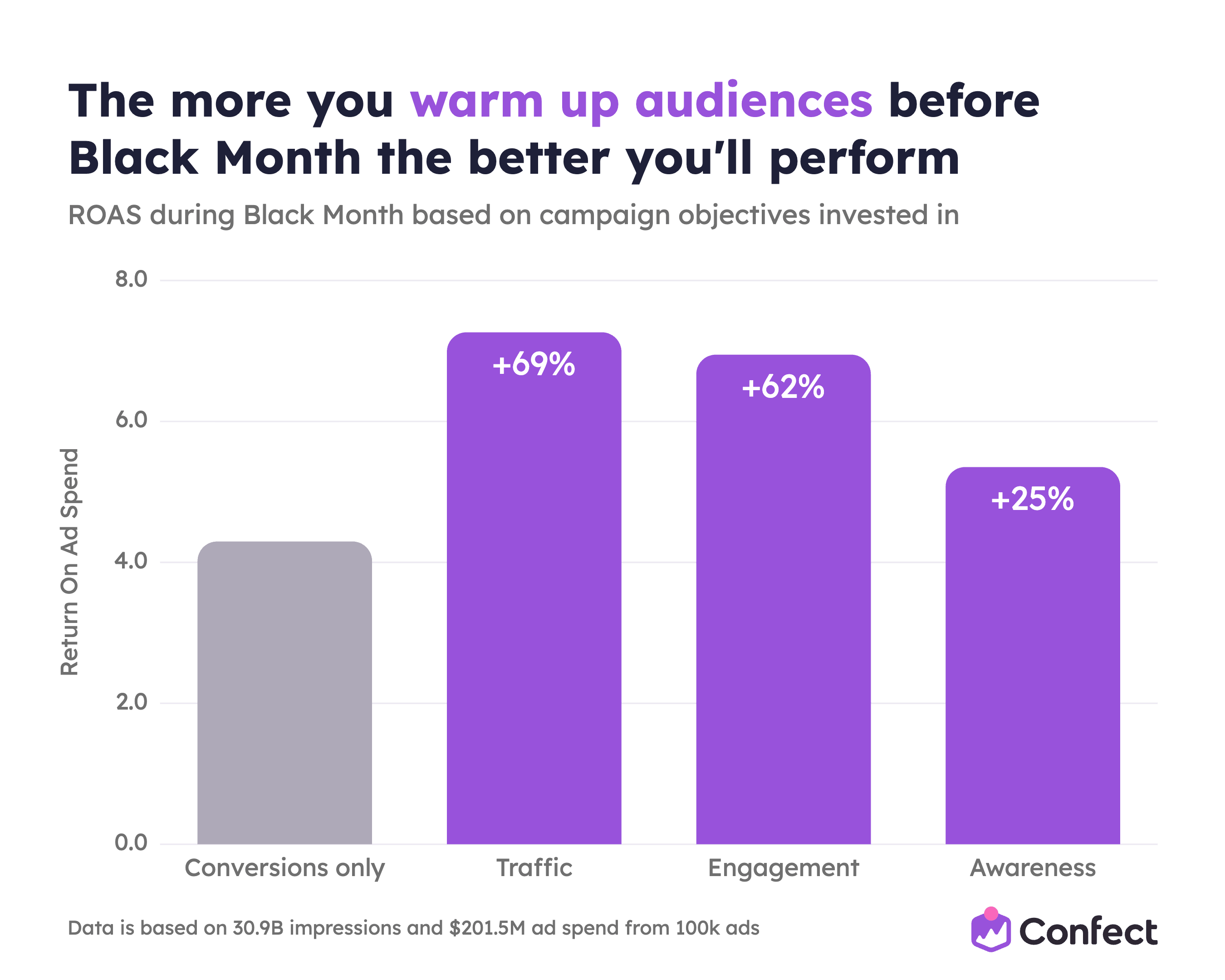
Outside the month, awareness is the best thing to have bought. Inside it, awareness loses most of its edge and traffic becomes the best thing to have bought.
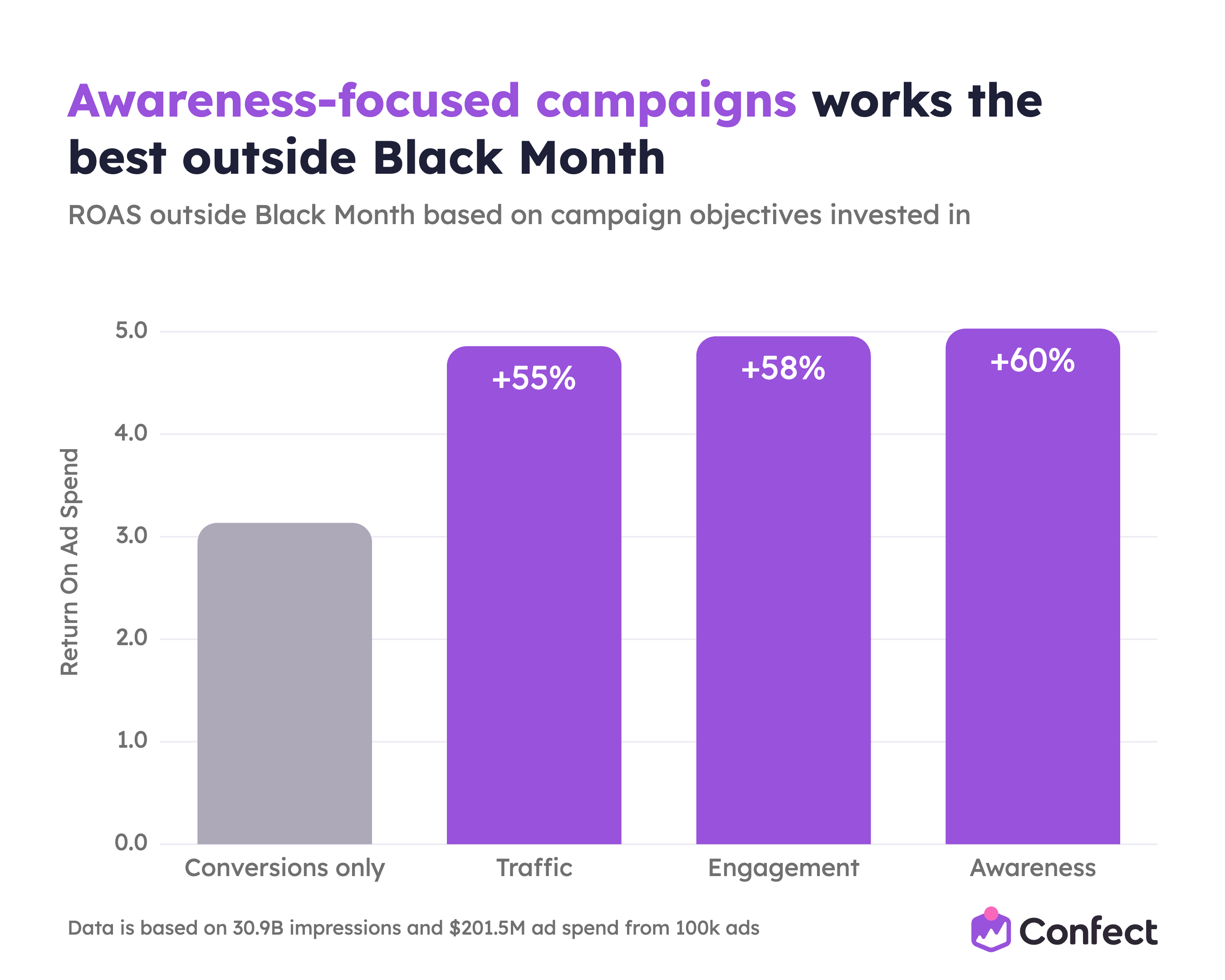
Outside the peak you are buying memory, and memory pays back over months. Inside the peak you are buying a shortlist for the algorithm, and it pays back this week. A person who clicked through to your site in October is a name Meta can find again during Black Month. A person who watched your brand video is a feeling with no address attached.
Binet and Field's split between brand-building and activation still holds. It just moves with the calendar.
The conversion rate drop is worth three sentences. What you bought was a bigger, colder pool, so more of the clicks are curious rather than committed. A warmed audience during Black Month is warm to everyone, because there is no loyalty premium in a month where every shop in the category is discounting. And some of those purchases happen through email or direct, where Meta never sees them. None of it matters, because the bigger basket and the cheaper CPM pay for it several times over.
What a big brand gets to do with it
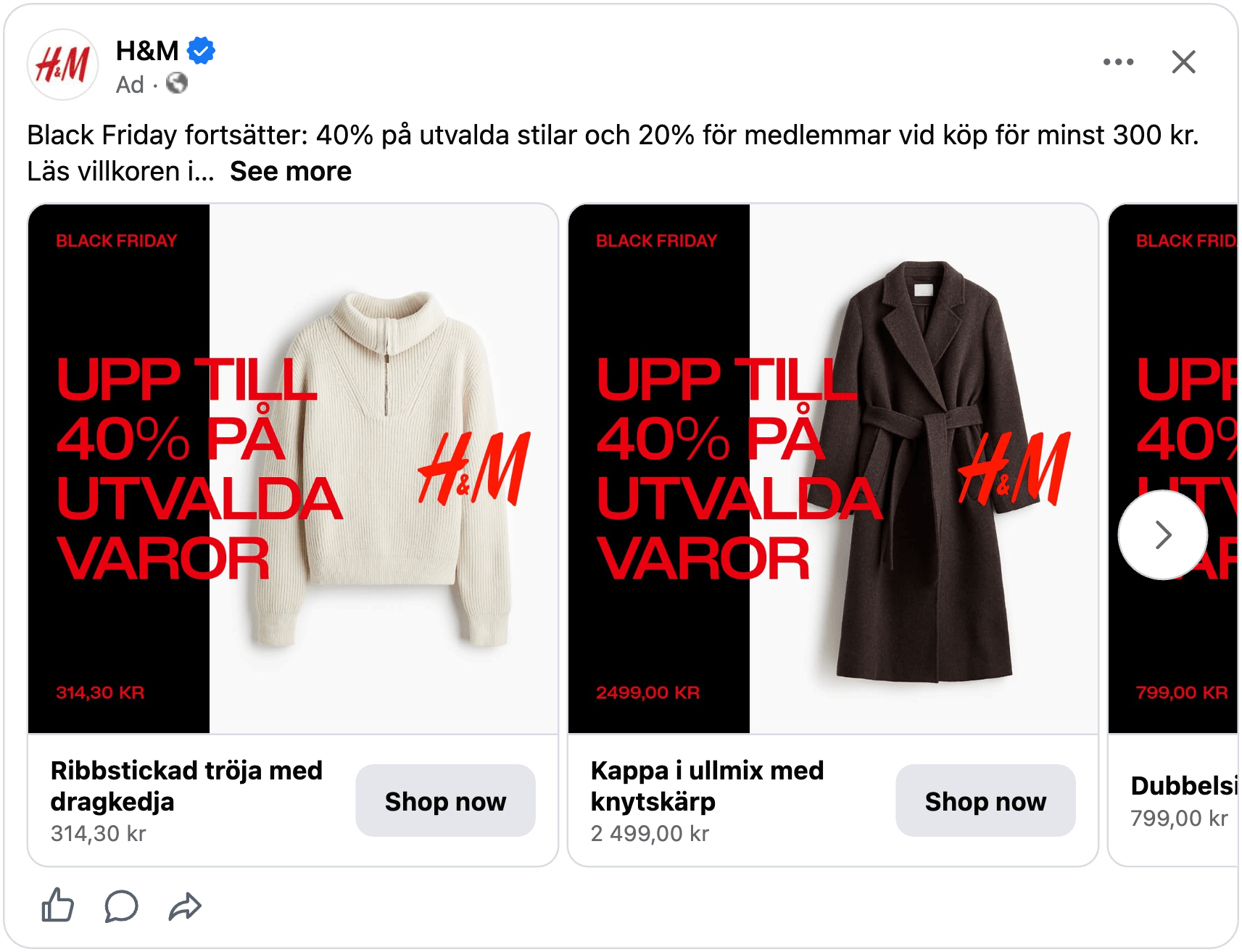
H&M is the kind of advertiser the +39% describes: a brand people already know from everywhere else. And the ad shows what that buys you during Black Month. When everybody already knows who you are, the design has less to prove about the brand (it still matters, just less) and can spend all of its space on making the deal look as good as possible. Black panel, red type, one number. Nothing to explain about who they are, everything to gain from how good the offer looks.
The cheapest Black Month lever there is: a traffic campaign running through October.
It has to exist before the month starts. You cannot build the audience during Black Week, and the advertisers who never built one are the ones whose Catalog Ads are 39% behind.
Audience targeting costs 19% of ROAS during Black Month
Manual audience targeting costs 19% of ROAS during Black Month and takes almost every other metric with it.
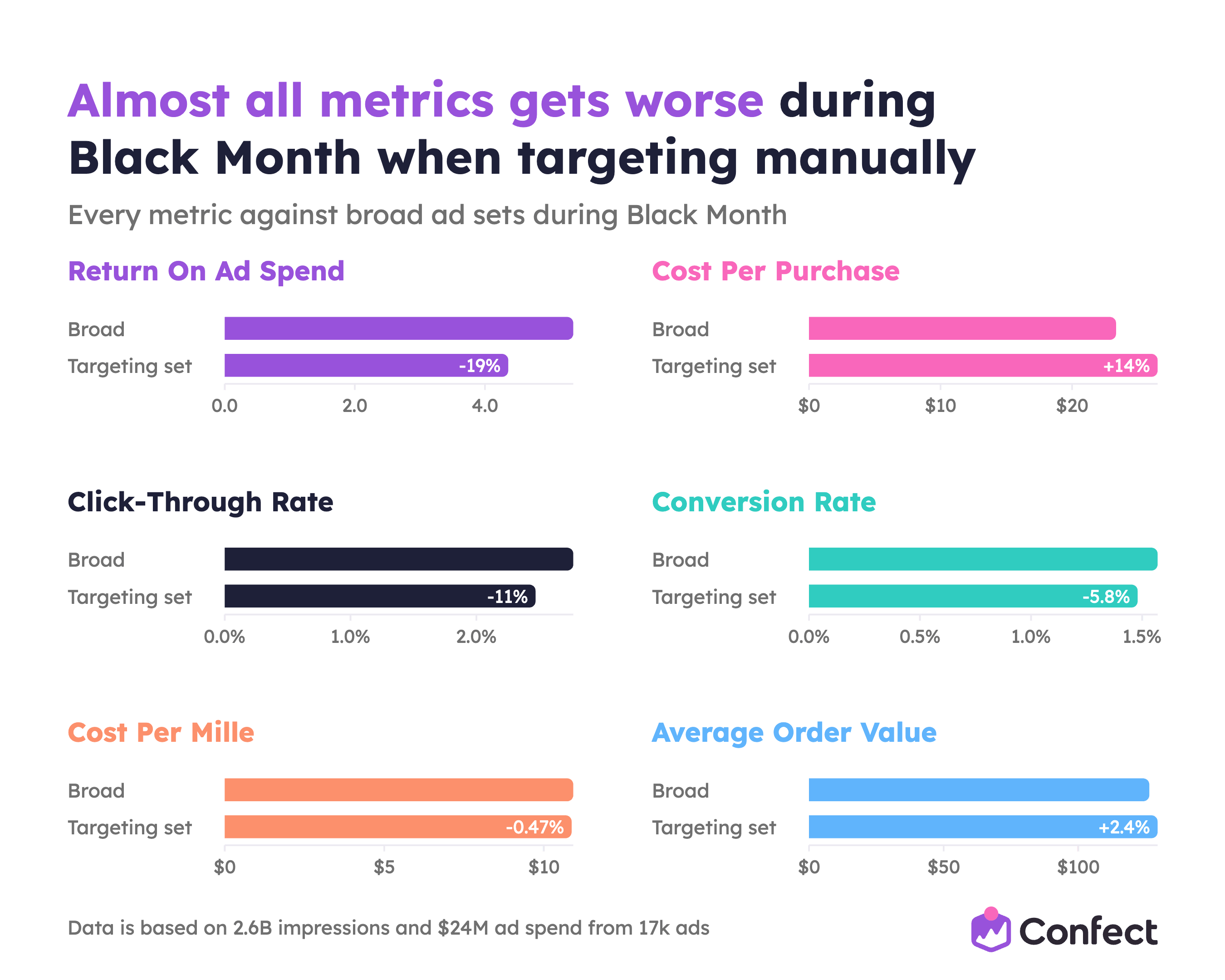
Against broad ad sets during Black Month, ad sets with manual audience targeting return 19% less ROAS. Cost Per Purchase is 14% higher, click-through rate 11% lower and conversion rate 6% lower. CPM and basket size barely move, which means the targeting is not even buying you a cheaper or better-quality impression. It is only buying you fewer of the right people.
Say it precisely, because "turn off targeting" is easy to misread as "stop being targeted". You should still be targeting during Black Month. Through the design and through the product set, not through the audience selector. Meta is now better at working out who wants a pair of running shoes than you are. The useful thing you can give it is a great ad about running shoes, not an instruction to only show it to women aged 18 to 24.
Three reasons, in this order.
The first is general. Since Andromeda, Meta matches creatives to people rather than audiences to ads, so an audience setting is a restriction on a system that already knows who to show the ad to. Every filter you add is a set of buyers you told Meta not to find. Interest targeting has become more of a soft suggestion than a hard filter, and the independent numbers point the same way: data from Lebesgue puts broad targeting at 49% higher ROAS than lookalikes.
The second is the window. A narrowed audience has less to learn from and less room to explore, and a two-week campaign never gets the time to compensate.
The third is the Black Month reason. A lot of the buyers are not the people who will use the product. Christmas shopping starts inside Black Month, so a jewellery brand that sells to women all year sells to more men, and a gaming PC goes to a parent. The demographic assumptions built from a year of buyer data are least reliable exactly then.
Open your Black Month ad sets and take out the age and gender filters. Then put the targeting back where it belongs, in the product set and the design.
Even if you are certain your buyer is a woman aged 18 to 24, telling Meta that costs you a fifth of your return during Black Month. The algorithm already knows who is buying, and a lot of them are buying for someone else.
Ad formats: the one thing Black Month does not change
After four sections of things to rethink, a release of pressure. Format is the one thing Black Month leaves alone. The three formats are level on ROAS, they buy different things underneath, and the difference only matters once you split by funnel.
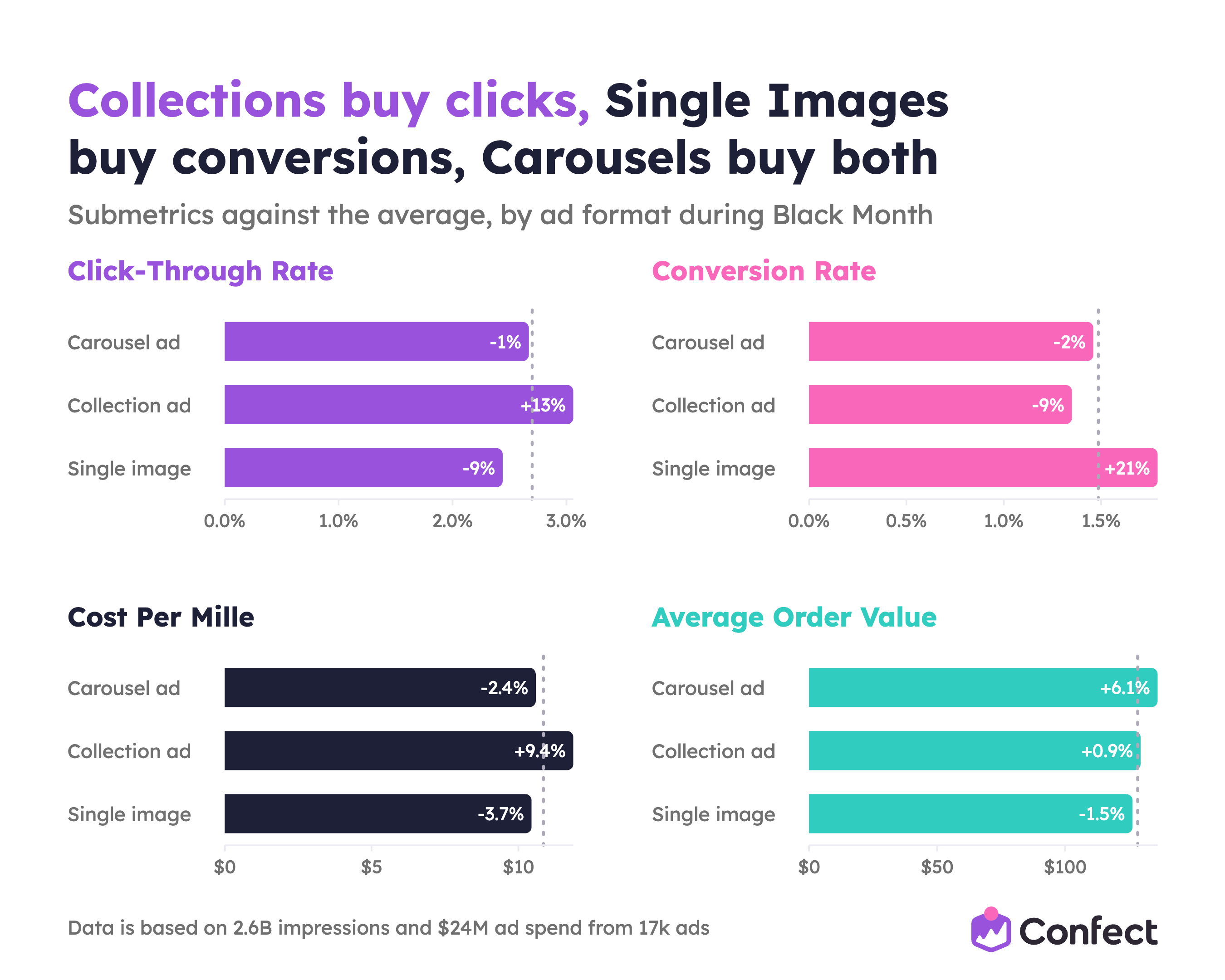
Against the average Black Month Catalog Ad, carousel returns +8.8% ROAS, collection +0.5% and single image +0.8%. Underneath, they buy different things. Collection wins clicks (click-through rate +13%). Single image wins conversions (conversion rate +21%). Carousel builds the biggest basket (average order value +6%).
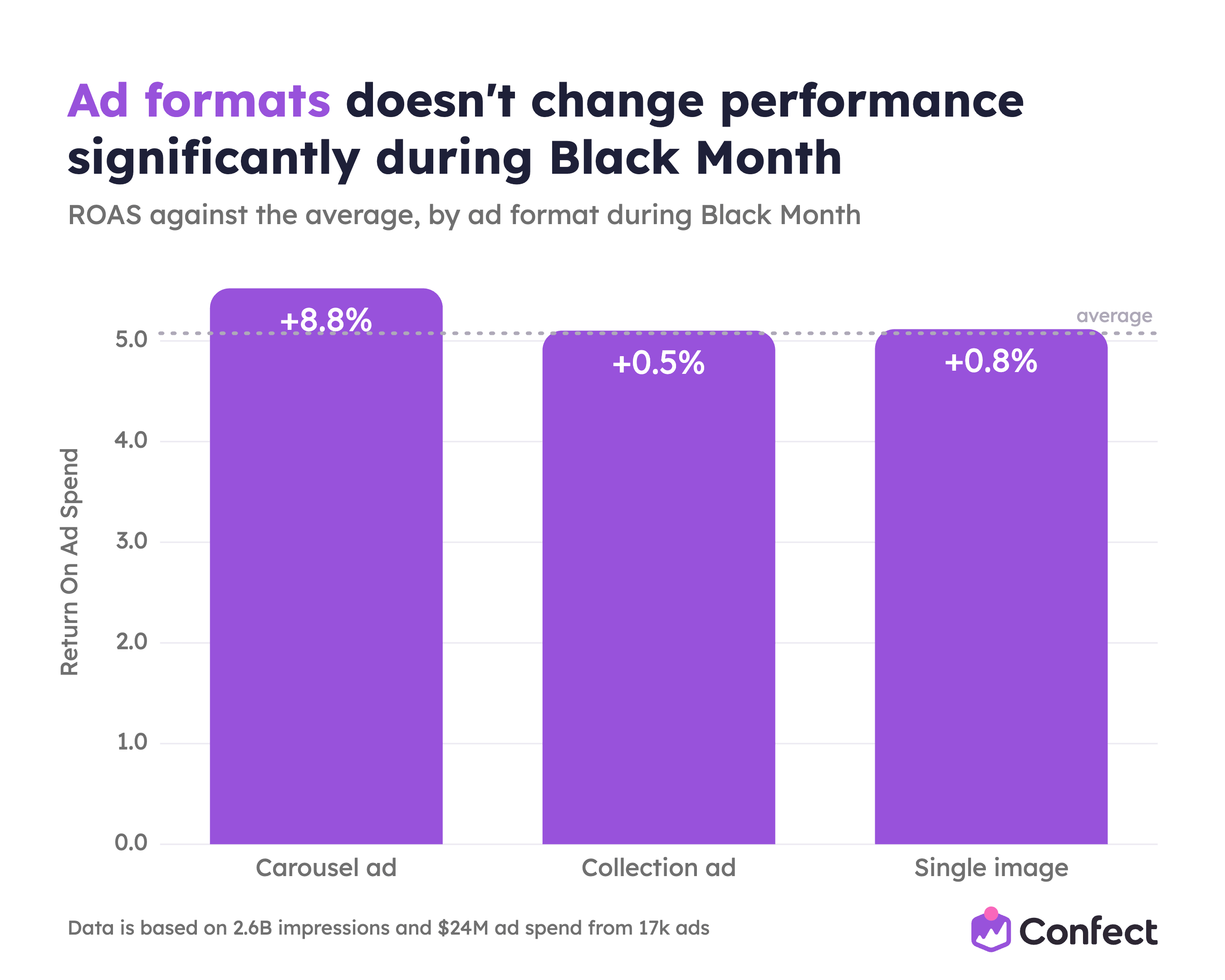
Collections buy clicks. Single images buy conversions. Carousels buy a bit of both and quietly build the biggest basket.
Split by funnel, against the average Catalog Ad in that funnel position: carousel is +5% in prospecting and +8% in retargeting. Collection is -3% and -13%. Single image is -25% in prospecting and +9% in retargeting.
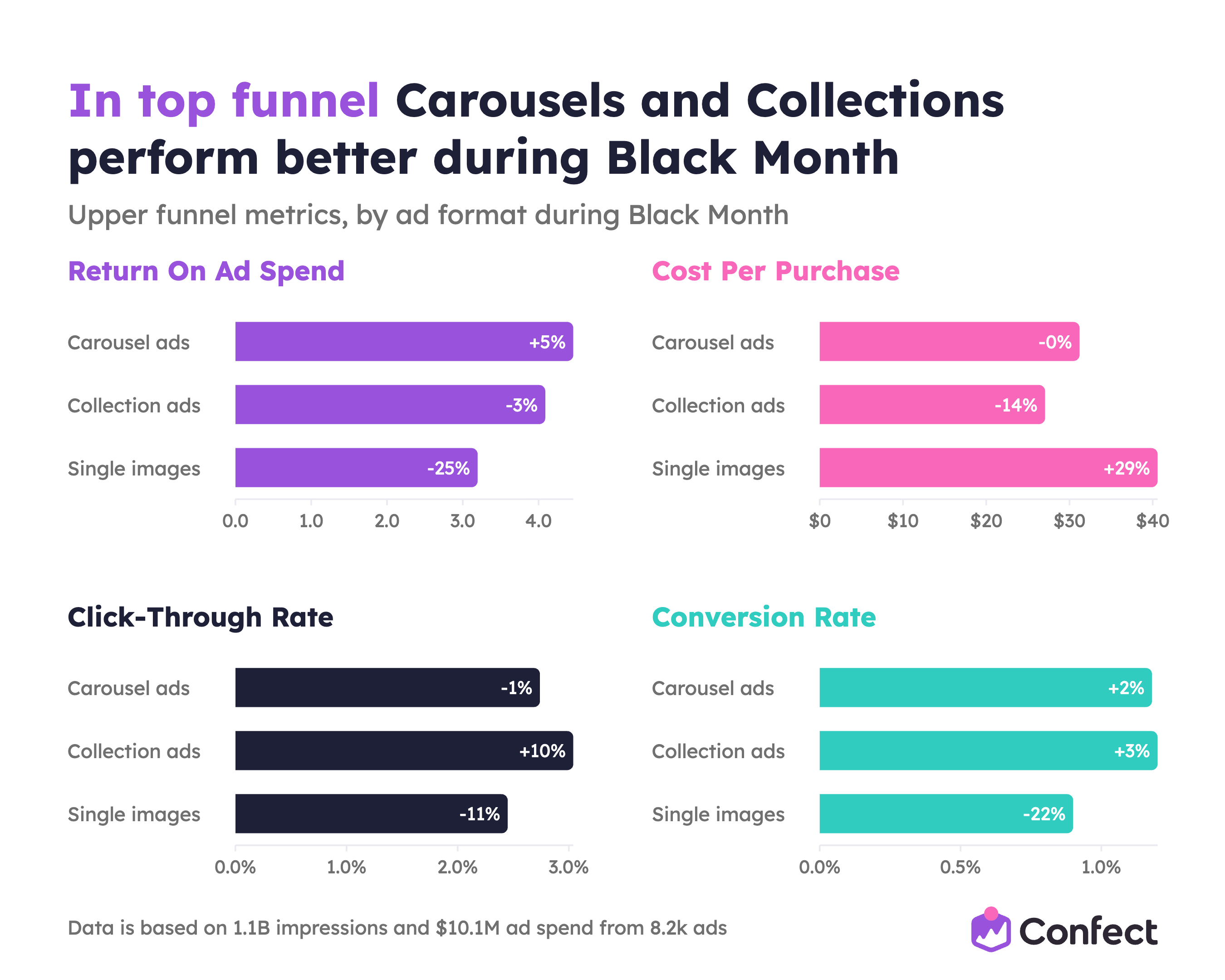
Single image swings 34 points between the two ends of the funnel. In prospecting it also adds 29% to Cost Per Purchase. In retargeting it cuts it 14%.
Each format asks the shopper a different question. Collection asks why you should buy at all: a hero on top, products underneath, closer to a small web page than an ad, which is why it wins clicks and loses conversions. Carousel asks which one you should buy, so you swipe until one is right, which is why it builds the basket. Single image asks whether you should buy this one, with nothing else in the frame, which is why it converts hardest and attracts least.
Prospecting needs options. Retargeting wants the product. The Andromeda study found the year-round version of this: multi-creative formats weathered the rollout best, because a carousel with ten product cards gives the retrieval engine ten visual signals and a single image gives it one.
If you only run one format during Black Month, run carousel.
Then judge collection on traffic rather than ROAS, and keep single image in retargeting, where the question it asks is the right one.
Design is where you win Black Month
A Catalog Ad has one job the format already does for it: it puts in front of somebody the product they are most likely to buy. So the creative has one job left. Remove the reasons not to buy it.
Every element in this section is either doing that job or getting in the way of it.
And here is the frame for all of it. During Black Month your discount becomes a point of parity. Everyone has one, so it qualifies you and nothing more. Everything else on the creative becomes the point of difference.
Most design elements are worth the same during Black Month. The exceptions are the story.
We plotted 26 design elements twice: how much each one lifts ROAS against the average ad during Black Month, and how much it lifts ROAS against the average ad in the rest of the year. Most of them sit on the diagonal. They are worth about the same in both periods.
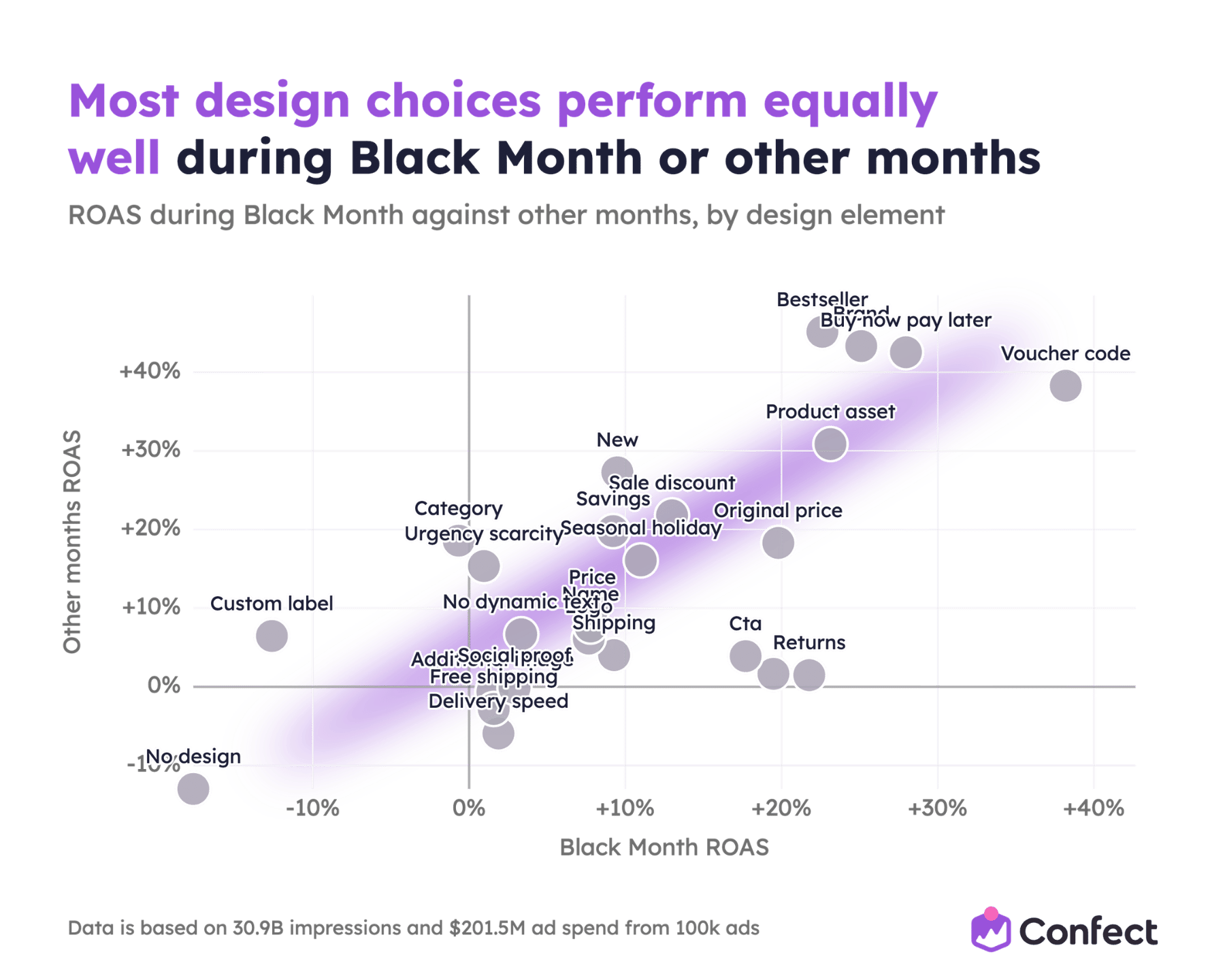
Two clusters leave the diagonal, and they are the whole design argument.
The first cluster gains. Returns go from +1.5% ROAS against the average ad in the rest of the year to +22% against the average ad during Black Month. A call to action goes from +3.9% to +18%. Shipping goes from +4% to +9%, and delivery speed from -5.9% to +2%.
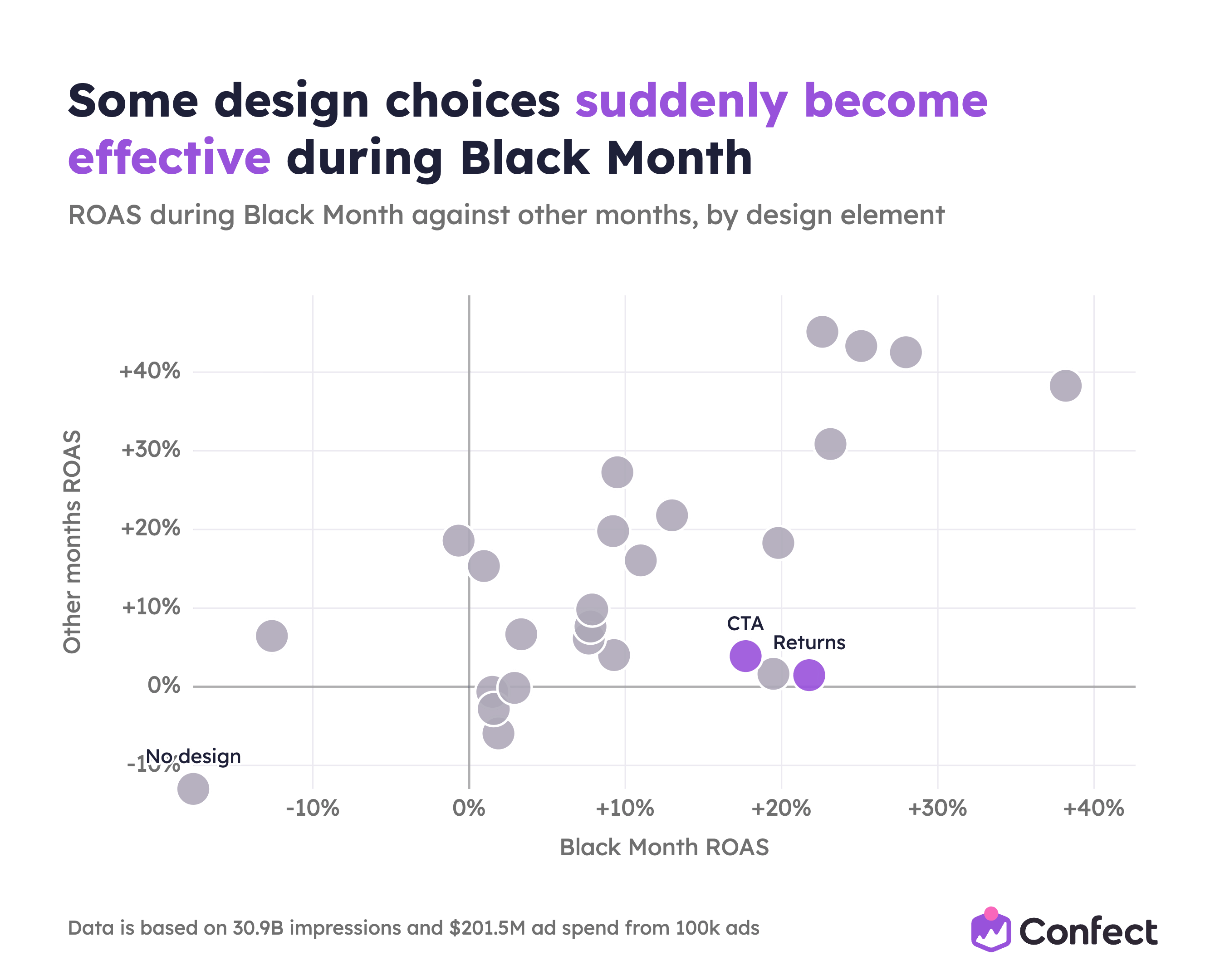
The second cluster loses. Bestseller falls from +45% to +23%. The brand of the product falls from +43% to +25%. New products fall from +27% to +9%. Category falls from +19% to -1%, urgency from +15% to +1%, and custom labels go from +6.5% to -13%. Buy now pay later slips from +43% to +28%.
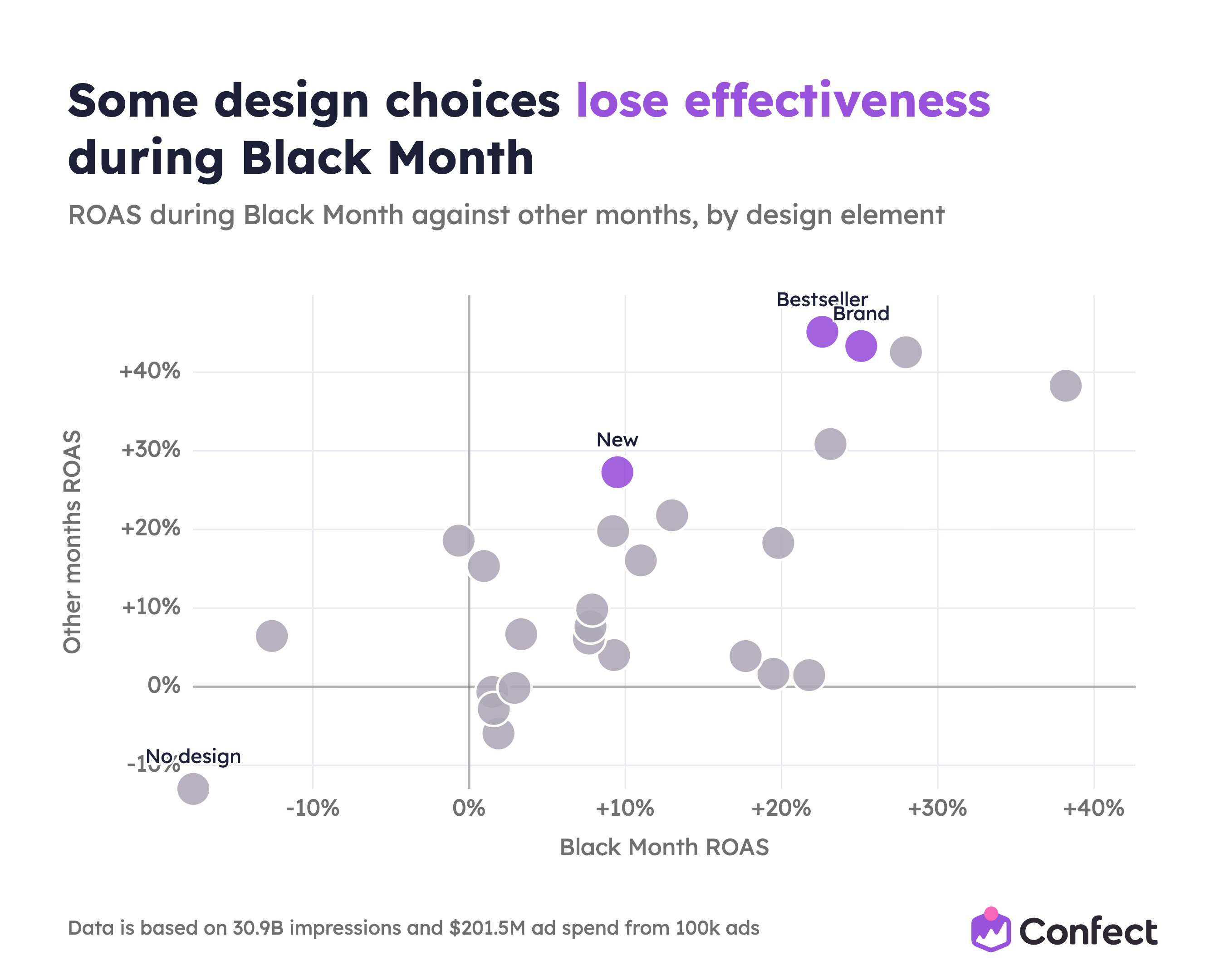
The biggest gainers are all about the transaction. The biggest losers are all claims about how special the product is.
Picture the shopper. Eight tabs open, the same Nike shoe in every one of them, the same 30% off in most of them. The product is identical and the discount is identical. So the comparison moves to the few things that still differ between the shops: whether shipping is free, how fast it arrives, whether it can be sent back. Those are the questions that move, so those are the answers that pay.
Bestseller and brand answer "is this the thing I want". By the time a shopper is comparing eight shops for it, that question is settled.
Psychologists call the underlying effect distinction bias. Side by side, people notice differences far more than they would judging each option alone. When the product and the discount are identical across the tabs, shipping and returns are the differences that get amplified.
Buy now pay later is the one transaction element in the losing cluster, and it still lands at +28%. Affordability is simply less scarce in a month when everything is discounted.
Many designs still beat one perfect design
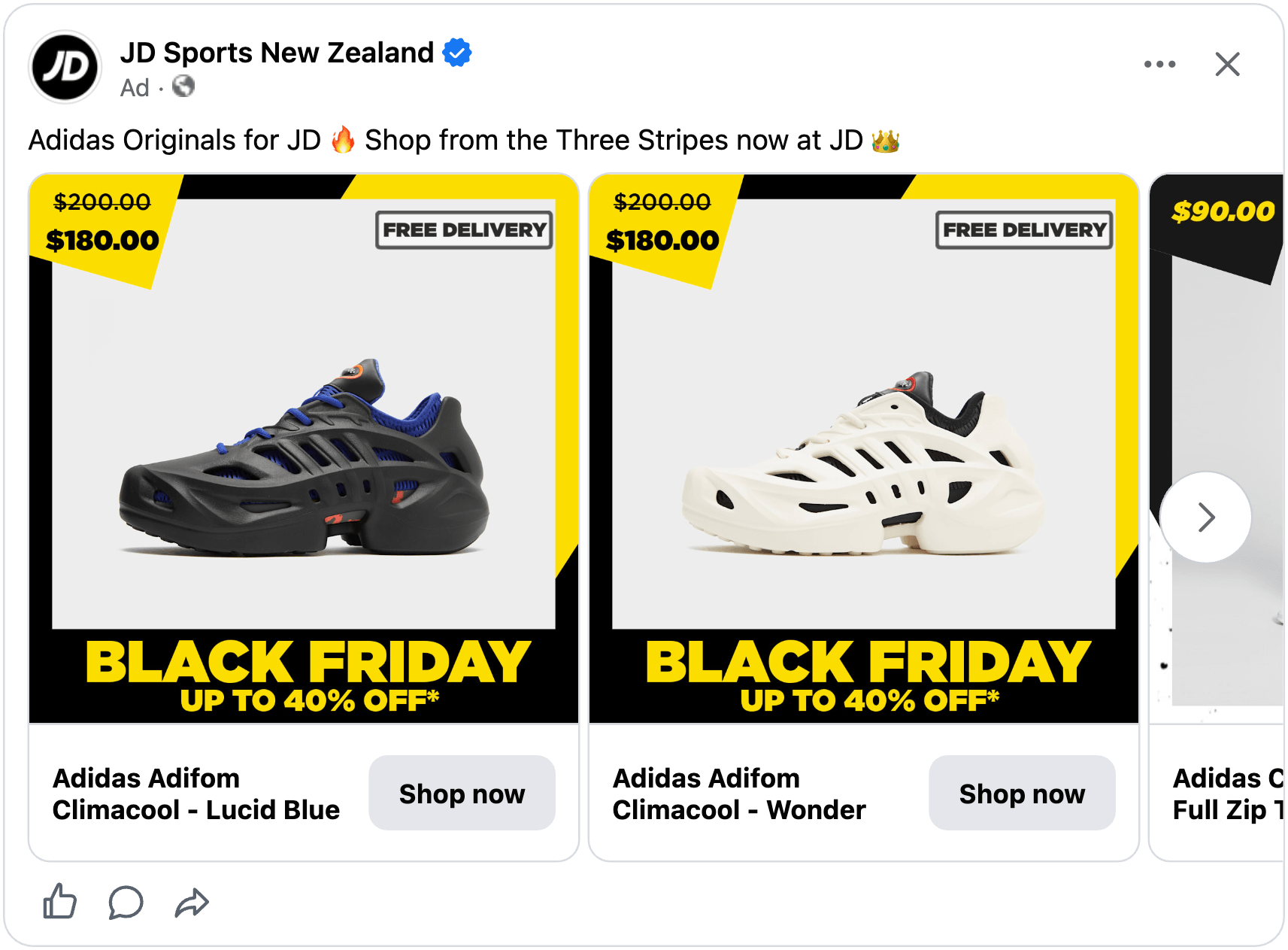
JD Sports runs these at the same time, alongside a Klarna always-on design and a Final Sale design with the legal reference-price line. Four visibly different Catalog Ads from one advertiser. The point is not which one is best. It is that they exist at once.
.png)
This matters more since Andromeda than it ever did. Meta's retrieval engine clusters similar-looking ads into one entity, so five designs that say different things get five tickets to the auction, and one design with every badge on it gets one.
Before you add anything to a Black Month design, ask what it gives a shopper to compare you on that the shop in the next tab cannot match. Is the deal real, is shipping free, how fast does it arrive, can it go back.
If it answers none of those, it is decoration. And during Black Month it is competing with the price for space.
The claim stops working. The proof does not.
Sale messaging overall is worth about half as much during Black Month as in the rest of the year: +20% ROAS against the average ad outside Black Month, +9% inside it.
Then split it into the three ways of saying "this is on offer".
The struck-through original price is worth +18% ROAS against the average ad in the rest of the year and +20% during Black Month. A discount badge falls from +22% to +13%. Broad sale messaging falls from +20% to +9%.
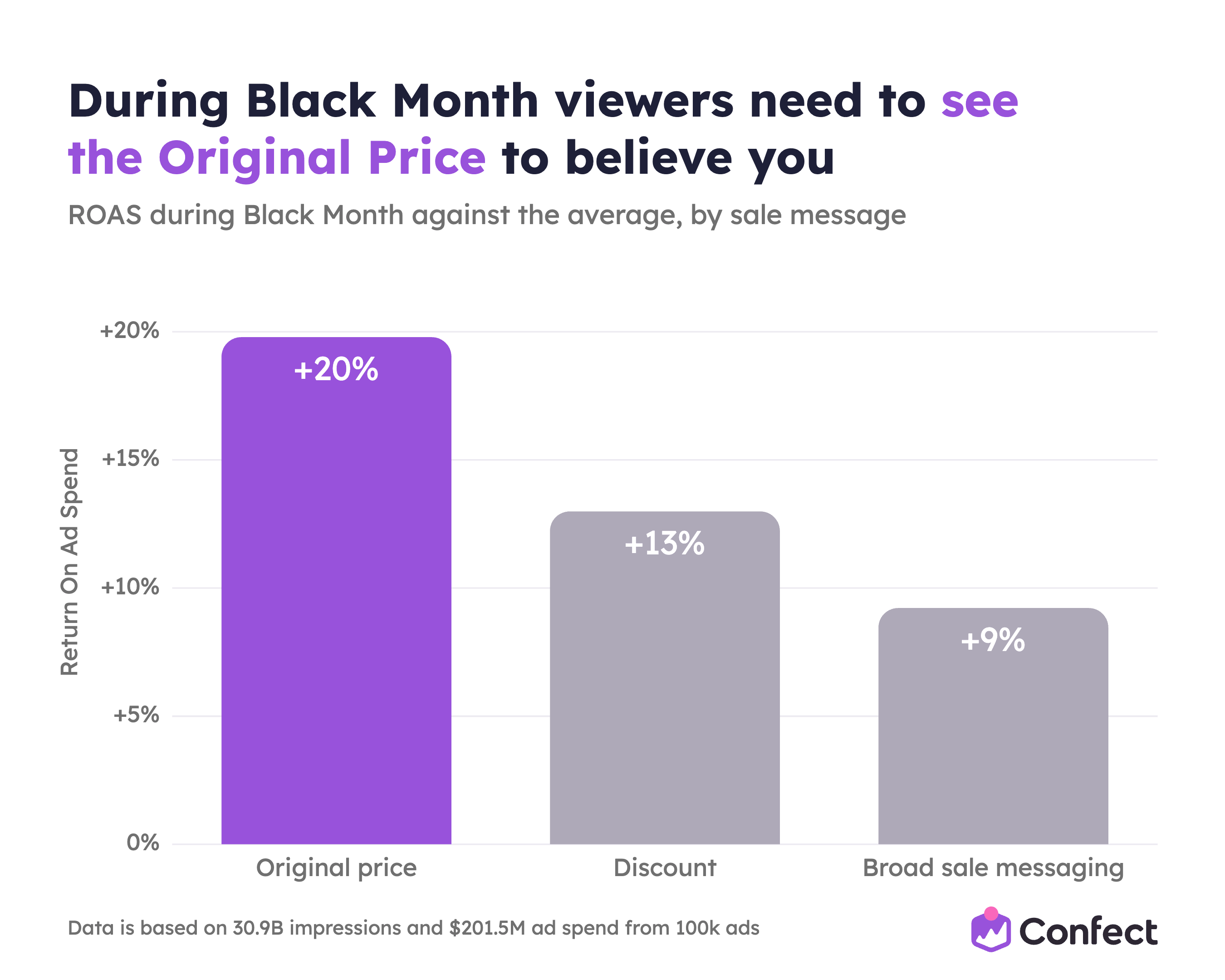
Three messages worth roughly the same for eleven months. In the twelfth, two collapse and one holds every point.
Every shopper has been burned by a previous Black Friday. They have seen "50% off" a price that went up in October. They have seen "biggest sale ever" four years running. They have read the stories about Black Friday deals that were cheaper in July.
So a discount badge is an assertion. And by the fourth week of Black Month an assertion is worth nothing, because every competitor is making the same one and the shopper has learned that some of them are not true.
The struck-through original price is not an assertion. It is evidence. Put €149 struck through next to €89 and the shopper is not being told it is a good deal. They are being shown the arithmetic and allowed to do it themselves.
This is anchoring, the oldest trick in pricing, with a Black Month twist. The anchor still works. But the shopper now insists on seeing it, because years of Black Fridays have built up what researchers call persuasion knowledge: well-developed defences against being sold to. Claims trip those defences. A verifiable number does not.
Three ads carry the argument.
.png)
That is the proof.
.png)
That is the claim. It is the pattern that scores +9%.
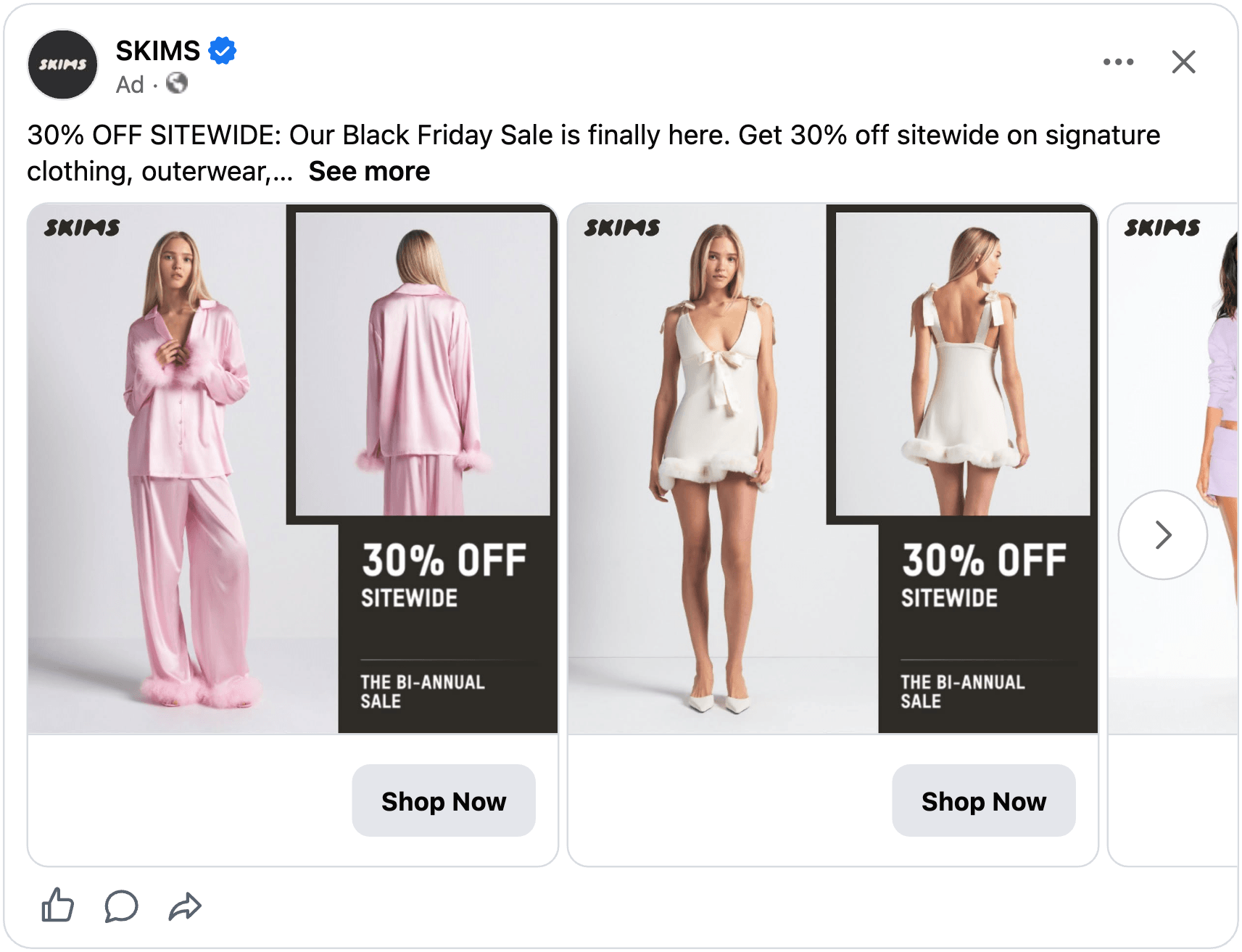
And that is the third route. If you will not show the arithmetic, prove the rarity instead. A sale that happens twice a year is a claim the shopper can check against their own memory.
The discount is why they clicked. The original price is why they believed it.
If your Black Month Catalog Ad carries a percentage and nothing else, you have built an ad that competes on the one thing every competitor also has, in the one month nobody believes it.
What every element buys, and why removing friction pays
Across 24 design elements plotted on ROAS against Cost Per Purchase, nearly everything beats the average Black Month ad. The winners are context about the product or the price. And removing friction turns out to be a tactic in its own right.
Against the average Black Month Catalog Ad, a voucher code leads at +38% ROAS and -31% Cost Per Purchase. Buy now pay later is +28% and -35%. The brand of the product is +25%. Product Assets +23% and -21%. Bestseller +23%. Returns +22%. Original price +20%. A call to action +18%. Then a middle band of discount badge (+13%), seasonal design (+11%), new (+9%), shipping (+9%), price (+8%) and your own logo (+8%).
Two elements sit below the average. Custom labels at -13%. And no design at all, a bare product image, at -18%.
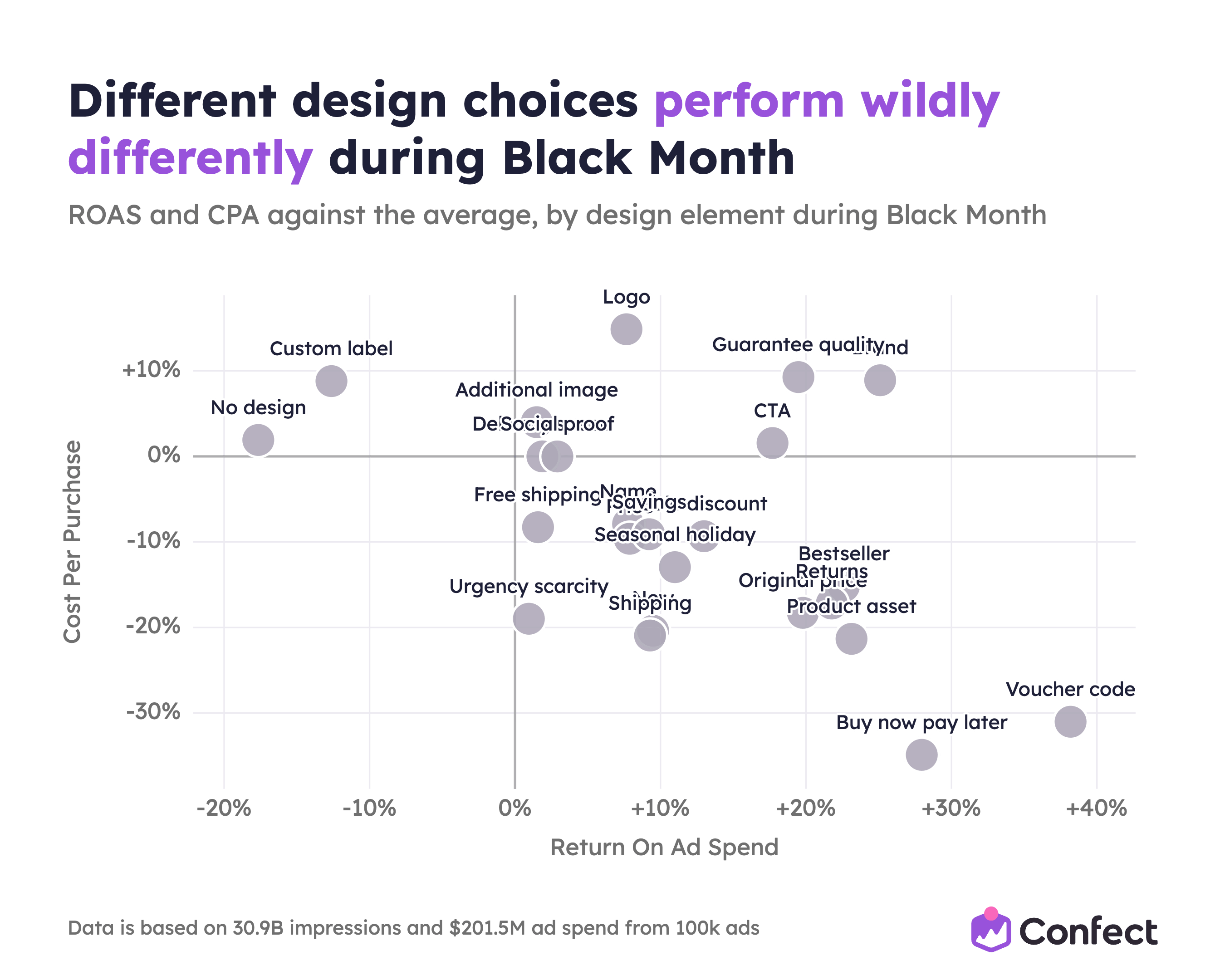
Voucher code and buy now pay later are the smallest groups of advertisers in this chart, so read their exact figures as directional. Their direction is not in doubt.
Read the floor first. A bare product image on a white background loses 18% against the average designed Black Month ad, and the average includes every design that was thrown together in an afternoon. The 18% is the floor, not the prize.
Friction removers
Group the elements that remove a reason not to buy (shipping, returns, delivery speed, buy now pay later) and compare Black Month Catalog Ads that show them with ones that do not: ROAS +12%, Cost Per Purchase -23%, conversion rate +24%. Click-through rate barely moves.
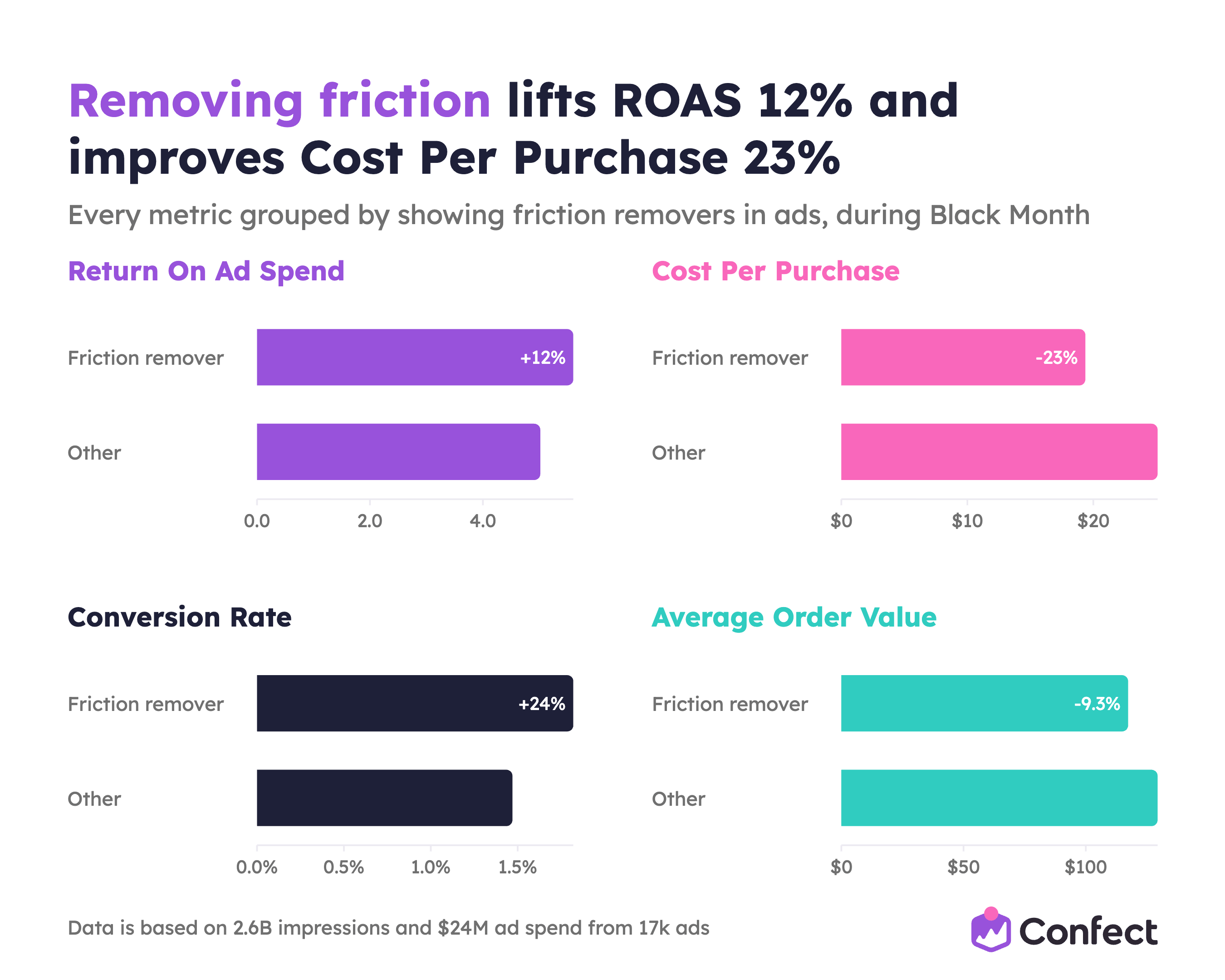
A friction remover does not attract anybody. It converts the people already there.
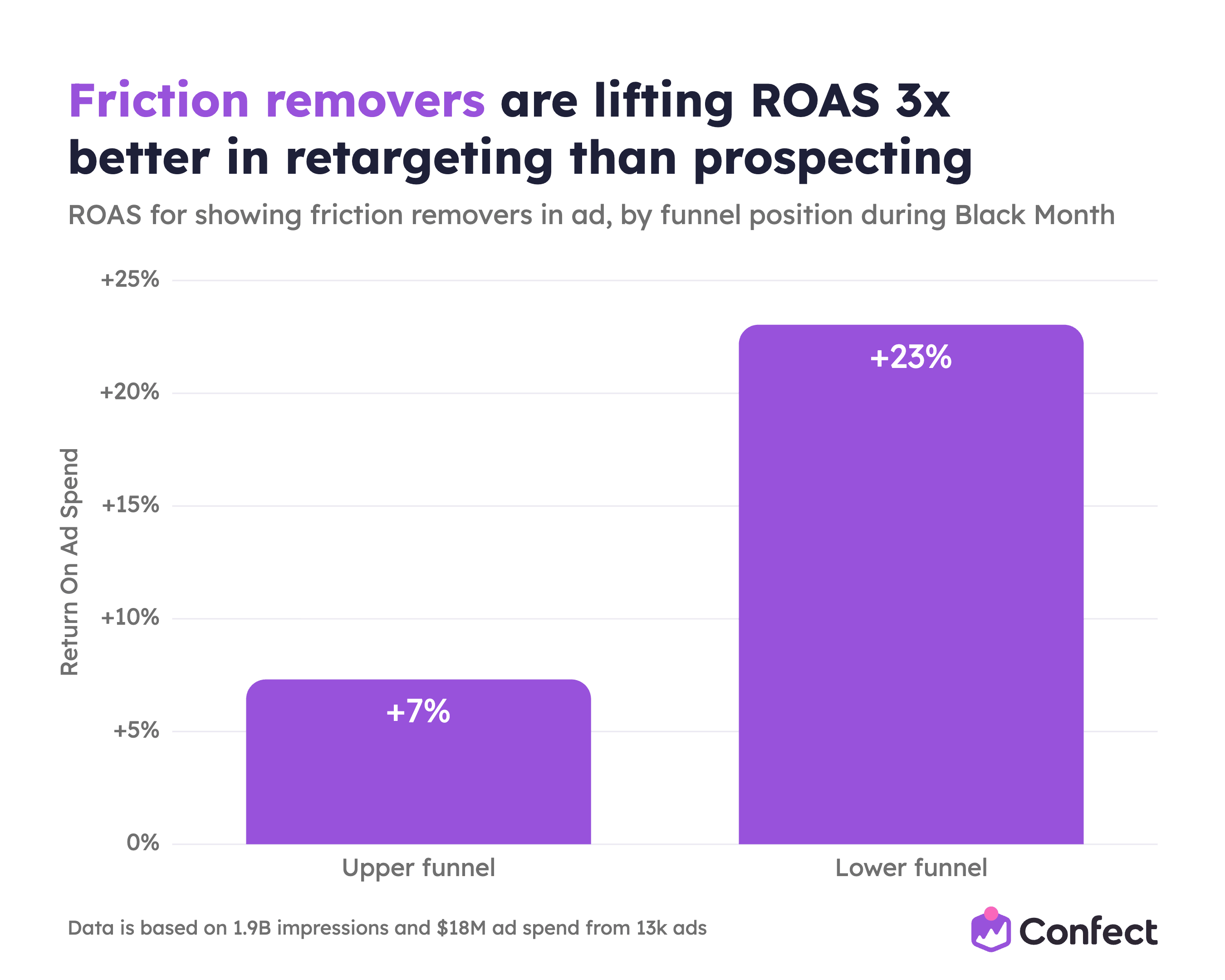
And it converts them three times harder at the bottom of the funnel: +7% ROAS in prospecting, +23% in retargeting.
New Balance is the template. The reassurance takes one line and costs the product nothing. It also works as one unit: "free returns, free shipping over £100" is two chunks to the eye, not eight words, which is why it can sit under a price without fighting it.
.png)
Why does one line do so much? Because for a lot of shoppers, no free returns is not a minus point. It is a deal-breaker. Stating it does not add a benefit. It removes an elimination criterion. And unexpected shipping costs are still the top reason baskets get abandoned, so shipping in the ad is the cost made expected.
One line of reassurance under the price: returns, shipping, or the monthly payment. It will not win you a click. It will win you the purchase from the click you already paid for.
Put it on the retargeting design first. It is worth three times more there.
Tell them what it costs, and what sits next to the price
Most product information performs well during Black Month. Transactional information performs very well. And the single most valuable thing on a Catalog Ad is the price, provided something sits next to it.
Product information first: name +8%, price +8%, discount badge +13%, new +9%, original price +20%, bestseller +23%, Product Assets +23%, all against the average Black Month ad. The exception is custom labels at -13%. Information only your merchandising team understands does not pay. Hold that thought, because it comes back in a surprising way two sections down.
Then the price, and what sits beside it.
Against the average Black Month Catalog Ad, showing no price at all is -10% ROAS and +12% Cost Per Purchase. Price alone is +8% and -10%. Price with the savings shown is +18%. Price with the original price is +18% and -19%. Price with returns is +20% and -22%. Price with buy now pay later is +18% and -31%. Price with urgency is +3% and -30%.
And price with a voucher code is +64% ROAS and -38% Cost Per Purchase.
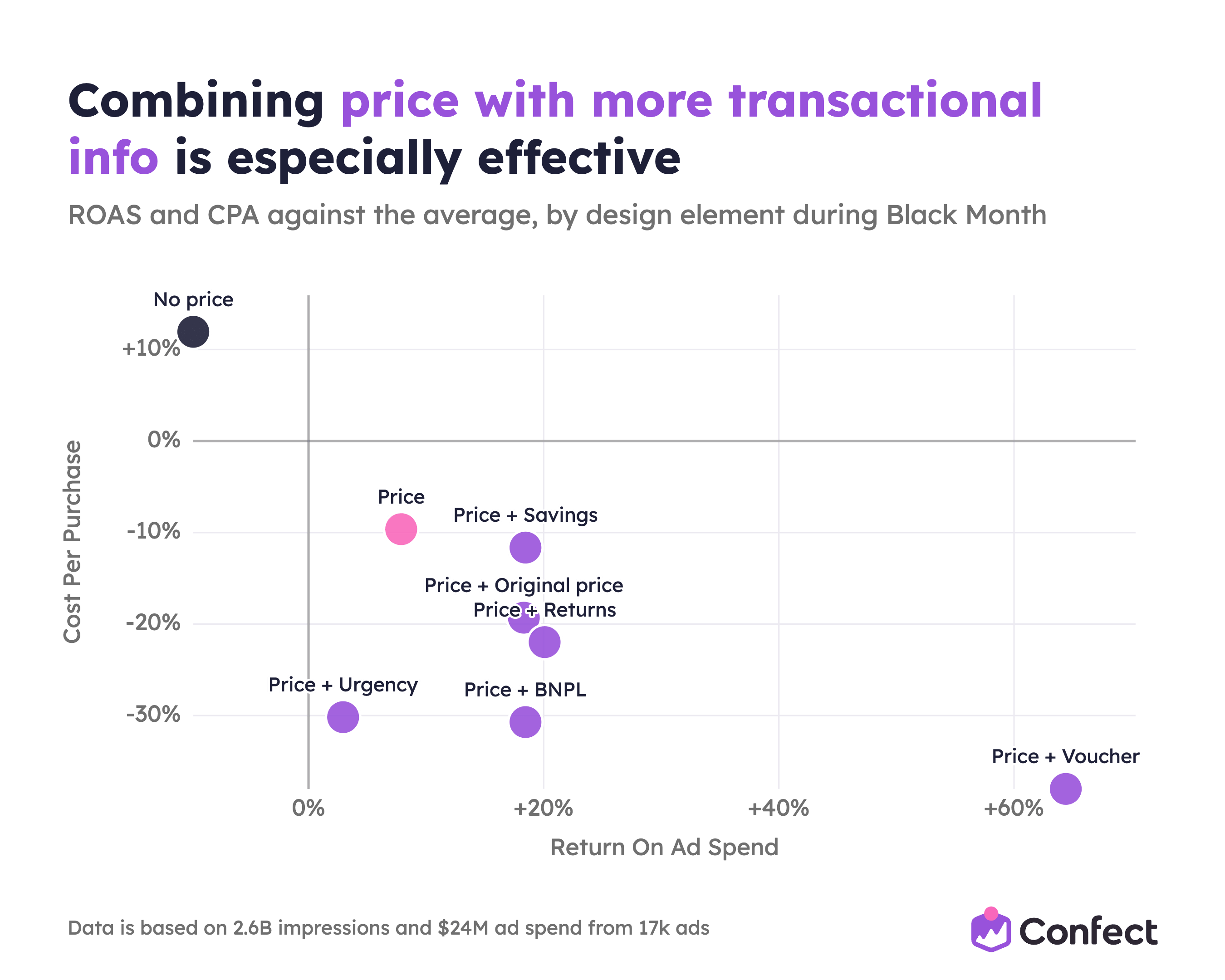
Price alone is table stakes. What sits beside it is the whole story. Price plus a voucher code also more than doubles conversion rate, though that is a smaller group of advertisers, so treat the exact figure as directional.
Why showing the price works
Two reasons. The first is that the price screens the clicks rather than buying them. Click-through rate falls, conversion rate rises, and nobody arrives on your product page to be disappointed by the number.
The second is bigger during Black Month. A lot of the people scrolling past your ad are interested and cannot be bothered to click. They assume the price is probably not good enough, or the deal is probably not as good as the next one. They are not rejecting your offer. They never saw it. In the one month every competitor puts a buy-now offer in front of the same person, yours is the one that made them guess.
Why the voucher code works
A discount is a property of the product. A voucher code is a possession of the shopper. It exists in this scroll, in this session, and there is no easy way to file it for later. So it gets used now, and it gets used on as much as possible.
Compare urgency plus price, which also creates a deadline and lands at +3% ROAS. You can come back tomorrow and the sale will still be on. A code cannot survive the scroll.
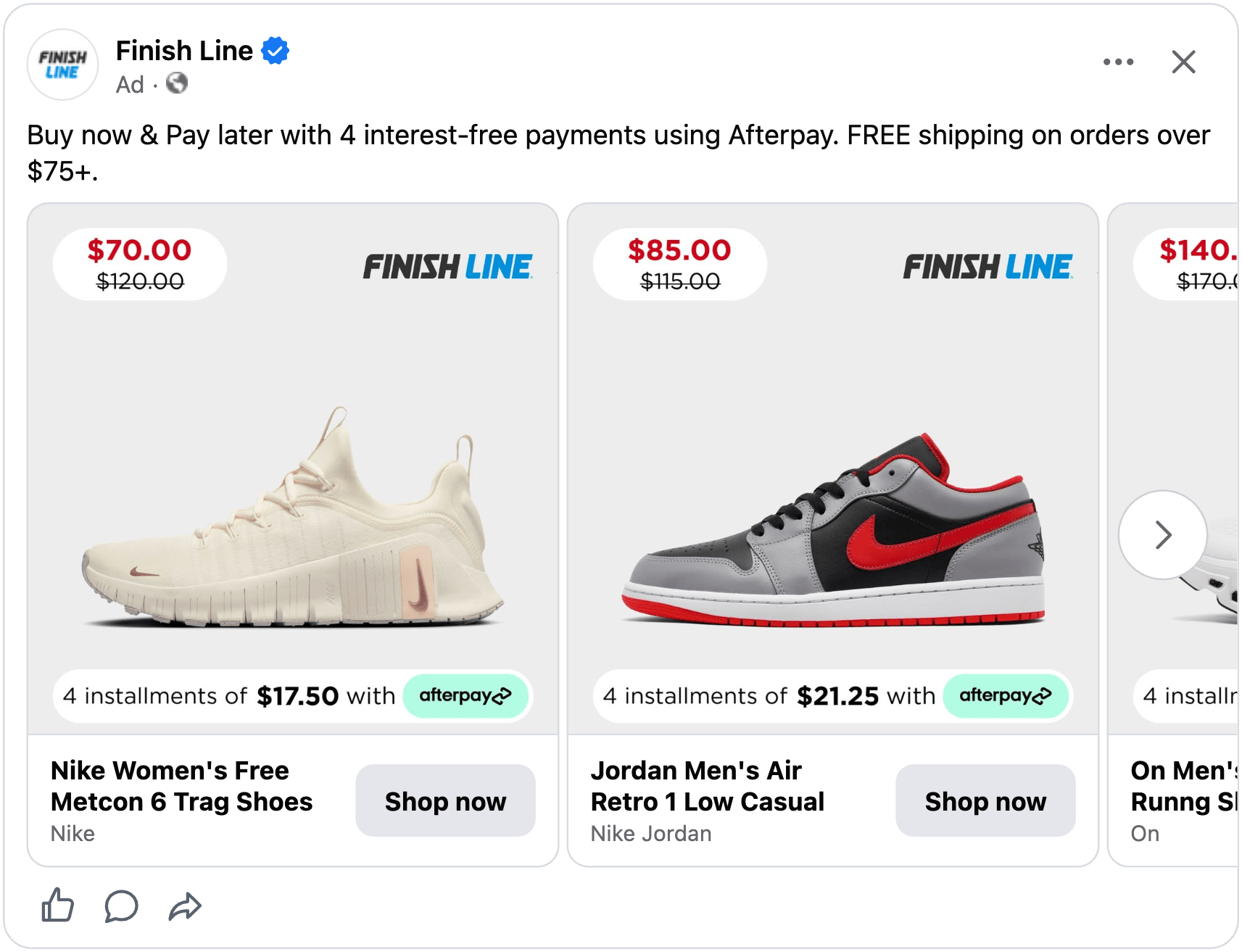
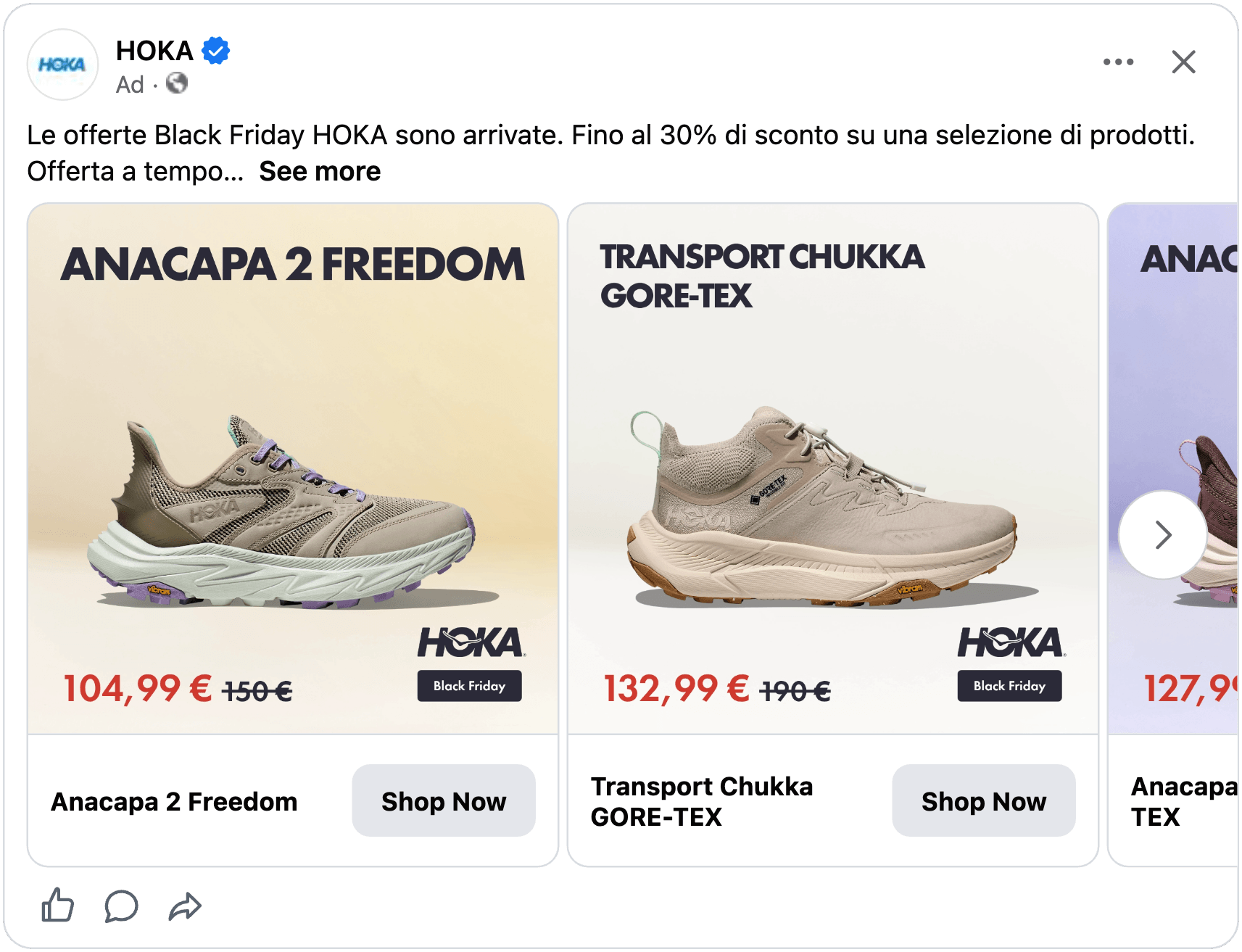
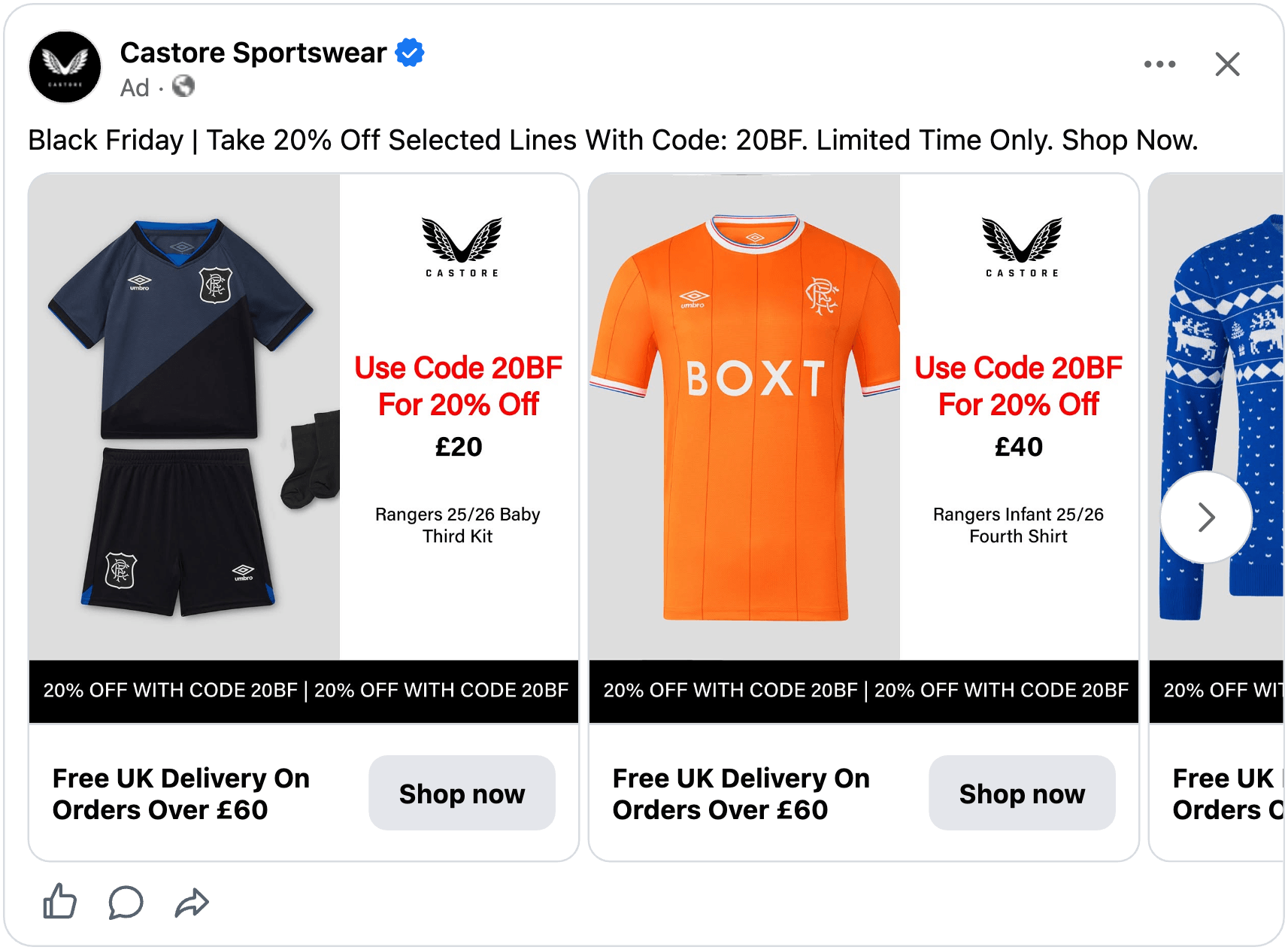
HOKA is product information done properly. Finish Line is transactional information, three elements in two pills. Castore is price plus code plus free delivery, which is the best combination in the data rendered as an ad.
Put the price on every Catalog Ad you run during Black Month. Then pick what sits next to it.
The trade worth recommending outright: instead of 40% off, run 30% off plus an extra 10% with a code. Same money, very different psychology, and the version with the code is the one that converts.
Down the funnel: the same design does two different jobs
How a design element performs in prospecting tells you almost nothing about how it performs in retargeting. Prospecting is about the product and the deal. Retargeting is about reassurance.
Most advertisers run one design across both. Which means half of what is on it is working against them somewhere.
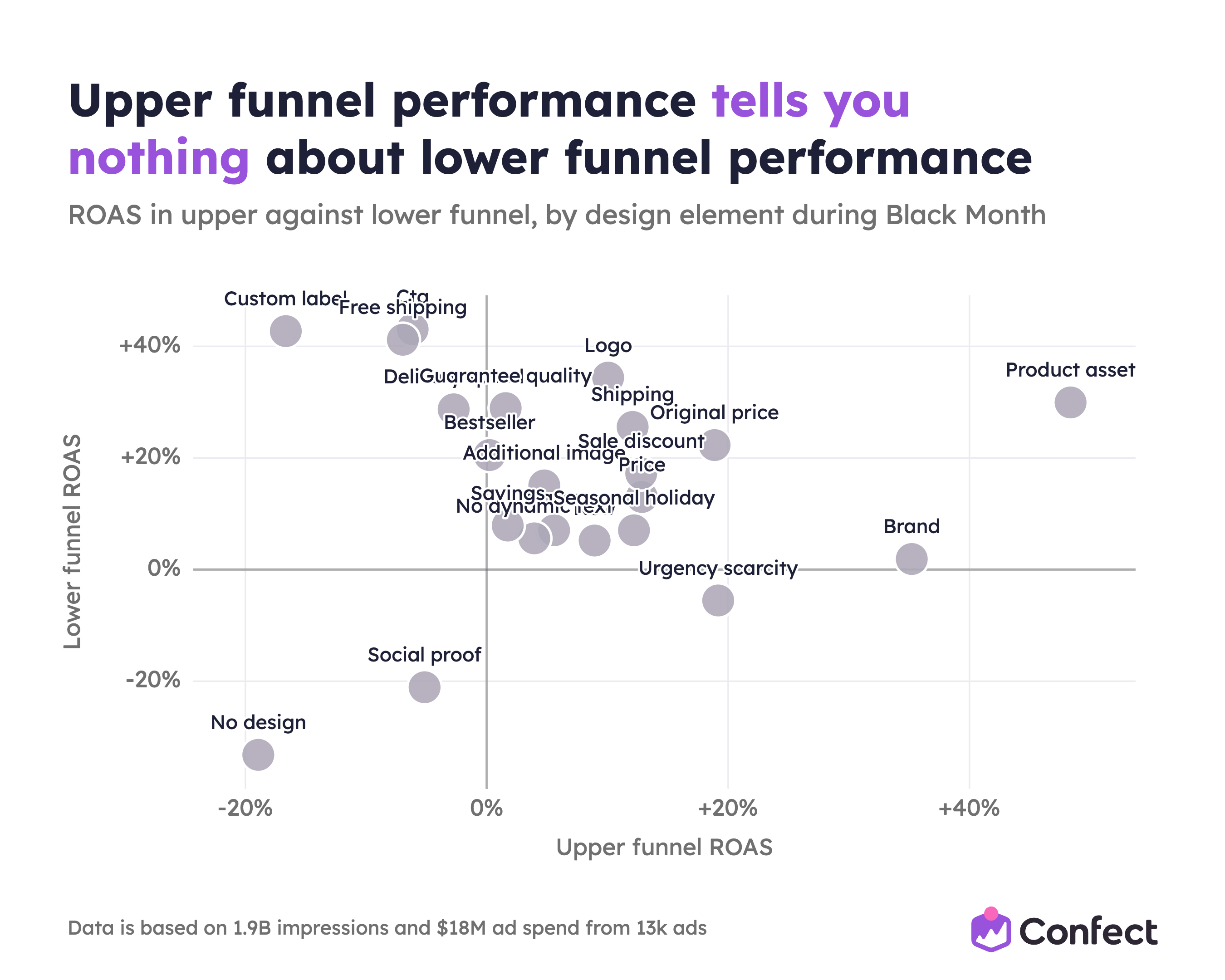
Three elements are negative in prospecting and worth more than 40% in retargeting, against the average ad in each funnel position: free shipping (-7% against +41%), the call to action (-6% against +43%) and custom labels (-17% against +43%). Delivery speed (-3% against +29%) and bestseller (0% against +21%) follow the same shape.
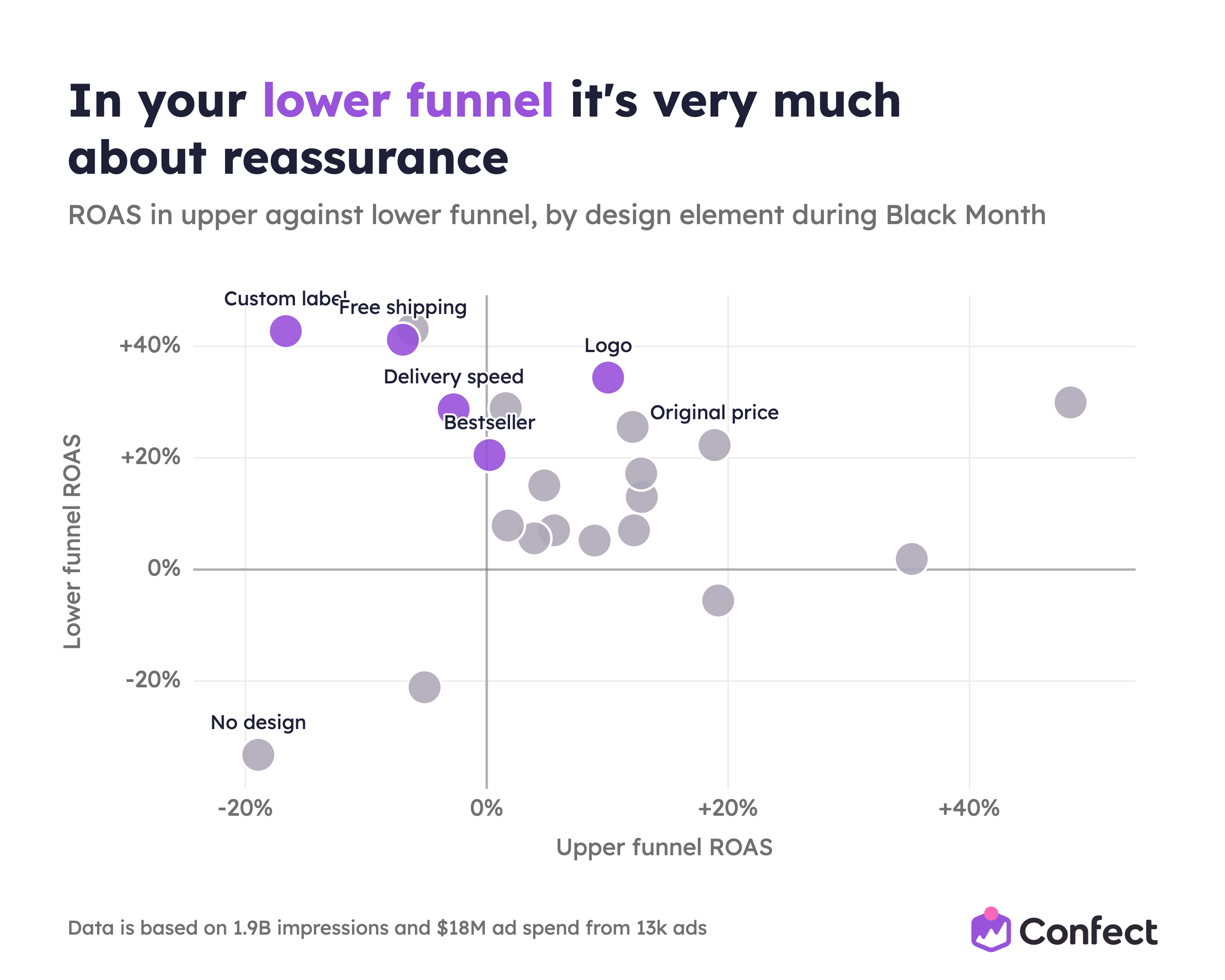
Three elements prefer strangers: Product Assets (+48% against +30%), the brand of the product (+35% against +2%) and urgency (+19% against -6%). Two are neutral: original price (+19% against +22%) and price (+13% against +13%). Your own logo is +10% in prospecting and +34% in retargeting. Social proof is negative in both (-5% and -21%). No design at all is -19% and -33%.
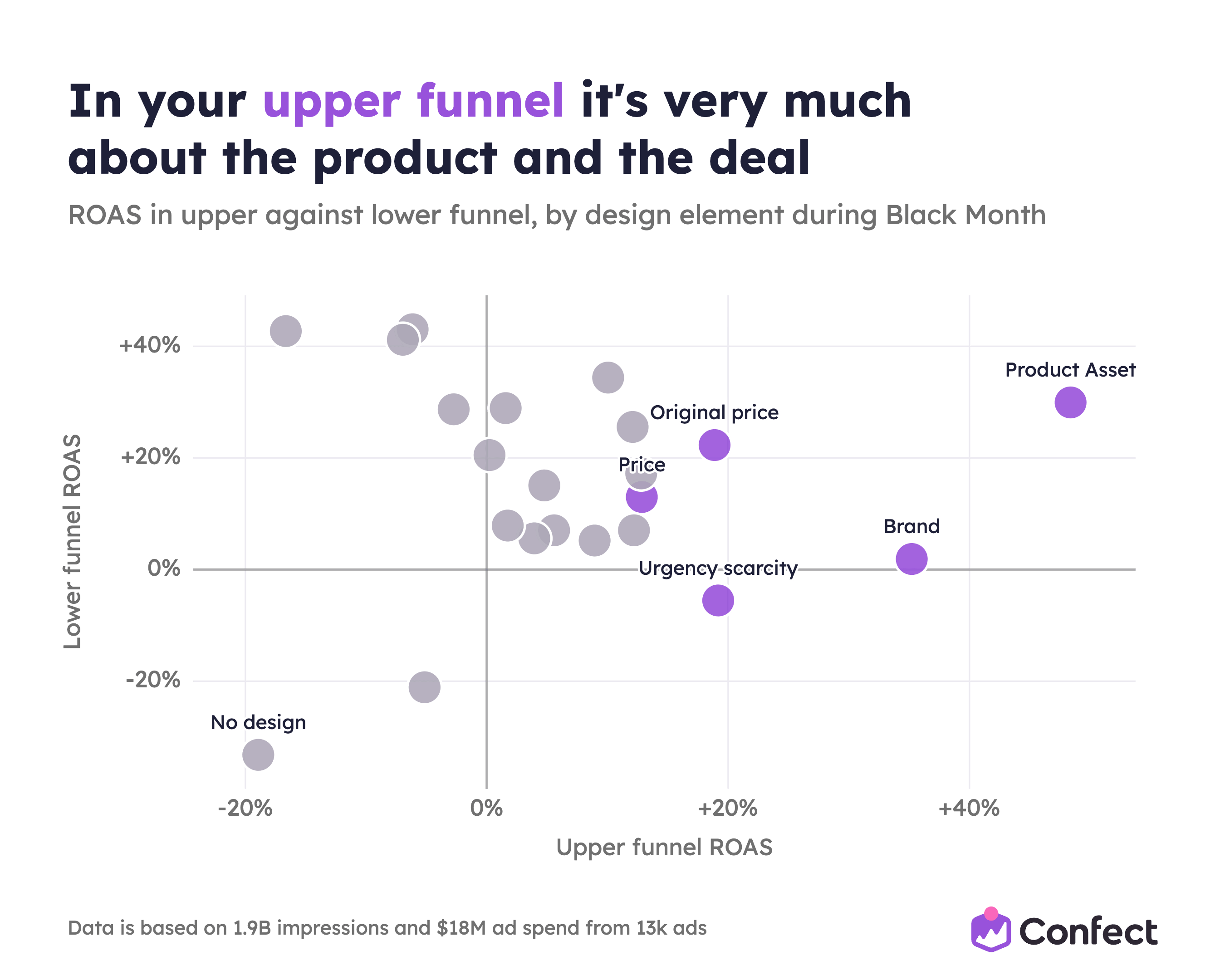
Custom labels is the element that sells the whole section. Across the whole month it reads -13% and looks like an element to avoid. Split by funnel, it is one of the best retargeting elements in the dataset. Judge an element on its blended number and you throw away the wrong things.
The crossover: their brand for strangers, your logo for returners
![The brand of the product lifts Catalog Ads ROAS 35% in prospecting, your own logo lifts it 34% in retargeting]](https://cdn.confect.io/uploads/media/58-Your%20logo%20wins%20in%20lower%20funnel%20while%20the%20product's%20brand%20win%20in%20upper%20funnel.png)
The brand of the product wins in prospecting (+35%) and does nothing in retargeting (+2%). Your own logo does little in prospecting (+10%) and wins in retargeting (+34%). They look like the same kind of element, and they are opposites.
The brand of the product works as a search filter. A stranger is looking for Samsung, and you are the shop that has Samsung. Your logo works as a memory trigger, and a trigger needs a memory to pull on. Shown to someone who has never met you, it is decoration competing with the product for space. Shown to someone who visited last week, it is the entire reassurance.
Distinctive brand assets pay off, in other words, but only where the memory already exists.
Urgency flips sign for a related reason: +19% in prospecting, -6% in retargeting. A stranger has no deadline of their own, so you give them one. Somebody who visited your site has been carrying their own deadline for a week, and adding a countdown to it reads as pressure rather than information.
And no design at all is worst exactly where advertisers assume design matters least: -19% in prospecting, -33% in retargeting. The returning shopper has already seen the product. A bare product image tells them nothing new.
![Sunglass Hut Black Friday Catalog Ad: yellow gradient, "BLACK FRIDAY", the product, a 30% OFF pill, the product's brand in capitals (ARMANI EXCHANGE, VERSACE), $73 next to $104 struck through]](https://cdn.confect.io/uploads/media/Deal_sunglass-hut__facebook-desktop-feed__01_(1).png)
Two ads, two designs.
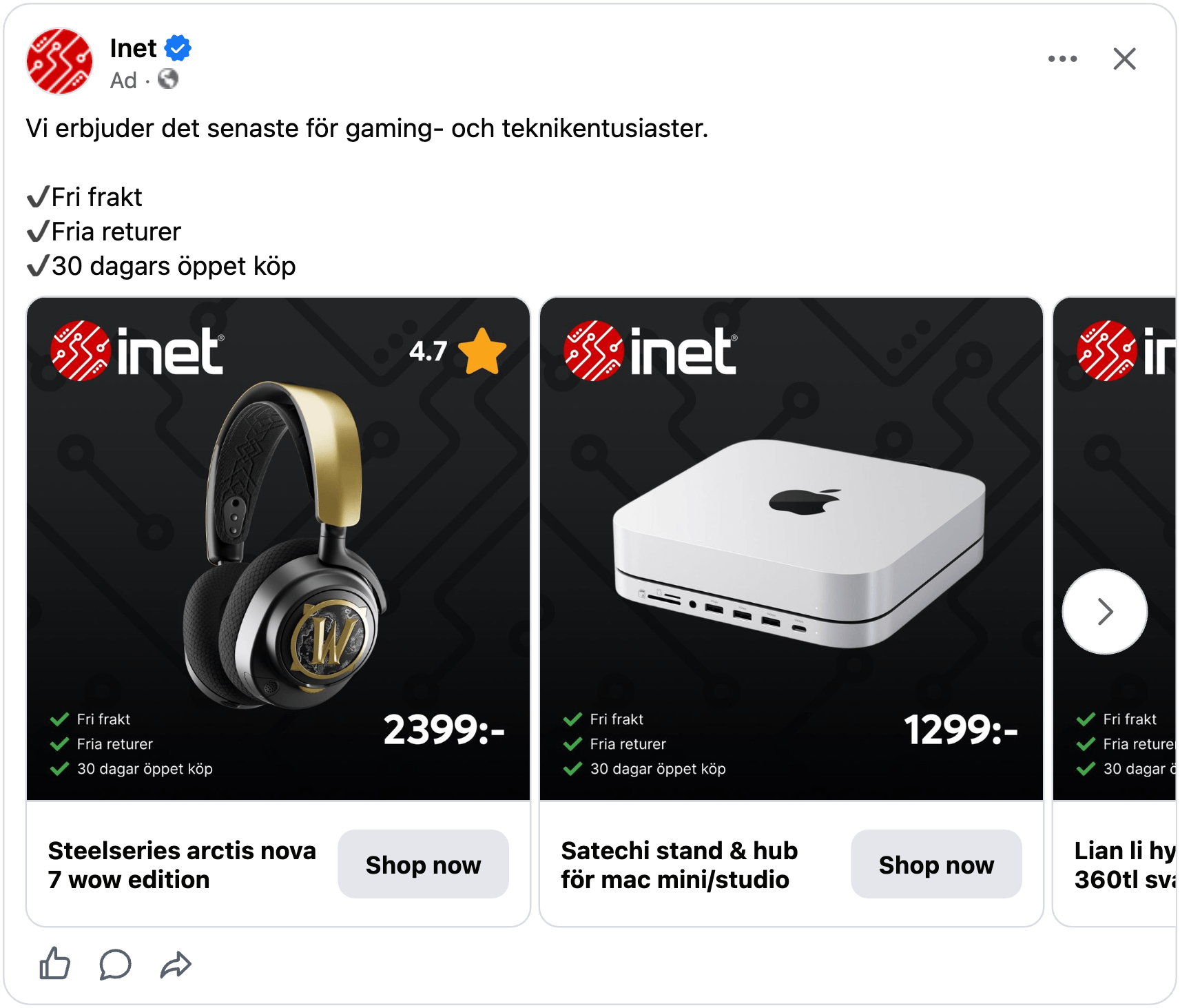
Sunglass Hut is the prospecting design: the product and the deal, with the product's brand doing the work. Inet is the retargeting design: the shop's logo and three green ticks. Those three ticks are exactly the three things a shopper can compare shops on when the product is the same. If you want the full year-round version of each, we have Tactics on Catalog Ads in prospecting and Catalog Ads in retargeting.
Build two design sets from the same products.
Prospecting: the brand of the product, Product Assets, the price, the original price, a reason to hurry.
Retargeting: your logo, free shipping, delivery, returns, buy now pay later. Almost nothing belongs on both, and most advertisers are running the retargeting set everywhere.
Clicks are not the metric
Design elements split into the ones that buy clicks and the ones that buy conversions. Conversion rate predicts ROAS. Click-through rate does not.
The attention buyers: bestseller (CTR +23%, conversion rate -6%), new (+22%, +9%), free shipping (+12%, +10%), and no design at all (+10%, -12%).
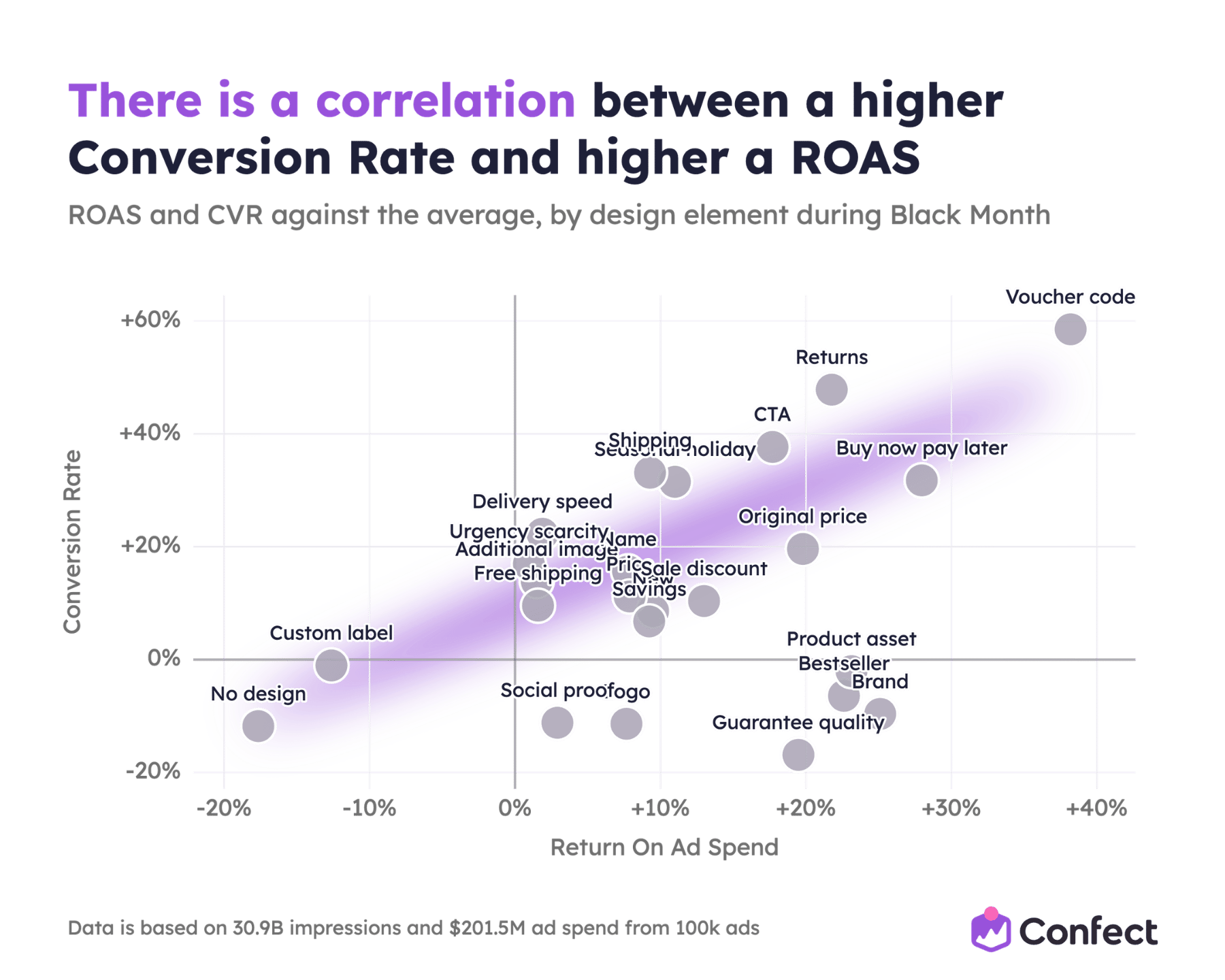
The conversion buyers: voucher code (CTR +2%, conversion rate +59%), returns (+4%, +48%), call to action (-17%, +38%), shipping (+2%, +33%), buy now pay later (+1%, +32%), price (-6%, +11%).
Now plot each element's conversion rate lift against its ROAS lift. The dots form a band sloping upward, voucher code top right, no design bottom left.
Plot click-through rate against ROAS instead and you get a flat cloud.
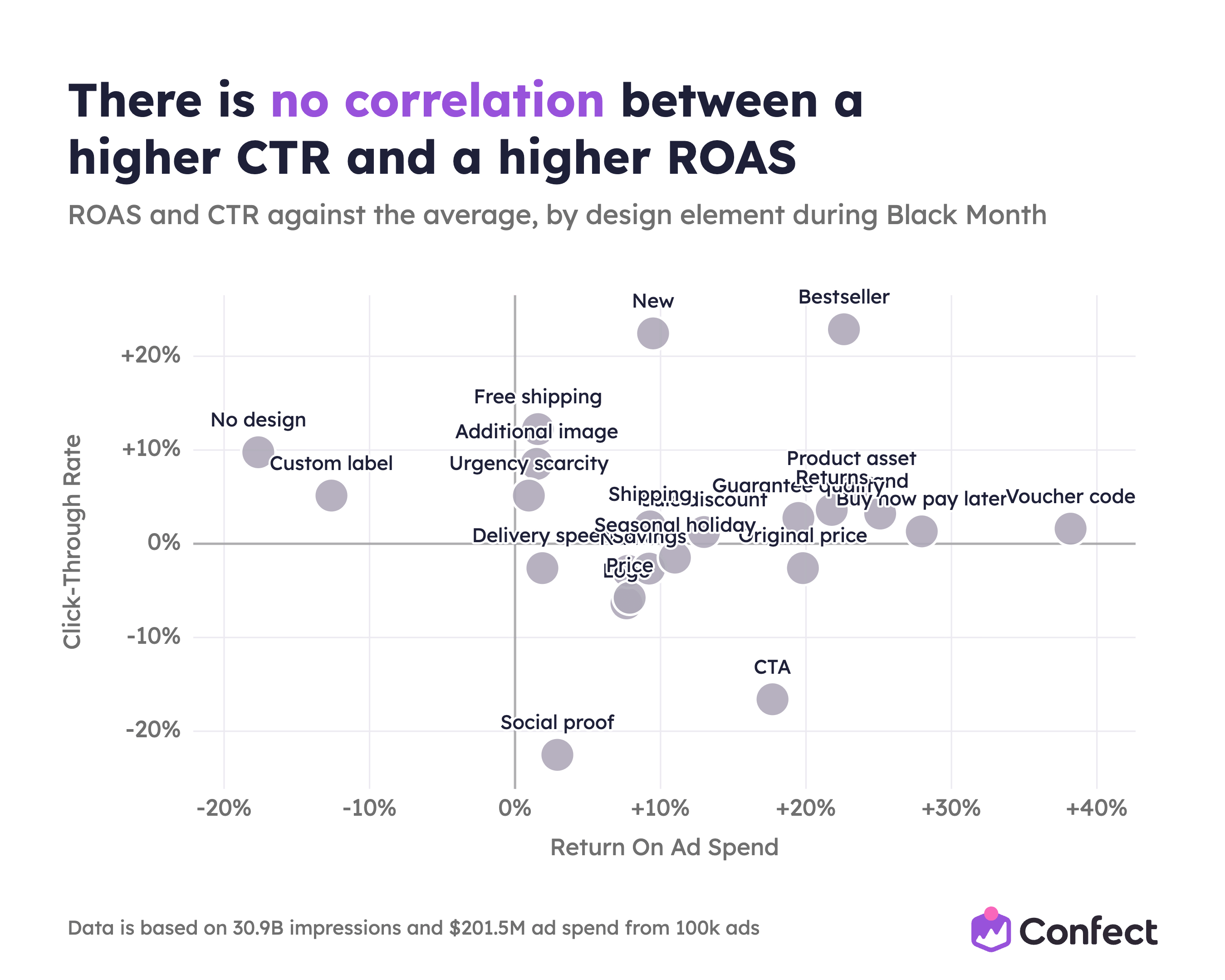
Bestseller and no design at all both win extra clicks. They sit 40 points apart on ROAS.
A bare product image on a white background is an attractor with nothing behind it. It wins attention it cannot convert. A voucher code attracts nobody extra and converts the people who were already going to look. The elements that make money are the ones that answer a question at the moment of decision, and the click is not the moment of decision.
The click is fast and visual, which is why bestseller and a clean white image win it. Anything above impulse price gets a slower second look, and that is where proof and reassurance win. "Do I like how this looks" gets swapped in for "is this worth buying", and the swap ends at the product page.
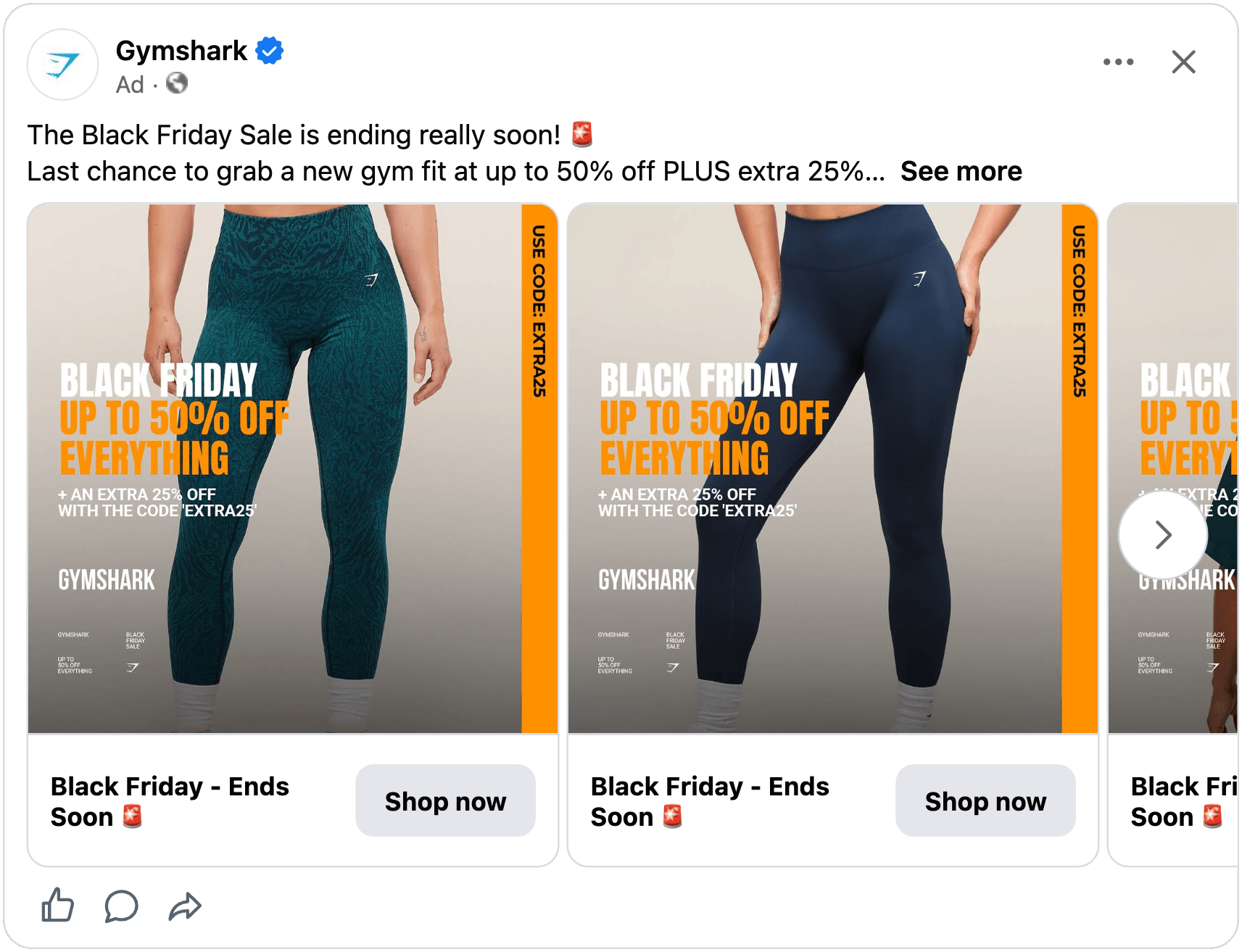
Gymshark again, and this time with the conversion buyers: a code and a deadline. Compare it with the same brand's ad higher up, which had the claim and neither.
This also closes the price argument. Losing clicks by showing the price is not a cost, because clicks do not predict anything.
If your Black Month creative report leads on click-through rate, you are reading a number that has no relationship to whether the design makes you money.
Rank your designs on conversion rate and ROAS. Then run several that say different things, and let Meta decide who sees which.
Which product sets to advertise during Black Month
Whether to filter your catalog is a funnel decision, not a yes or no. Filters pay in prospecting. Running everything wins in retargeting.
And a product set is more than a targeting choice. It is the thing that lets the design speak to why someone buys that kind of product, which is where most of its value comes from.
Across the whole month, most filters help. The exceptions are catalog plumbing.
Against the average Black Month Catalog Ad, a product set filtered on brand returns 25% more ROAS at 23% lower Cost Per Purchase. Custom number, a field the advertiser fills in themselves, also returns 25% more. Sale price, all products, custom label and product type all land between +9% and +12%.
The three that lose are item group id (-19%), name (-9%) and product id (-7%). Those are catalog plumbing. They group products by how the data source is built, not by why anyone buys them, and they are too narrow to give Meta anything to learn from.
![Most product set filters improve Catalog Ads ROAS during Black Month, brand and custom number lead at +25%]](https://cdn.confect.io/uploads/media/66-Only%20too%20narrow%20product%20set%20filters%20will%20decrease%20your%20performance.png)
Filters are also worth less during Black Month than in the rest of the year. Gender goes from +38% outside the month to +3% inside it, tags from +25% to 0%. A filter is a bet that needs data to pay off, and a two-week campaign has almost no history to bet with.
Then split by funnel, and it becomes an instruction
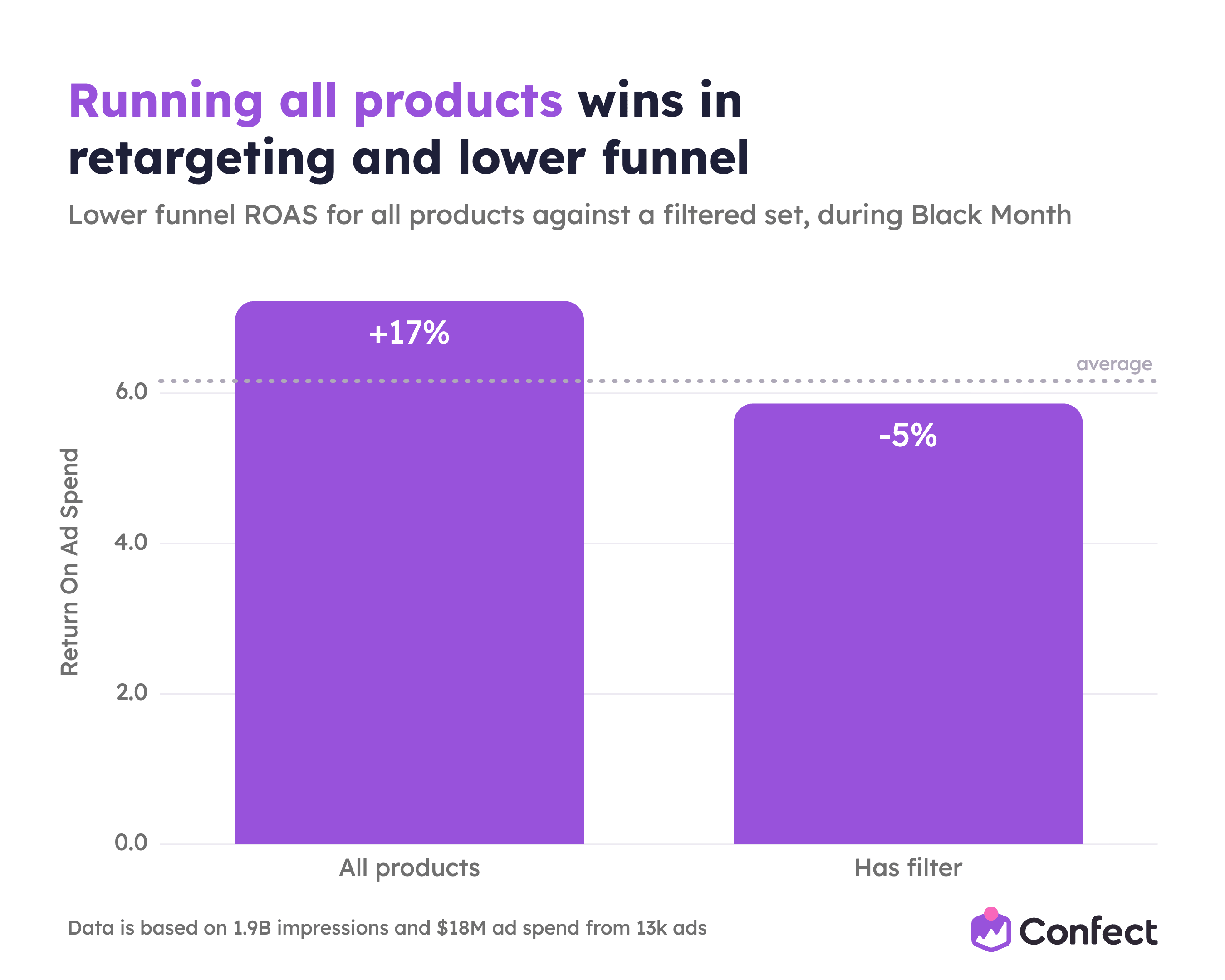
In retargeting during Black Month, Catalog Ads running all products return +17% ROAS against the average. Catalog Ads running a filtered product set return -5%.
In prospecting, against Catalog Ads running all products: tags +47% ROAS and -31% Cost Per Purchase. Custom number +45% and -27%. Sale price amount +27% and -26%. Custom labels +18%. Brand +15% and -21%. Gender +14% and -20%. Product id, product type, price amount and item group id all land between +2% and +5% on ROAS. Name is the only filter that loses, at -11%.
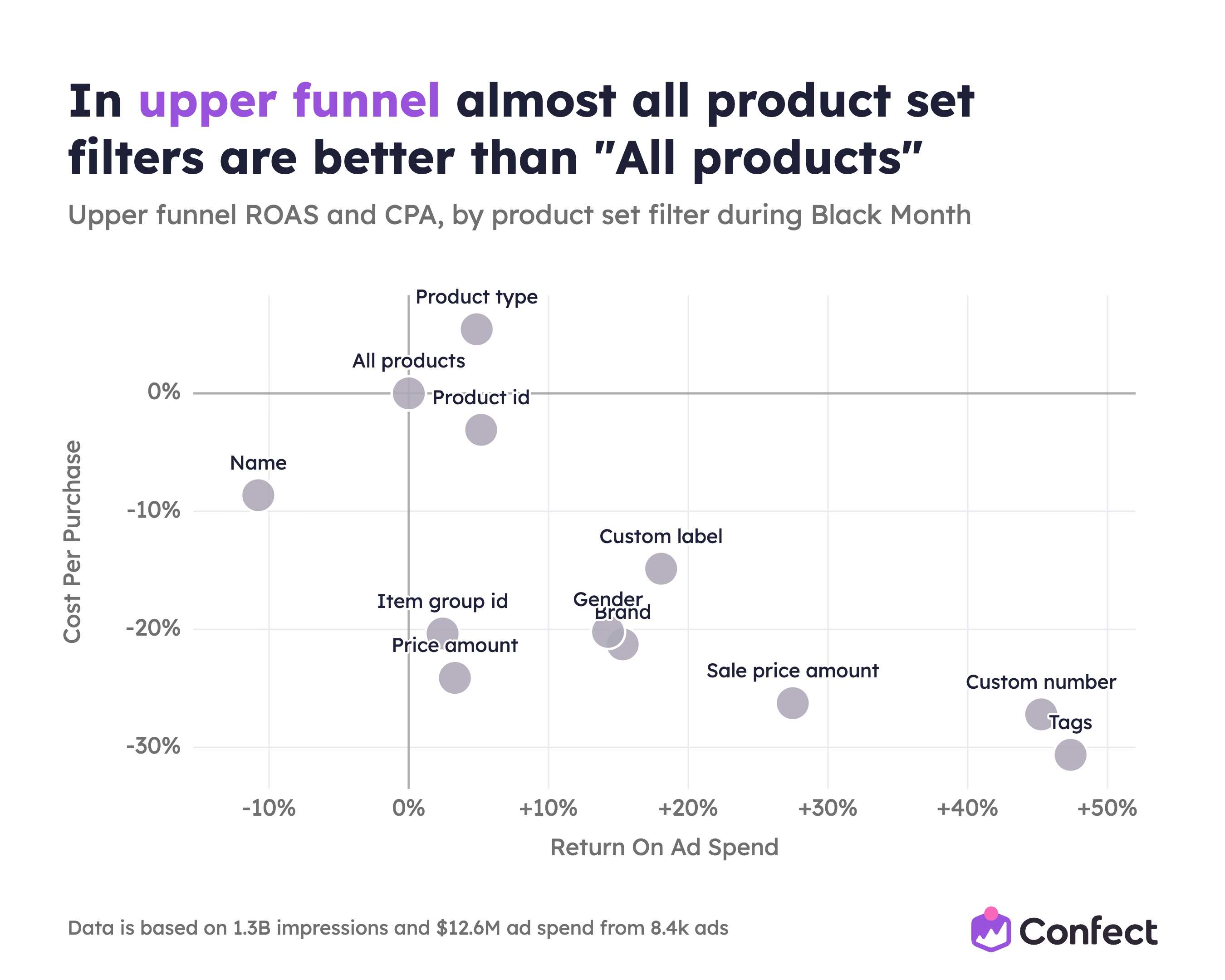
Ten of eleven filters lift ROAS in prospecting. Ten of eleven cut Cost Per Purchase. And the two that lead are the two the advertiser writes themselves.
In retargeting you are splitting a few thousand people over a few days five ways, and none of the five gets enough signal to learn anything. The returning shopper is not choosing from your catalog anyway. Meta is choosing for them from the products they already looked at, so the wider the set, the better the match.
In prospecting the audience is large enough for Meta to sort inside the window. And the filter earns its keep through the design.
A product set is a bundle of buying reasons
Marketing scientists call them Category Entry Points: the situations, needs and cues that make someone think of a category at all. "I need something for the kids." "A gift under 50." "New running shoes before the spring race."
Every product set is a bundle of Category Entry Points, because the people who buy that type of product enter the category through the same handful of situations. Filter your catalog down to a product set and you can build the ad for those exact entry points. The headline names the situation, the design shows the products that answer it, and the shopper in that situation recognises themselves.
A running-shoes set can talk about the marathon in spring. A gifts-under-50 set can talk about Secret Santa. A Nike set can lean on Nike. An all-products ad can say none of that, because it has to work for a blender and a bikini at once. Its entry point is "I want to buy something", which is nobody's actual thought.
This is why tags and custom number lead in prospecting. A tag like "gifts under 50" is a Category Entry Point written straight into the data source, and a design built on it is a filter the shopper would have written themselves. It is also why the plumbing fields trail: there is no shared reason for the design to speak to.
And it is the positive half of the targeting section. You are not being told to stop being specific during Black Month. You are being told to be specific about the products and the message, and to leave the audience alone. The product set replaces the audience as the place where you say who the ad is for. Meta, with all that structured data, does the rest.
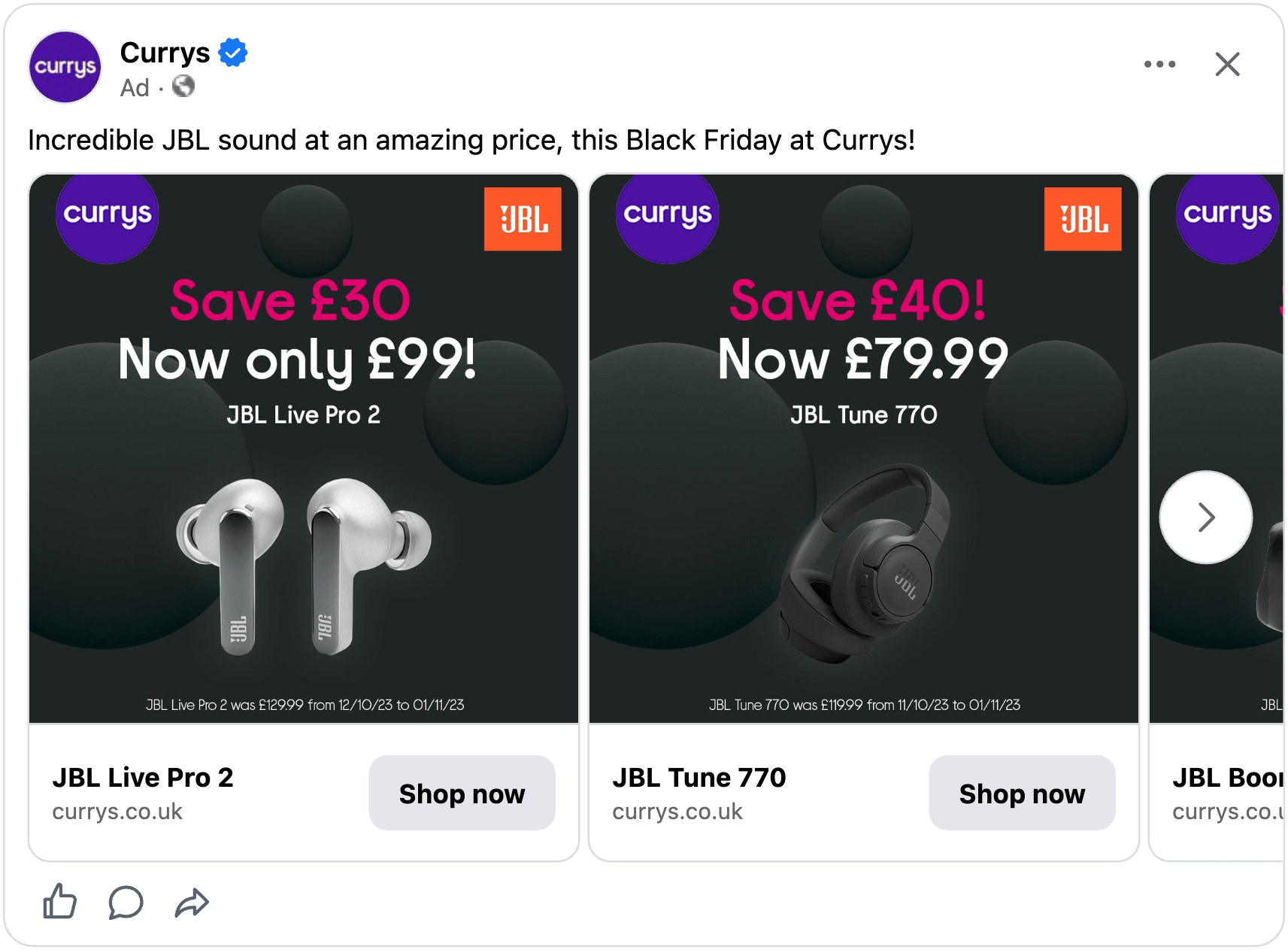
Currys runs a brand filter, JBL only, with the JBL logo doing the search-filter job from the funnel section. POWER runs a category filter for prospecting with the category written on the creative, which is what a prospecting product set should look like. If product sets are new territory, here is the primer.
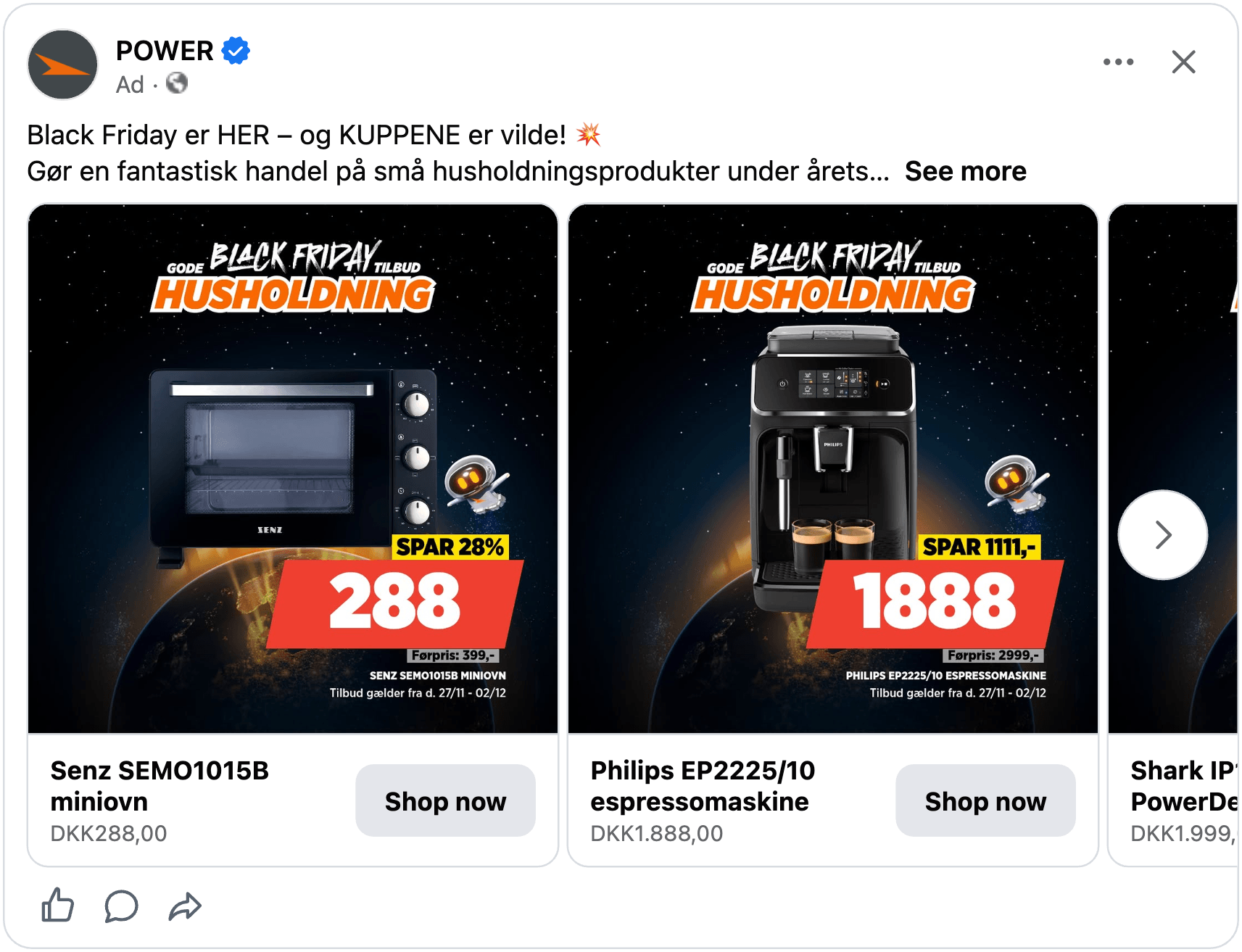
Retargeting: one ad, all products, no filters.
Prospecting: several ads, several product sets, each with a design written for the reason people buy that type of product. Ask of every set "what situation makes someone go looking for these?" and put the answer in the headline. Do not build the same ad five times with a different filter on it. And if you can, filter on a field you authored yourself, because a tag you wrote is a buying situation you already named.
Design Rules: let the design follow the product and the calendar
The largest numbers in the Black Month data are not design elements. They are the two ways of letting the design follow the product and the calendar. Together they are how you run everything above without anyone touching an ad during Black Month.
If you have never used one: a design rule is a condition that decides which design a product gets. It can read the product's own data. A product on sale gets the on-sale design and everything else keeps the normal one. An Apple product gets the Apple design. A bestseller gets the badge.
Or it can read the clock: the design changes when Black Week starts, again on Friday, again on Cyber Monday. Nobody touches the ad. The image the ad pulls changes underneath it.
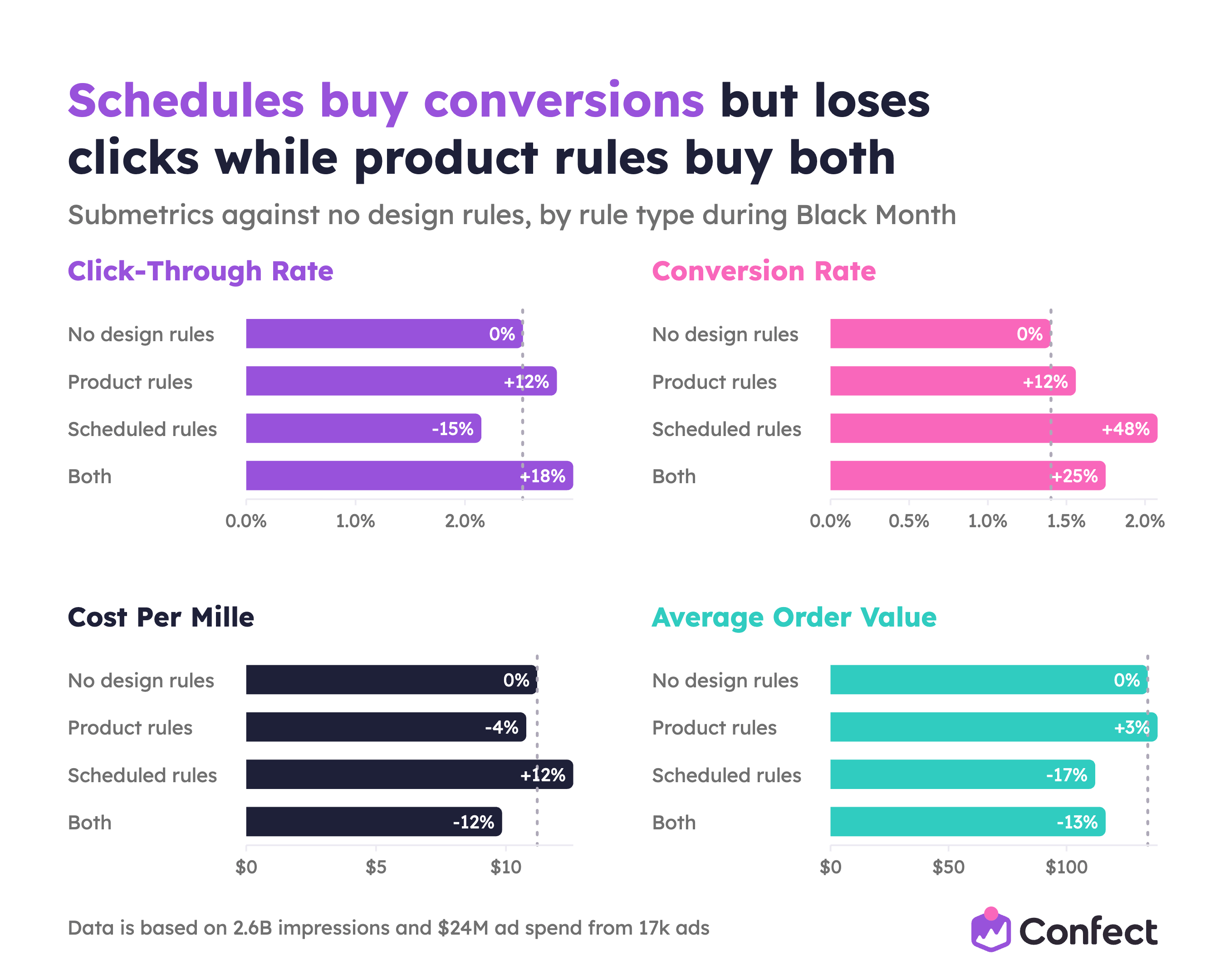
Against Black Month Catalog Ads with no rules, rules built on product data return +22% ROAS. Rules built on the calendar return +23%. Both together return +55%. Underneath: scheduled rules cut click-through rate 15% and lift conversion rate 48%. Product rules lift both by 12%. Together they lift click-through rate 18%, conversion rate 25%, and cut CPM 12%.
![Catalog Ads with design rules on both product data and the calendar return 55% more ROAS during Black Month than Catalog Ads with no rules]](https://cdn.confect.io/uploads/media/71-Product%20and%20scheduled%20rules%20together%20lift%20ROAS%2055%25%20during%20Black%20Month.png)
Two instruments worth about +23% each combine to +55%, which is more than the sum. (Scheduled rules on their own are a smaller group of advertisers, so treat that figure as directional.) Schedules buy conversions and give back clicks. Product rules buy a little of everything. Together they cover each other's weakness. It is the only place in the whole dataset where two instruments do not trade off.
Which product field you build the rule on matters less than you would think.
By the field the rule reads: brand +78% ROAS, product id +77%, product background +66%, on sale +39%, category +30%, custom label +27%, number of additional images +4%.
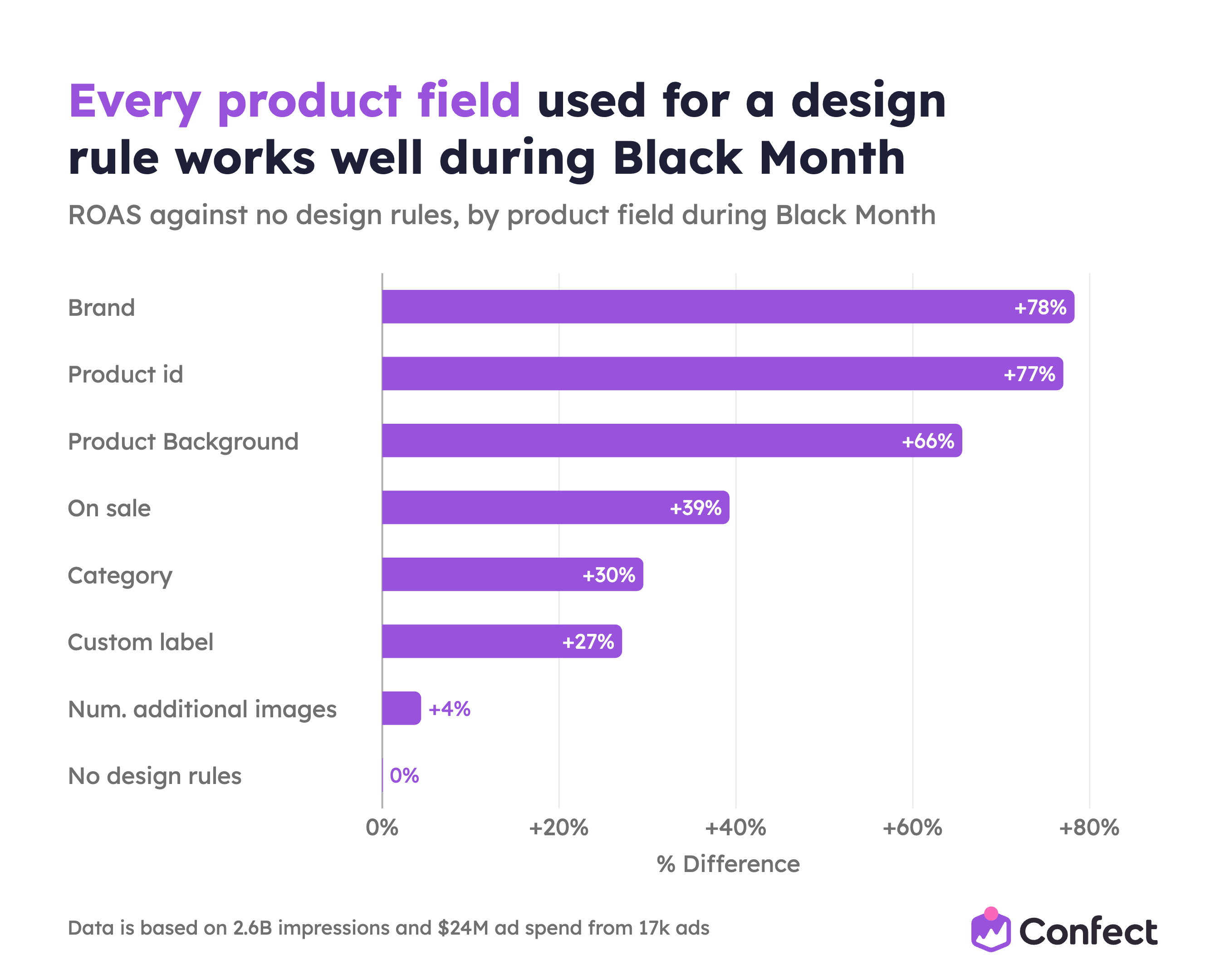
Six of the seven fields land between +27% and +78%. Brand and product id are built on smaller groups of advertisers, so read the exact figures as directional. The six that pay all describe something about the product a shopper could recognise. The one that trails describes your image inventory. Tailoring at all is what pays.
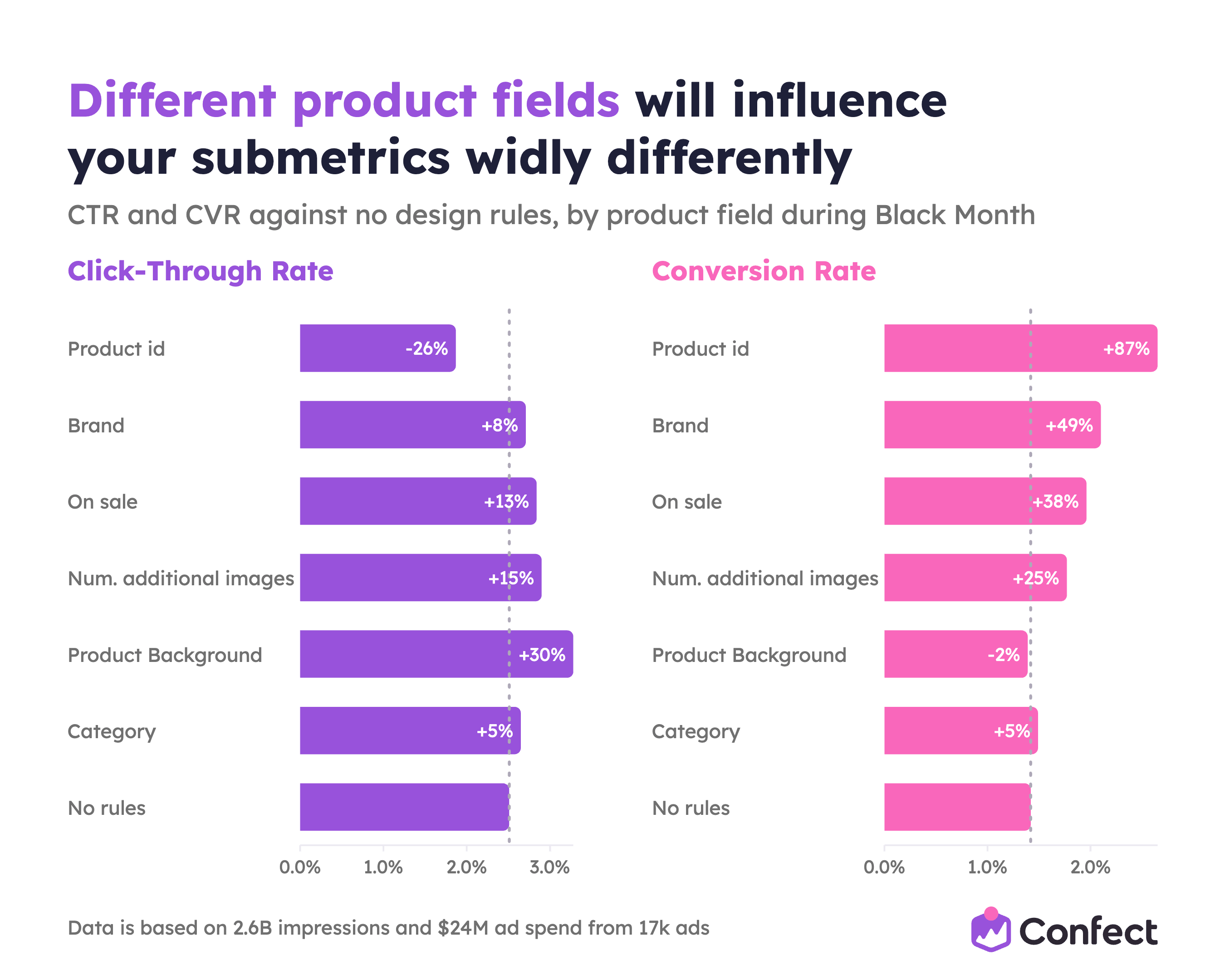
Two fields are worth a sentence each. A rule on product id loses a quarter of its clicks and nearly doubles conversion rate, because it is the most specific design a product can get: fewer people stop, and almost everyone who stops was the right person. A rule on product background is the mirror image, +30% clicks and no conversion movement, because it is a purely visual split with no message attached. Packshots get the design that suits a packshot, model shots get the one that suits a model shot, and the ad simply looks better.
Three mechanisms, and they stack
Relevance. A Cyber Monday design on Cyber Monday beats a Black Month design on Cyber Monday, and scheduled rules lift conversion rate 48% on nothing more sophisticated than the ad agreeing with the calendar.
No learning reset. You change the image the ad pulls, not the ad, so the ad keeps its history. In a month where nothing has three weeks to learn, that is the whole argument.
Creative refresh without new creative. A design that changes on Friday, again on Saturday and again on Monday is a cadence no production team could match by hand. And since Andromeda every conditional variation registers as a different visual entity in retrieval, which is why design rules were the single biggest behavioural gap between top and bottom performers in our Andromeda study: top performers were 103% more likely to use them.
Humac's Christmas campaign is the calendar mechanism in a published case: design switched on 1, 18 and 24 December, +42% conversion rate. Swap the dates for Black Week, Black Friday and Cyber Monday and you have the plan.
Product Assets, briefly
A Product Asset does for one image layer what a design rule does for the whole design. It swaps a logo, a mark or a badge based on a product field. During Black Month, Catalog Ads using Product Assets return 23% more than the average ad at 21% lower Cost Per Purchase, and 48% more in prospecting. It is one of the few elements that pays more in prospecting than in retargeting.
That makes sense once you remember who is looking. To a stranger, a visual mark is information about the product rather than decoration about you. An image carries a product fact more cheaply than text does. HiFi Klubben put brand logos on a retailer's products as Product Assets and saw ROAS rise 48%.
One rule pays for itself: products on sale get the on-sale design, everything else keeps the Black Month design. +39% ROAS.
Then add the schedule for Black Week, Friday, the weekend and Cyber Monday, and stop planning to be awake at midnight on the 27th.
Your Black Month 2026 calendar and checklist
None of this comes from a new chart. It is everything above, in the order you will need it.
Black Friday 2026 is 27 November. Black Week runs 23 to 27 November. Cyber Monday is 30 November.
September and October. Traffic or engagement campaigns running. Catalog widened, long tail back in, Catalog Ads share of Meta spend above a third. Broad ad sets, audience filters out. Prospecting product sets built on fields you authored, one design each, plus one all-products ad for retargeting. Two design sets, prospecting and retargeting, plus several that say different things. Design rules and schedules set.
1 November. Black Month design live everywhere. Product rules on, so on-sale products get the on-sale design. Every design shows the price and the original price.
23 to 26 November. Black Week design.
27 November. Black Friday design.
28 and 29 November. Black Weekend design.
30 November. Cyber Monday design.
All of it as design rules, so none of it requires anyone to work a weekend.
The checklist
- 1. Build a design that knows what month it is. Always-on ads pay the premium and collect less than half the lift.
- Know which hand you were dealt. Small, mid-priced and single-brand shops plan for offence. Big, high-end and multi-brand plan for defence.
- Widen the catalog and the Catalog Ads budget. Breadth is what Meta matches against a comparing shopper.
- Buy traffic in October. It is the cheapest lever in this piece, and it has to exist before the month starts.
- Take the audience filters out. Target through the product set and the design.
- Show the price, show the original price, put one line of reassurance under it, and run several designs that say different things. Two of them at minimum: one for strangers, one for people who came back.
- Filter in prospecting. Run everything in retargeting.
- Let design rules run the calendar.
Every ad in this piece can be recreated for your own products in Confect. Which one you start with is up to you. The Nudient pair at the top is the honest place to begin.
Black Friday Catalog Ads: frequently asked questions
When is Black Friday 2026?
Black Friday 2026 falls on 27 November 2026. Black Week runs from 23 to 27 November, and Cyber Monday is 30 November. Most retailers run offers across the whole month, which is why this piece talks about Black Month.
What is Black Month?
Black Month is the whole of November as a sales period: the run-up, Black Week, Black Friday, Black Weekend and Cyber Monday. In our data, Catalog Ads built for the period outperform always-on ads across the full month, not only on the Friday.
Should I leave my always-on Catalog Ads running during Black Friday?
Not unchanged. Always-on Catalog Ads paid a higher CPM during Black Month 2025 than ads built for the period ($12.0 against $10.6) and got less than half the ROAS lift (+15% against +37%). The ads themselves can stay; the design should change.
Should I turn off audience targeting for Black Friday campaigns?
Ad sets with manual audience targeting returned 19% less ROAS during Black Month than broad ad sets, with higher Cost Per Purchase and lower click-through rate. Target through the product set and the design instead.
Should Black Friday ads show the original price?
Yes. Among sale messages, the struck-through original price was the only one that held its value during Black Month (+20% ROAS against the average ad), while discount badges fell to +13% and broad sale messaging to +9%, both well below what they are worth in the rest of the year.
Which ad format works best for Black Friday Catalog Ads?
Carousel, if you run only one. Formats are level on ROAS across the month, but single image loses 25% in prospecting and gains 9% in retargeting, and collection wins clicks rather than conversions.
When should I start preparing Black Friday campaigns?**
September and October. The three biggest levers in the data have to exist before the month starts: a traffic campaign, a wide catalog with a healthy Catalog Ads budget share, and design rules with a schedule.
Do Catalog Ads work for Black Friday prospecting?
Yes, provided the product set and the design are specific. In prospecting during Black Month, filtered product sets returned up to 47% more ROAS than all-products ads, and Product Assets returned 48% more than the average prospecting ad.
How we measured this, for the nerds
Two scopes. Comparisons inside the month use Black Month 2025 only: 2.6 billion impressions, $24 million in ad spend, 17,390 Catalog Ads and 1,362 advertisers. Comparisons against other months use the whole of 2025: 30.9 billion impressions, $201.5 million, around 100,000 Catalog Ads and 2,794 advertisers.
Every percentage is a comparison of advertiser-balanced medians. We take each advertiser's typical Catalog Ad first, then the median across advertisers, so no single large spender moves a number.
Ads under $30 in spend are excluded. Ads with extreme performance (a ROAS above 100, a conversion rate below 0.1% or above 20%) are excluded as outliers.
Design elements, industries and shop types are tagged only where the ad or advertiser clearly fits, and a tag is only reported with at least 20 advertisers and 50 ads behind it. Groups near that threshold are described as directional in the text.
For scale, the medians the percentages move off are a ROAS of 5.08, a Cost Per Purchase of $24.51, a click-through rate of 2.70%, a conversion rate of 1.49%, a CPM of $10.85 and an average order value of $128. These are the medians of a specific set of advertisers, not a benchmark to hold your own account against.
These are correlations across a very large dataset, not controlled tests. Where we say a design element "returned X% more", we mean that Catalog Ads showing it did, not that adding it will lift your ROAS by X%. The reasoning in each section is there to help you judge whether the mechanism applies to you.
This is Black Month 2025, the first one run largely under Andromeda. It replaces our earlier Black Week study. A lot has changed since then, in how shoppers behave during Black Friday and in how Meta delivers ads, and where the two disagree, this one stands.