
How Nobody's Child & Incubeta increased CTR by 21% with Confect
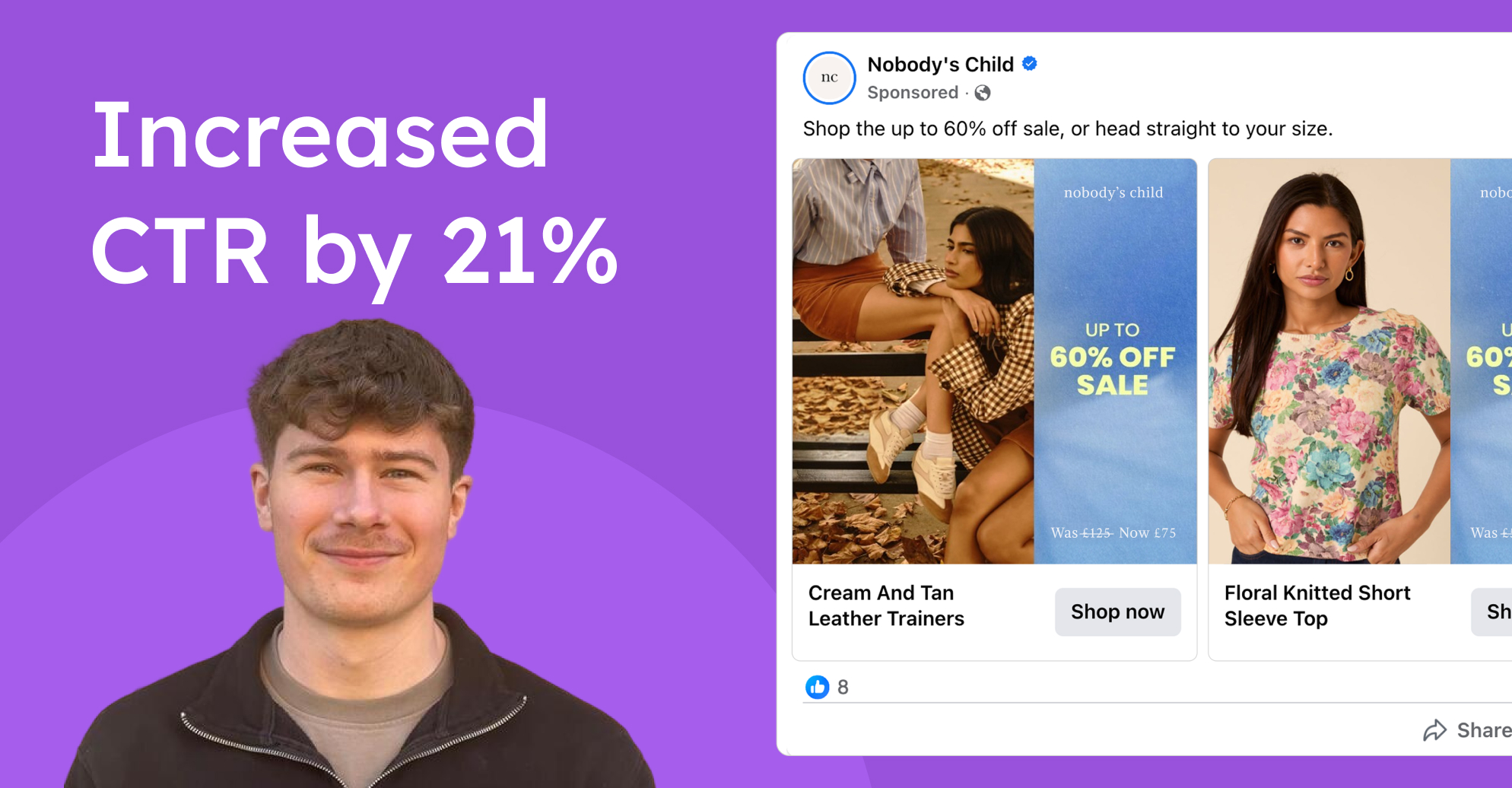
Nobody's Child is a UK-based fashion brand with a strong focus on sustainable, size-inclusive clothing. They operate at scale on Meta, with Catalog Ads running year-round as one of their highest-performing formats.
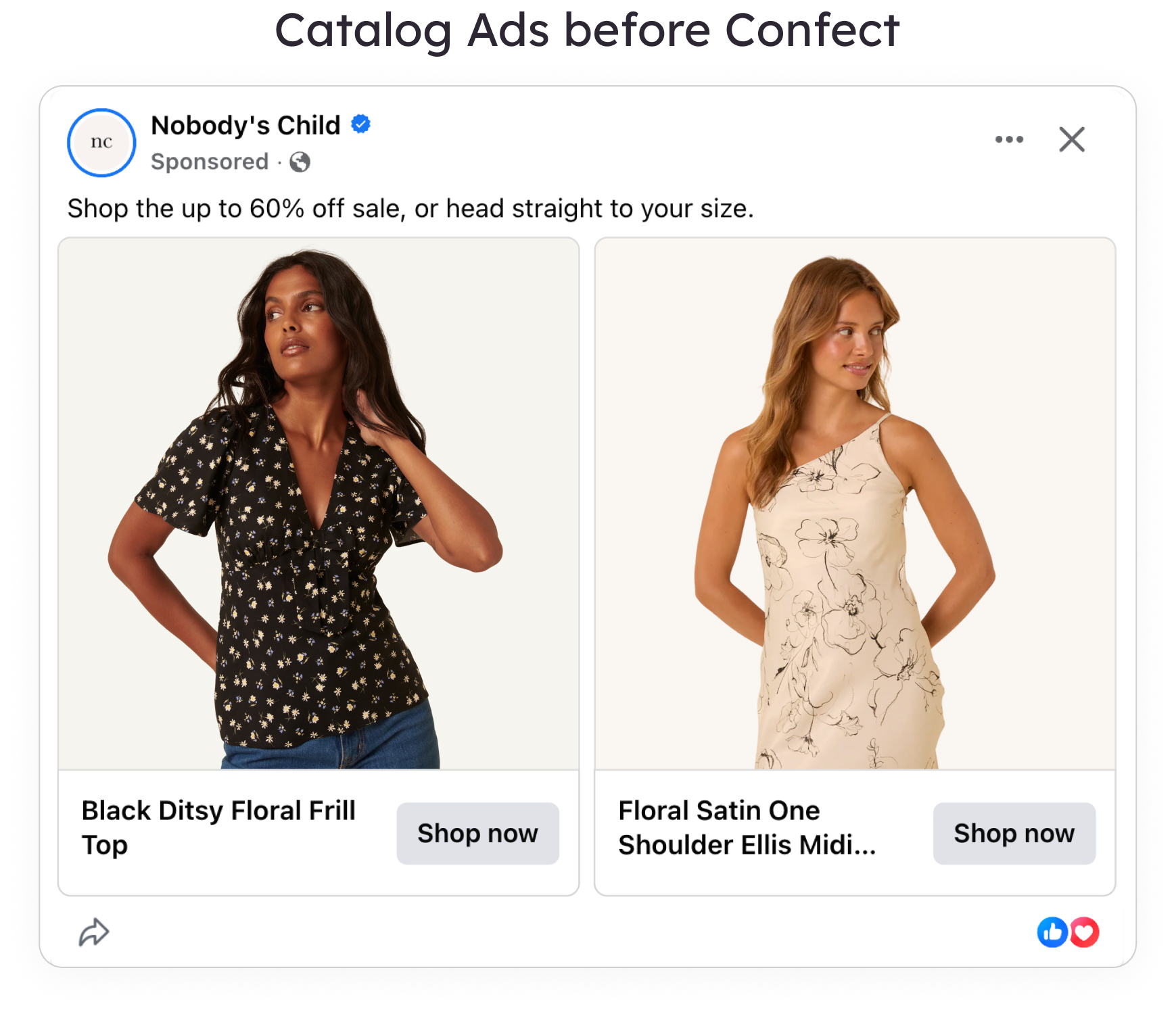
Before Confect, their Catalog Ads looked the way most Catalog Ads do: raw product images on a plain white background, with no logo, no pricing information, and no way to communicate brand identity or promotional messaging. The product was the entire ad.
Working with performance agency Incubeta, Nobody's Child rebuilt their Catalog Ad strategy from scratch.
They now run purpose-built Catalog ads for BAU and sale periods, tuned for different placements and different customer mindsets, each design tested through a structured iteration process.
We spoke with Will, Performance Media Manager at Incubeta, about how they use Catalog Ads with Confect for Nobody's Child.
Their results using Confect for their Catalog Ads
Will and the team at Incubeta saw increased performance for business-as-usual catalog ads and key moments like different sales periods. Here are the four tactics they implemented using Confect.
Finding winning design for BAU Catalog ads
When Incubeta first built Nobody's Child's Business as usual Catalog Ads, the starting hypothesis was intuitive: less is more.
The brand has a premium feel, and giving the products breathing room with generous white space seemed like the right call.
One product image, a logo at the top, a price underneath. Clean. Restrained. On-brand.
Already looking much better than the default catalog ads they ran before.
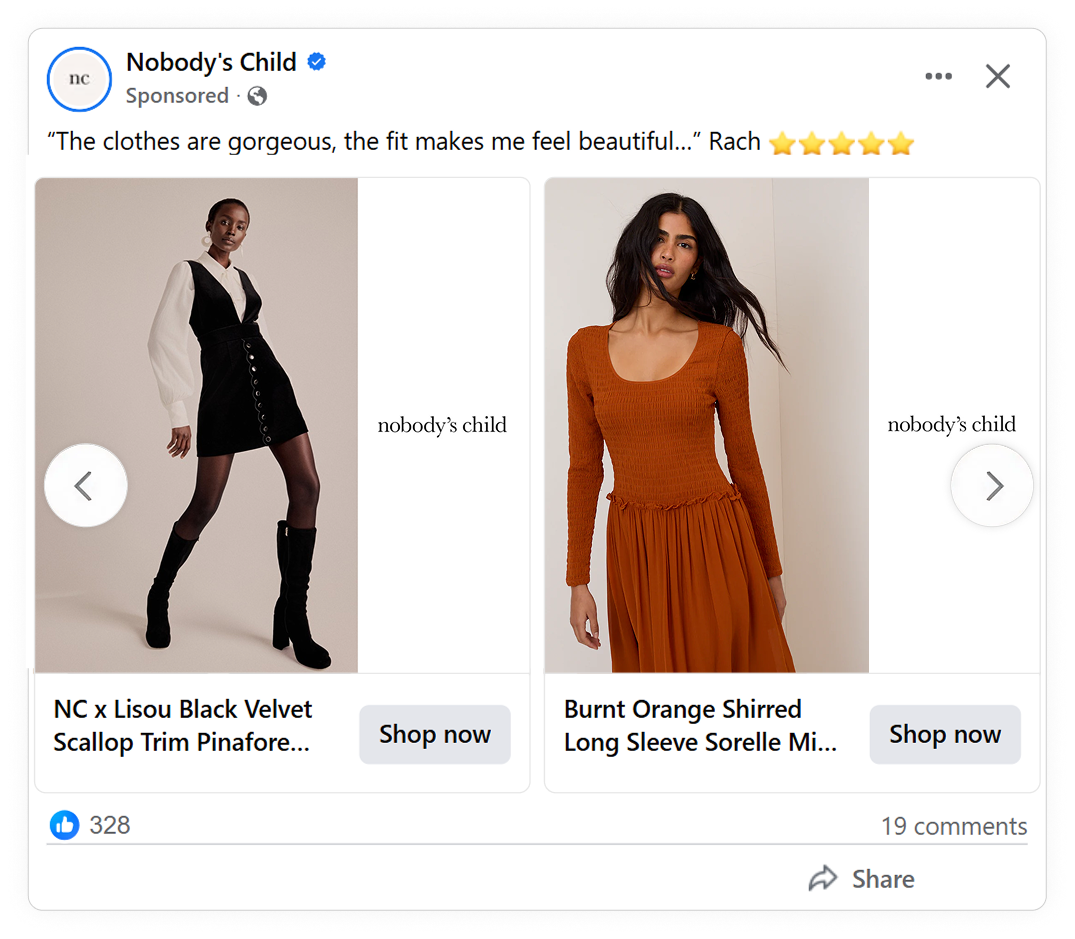
What Will and the team noticed is that the original Catalog ae images (before Confect, with no design enhancements) were actually performing reasonably well on engagement, because the raw product images were large.
When the design improvements were added and the product image got smaller, engagement dipped. People were there to see the clothes. Making the product harder to see was the problem.
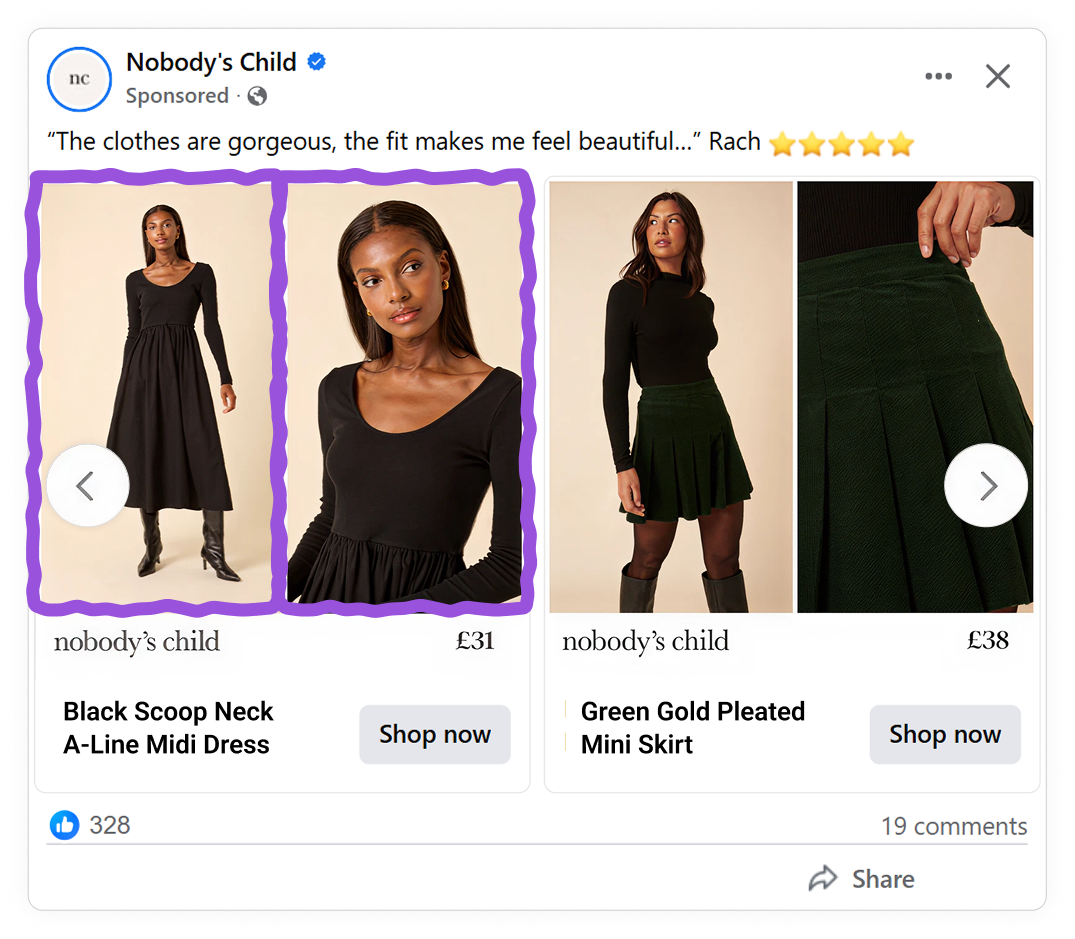
The fix was to make sure the product was the hero in a way that still felt premium and on-brand. The answer: a second product image.
The result is a dual-image catalog ad design that shows a full-body shot alongside a close-up of the product detail.
Customers can see how it looks when worn, while also seeing the craftsmanship up close, all within the same creative.
The learning here is not just "bigger images perform better." It is that the design should amplify what makes the products worth buying, not compete with them. For Nobody's Child, that meant getting out of the way and letting the clothes do the work.
 Will Carpenter
Senior Account Executive, Incubeta
Will Carpenter
Senior Account Executive, Incubeta
Create desirable sale campaign with Catalog Ads
Most brands running Catalog Ads on Meta treat them as a single, permanent design. It goes live and it stays live.
Nobody's Child operates differently. They maintain distinct design strategies for BAU periods and sale periods, with fundamentally different creative logic behind each.
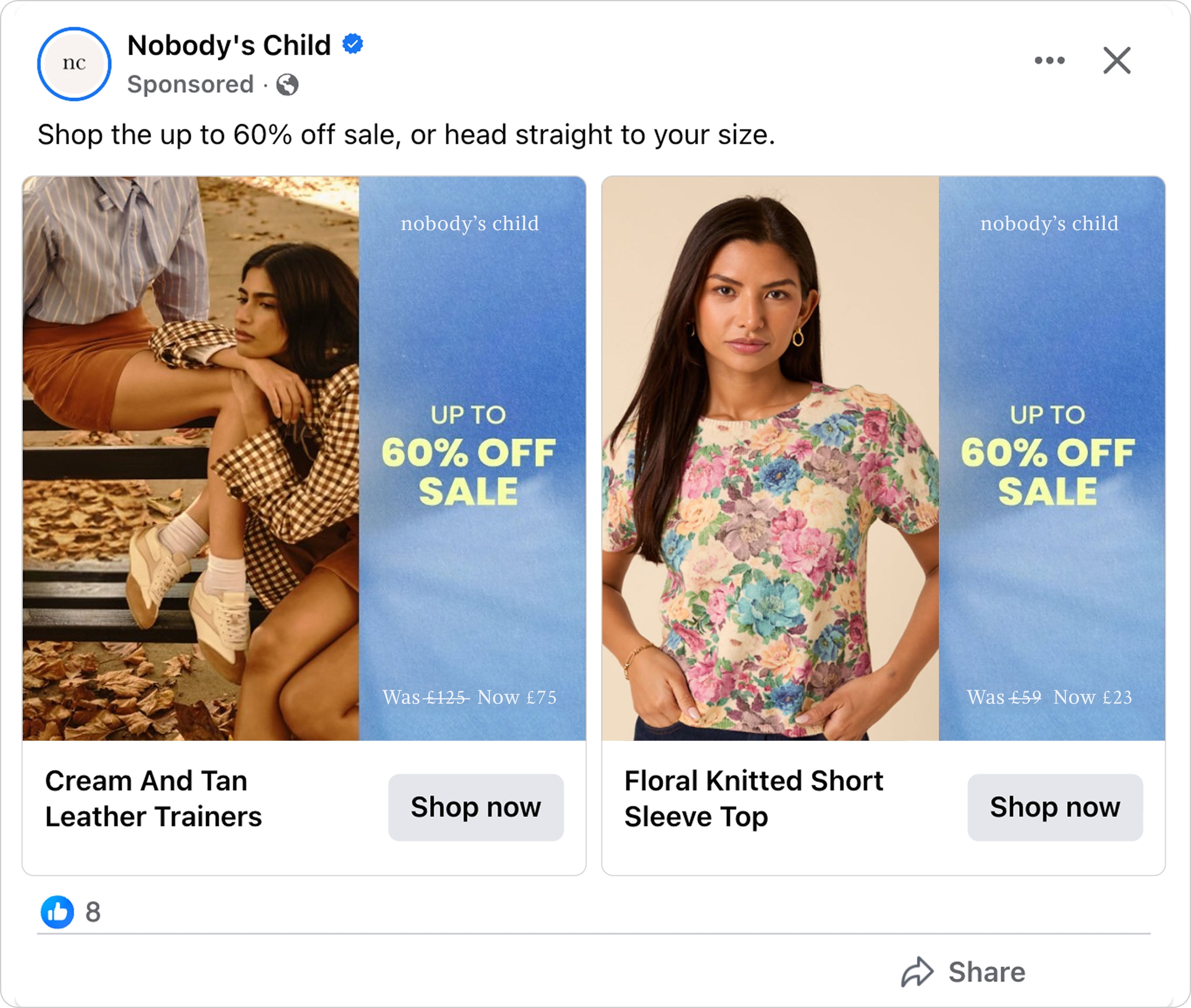
The sale Catalog ad is a different brief entirely. When Nobody's Child runs a promotion, the design strategy flips. The offer is the hero. The discount percentage sits bold and large. The was/now pricing asset appears directly alongside the product, so customers can see the exact markdown in relation to what they are looking at. Nothing is buried.
The reasoning behind this is not just aesthetic. It is conversion logic. Sale traffic that arrives already knowing the discount amount is higher quality than traffic arriving to discover it. The information does the qualifying work before the click.
The data confirmed the strategy. BAU ads saw a 6% increase in CTR versus the previous undesigned DPAs. Sale Catalog ads, with the explicit offer messaging and was/now pricing, saw a 21% CTR increase.
Will Carpenter
Senior Account Executive, Incubeta
Designing for 9:16 placements, not just the feed
Stories and Reels have become some of the highest-traffic placements on Meta. User behavior has shifted hard toward vertical, full-screen content - and it has shifted at scale. The amount of time people spend in Reels alone has changed how the platform delivers ads and what performs when it gets there.
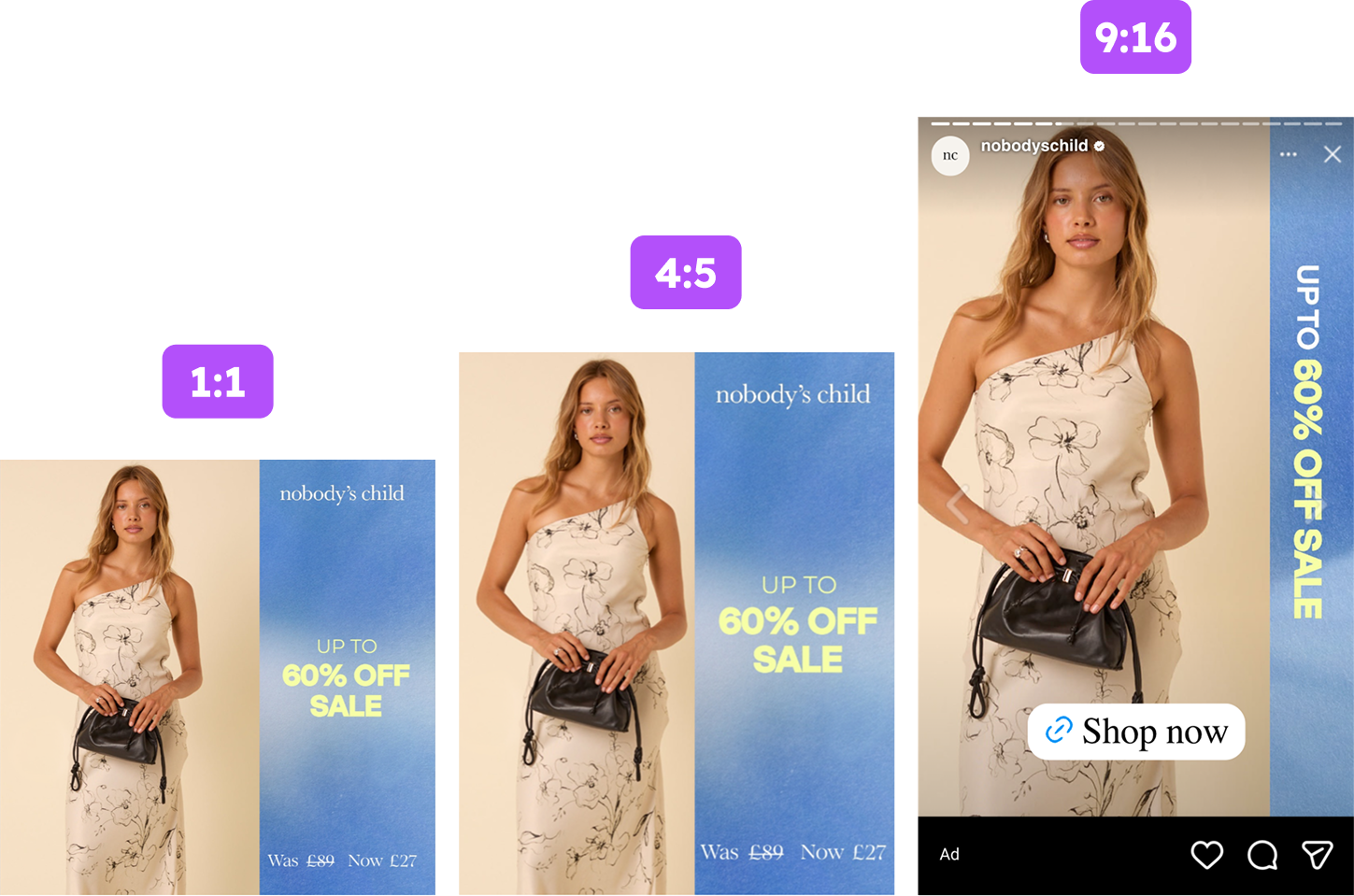
The old approach was to let Meta crop and adapt the feed image to fit the 9:16 format. The result was a stretched or letterboxed product image surrounded by black bars, with interface elements from Instagram covering parts of the content. Nobody's Child, through Incubeta, chose a different approach.

For Nobody's Child's vertical placement design, the product image fills the full screen. The offer depth - the discount percentage and was/now pricing - sits in the center of the frame, in the safe zone between the bottom CTA button and the top progress bar. Nothing important gets covered.
On each placement, their ads look good and appear exactly as expected, whether it’s in the desktop feed, Reels, or Instagram Stories.
 Will Carpenter
Senior Account Executive, Incubeta
Will Carpenter
Senior Account Executive, Incubeta
Serve more product information with Video Catalog Ads (PLV)
By the time Nobody's Child and Incubeta had their static Catalog Ad system dialed in, the next logical step was product level video. Not as a replacement for the static catalog ads that were already performing, but as an additional layer that unlocks something static fundamentally cannot do.
For Will, the case for Video Catalog Ads is not just that video performs well on Meta in general. It is specifically the combination of what Catalog Ads already do - serve each person the most relevant product from the catalog automatically - with what video does better than any other format: hold attention and communicate complexity.
Will Carpenter
Senior Account Executive, Incubeta
For Nobody's Child, that complexity ceiling matters. Fashion is a category where a single front-on packshot only tells part of the story. How does the fabric move? How does the fit look on a real person in motion? How does the color read in natural light rather than a studio? These are the questions a customer is actually asking before they decide whether to click through, and a static image can only answer some of them.
The result for Nobody's Child is a Catalog Ad format that does what neither static nor standard video ads can do alone. The personalization engine ensures each viewer sees the products most relevant to them. The video format shows those products from multiple angles, in use, in motion, giving a much clearer sense of fit and quality than any image can.
Conclusion
Nobody's Child and Incubeta came into Confect knowing that a large share of their media spend was going into DPAs with no logo, no promotional capability, and no placement-specific design. They also knew that the format itself, when run at scale with the right creative, is one of the most efficient ways to reach customers on Meta.
What they built over the course of testing and iteration is a Catalog Ad setup that does more than deliver product images. The BAU ads build brand recognition while prospecting. The sale catalog ads communicate the depth of an offer before a customer ever clicks through. The vertical formats show up natively in every placement Meta's algorithm finds valuable. The video Catalog Ads show fashion the way it is actually experienced. And every design is the product of a testing process that started with a hypothesis, measured the result, and went again.
The numbers reflect it. A 6% CTR increase on always-on BAU Catalog ads. A 21% CTR increase on sale from a format that could not carry promotional messaging at all before Confect.
Will Carpenter
Senior Account Executive, Incubeta