
How Semler Mobility improved their Cost Per Lead by 56%
June 23, 2026

Semler Mobility is part of Semler Gruppen, Denmark's largest car company. More than one in four new cars registered in Denmark comes through the group.
Semler Mobility itself is a retail chain. It sells cars, new and used, from six brands: Audi, Volkswagen, Volkswagen Commercial Vehicles, Skoda, SEAT, and CUPRA, through dealers all over the country. Think of it less like a single-brand dealership and more like a chain that carries several strong brands under one roof.
For a long time, the product ads behind that business looked like most product ads do. A photo of a car on a plain background, a name, maybe a price. The kind of ad that tells you a Q5 exists, but nothing that helps you decide whether it is the right Q5, at the right dealer, for you.
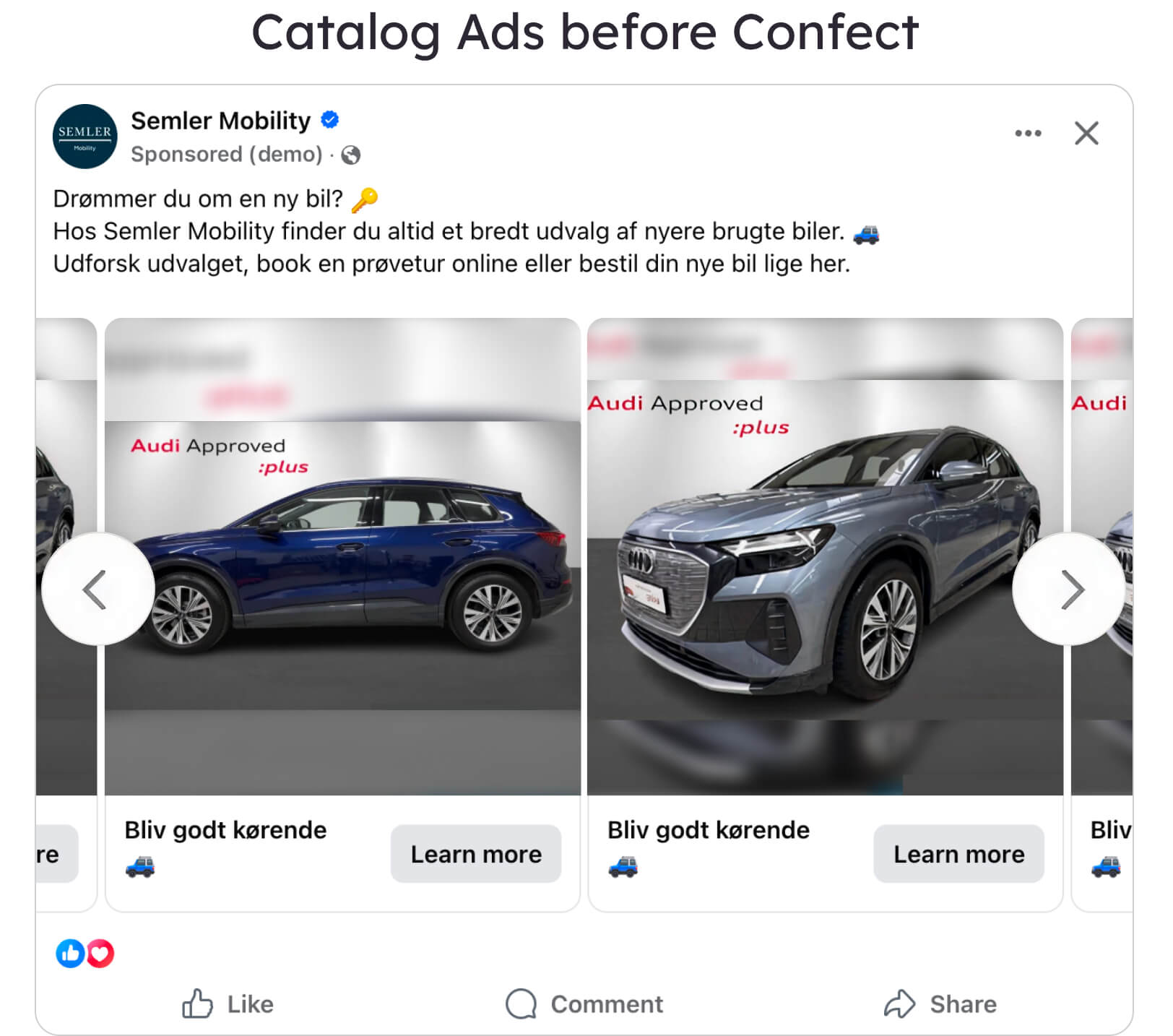
That changed when Semler Mobility started designing their Catalog Ads in Confect. They turned every listing into a proper ad: the right specs on the creative, the right brand weight behind it, the dealer and location shown, all generated automatically across an inventory that never stops moving. The result was not a prettier ad. It was a cheaper, harder-working one.
We spoke with Ahmet Simsek, Content and Social Media Manager at Semler Mobility, about how the team built this and what it did for their numbers.
Results
Cost per lead is improved by 56%. Click-through rate up by half. And more than twice as many leads, all without spending a dollar more than the year before.
Ahmet shared four tactics Semler Mobility, and the wider Semler group, do with Catalog Ads in Confect that drove these results.
Building a shop window good enough to sell a $100,000 car
Selling a car is not selling a t-shirt. You are asking someone to take a product worth hundreds of thousands of kroner seriously, from a single ad in a social feed, between a friend's holiday photo and a meme.
That is a lot to ask of a bare product photo. A $100,000 car shown on a plain white background does not look like a $100,000 car. It looks like a stock image. And a stock image is not going to start a buying process worth half a million kroner.
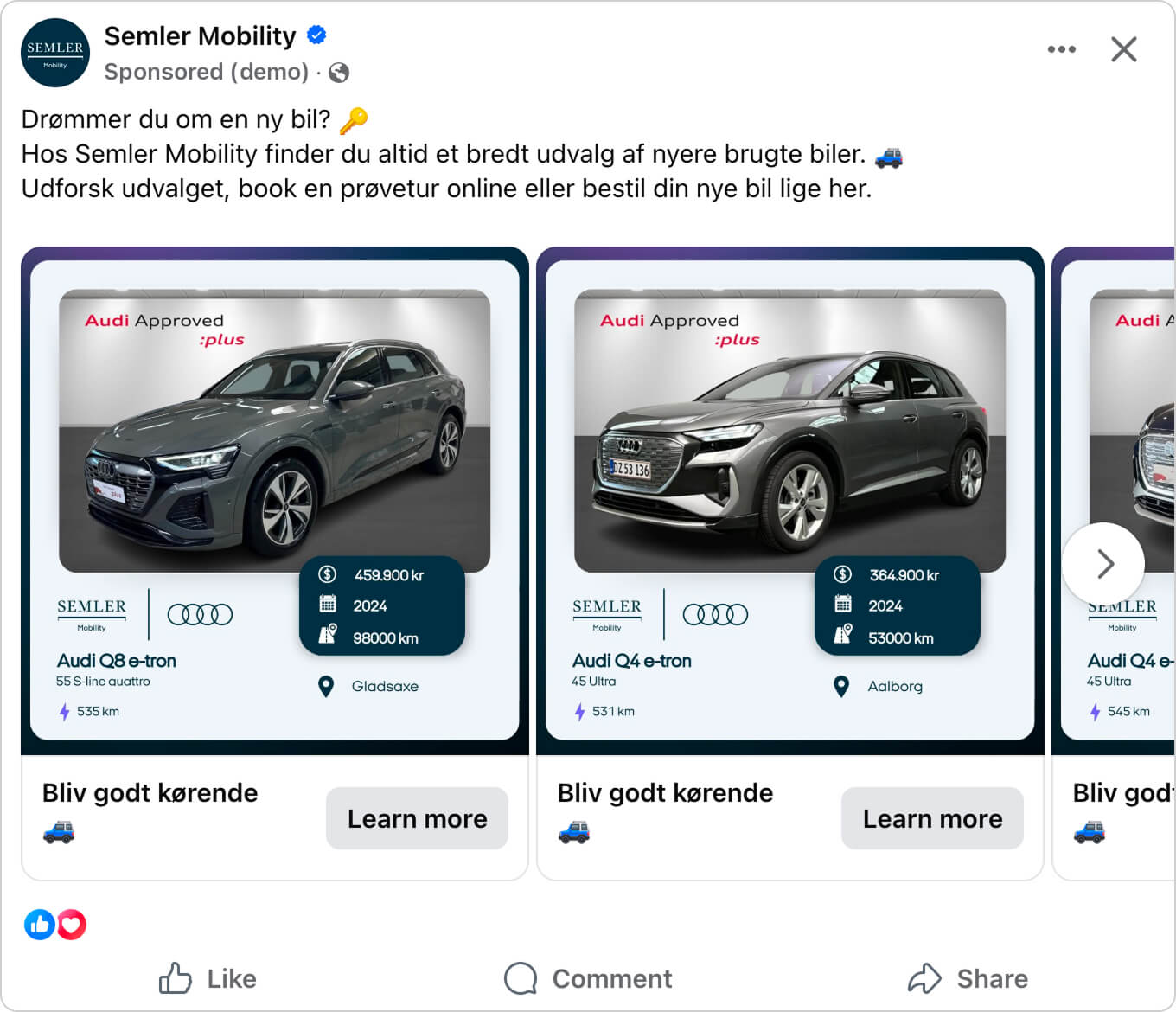
So Semler Mobility treats every listing as a shop window. The ad has to do several jobs at the same time, and it has to do them automatically, on every single car.
It has to make the car look worth its price. A designed creative signals quality before a buyer reads a word of it. The polish is the first proof that this is a serious car from a serious seller.
It has to carry the weight of the brand being sold. Each car's marque logo sits beside the Semler Mobility wordmark, so the ad borrows the credibility of Audi or Volkswagen while still being unmistakably Semler Mobility. For a purchase this large, that transfer of trust matters.
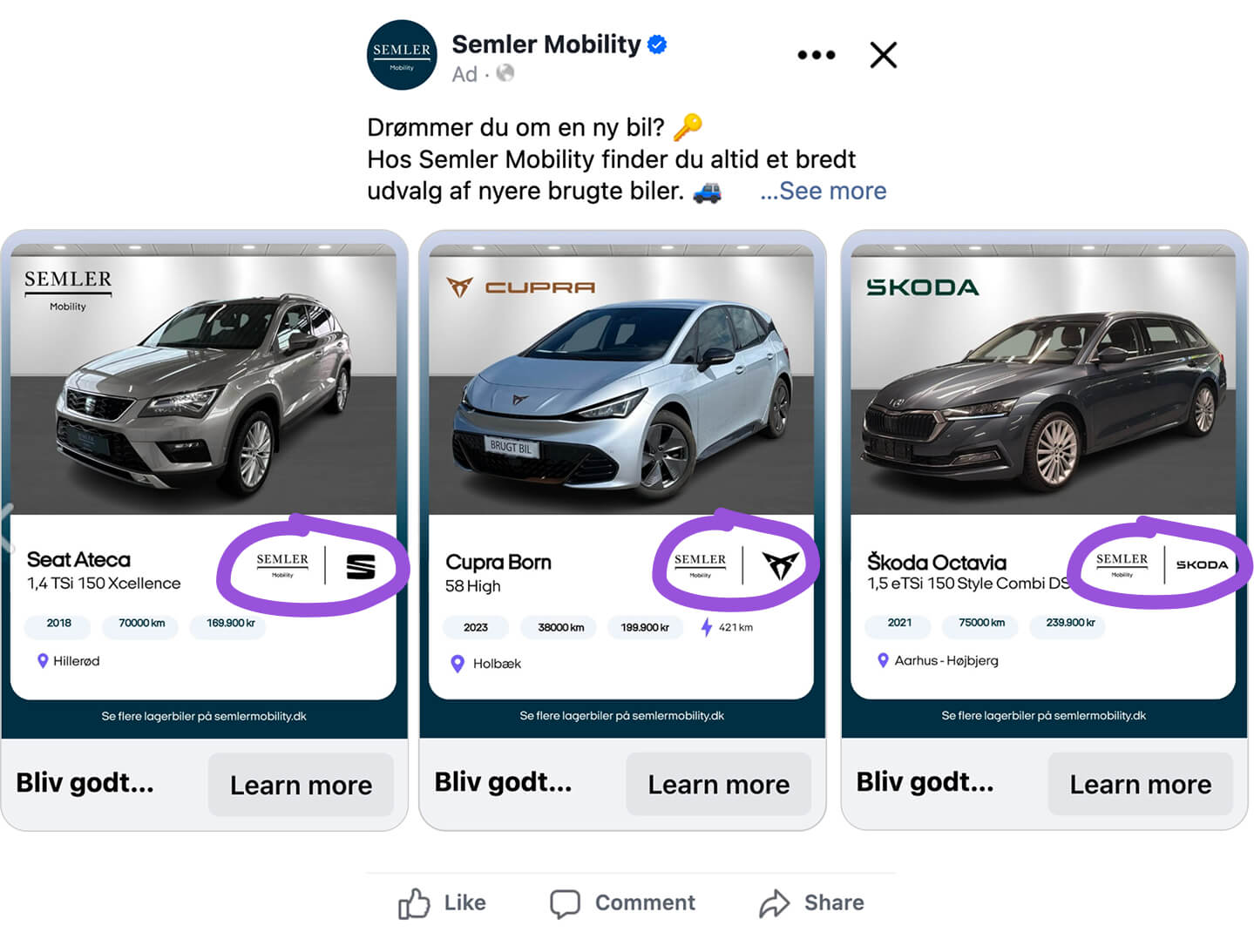
It has to respect the rules. Car advertising comes with legal requirements, and those requirements have to be met on the creative itself. Doing that by hand on hundreds of cars would be a job that is never finished. Built into the design once, it simply applies to every car.
And it has to look like Semler Mobility. Not a generic feed export, but the retailer they actually want to be.
The insight: for a high-price, high-consideration purchase, the creative is the shop window, and a shop window has to do more than show the product. It has to signal quality, borrow the brand's credibility, satisfy the law, and stay on-brand, all at once. A clean, designed creative is read as higher quality before anything is even understood, which is exactly the first impression a $100,000 car needs to make.
 Ahmet Simsek
Social Media Manager @ Semler Mobility
Ahmet Simsek
Social Media Manager @ Semler Mobility
Letting the engine decide what the ad leads with
Walk up to two cars on a Semler Mobility listing and your first question changes depending on what powers them.
For an electric car, you want to know how far it goes. Range is the number that decides whether the car fits your life. For a car with a combustion engine, range barely matters. You want to know how old it is, because model year tells you almost everything about condition, technology, and value.
So Semler Mobility stopped showing the same thing on every car. An electric listing leads with its range. A combustion listing leads with its model year. Same template, same skeleton, one field swapped for the thing that buyer actually cares about first.
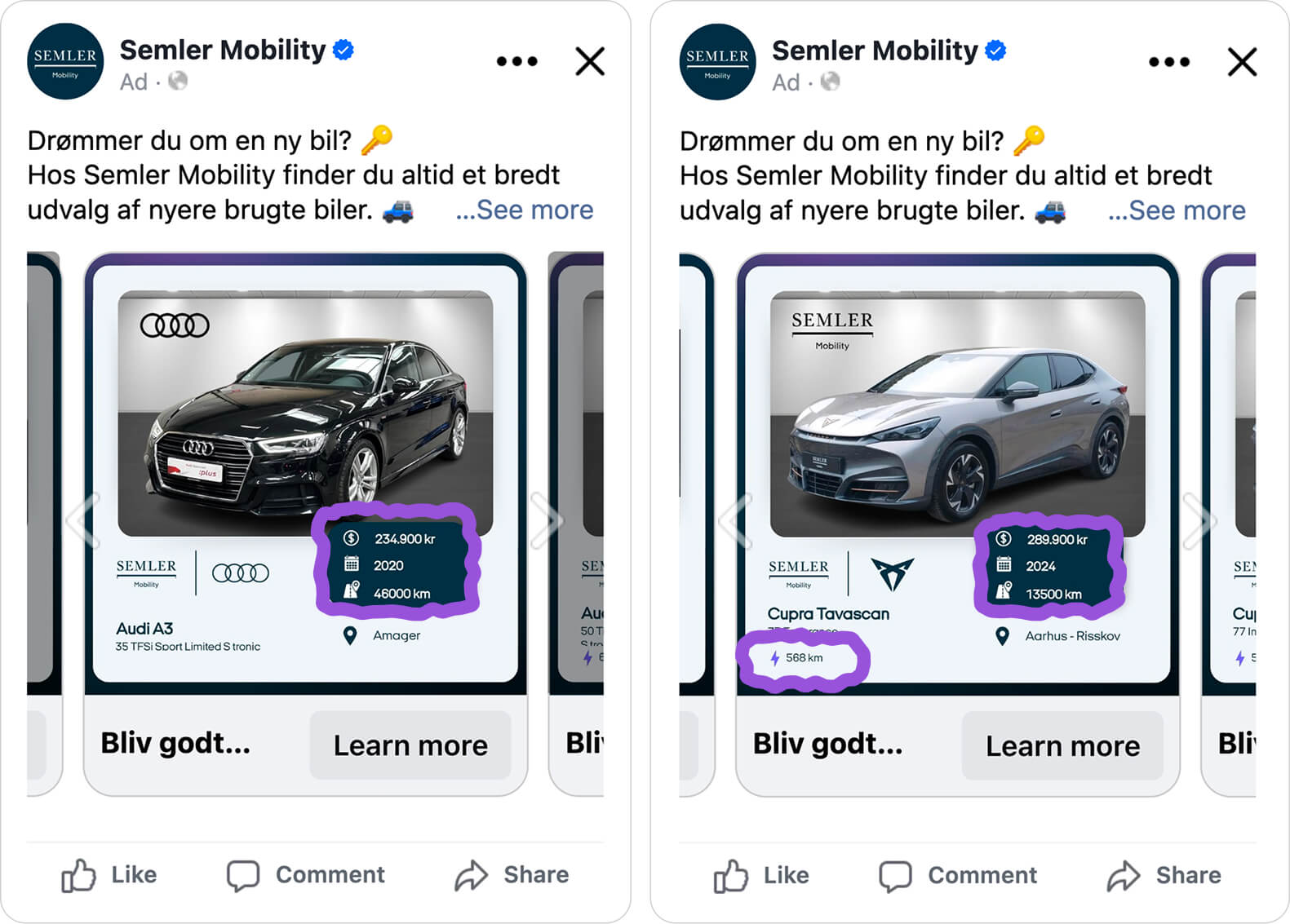
The clever part is that nobody sorts these cars by hand. Confect reads each car's data source and works out whether it is electric or runs on a combustion engine from the name and description, then applies the matching design. With between 800 and 1,500 cars live at any moment, hand-sorting would be impossible. A design rule does it the instant a car enters the catalog.
And this was not a guess. The team landed on range-first for electric and year-first for combustion through A/B testing, watching which version performed better for each category. The data told them what buyers wanted to see first, and the designs now reflect it.
The insight: the win here is not showing more information. It is showing the right information first. Every ad has limited space and a fraction of a second to land. Leading with the one spec that answers the buyer's first question, and letting the rest fall in behind it, is visual hierarchy applied to a feed of hundreds of cars. Most sellers show every car the same way. Semler Mobility lets the car decide.
Ahmet Simsek
Social Media Manager @ Semler Mobility
Built for a buying journey that takes months, not minutes
Buying a car is not a snap decision. On average the journey runs three to four weeks, and it can stretch to months. The buyer researches, compares, second-guesses, books a test drive, compares again, and then buys, almost always offline, at a dealer, long after the first ad was ever seen.
One ad will not carry someone through that. You need to show up more than once, in the right way for where the buyer is in the process, across whatever they happen to be scrolling that day.
Semler Mobility builds for exactly that.
They run different templates for different stages of the funnel. Lighter designs do the work mid-funnel, when a buyer is still exploring. Darker, sharper tones take over low-funnel, when a buyer is close to deciding. The same car, dressed for the moment.
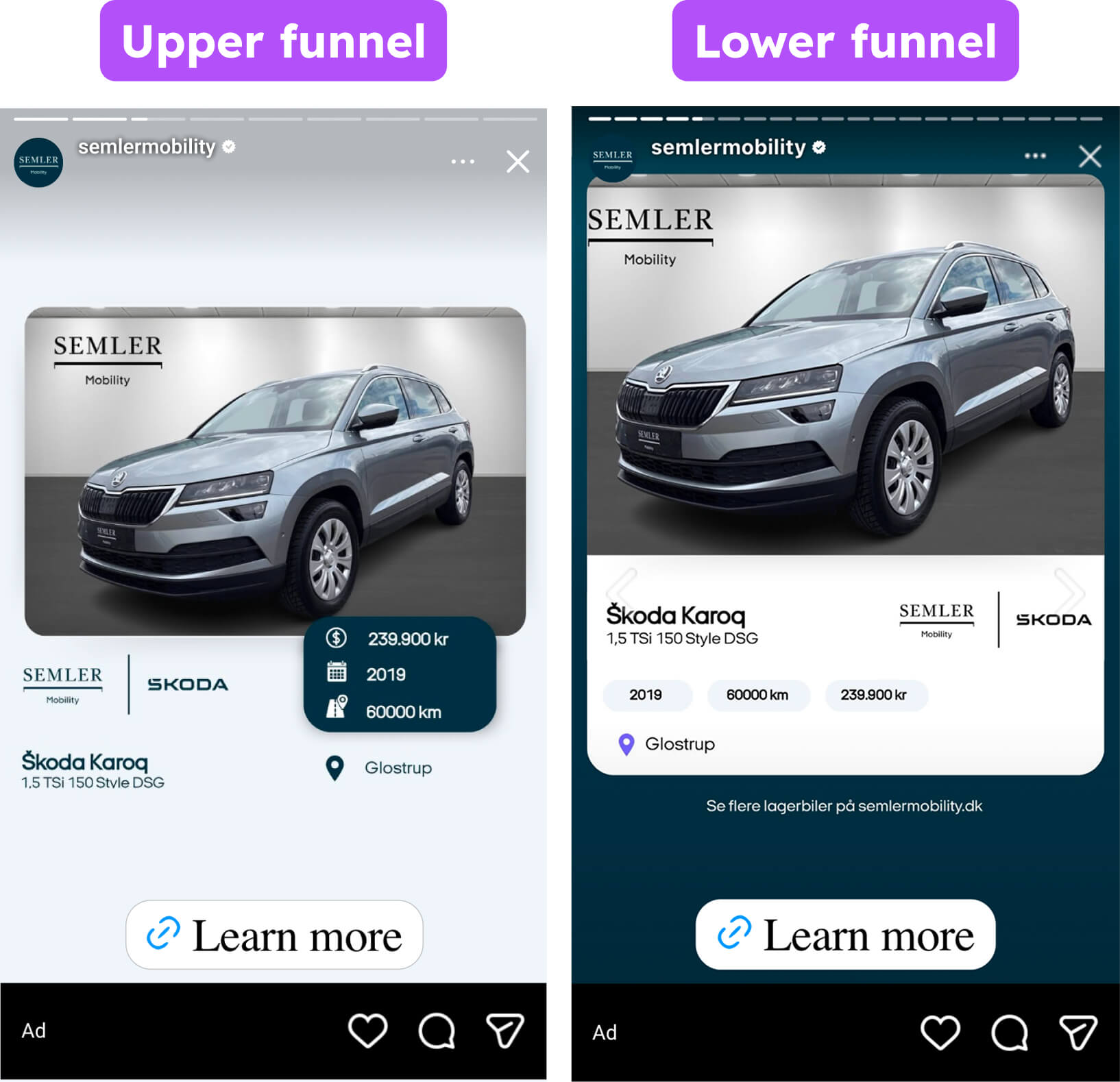
The algorithm decides what gets shown to whom. Semler's job is to make sure that whatever it shows, at whatever stage, looks right.
They cover every placement. The same car is designed for 1:1 in the feed, 4:5 and 2:3 for taller slots, and 9:16 for Stories and Reels. Wherever the buyer is during those weeks of deciding, the car shows up built for that surface, not cropped and broken from another one.
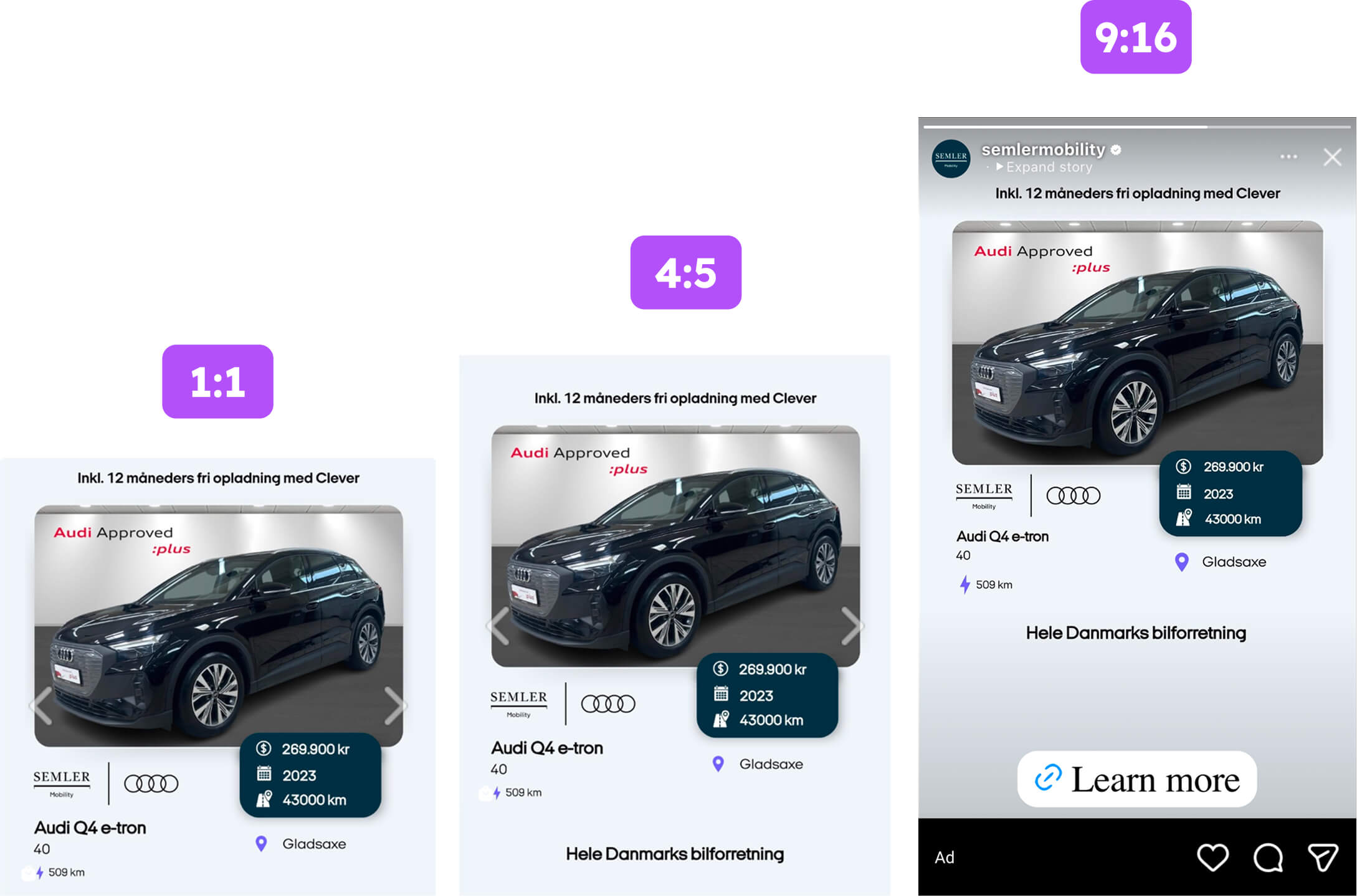
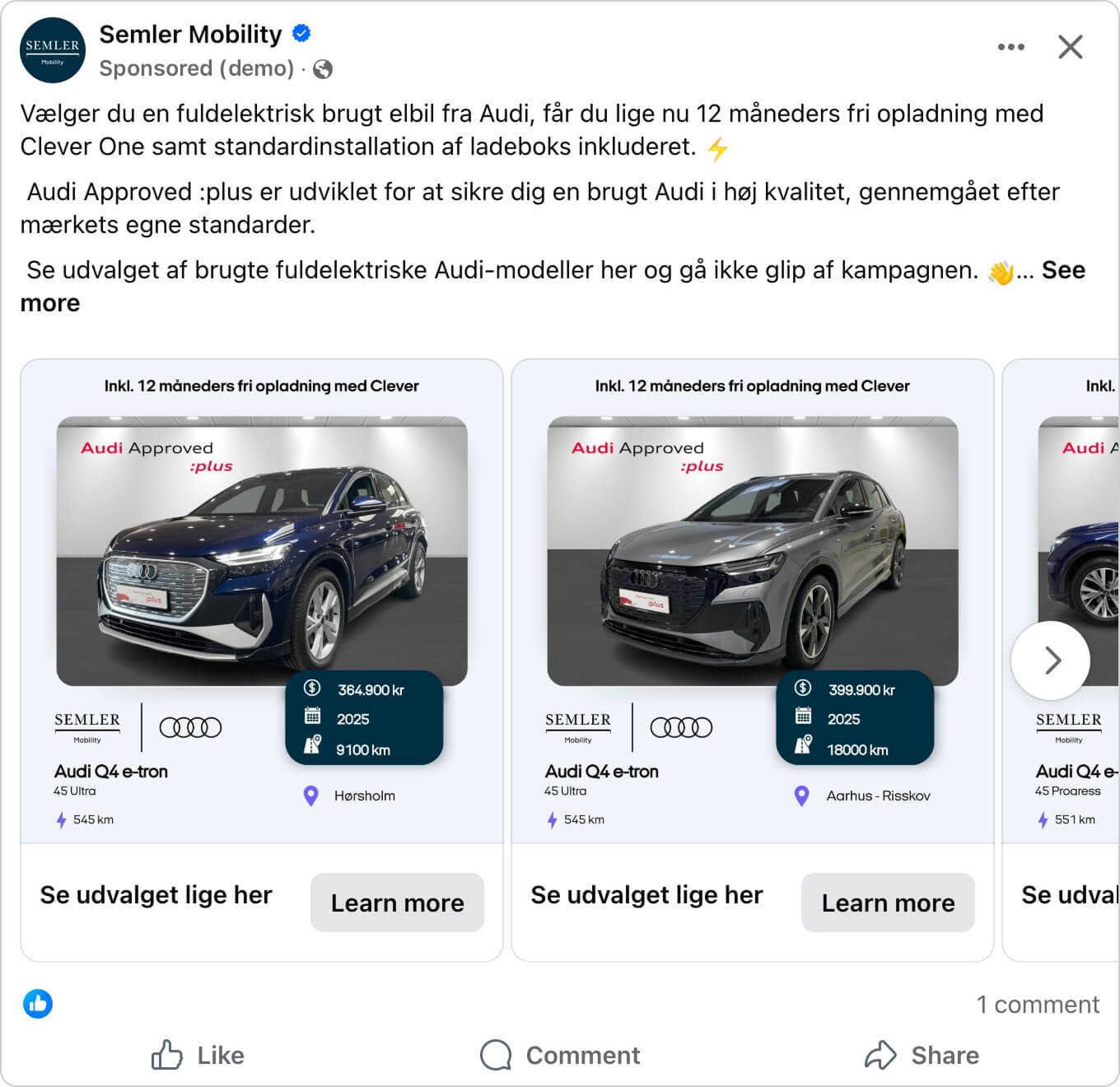
And when there is a campaign to run, the message goes straight onto the right cars. A standout example: a Clever offer of twelve months of free charging on used Audi models. Instead of a separate ad, the offer was built directly into the creative, sitting right above the exact product it applied to. The message landed where the eye already was, on the cars it was actually valid for, and nowhere else.
The insight: a weeks-long journey rewards showing up repeatedly, in the right tone for the stage, on every surface, with the right message on the right car. Doing that by hand across hundreds of cars is impossible. Catalog Ads let one setup produce mid-funnel and low-funnel versions, fit every placement, and layer a campaign offer onto exactly the cars it belongs to, automatically.
Ahmet Simsek
Social Media Manager @ Semler Mobility
Keeping up with an inventory that never sits still
A car buyer has two things on their mind, not one.
The car, obviously. But also where the car is. A perfect car sitting at a dealer on the other side of the country is, for most buyers, a no. Nobody drives four hours to look at a used car when there is a similar one nearby. Location is not a nice-to-have detail. It is as decisive as the model itself.
That makes Semler Mobility's inventory a hard thing to advertise well. Between 800 and 1,500 cars are live at any given moment, arriving from dealers all over the country, each with its own mileage, specs, price, and location. Cars sell and get replaced constantly. A car you advertise today might be gone next week, with three new ones in its place.
Catalog Ads are built for exactly this. Semler Mobility designs the template once, and Confect generates a current, correct ad for every car in the data source. When a car sells, its ad stops. When a new one arrives, its ad appears, already on-brand, already carrying the right specs. The advertising stays in step with the inventory without anyone touching it.
Crucially, every ad shows where the car is and which dealer has it. A buyer in Aarhus knows at a glance whether a car is around the corner or across the country. That single field turns one national inventory into a local one for each buyer, which is exactly what a car shopper needs to decide whether a listing is even worth a click.
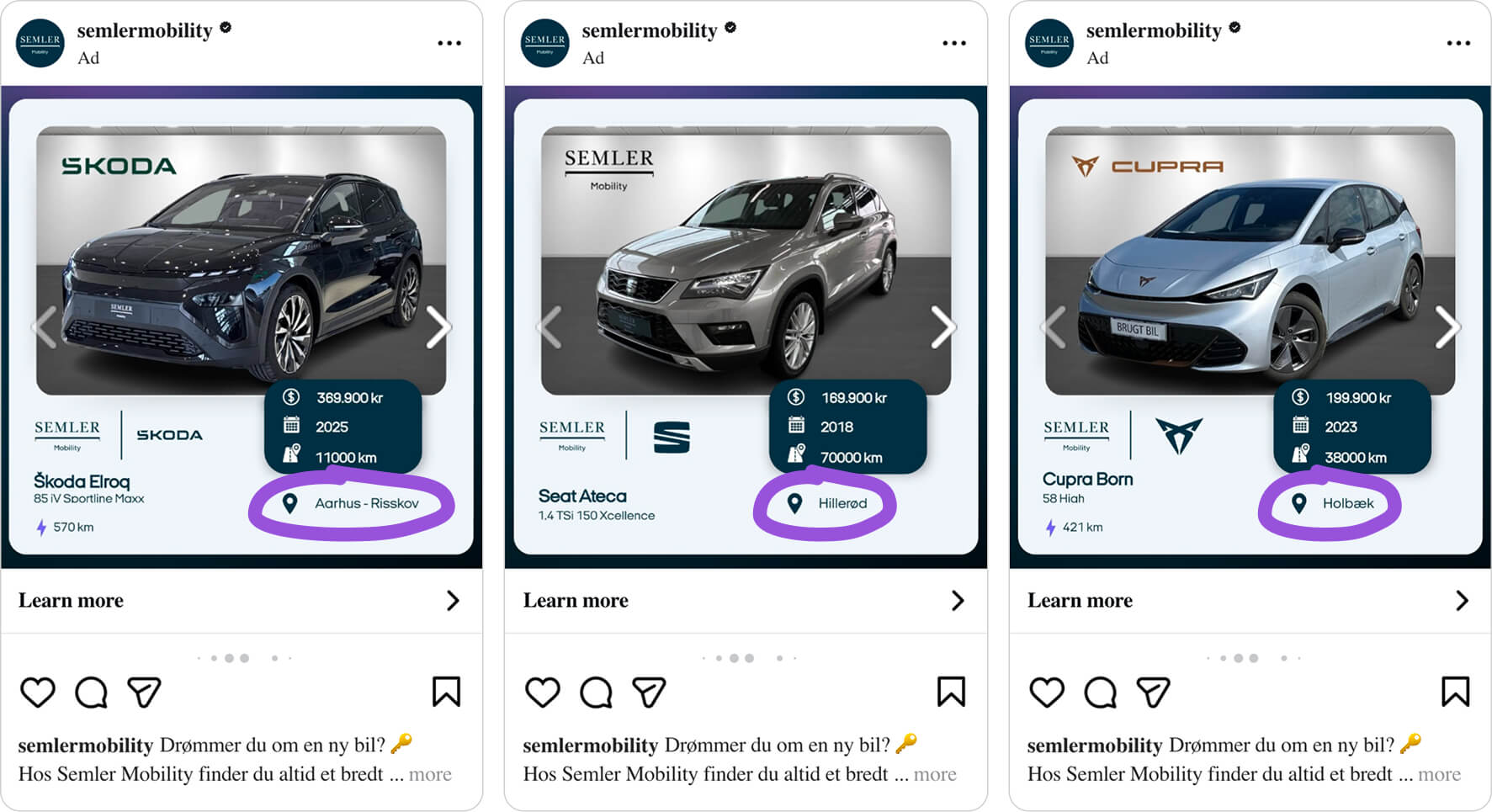
The team also stays in control of what gets shown. They filter out cars they do not want advertised, for example off-brand trade-ins like a customer's traded-in Toyota, so only the right cars reach the feed. And when they need to push specific cars hard, they spin up a separate track for them, which has moved cars from one day to the next.
It is paying off in the on-platform signals too. Alongside the headline results, the cost of getting someone to view an individual car online dropped by about 12%, off a level that was already strong.
The insight: a living, nationwide inventory is unmanageable by hand, and it only converts if each ad answers both questions a buyer is asking, which car and where. Catalog Ads keep every car current, on-brand, and locally relevant, while leaving the team in full control of what shows and what gets pushed. Showing location is not a finishing touch. It is half the buying decision.
Ahmet Simsek
Social Media Manager @ Semler Mobility
And it's not just about proximity. Semler Mobility are giving extra focus on special models or groups of cars during their strategic campaigns, like the Audi charging campaign in collaboration with Clever above, or ads specifically showing the special Volkswagen ID.3 models available. They use their Catalog Ads to direct attention to specific groups of cars - based on the current needs of their business.
The bigger picture
Semler Mobility's results come from treating Catalog Ads as real advertising rather than a plain export of their data source. They built a shop window good enough for a 500,000 kr car, they let the car decide what the ad leads with, they designed for every stage and surface of a weeks-long journey, and they kept a constantly changing, nationwide inventory current, local, and under control.
The payoff was not subtle. Cost per lead is down 56 percent, Click-through rate up with a 50 percent jump. And more than twice as many leads, 127 percent more, on a budget that did not grow at all. For a retailer where the actual sale happens offline weeks later, more than doubling qualified leads while spending the same is about as strong a leading indicator as you can ask for.
What makes the story unusual is the scale of what runs automatically. Hundreds of cars, six brands, funnel-stage variants, every format, campaign messages on exactly the right products, each car's location shown, all current, all on-brand, all the time. Semler Mobility did not get there by working harder on each ad. They got there by building a setup smart enough that each ad takes care of itself.
If you sell a large, varied, fast-changing inventory, and your buyers take their time, this is what good looks like.