
Sparfönster by JABS Group & BeSocial
.jpg)
The ad: a Catalog Ad built to guide the eye, then extended everywhere it could go
If you need to buy windows and doors, Sparfönster is a great online store for doing so.
Together with the agency BeSocial, they built a Catalog Ad that gets more from one strong design than most brands get from an entire campaign.
Sparfönster is part of Jabs Group, whose Performance Marketing Manager Katrine Hellesen helped bring this feature to life. You can find Jabs Group on LinkedIn here: Jabs Group.
Windows and doors are considered, big-ticket purchases that you do not make randomly. Catalog Ads have to respect that and contribute not only to direct performance but also to strong brand recognition and recall.
Sparfönster and BeSocial were very deliberate with their choices, picking elements and assets their customers know and recognize without crowding the design. The same design was then built to travel across every format, into video, and beyond Meta entirely.
Why it won Catalog Ad of the Week
This Catalog Ad outperformed their other Catalog Ads. Even better, the design was later adapted to other formats and channels.
It’s a playbook we see many preach, but few actually follow.
Let’s get into the details and understand what the Catalog Ad is made of and how it was built.
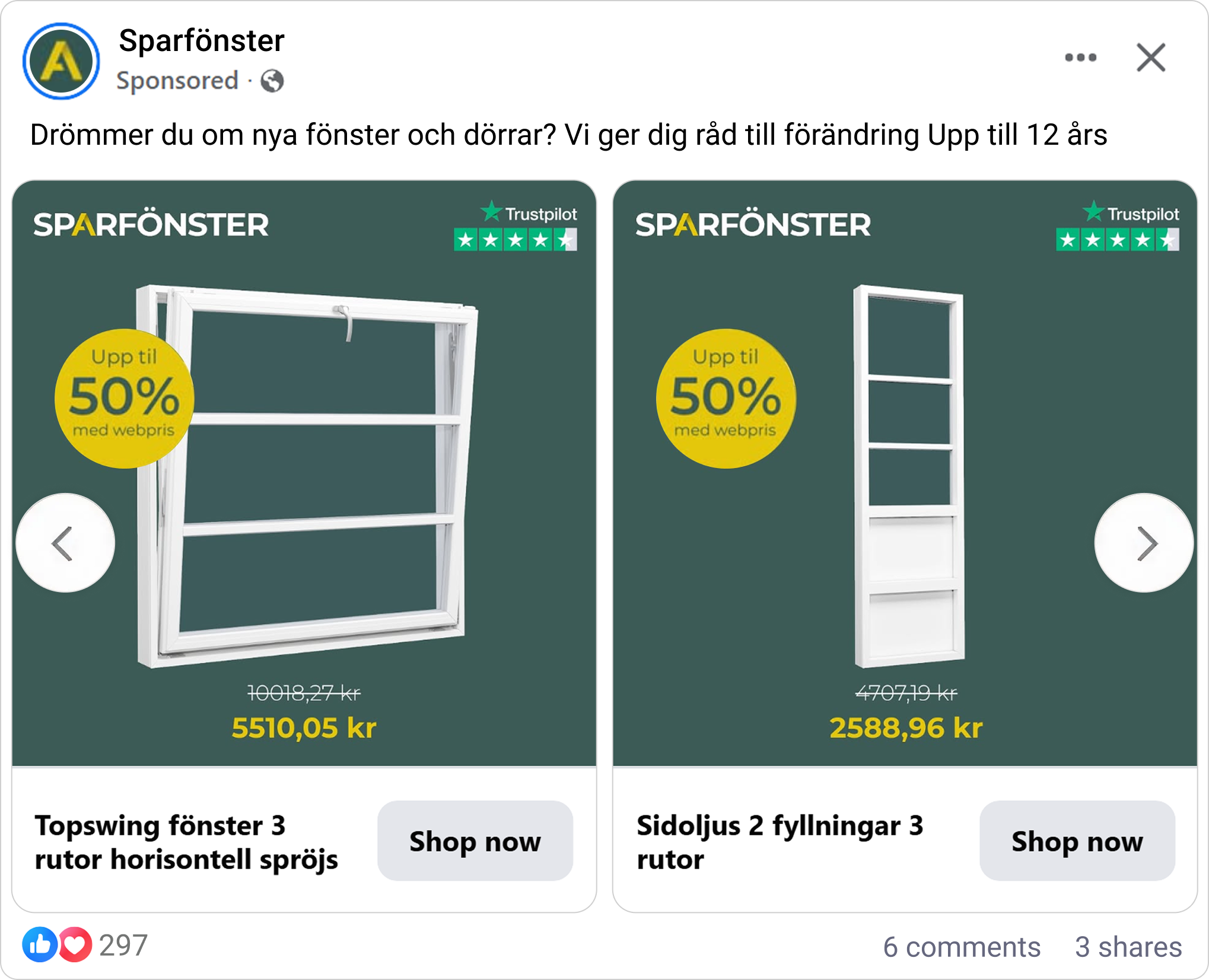
This is what their winning Meta Catalog Ad looks like:
And this is how the exact same image Catalog Ad template was turned into a Video Catalog Ad:
What makes this Catalog Ad great
A composition made to guide the eye from trust, to product, to offer
The Catalog Ad gives information to the buyer in a specially sequenced manner. The composition is built around a trust, value, price model, a structure long used in direct response advertising: trust lowers a buyer's anxiety before anything is asked of them, the product carries the value proposition, and price represents the cost, or the incentive, of acting on it.
.png)
They placed the logo and Trustpilot rating at the edges of the ad, where the viewer’s anxiety drops before the product is processed.
After that, they then positioned the product centrally and made it large, allowing it to carry the value proposition in the form of a visible discount. The price came last, anchored by the struck-through original price above it. This means it acts as the purchase incentive only after trust and value have been established.
For a big-ticket, research-heavy category like windows and doors, that order is exactly right: belief is built before the sale is ever asked for.
The winning design, turned into video
It is super easy to treat video as a separate, expensive production problem, one brands don't want to solve.
Sparfönster and BeSocial took the design they already knew was working as a still image and extended it into a video Catalog Ad. Animation on the elements and from static it turned to dynamic, giving them chance to connect with the buyers not only with images but also videos.
Meta's Andromeda update rewards creative diversity across formats, and expanding into video is exactly that kind of diversity.
It is the clearest proof that video Catalog Ads do not require a new concept or a film crew, start from a design with performance behind it, then add motion.
Same design to reach buyers on Pinterest too
The same catalog design does not stop at Meta. Sparfönster and BeSocial run it on Pinterest as well, putting the product in front of shoppers who are actively planning home projects, exactly the mindset for windows and doors.
.png)
The design that performs well in the Meta feed carries straight over to a second channel, so the work that went into it pays off more than once. The logic here is simple: you already know what works, so adding a new distribution channel is the obvious next step.
Built to run across every Meta placement
The Catalog Ad design is made to be taken places, or to be more precise "placements". Sparfönster and BeSocial did not settle for default. Instead, they made the Catalog Ad work perfectly across 1:1, 4:5 and 9:16.
In the feed, in the taller portrait slots, and full-screen in Stories, the sequence from trust to product to offer stays intact.
.png)
What is really cool is that Sparfönster and BeSocial respected the specifics of each placement. Keeping the logos in the top corners of the Story ad would look weird, and they would be obstructed by the default interface elements. So, they decided to reposition the logos to make the most of the 9:16 placement. Their Video Catalog Ads were also designed in a story format, carrying over the same elements as their image ads.
Key takeaways
The throughline here is not really about windows. It is that a Catalog Ad's layout can be a deliberate sequence, and one design built well enough can be extended into video and into other channels rather than staying a single, one-off creative.
👉 Sequence the composition: trust, then value, then price
Place trust cues where they read as third-party proof, not a self-made claim, to lower a buyer's anxiety first. Let the product carry the value proposition on its own. Show price last, anchored by the original above it, so it reads as the incentive to act once trust and value are already established.
👉 Extend a proven static design into video
Do not treat video as a separate production. Start from a design that already performs as a still image, then add motion, the performance case is already made.
👉 Design once for every placement
Build Catalog Ads that look great for 1:1, 4:5 and 9:16 so the buyer immediately recognizes brand and product no matter the device or placement.
👉 Reuse your best Catalog Ad design on other channels
If a design performs well on Meta, put it to work on other channels too, like Pinterest, instead of building something new from scratch.
Sparfönster and BeSocial got all four of these right in one creative, which is exactly why it is this week's Catalog Ad of the Week.