
icelolly.com & Journey Further
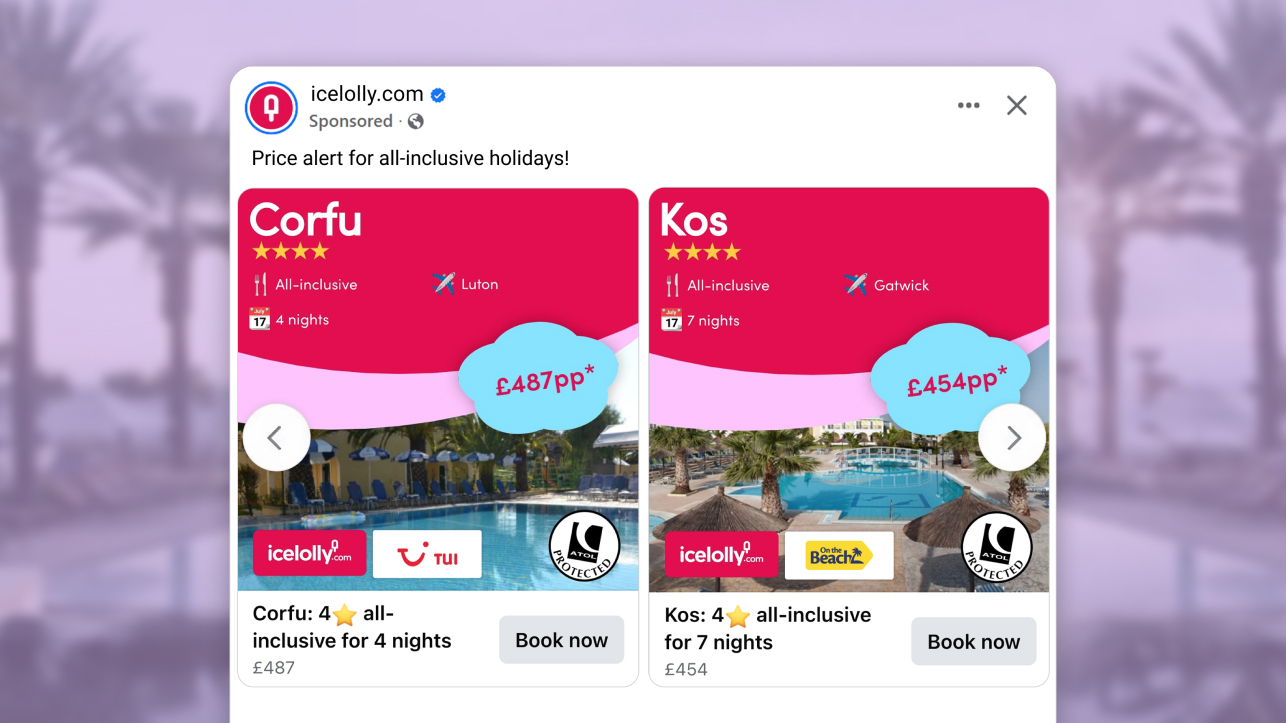
The ad: An ad helping you find the perfect holiday destination
icelolly.com is one of the UK's best-known holiday price comparison sites, part of Ice Travel Group, comparing package holiday deals from all the leading UK tour operators in one place. When you advertise as a comparison site, every "product" is a live holiday deal. This Catalog Ad from icelolly.com and their agency Journey Further makes each of those deals look like a finished, hand-built ad.
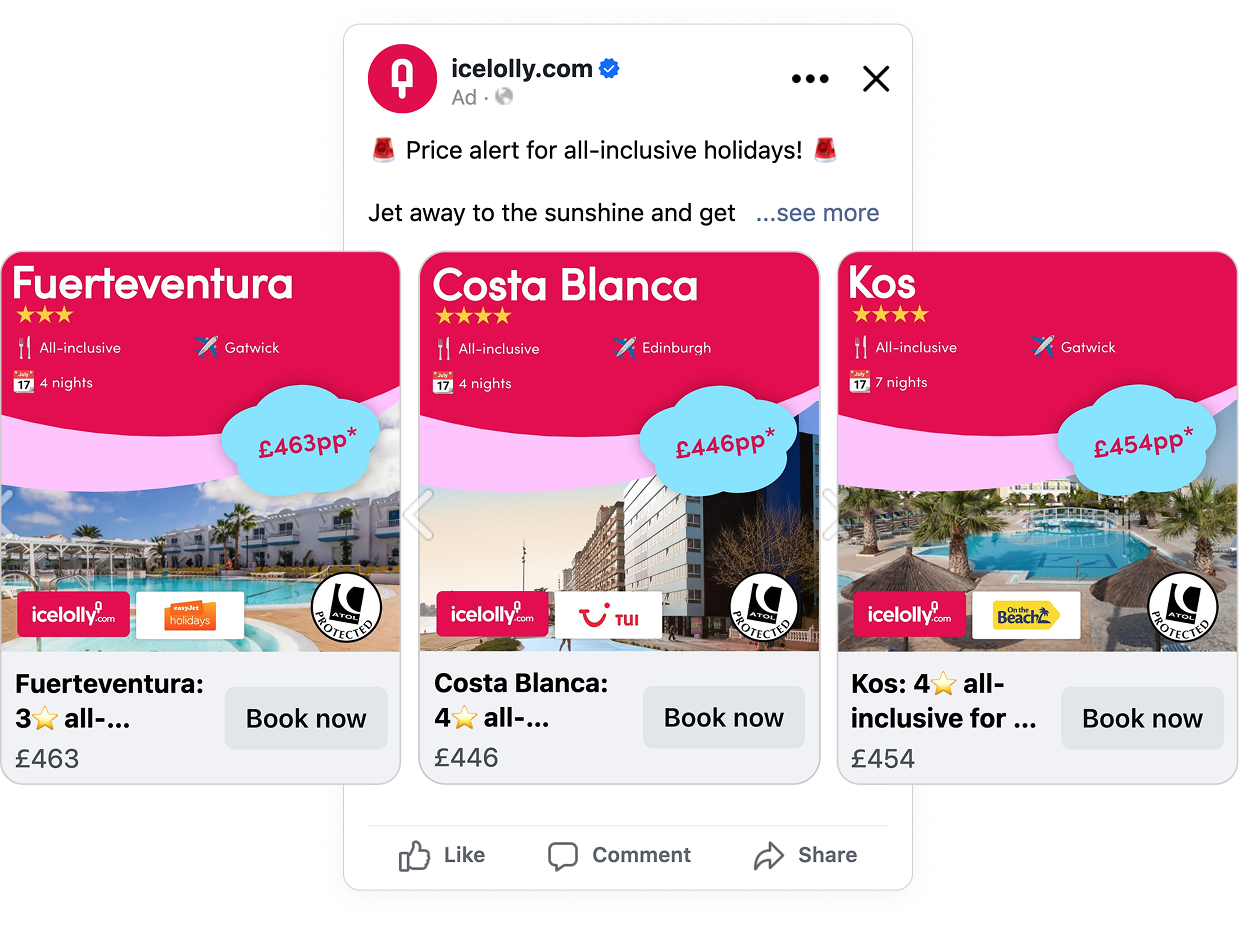
It is a Meta carousel promoting all-inclusive holidays, pulling live deals straight from icelolly.com's data source. Every card is a real package: a destination, a hotel, a departure airport, a board basis, a number of nights, and a price per person. Journey Further runs it as a purchase-optimised Catalog Ad, so Meta matches each deal to the traveller most likely to book it.
Here is the part worth pausing on. Almost every element on these cards is dynamic. The destination name, the image, the star rating, the board basis, the airport, the nights, the price, and the operator logo all load automatically from the data source. The only fixed thing is the design itself. icelolly.com and Journey Further did not build one ad. They built one template that turns their entire deal catalog into finished, hand-built-looking creatives, and the numbers back it up.
Why it won Catalog Ad of the Week
The proof that these decisions work is in the numbers. When you put the full deal on the card, price included, you change who clicks and how ready they are to book. icelolly.com and Journey Further did exactly that, and the results followed.
A lift like this is what happens when an ad does the qualifying work before the click, not after it. icelolly.com and Journey Further put the price, the destination, the star rating, the number of nights, the departure airport, and the board basis on every card, so the people who click on the ad are pre-qualified before reaching the icelolly.com website. Conversion rate climbed by 42%, while cost per purchase fell by 28%, contributing to a 39% increase in ROAS. This is not about driving sheer volume, it is about driving high quality, pre-qualified traffic.
Here is the clever part. Fewer people click this ad than click icelolly.com's other Catalog Ads. But far more of the people who do click go on to convert. For a purchase-optimised campaign, trading raw clicks for qualified clicks is exactly the trade you want, and a 39% ROAS lift is the result.
What makes this Catalog Ad great
Optimise the creative for ready-to-book travellers, not for clicks
icelolly.com puts everything a traveller needs to make a decision directly on the card: the destination, the price per person, the board basis, the number of nights, the departure airport, and the star rating. Nothing important is hidden behind the click.
You are scrolling, half thinking about a summer break. You see Antalya, 4 stars, all-inclusive, 7 nights from Manchester, £420pp. If that fits your budget and your plans, you click with real intent. If it does not, you keep scrolling, and icelolly.com has not paid for a click that was never going to book.
This is the ambiguity effect working in icelolly.com's favour. People avoid options where the outcome is unknown, and a holiday ad with no price or details about the deal is pure ambiguity. By showing the full picture upfront, icelolly.com and Journey Further let each traveller apply their own filters, budget, destination preference, board basis, departure airport, before they ever click. The data proves it worked: click-through rate is down 34%, but conversion rate is up 42% and cost per purchase is down 28%. The ad moved the decision from the landing page to the creative, and only ready-to-book travellers make it through.
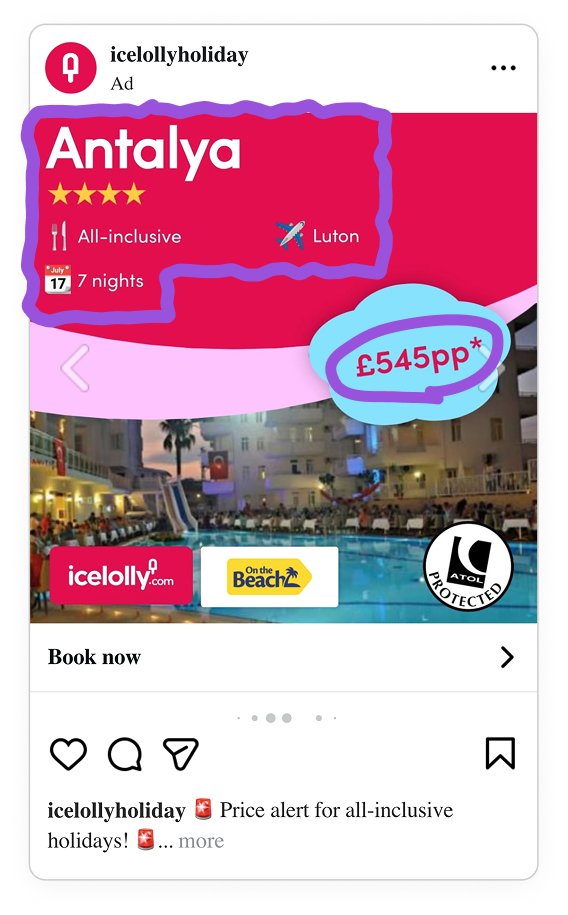
None of this is typed in by hand. Every price and detail is pulled live from icelolly.com's holiday deals data source and placed on the matching card, so every deal in the catalog qualifies its own audience automatically.
Make it easy to compare deals by leading with the facts, not the hotel photo
Look at where icelolly.com puts the information. The destination name is the largest thing on the card, the star rating sits right under it, and the key details (board basis, airport, nights, price) all appear above and around the hotel image, not buried inside it.
That order is doing something smart. Try comparing two holidays using only a photo of each hotel pool, it is almost impossible, one blue pool looks much like another. Now compare them on destination, star rating, board basis, and price, and the choice takes a second. icelolly.com leads with the exact information a shopper compares on, and lets the photo play its supporting role.
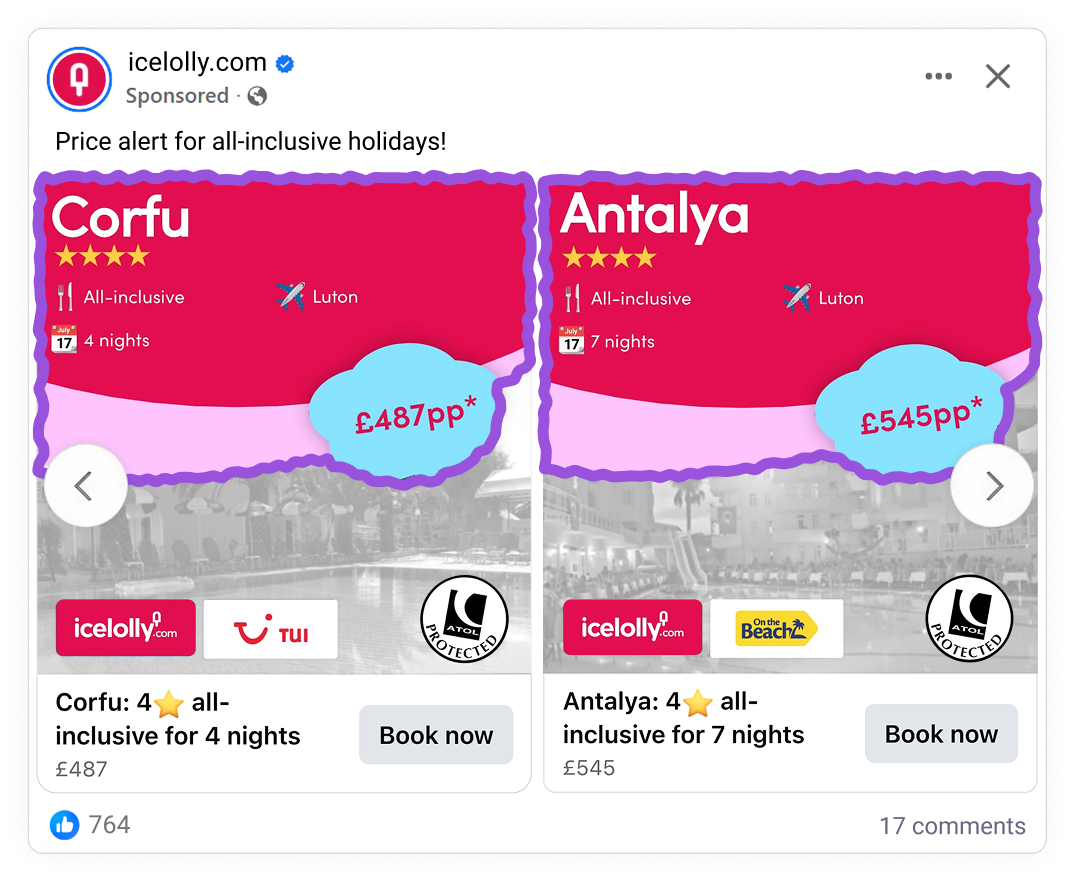
This is how goal-directed shoppers actually decide. Holiday buyers do not fall in love with a hotel exterior, they filter on where, how good, what is included, and how much. By making those facts the hero and the image the backdrop, icelolly.com and Journey Further match the card to the way people genuinely compare deals, which is exactly what a comparison site should do. It is visual hierarchy in service of a real decision: put the comparable facts first, and the deal becomes easy to judge against the next one in the carousel.
Stack the operator logo, the ATOL Protected badge, and the star rating on every deal
Along each card, icelolly.com brings together three trust signals: its own logo, the tour operator behind the deal (TUI, On the Beach, easyJet holidays), the ATOL Protected badge, and the hotel's star rating. The operator logo and the star rating both load dynamically, so every deal shows the right operator and the right rating automatically.
A holiday can be a big, upfront purchase for something you will not experience for months. The moment you see a name you recognise, plus the ATOL Protected mark, plus a clear star rating, the worry about paying an initial deposit to a tour operator quietly disappears, and the quality of the deal is spelled out before you click.
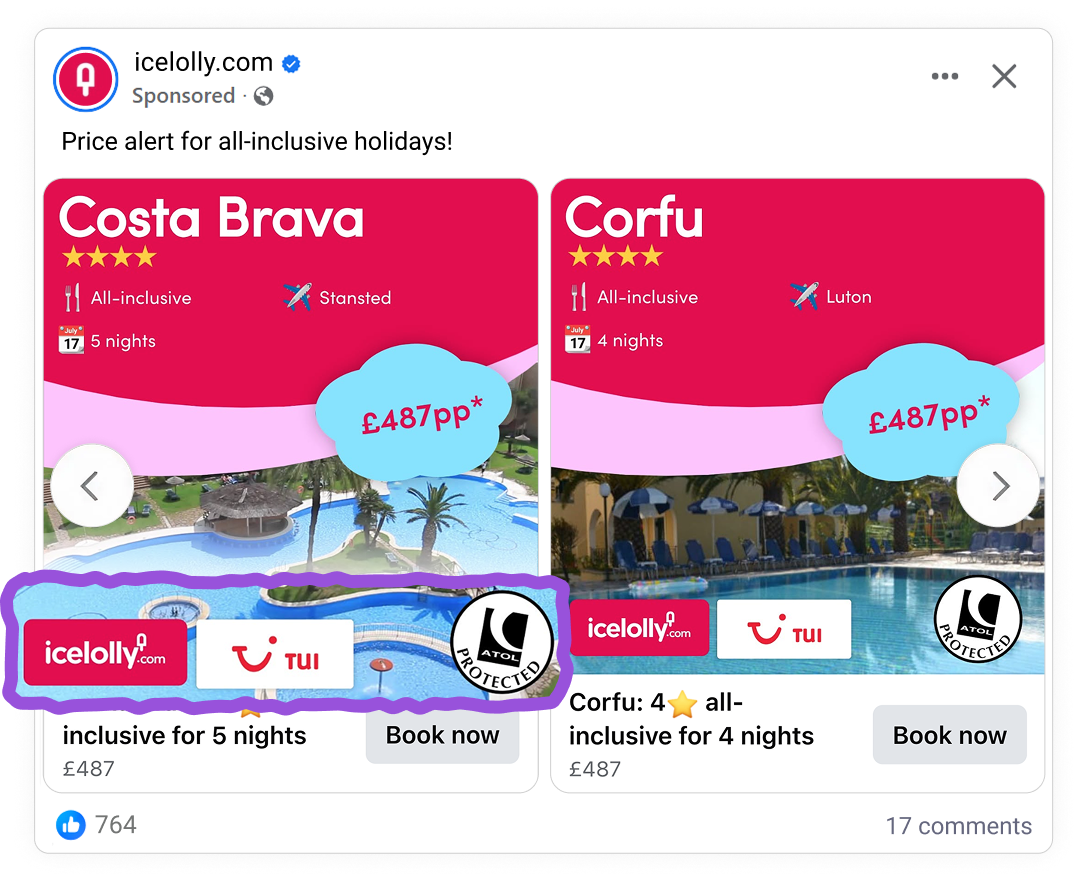
This is trust transfer and risk reduction. By borrowing the established trust of a known operator and the industry-standard ATOL protection, and pairing it with a star rating that sets quality expectations, icelolly.com and Journey Further give every deal instant credibility, Cialdini's authority principle delivered in a single row of badges.
Two of those three signals, the operator logo and the star rating, are Product Assets placed automatically on the correct deal. A package sourced from easyJet holidays shows the easyJet holidays logo and its own rating without anyone building that card by hand.
Filter the catalog so Meta optimises against the right buyer
icelolly.com does not point this ad at their whole catalog. They narrow it to all-inclusive deals only, using a custom label on the data source, and let this ad specialise in one kind of holiday.
That is a smarter decision than it looks. When every product in an ad is an all-inclusive deal, Meta stops guessing across the full range and starts learning exactly who books all-inclusive. The algorithm optimises against a cleaner signal, so the people it finds are the people already leaning that way, and the qualifying the creative does on the click, the catalog does on the audience.
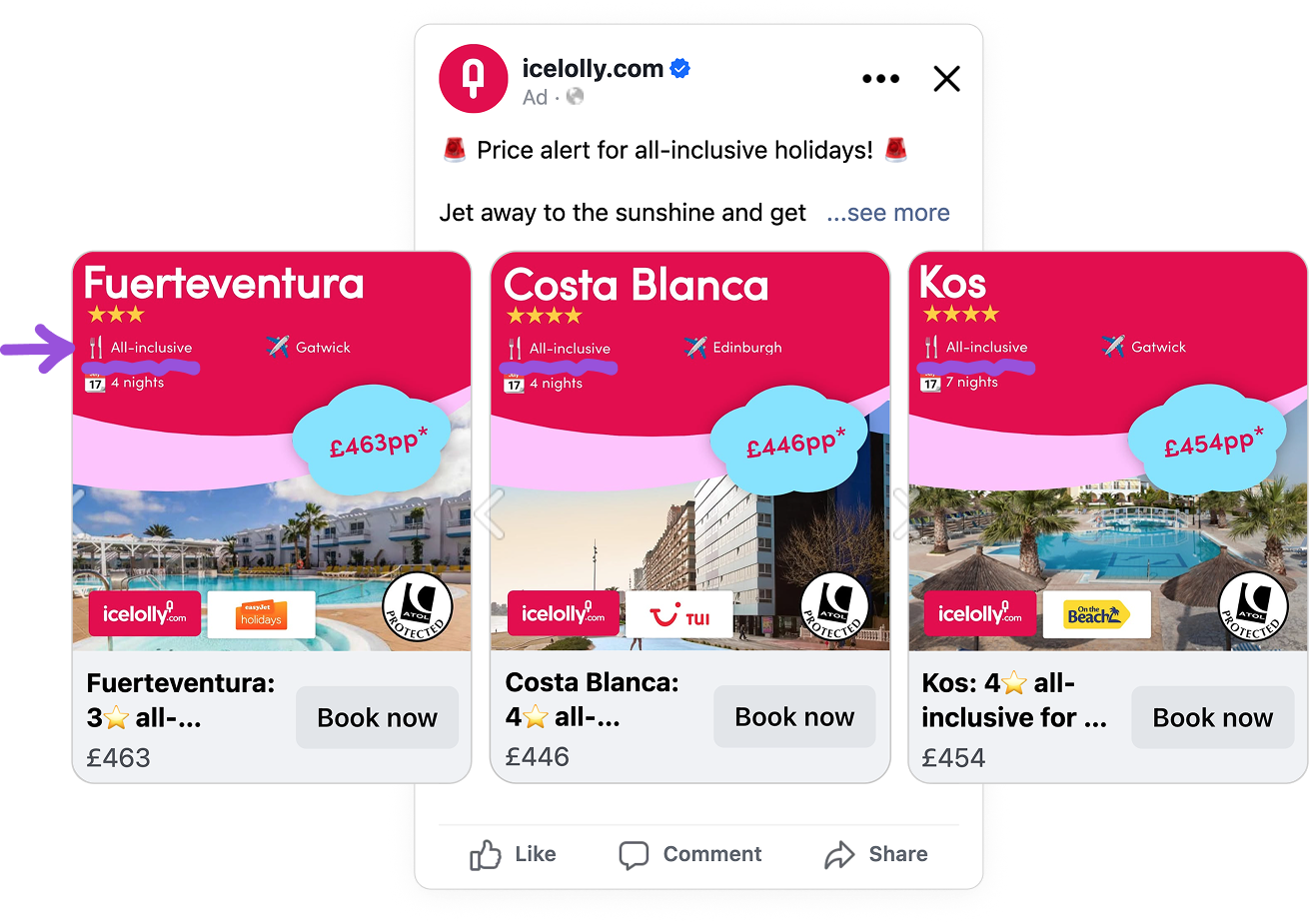
It also points to a smart way to build a media mix. Some ads stay broad and open. Others are carved out by a single attribute: all-inclusive only, one departure airport only, one tour operator only. Each specialised ad gives Meta a tighter audience to optimise toward, and together they cover far more intent than one catch-all ad ever could. icelolly.com and Journey Further are running the catalog as a set of focused ads, not one big one.
The neat part is where the filter comes from. The same board-basis data that dynamically prints "All-inclusive" on each card, and that could just as easily read half board, full board, or room only, is what defines the product set behind the ad. One attribute in the data source does double duty: it writes the label the shopper reads, and it decides which deals Meta gets to show in the first place.
Key Takeaways
What makes this one stand out is how quietly clever it is. icelolly.com and Journey Further took the part of a holiday ad most brands leave off, the price and the specifics, and turned it into the thing that makes the whole campaign more efficient. That is the kind of decision that looks obvious only after someone smart has already made it.
The lesson running through this ad is simple: the more a shopper knows before they click, the better the click. icelolly.com and Journey Further built every takeaway below around that idea, and the numbers followed.
👉 Put the decision on the creative, not behind the click
Price, destination, number of nights, board basis, and departure airport all on the card means only pre-qualified users click through. icelolly.com's click-through rate dropped, but conversion rate rose 42% and cost per purchase fell 28%. Fewer clicks, far better clicks.
👉 Lead with the facts people compare on, not the photo
One hotel pool looks like the next. Destination, rating, board basis, and price do not. Putting the comparable facts first makes every deal easy to judge against the one beside it in the carousel.
👉 Stack your trust signals in one place
For a high-consideration purchase, a recognised operator logo, the ATOL Protected badge, and a clear star rating put the user's mind at ease. icelolly.com shows all three on every card, two of them placed dynamically.
👉 Filter your catalog so Meta optimises against the right buyer
Point an ad at one slice of your catalog, all-inclusive only, one airport, one operator, and Meta learns exactly who books that slice instead of guessing across everything. Run a few of these specialised ads alongside your broad ones. icelolly.com and Journey Further carve theirs out with a single custom label on the data source, the same board-basis attribute that prints "All-inclusive" on the card.