
How Vanquish Fitness & Prospa increased ROAS by 94% with Confect
October 1, 2025

Prospa Media is a performance marketing agency that focuses on scaling eCommerce brands through high-level advertising frameworks. They help brands like Vanquish create, test, and optimize ad strategies on Meta.
For Vanquish, an eCommerce brand in the process of launching its biggest collection of the year, the Dragon Ball Super collection. They knew Catalog Ads would be a huge driver of sales and revenue.
But like many other eCommerce stores, their Catalog Ads looked like this:
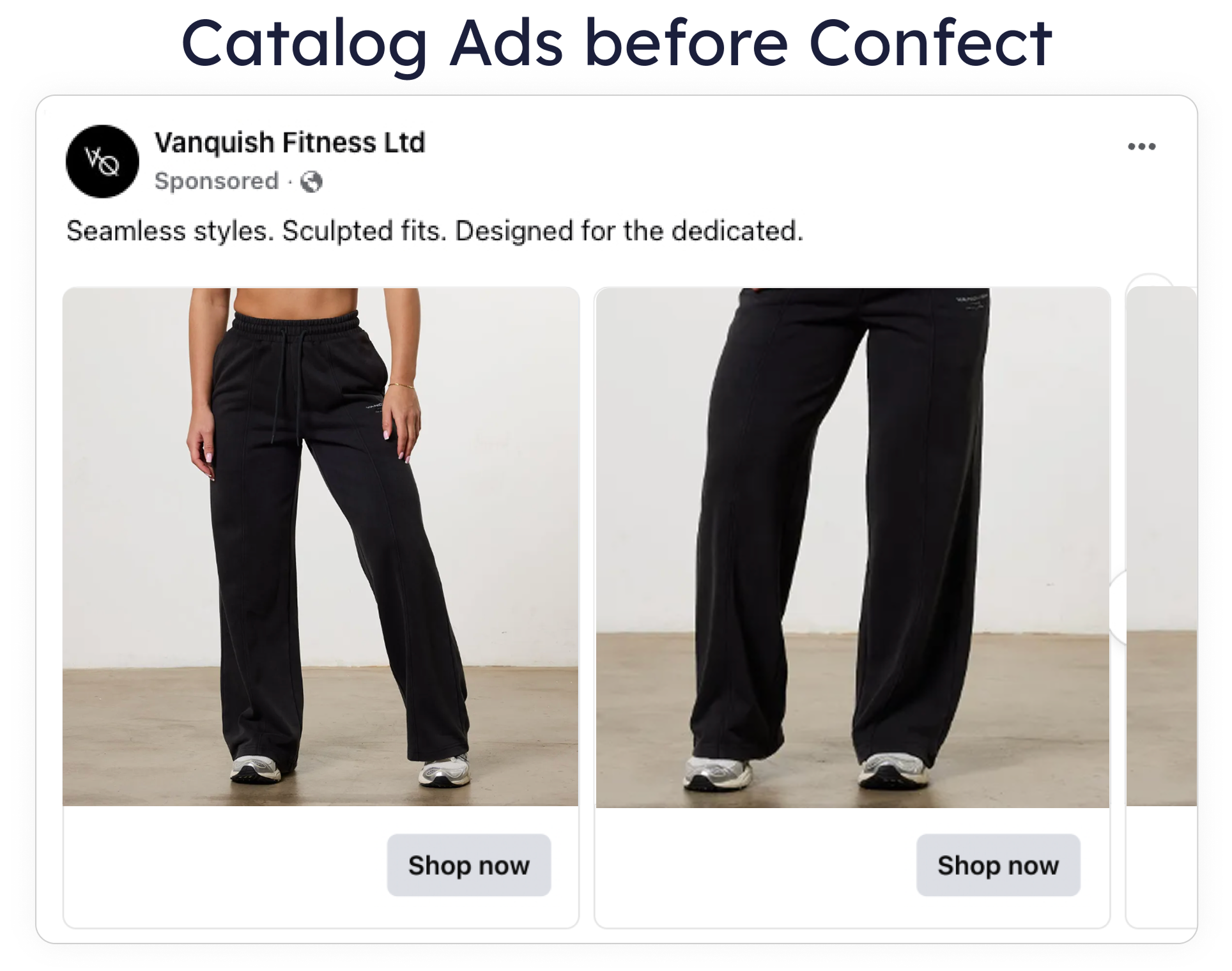
Prospa turned these generic product shots into a high-performing Catalog Ads campaign for Vanquish using Confect. They tested multiple design variants, and honed in on the layouts that had the best conversion rates, lowest costs and that delivered better results.
Prospa’s strategic approach to Catalog Ads is something that any eCommerce brand, in fashion or other niches, can look at and learn from.
We recently spoke with Ferne Lacon, a Head of Paid Social with Prospa Media, who took us through the Vanquish campaign and how they used Catalog Ads with Confect.
Their results using Confect for their Catalog Ads
Ferne explained to us how Prospa used 3 different tactics to achieve these impressive results.
Let’s take a better look at the tactics Vanquish and Prospa use in their Catalog Ads.
Products that sell themselves with design and brand
When it came to Vanquish and Prospa, they already knew that they had great products that were visually captivating.
So instead of getting fancy with price overlays, product descriptions, or discounts, they wanted to let the products speak for themselves. They did this by letting the product images take up the majority of the space and by including minimal product information.
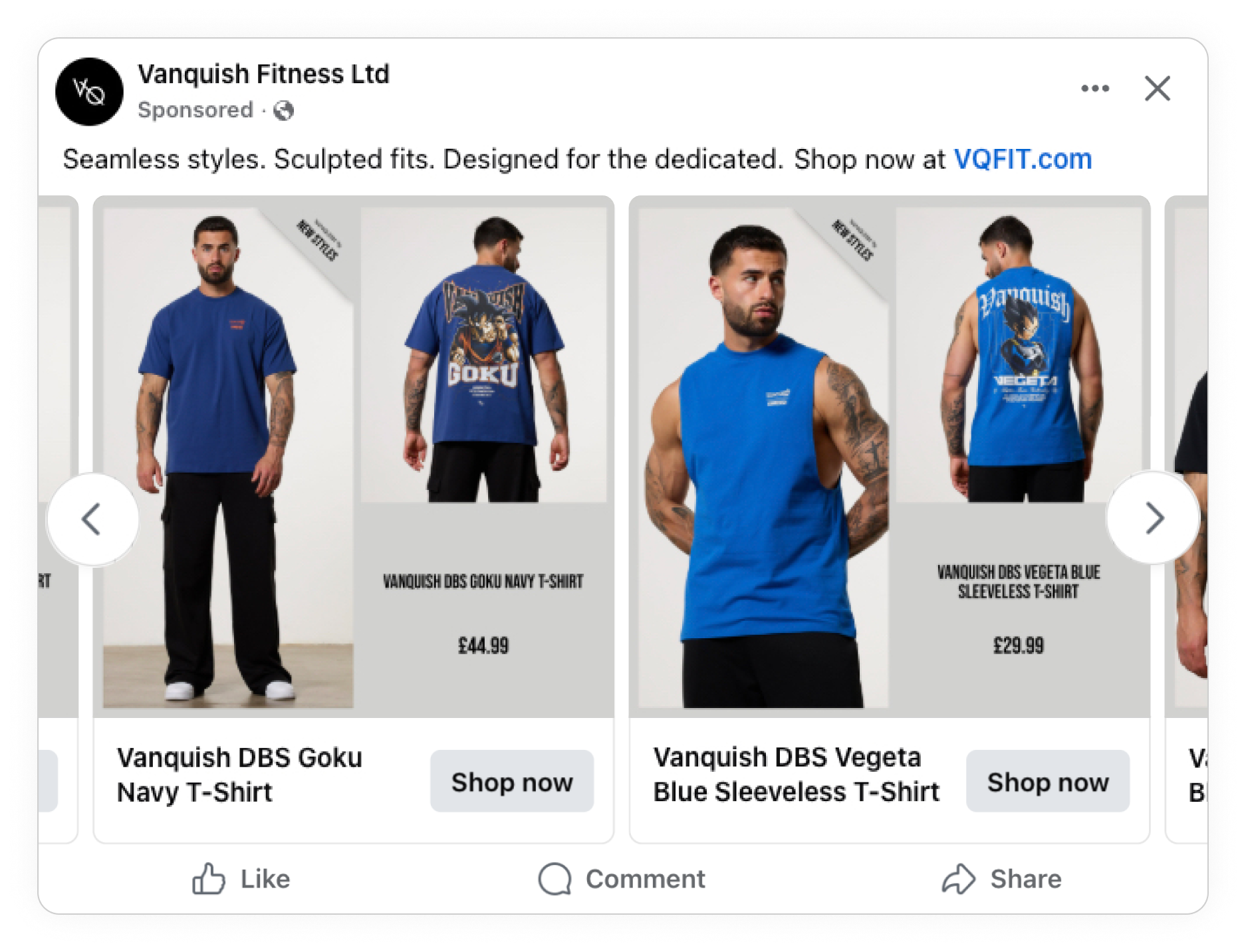
Ferne explained to us that brands with visually strong products, particularly fashion brands, can let their products speak for themselves by not including too many other design elements.
 Ferne Lacon
Head of Paid Social @ Prospa
Ferne Lacon
Head of Paid Social @ Prospa
So Prospa’s strategy was to literally design Catalog Ads that put the clothing pieces front and center, without any clutter.
Yes, they included other information, like TrustPilot scores, prices, and brand logos. But the idea was to create Catalog Ads that framed the eye-catching garments as the main selling points.
Vanquish’ ads use larger product images, which naturally guide the viewer towards looking at the clothing first. Then, any additional details are placed outside the main image frame, where your eyes will wander to only if you like what you’re seeing.
We like to think about it like this: When you’re shopping for a new outfit… Yes, price and brand name might matter. But the main factor you’re going to consider is what the clothing looks like. right?
Whether it’s cheap or expensive, from a brand you love or one you’ve never heard of before, you’re not going to buy anything or wear it if you don’t like the way it looks.
In other words, a fashion item’s appearance is the most important decision-making factor for anyone thinking about buying a new piece of clothing.
So if you’re an ambitious fashion brand trying to create Catalog Ads to convert prospects into paying customers, you would be wise to focus your ads on the relevant information that matters most to your potential customers.
Your ad viewers are in the process of deciding whether or not to buy something.
Ferne Lacon
Head of Paid Social @ Prospa
So if you can spoon feed them the exact information they’re looking for, the stuff that informs their decision-making process, you’ll be filtering out people who aren’t interested, and creating more qualified traffic landing on your web page.
And when you use custom, on-brand ads, rather than generic-looking DPAs, you too can achieve results just like Vanquish and Prospa.
Launching collections with themed catalog ads
One of the most interesting cases is how Prospa used catalog ads to launch a collection. Vanquish has a truly astonishing collection of eComm model shots, which focus on the clothing pieces themselves rather than anything else.
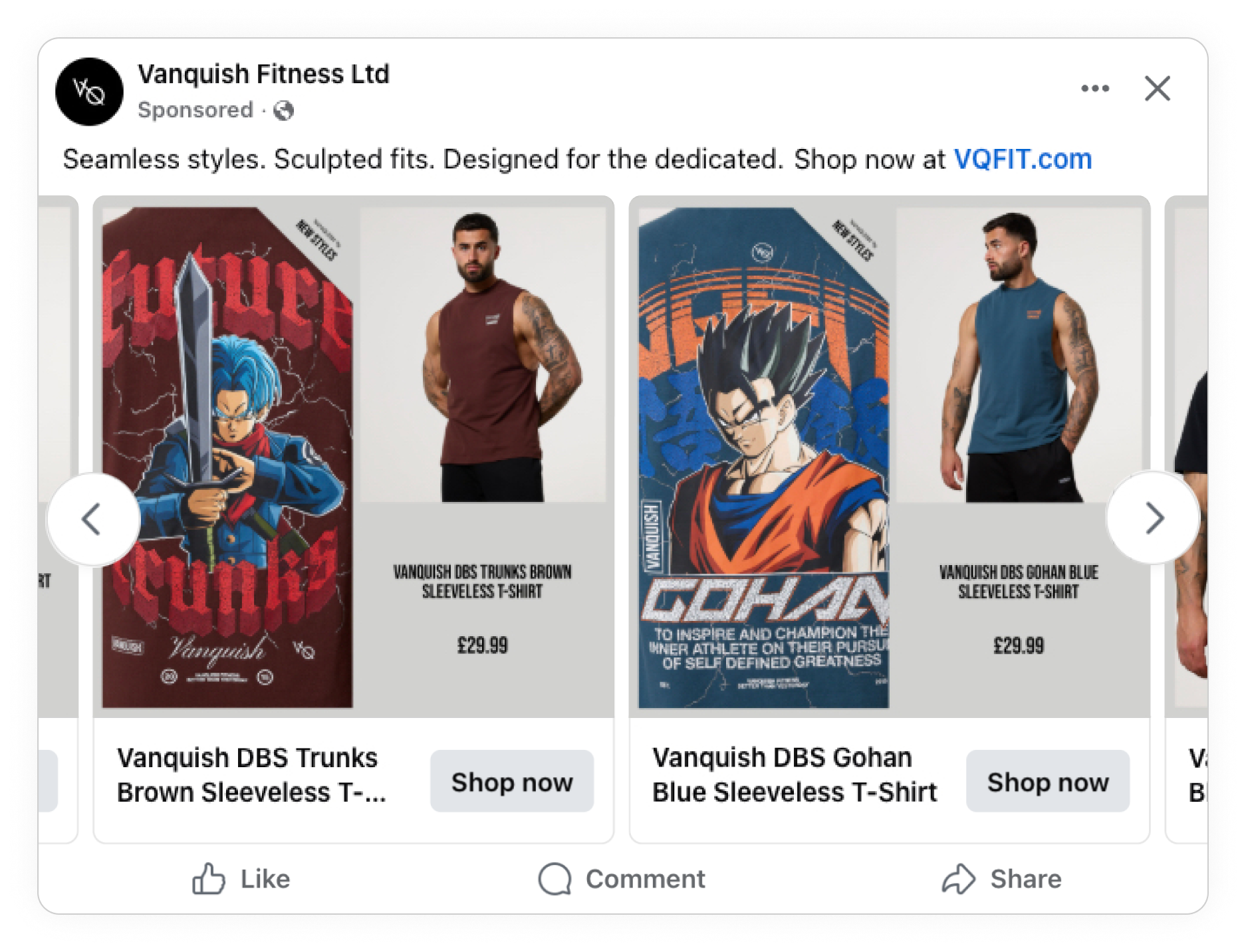
In this case, Vanquish was launching a Dragon Ball Super-themed clothing collection, where the products all feature bright and vibrant colors, and overall stunning designs
They didn’t start the campaign pretending that they knew what was best.
Instead, they kicked off a test and creative roadmap project, where the goal was to find out exactly what did and what didn’t work. The idea here was to create several ad variants and run them against each other, so they could learn about which ad layouts had the best conversions.
Ferne also explained how Prospa kicked off its test and learned the creative roadmap for the Dragon Ball Super Collection.
The initial problem was that Vanquish had a ton of great eCommerce shots. Not that that’s a bad problem to have. But having too many images, even when they’re great shots, can make it challenging to know which shots to use in your campaigns.
So instead of guessing, Prospa tested out three different ad variants they thought were most likely to resonate with the audience. The idea was to test out different image sizes vs model shots, showing price vs no prices, backgrounds, colors, etc.
Ferne Lacon
Head of Paid Social @ Prospa
Once they found the design layouts that delivered the best results, they were then able to apply that design to other product ads and optimize the entire Catalog Ad collection.
Just remember that A/B testing isn’t just about finding out what can help you sell one product…
It’s about finding the best tactics to connect your products to your audience.
By learning from their male-led campaign, Vanquish and Prospa can now look at evolving the strategy for other collections, like female-led collections, children’s collections, other products, etc.
And if you listen closely, Ferne isn’t just talking about her campaigns for Vanquish or their products. She’s talking about the way Prospa can apply what they’ve learned to other campaigns and with other clients, too!
When you plan, test and learn from campaigns like these, you get creative ideas that can be used in a ton of different ways.
Challenge catalog ad assumptions by testing
To understand how Prospa helped Vanquish find their Winning Design, it’s worth looking at the testing process step by step. Instead of relying on guesswork, Prospa set up structured design variations and each tested against the baseline “business-as-usual” Catalog Ad.
The first round of tests explored bold creative elements.
Design A: DBS Lightning Background: This ad leaned into a strong Dragon Ball Super theme with a lightning background and black border. It pulled attention, but ultimately brought a smaller ROAS increase.
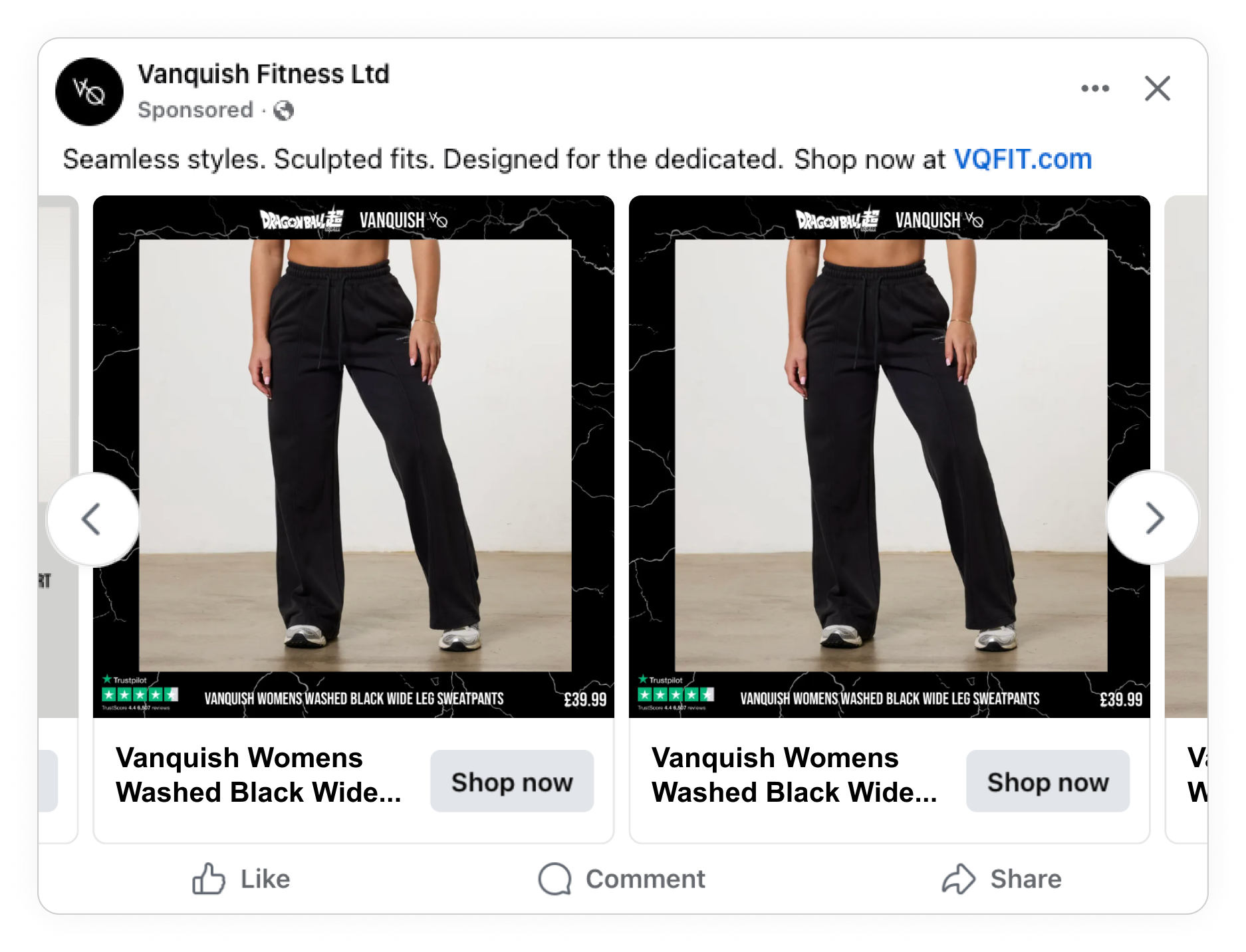
Design B: Logo + TrustPilot: Here, Prospa tested the effect of social proof, combining the Vanquish logo and TrustPilot rating with a clean single product image. That design returned a solid 59% ROAS increase.
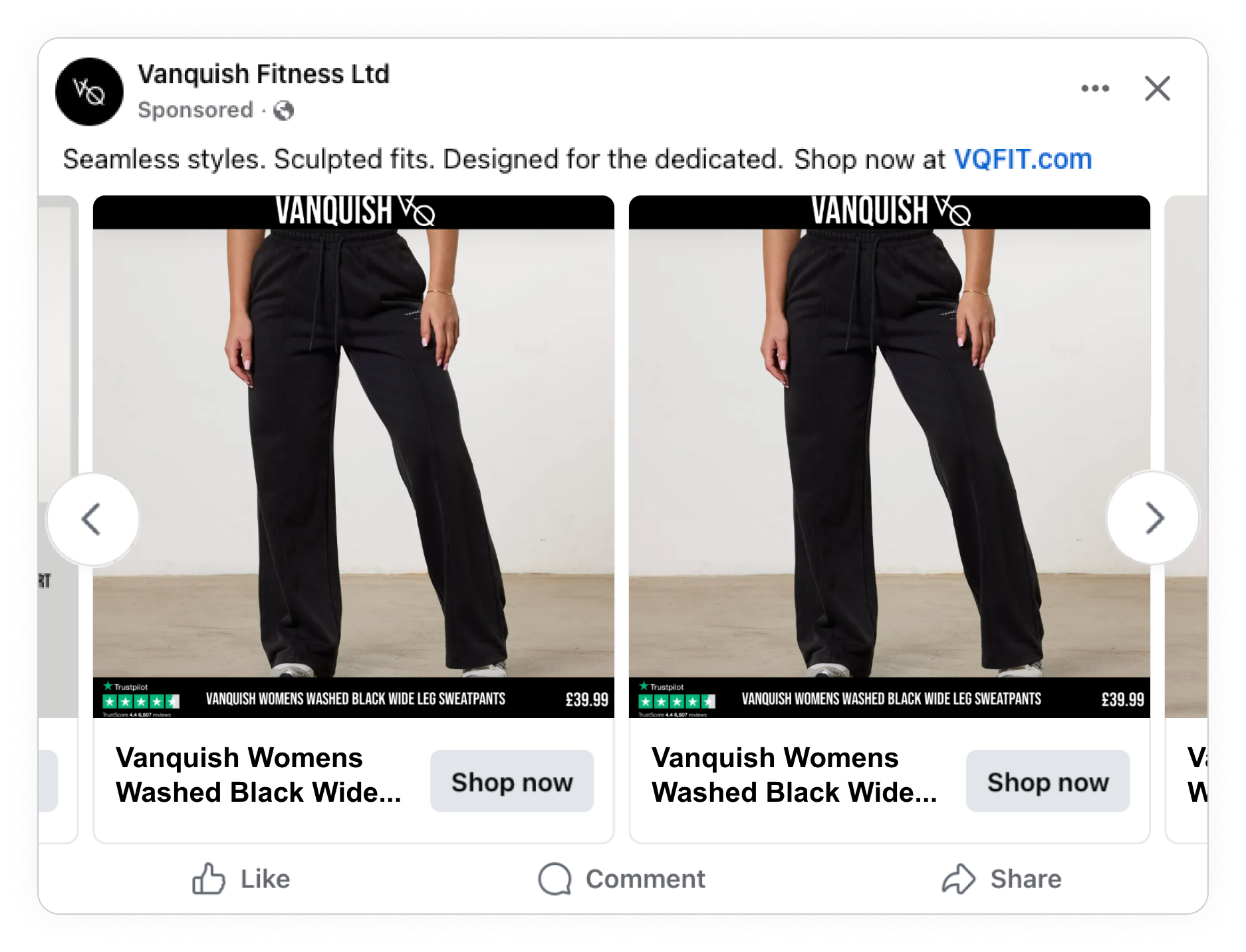
Design C: Split Image Grey: This variation experimented with multiple product shots, giving shoppers a chance to see the clothing from different angles and contexts. It performed much stronger, with a 71% increase in ROAS compared to the base line.
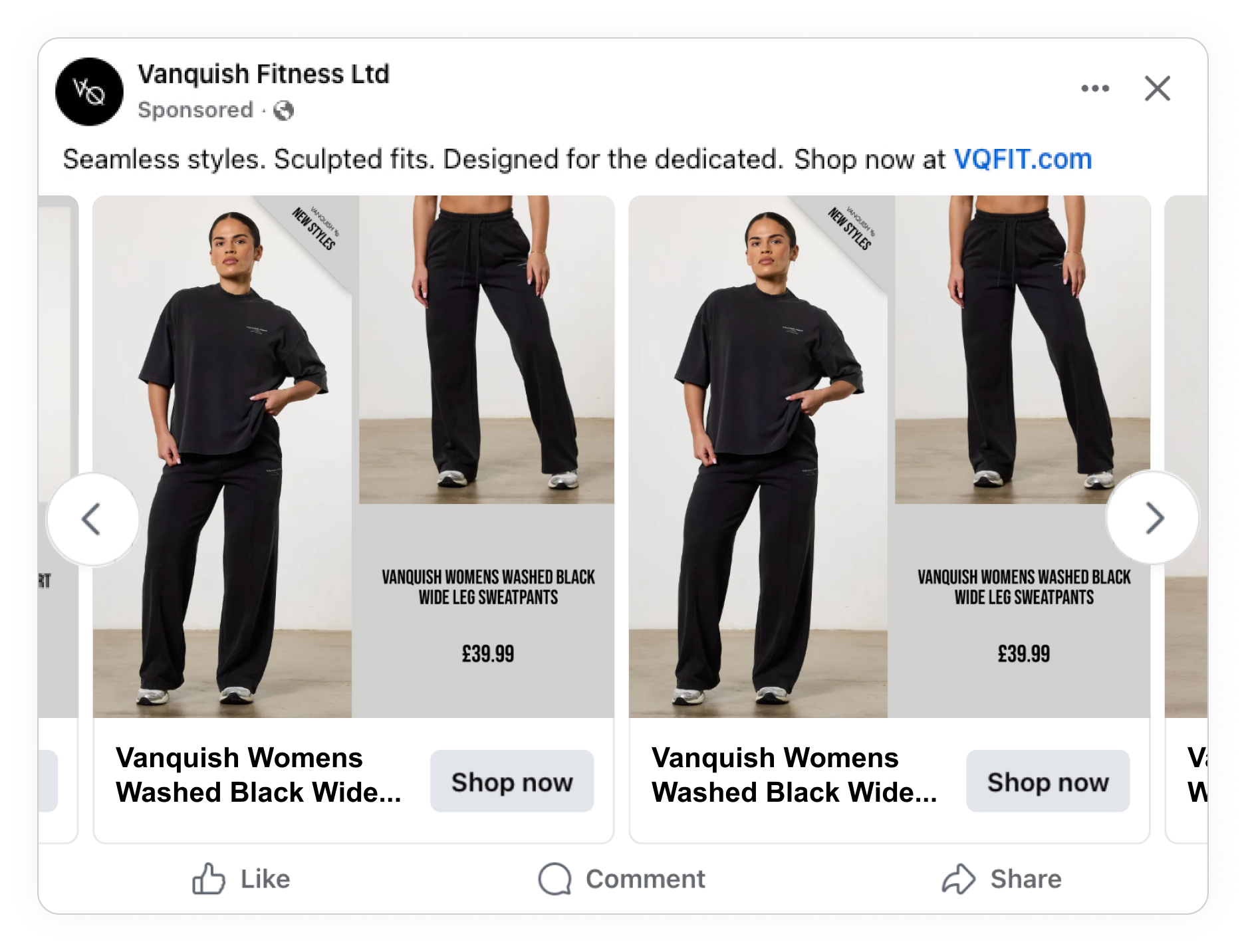
With each iteration, Prospa and Vanquish weren’t just looking for a winner, they were learning which creative elements resonated. For example, multiple images and social proof clearly drove stronger engagement, while the themed background underperformed.
From this learning loop emerged the Winning Design: a simple, off-center product placement against a black background, with high-contrast text highlighting the price and product details. This variation pulled a 94% ROAS increase compared to the BAU.
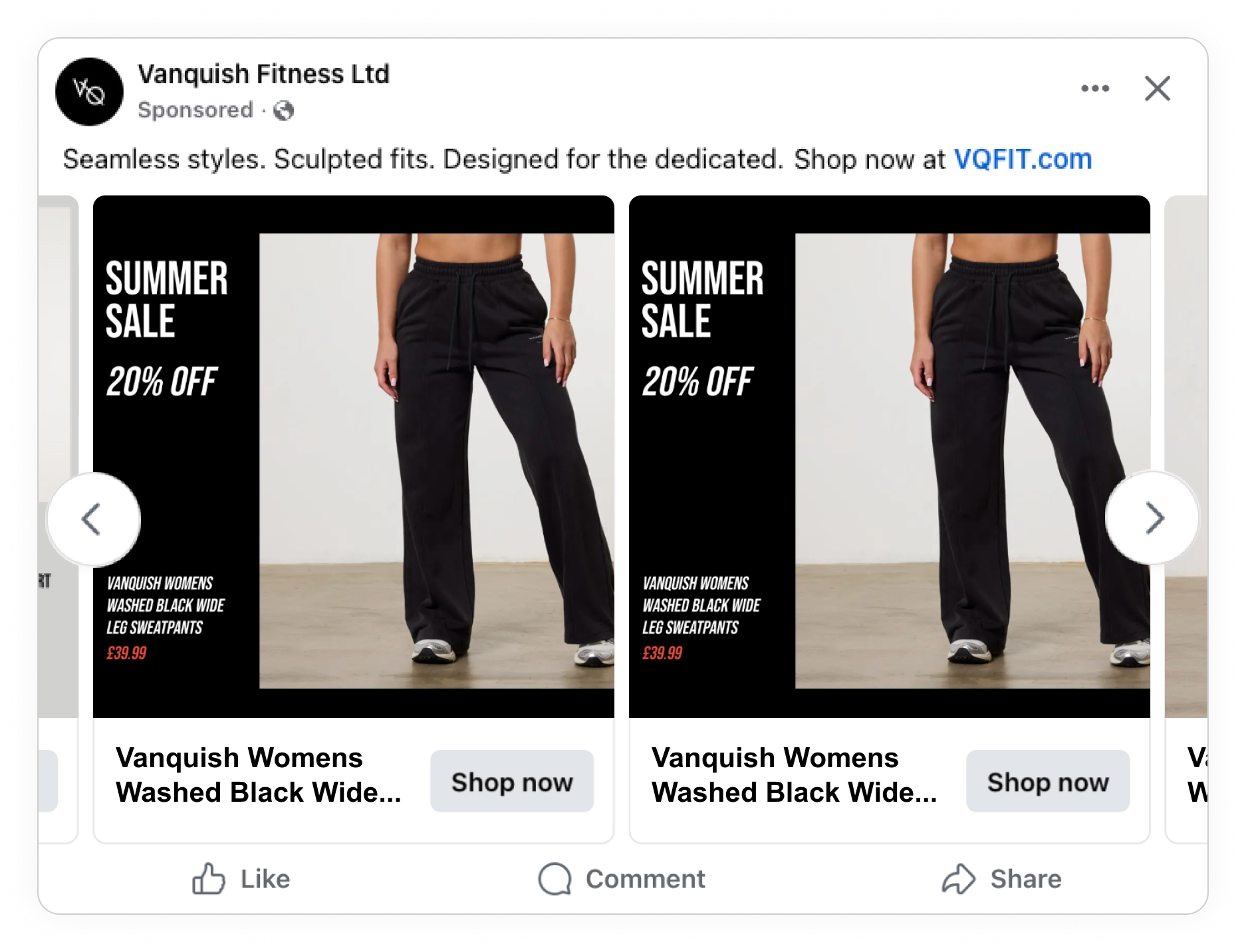
The key insight here is that success didn’t come from a single overhaul. It came from small, testable design changes, layered one at a time, and measured directly against the baseline.
And this process doesn’t stop with one winner. Now Vanquish and Prospa can challenge the winning design with the next round of creative concepts. Every new test has the potential to outperform the current best, which makes optimization a continuous cycle instead of a one-off experiment.
Ferne Lacon
Head of Paid Social @ Prospa
In short: testing design A vs design B vs design C vs baseline isn’t just about short-term ROAS. It builds a system for creative improvement that compounds over time. This helps brands consistently push their Catalog Ads to perform better, campaign after campaign.
Conclusion
Prospa’s campaign for Vanquish shows the when you take a strategic approach to advertising on Meta, you really can achieve considerably better lower costs and better returns.
Prospa set out with a goal and created a game plan that was aligned with the brand, the products and the target audience. Whether you’re selling clothing or anything else, knowing your brand and audience makes it impactful to come up with scalable campaign ideas and design theories.
Because Vanquish had visually strong products and great eCommerce shots, Prospa leveraged that and created ads tailored to the brand and its products. They knew the clothing was already visually captivating. So they decided to design Catalog Ads that let the products speak for themselves. And it worked!
Once Prospa had a few Catalog Ad layout ideas, they ran tests to find out which designs resonated best with the audience. You can literally test dozens of different design elements, like showing price vs not showing price, logo vs no logo, pricing, shipping or discount information, etc.
Once they had their design theories and tested ad variants, the only thing left to do was to wait for the results. In this case, they found the winning design, which was then used to optimize layouts for the entire campaign. They also took things a step further and looked at how they could use this information to scale the results to other product collections in the future.