
How Bed Kingdom & Connective3 improved CPA by 58% with Confect
October 2, 2025
.png)
Connective3 is a performance marketing agency focused on helping clients achieve high performance on a global scale. They help brands like Bed Kingdom achieve marketing results they can be proud of.
Bed Kingdom, on the other hand, is one of the UK’s leading eCommerce brands that sells beds, mattresses, furniture and other great consumer products.
Their big problem was their Meta catalog ads that used to look like this:
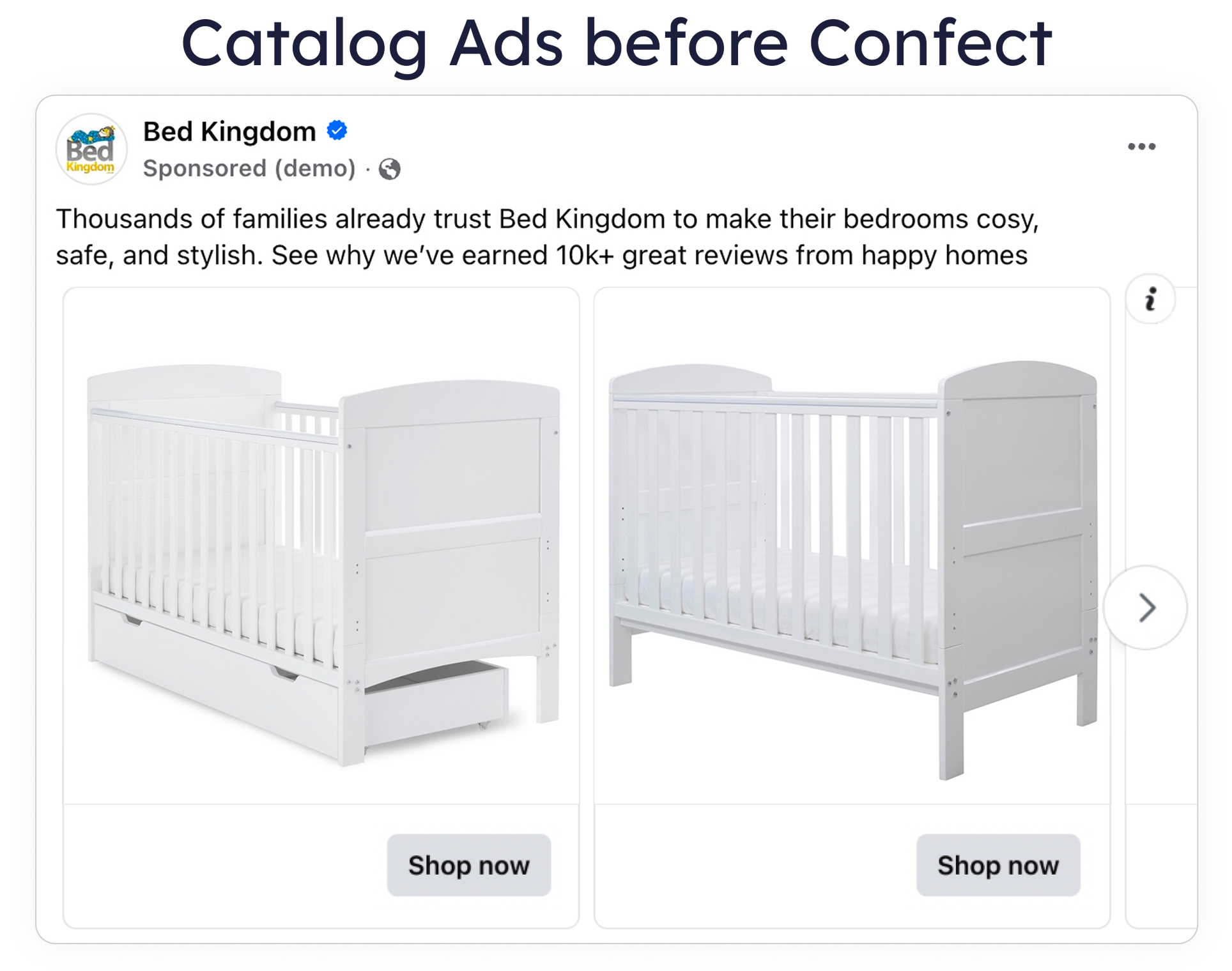
Connective3 set out with the goal of improving the performance of Bed Kingdom’s Catalog Ads.
The team’s aim was to leverage lifestyle-led creatives, improve targeting, increase trust and engagement, and drive higher average order values for Bed Kingdom.
Their goals were ambitious. But the strategy, execution, and results are something that any eCommerce brand can learn from.
We recently spoke with Will Hex, Digital Marketing Executive, and Tash Carlisle, Senior Brand Media Manager, of Connective3, who walked us through their process and showed us exactly how they use Catalog Ads with Confect.
Connective3's results using Confect for their Catalog Ads
Will and Tash explained to us how they used Confect to implement 4 tactics to achieve these results.
Implement lifestyle-led creative in Catalog Ads to increase conversion rates
The first thing the team at Connective3 set out to do was implement lifestyle-led creatives to improve the overall look at Bed Kingdom’s Catalog Ads.
Meta’s BAU ads are boring and uninspiring, featuring basic image cutouts and white backgrounds.
But with Confect, Connective3 implemented higher-quality visuals that included contextual settings. They designed the Catalog Ads to showcase lifestyle imagery, such as sofas in real living rooms or kids’ bedframes in children’s rooms.
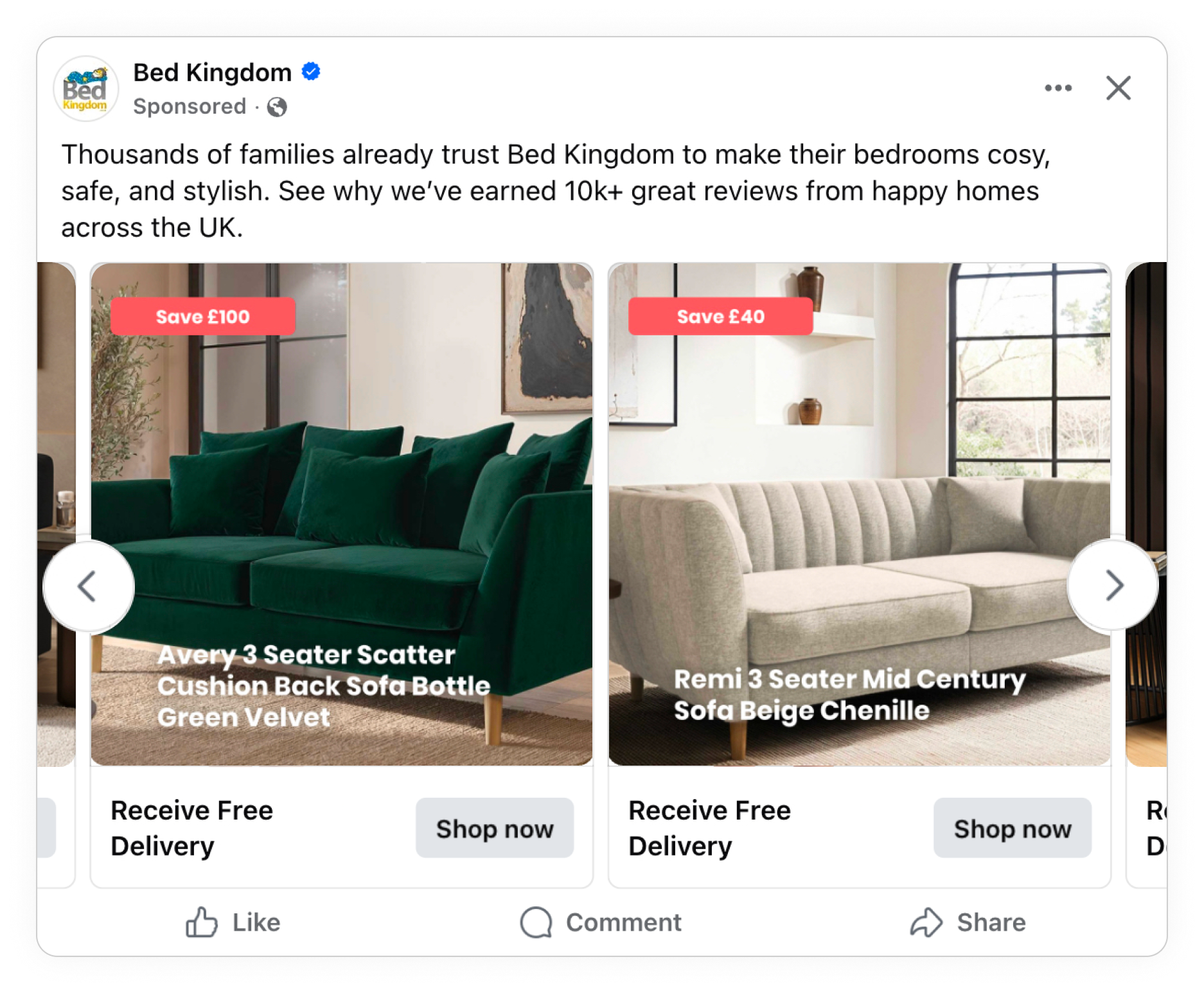
They also added text-based overlays that include descriptors like product names, prices, materials, savings, etc.
All this made the products look more relatable and aspirational. AKA they turned plain product images into visuals that make people want to buy the products they’re looking at.
When you use lifestyle images, it becomes that much easier for people to imagine using those products in real life.
And when you see results like -39% lower CPA and +63% more conversion, you really can say that tactics like this work!
People saw Bed Kingdom’s sofas, beds, and mattresses. They imagined the furniture in their own homes. And then the product descriptors gave them all the info they needed to know if they wanted to buy or not.
So when they actually clicked-through to the shop, they were already in the mindset to make a purchase.
That’s because using lifestyle-led creatives and including relevant product information sets the stage for people to actually want to buy things.
 Will Hex
Digital Marketing Executive @ Connective3
Will Hex
Digital Marketing Executive @ Connective3
Customized designs for different product categories
The next important tactic that Connective3 implemented was to structure its creative assets to signal intent and relevance to Meta’s algorithm. They created segment-specific product sets, such as Catalog Ads for kids’ beds, and then separate Catalog Ads for gaming, sofas, armchairs, etc.
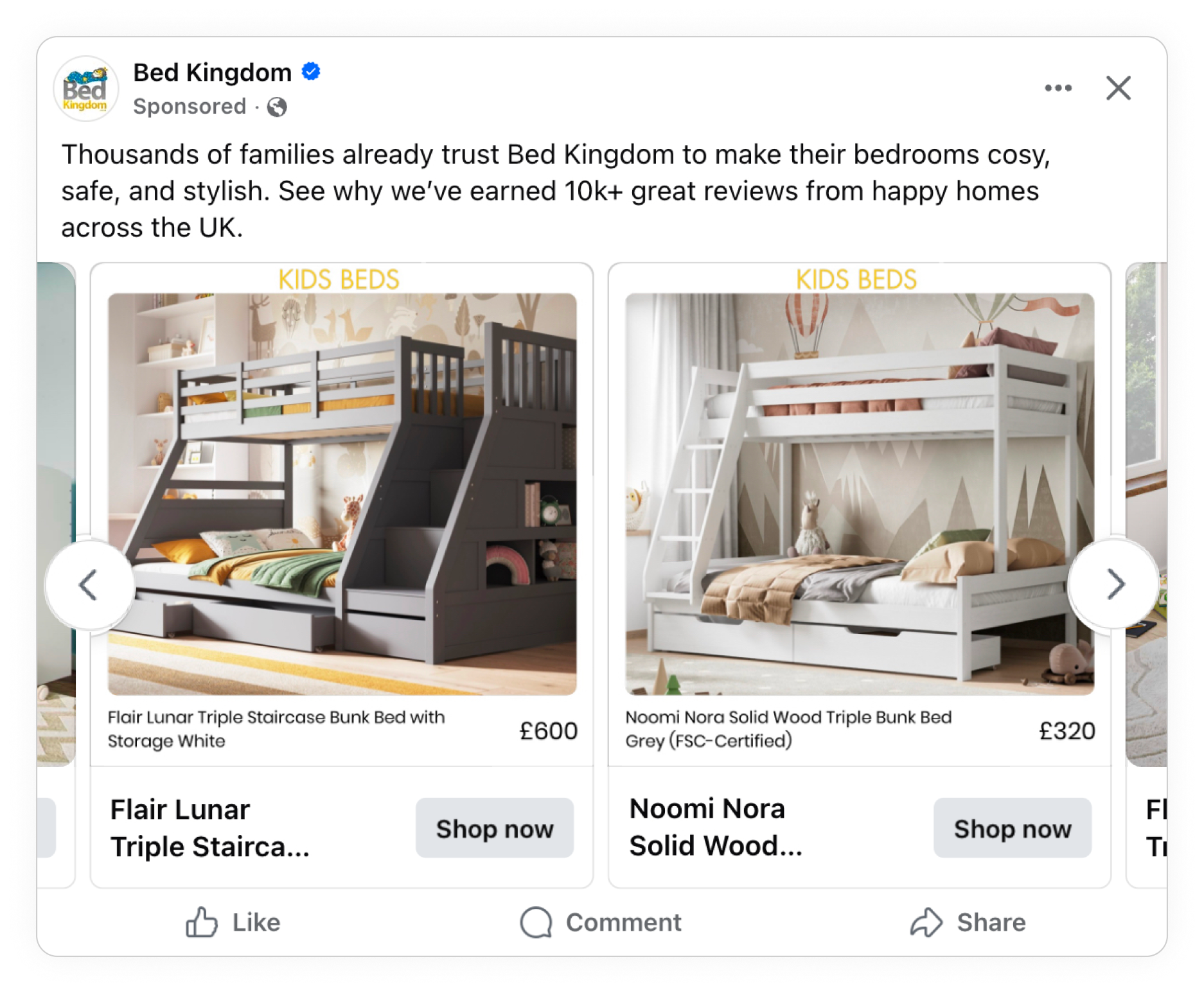
As Will explained to us, his team used Confect to create a set rules for each product line it’s own designs.
For example, for sales, they included overlays showing exactly how much people save, which Will tells us just makes it easy for people to visualize how much money stays in their bank account.
They also used Confect to implement different image types based on the products being shown. So for armchairs, they showed lifestyle shots. But for products like mattresses, they used closeup product shots that focus on detail instead of setting.
Ultimately, improving segmentation and targeting is incredibly important.
Not just because it improved ad targeting or allowed Bed Kingdom to achieve a +12% click-through rate. But also because Meta’s algorithm is shifting toward creative-first targeting with Advantage+.
 Tash Carlisle
Senior Brand Media Manager @ Connective3
Tash Carlisle
Senior Brand Media Manager @ Connective3
So by segmenting Catalog Ads, Connective3 was able to create custom product sets, where they applied relevant product info and lifestyle images based on that specific product and audience it was being shown to.
Aside from a better click-through rate, this tactic helps the algo find higher-intent audiences and simplifies the buyer journey.
And that, my friends, resulted in nearly doubling Bed Kingdom’s conversion rate on this campaign!
Outshine competition with 9:16 designs
We often see advertisers create 1:1 square ads and then use them as in-feed ads, in Stories and in Reels. This results in misaligned and unprofessional-looking ads that can actually damage your brand perception and lower engagement overall. That’s never a good thing!
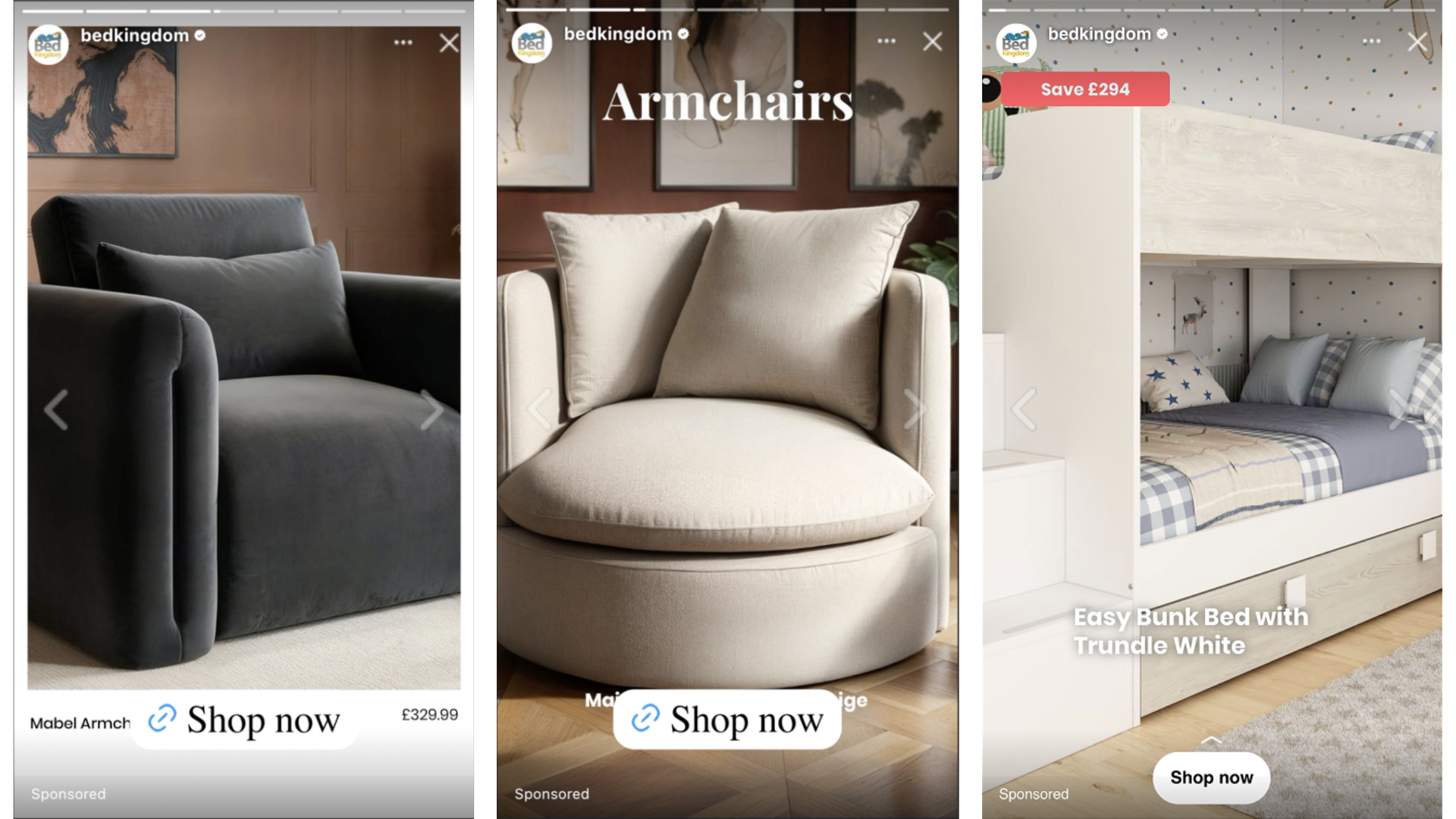
So instead of taking that route, Connective3 used Confect’s adapt to placement feature to ensure 9:16 formats were rendered properly when serving ads in different locations.
This eliminated the risk of squashed, poorly cropped, or unclear multi-product grid-style visuals. And instead, potential customers got served full-screen ads and product-centric visuals with clean layouts.
Making sure all your Catalog Ads are shown as full-screen ads is important when running campaigns on Meta.
When you show relevant images and product info within safe zones, it makes sure people see the details you need them to see. And when you take up as much space as possible on your viewer’s screen, it improves the overall image quality and the professionalism of your brand.
Tash Carlisle
Senior Brand Media Manager @ Connective3
It also ensures your ads captivate attention, which drives stronger engagement.
Without placement-specific designs, your ads can just look sloppy.
But with adapt to placement designs, you can increase user trust, get more higher-intent shoppers clicking, and outshine the competition with better-looking Catalog Ads, no matter where they’re being served.
Make high value purchases attractive
Another of Connective3’s goals was to drive higher average order value (AOV).
They wanted to help viewers make buying decisions upfront, instead of having them click-through to the shop, browse around looking for info, and then possibly not even buy anything.
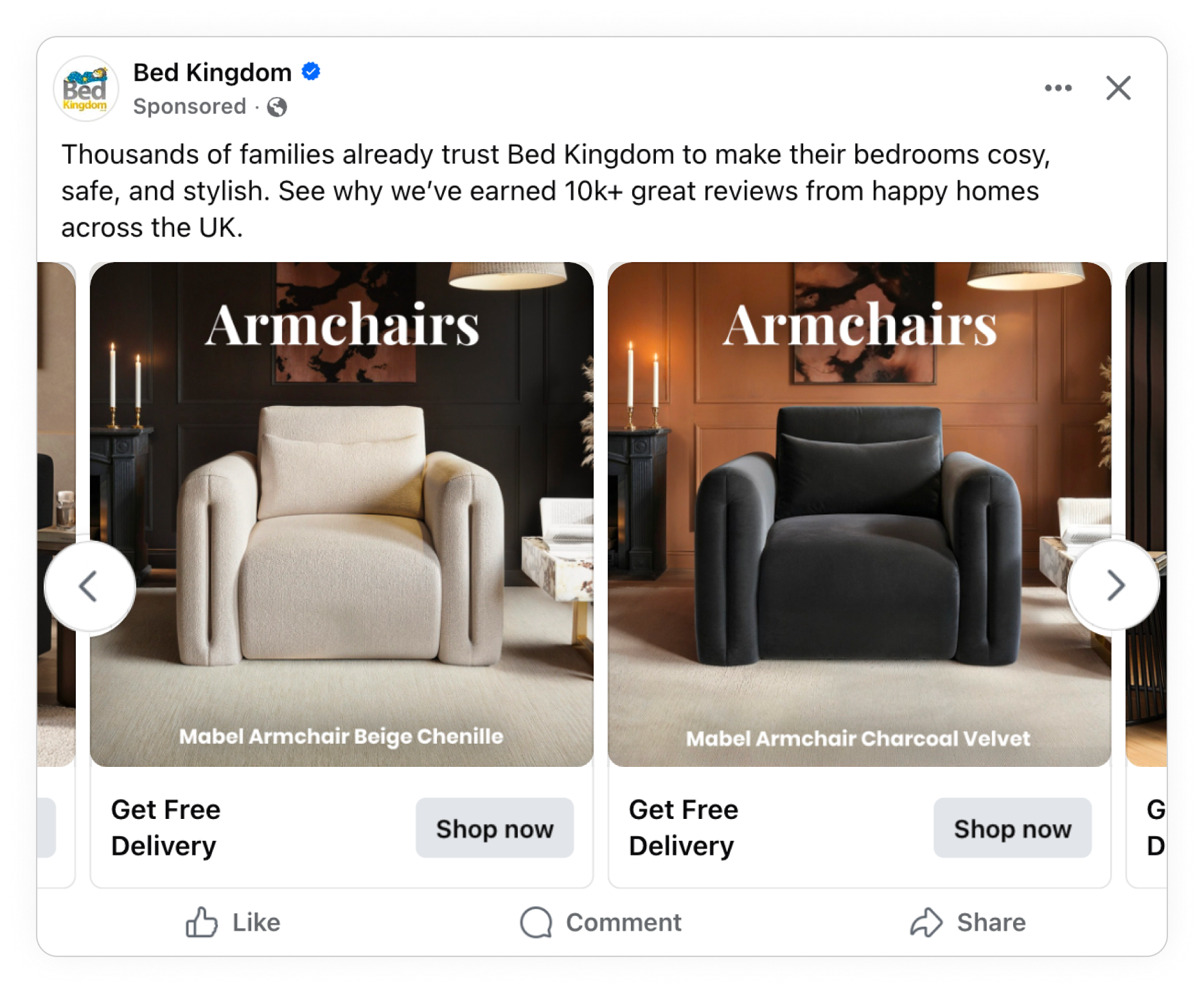
They also knew that high-value purchases, like sofas, armchairs, and mattresses require more product information to get people to buy them.
So Will and Tash’s team used Confect overlays to show detailed and relevant product info directly on Bed Kingdom’s Catalog Ads.
Will Hex
Digital Marketing Executive @ Connective3
For example, they added text-based overlays that would say “2-seater velvet sofa” on sofa ads or “£20 off” on sales ads.
Including relevant info like this has a few important implications.
For starters, it ensures all product variants are distinguishable in-feed. Users no longer have to click on an ad to learn about the details. That info is served to them before they even have a chance to think about it.
And secondly, using overlays showcased important differences between similar-looking products. As Will and Tash explained to us, this works wonders for conversions because it helps people instantly know if (or if not) a product is right for them.
So you’ve got an initial WOW factor thanks to the high-quality visual. But then the key product info helps to incentivize, simplify and inform the buying decision.
And the results?
Bed Kingdom saw an increase in its average order value, as well as +84% higher YoY revenue, +63% more conversions, -39% lower CPA, and a dazzling +90% higher conversion rate!
Not bad for implementing a few better-looking designs that include key product information you already have on hand!
Conclusion
Both Bed Kingdom and Connective3 knew that generic BAU ads don’t cut it. So they implemented lifestyle-led imagery and creatives that include relevant information specific to the products being shown. Ultimately, this sets the stage for higher-intent shoppers to actually click on Catalog Ads.
Instead of relying on narrow manual targeting, Connective3 segmented and structured creative assets to signal intent and relevance directly to the algorithm. By creating custom product sets, they ensure the right products are shown to the right people, at the right time.
Then Bed Kingdom realized they needed to connect with their audiences wherever they’re viewing content. This means serving ads in-feed, in Stories and in Reels. Thanks to Confect’s adapt to placement, Connective3 ensured ads are shown as full-screen 9:16 Catalog Ads no matter where they’re being shown.
Successful advertising is about simplifying and nurturing the buyer’s journey. But one problem we see often is that shoppers have to click on ads to learn more about the product. But with Confect, Connective3 included relevant product info directly on Bed Kingdom’s Catalog Ads, resulting in higher-intent traffic landing in their web shop.