
Marketing Automation for eCommerce Advertising
August 7, 2025
What is marketing automation?
Marketing automation is when you use software to streamline, schedule, personalise, and measure marketing activities. In online advertising, for example, automation tools can dynamically update Catalog Ads based on product inventory, pricing, or user behavior—making campaigns more efficient and scalable.
Why is marketing automation important in e-commerce?
Marketing automation allows e-commerce businesses to automate repetitive tasks like updating Catalog Ads, personalising offers, and delivering timely, relevant content to target audiences at scale. As such, it improves marketing teams’ efficiency and performance significantly.
In the context of Catalog Ads, marketing automation is especially powerful. It allows you to pull product data from your catalog and display the most relevant items to customers automatically based on their preferences and browsing behaviour.
Key components of marketing automation
Product feed
Your product feed is a core element of Catalog Ads. With automation, you can ensure that this product feed remains up to date. If there’s a pricing or inventory change which can impact your ads, the product feed will be updated in real time, reducing the risk that your ads will promote out-of-stock products or list wrong prices.
Audience segmentation
Marketing automation software helps you to apply audience segmentation using filters like behaviour, demographics, and recent purchases. This way, you can customise your Catalog Ads, messaging, and product recommendations.
Reporting and analytics
Many marketing automation tools include dashboards where you can measure the performance of your Catalog Ads. Via this dashboard, you can track metrics like conversion rate, click-through rates (CTR), and return on ad spend (ROAS).
Integration with other platforms
Marketing tools typically plug into the rest of your marketing tech stack easily. These can include key integrations with e-commerce platforms like Shopify, ad platforms, email software, and CRMs.
Best practices for using marketing automation when running ads
The following are a few best practices for e-commerce businesses interested in leveraging marketing automation to grow their ad strategy:
- Ensure your product catalog is accurate and up to date as poor product data will negatively impact the performance of your ads.
- When you name your products, use clear naming conventions and keyword-rich product titles to help automation tools match user queries and interests more effectively.
- Categorise your products properly as it will make it easier for your automation tools to match them with an appropriate audience.
- Integrate behavioural triggers like purchased a product or abandoned cart, so that you can run retargeting ads based on real-time customer behaviour to improve relevance and conversion.
- Marketing automation tools often include A/B testing and analytics features. Use these to improve your Catalog Ads continuously.
Examples of marketing automation tools for Catalog Ads
Meta Advantage+
Meta Advantage+ leverages AI to help you run ads automatically. It offers a powerful set of tools that you can use to generate ad creatives dynamically, run retargeting campaigns, and simplify ad localisation to mention only a few use cases.
.jpg)
Confect
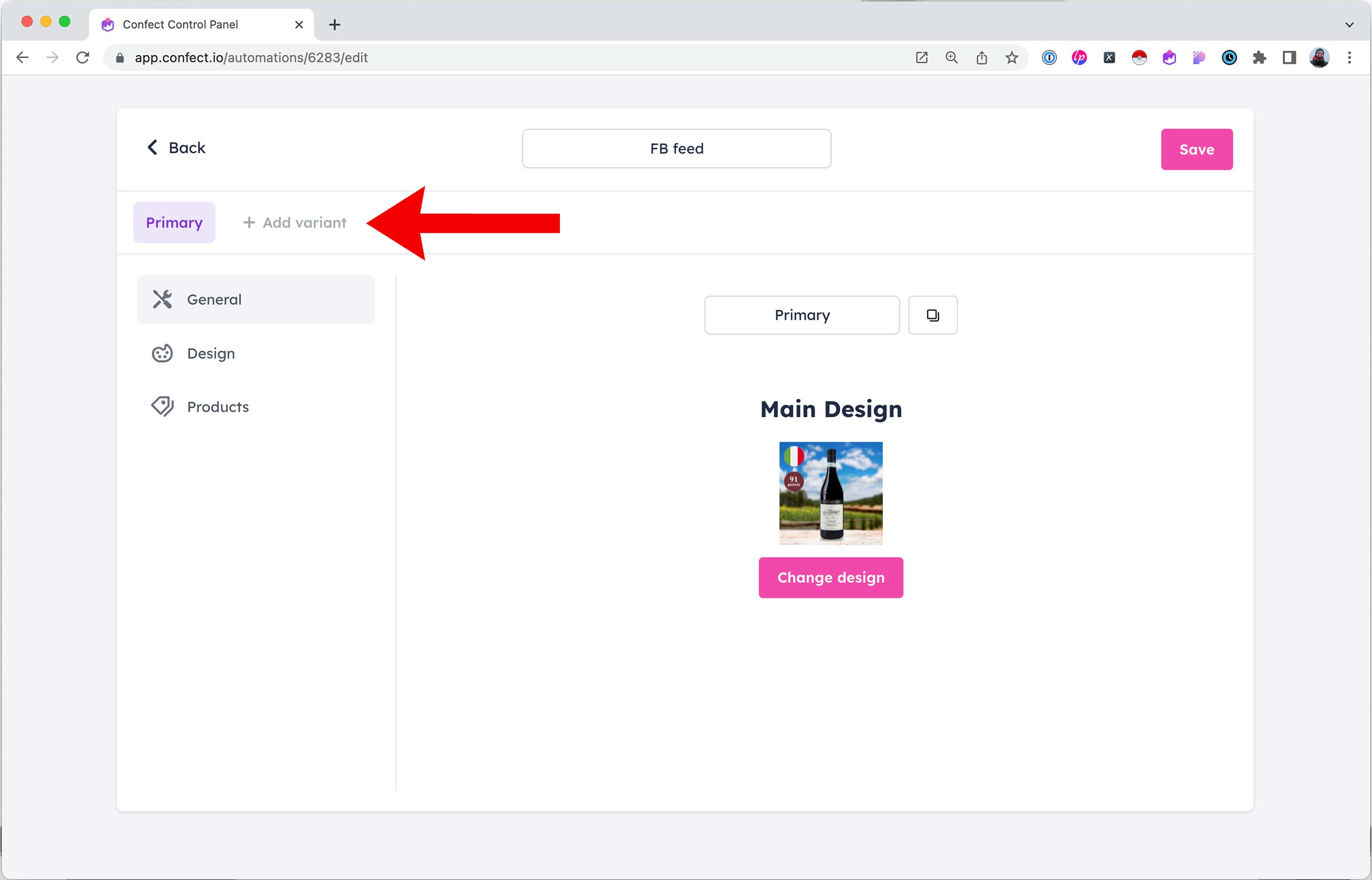
Confect uses the same connection as Google Shopping and Meta, making it easy to link your products. Then, after you’ve connected your products, it will update automatically every hour.
It shines in terms of ad creative automation. After you’ve created a design using the premade templates or drag-and-drop editor, it will automatically create ad creatives for each product in your catalog. It can also automatically remove product backgrounds and adjust their size or positioning.
Try Confect for Free
Confect can help you to create great-looking Catalog ads and Dynamic Product ads for Facebook, Instagram, TikTok, Snapchat and Pinterest.